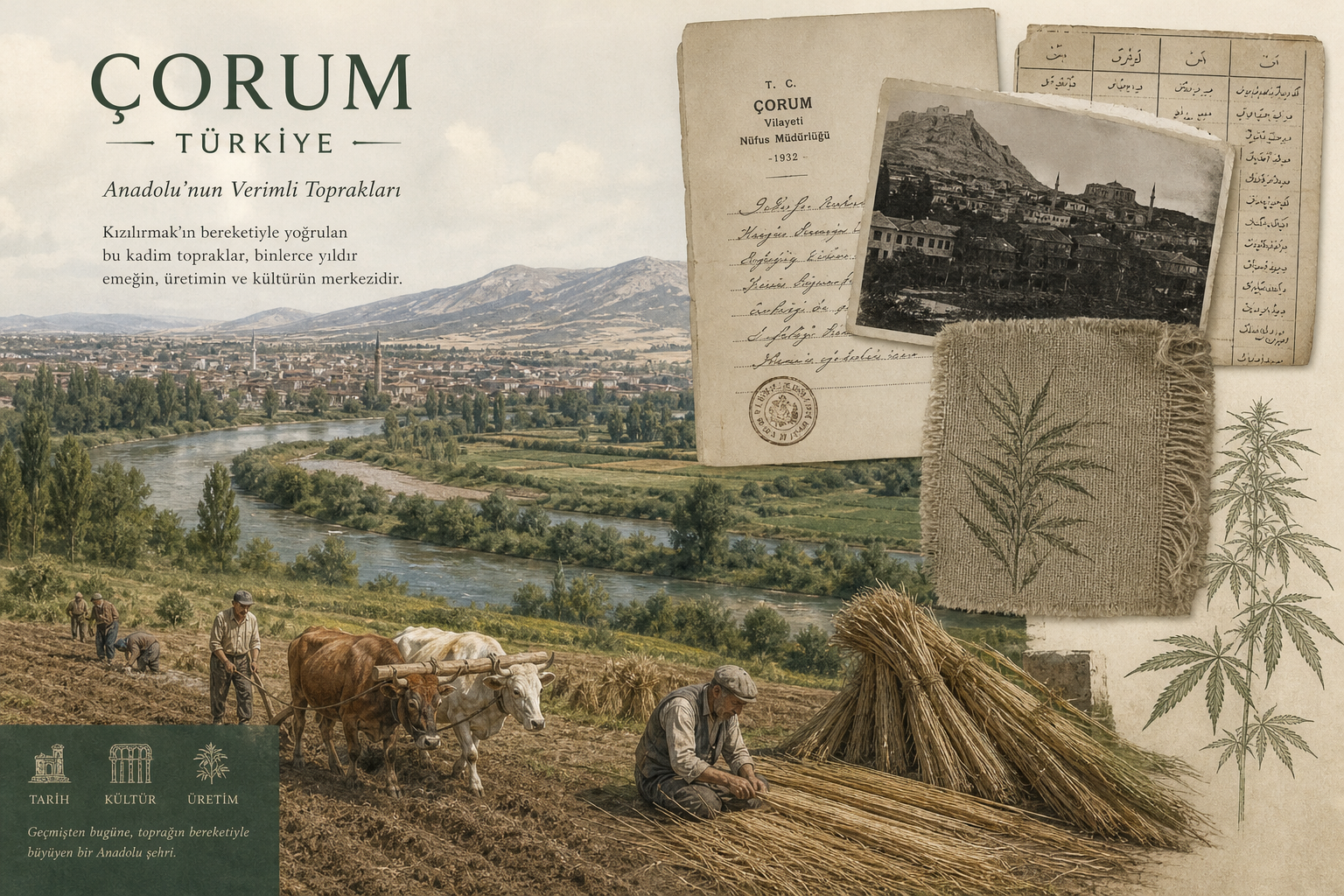
Marijuana history in Çorum is best understood through careful comparison between regional agricultural history, Ottoman and Republican-era administration, and Turkey’s modern legal framework. Çorum is an inland province in north-central Anatolia with a long history of farming, settlement and trade, but that does not automatically prove that cannabis was an important local crop. In historical research, hemp, cannabis, marijuana and wild-growing plants must be distinguished rather than treated as interchangeable terms.
This article examines what can reasonably be said about cannabis history in Çorum, what remains uncertain, and why modern references to weed in Çorum should not be confused with evidence of a traditional local industry. It also explains the difference between historical research and present-day legal or medical advice.
Why Çorum’s cannabis history requires caution
Çorum has a deep recorded past, including the legacy of Hittite settlements and later participation in the political and economic life of Anatolia. However, the existence of an ancient agricultural society in the region is not proof that it cultivated cannabis. Claims about early marijuana use often come from broad statements about Anatolia or Eurasia and are then incorrectly assigned to individual provinces.
A reliable local history would need evidence such as tax registers, agricultural reports, seed records, trade documents, farm inventories, archaeological plant remains or oral histories that can be independently checked. Without that documentation, it is more accurate to describe cannabis in Çorum as a research question than as a confirmed defining tradition.
Hemp and marijuana are related but not identical historical subjects
Hemp is cannabis cultivated for fibre, seed or other industrial purposes, generally with very low levels of intoxicating compounds. Marijuana commonly refers to cannabis cultivated or processed for its intoxicating effects. Historical documents may use older regional terms that do not match modern scientific or legal categories, so a reference to hemp cannot automatically be presented as evidence of recreational marijuana production.
This distinction matters when interpreting agricultural history. A record of fibre plants, rope-making or seed commerce could indicate the use of hemp without demonstrating that people in Çorum produced or consumed cannabis for intoxication. Conversely, the absence of a surviving record does not prove that no plant was ever present.
Çorum, Anatolian agriculture and the Ottoman period
Çorum’s economy historically depended heavily on agriculture, animal husbandry and regional exchange. Grain production and other dryland crops were especially important to inland Anatolian communities. These conditions provide a plausible setting for many types of traditional plant use, but plausibility is not the same as documentation.
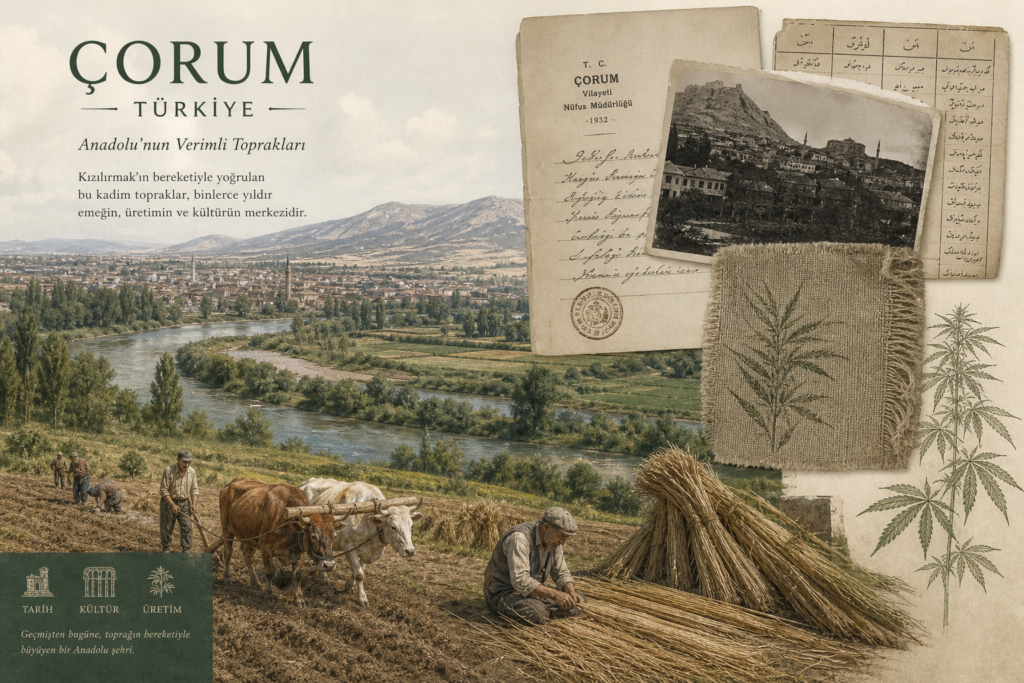
Ottoman administrative records sometimes identified crops according to taxation, supply needs or local commercial importance. If hemp was grown in a particular district, it might appear in production, tax or trade records. Yet surviving sources are uneven, and a crop could be absent from a summary because it was cultivated on a small scale, consumed locally or recorded under a different term.
For readers researching cannabis history in Çorum, the most responsible conclusion is therefore limited: the province belonged to a wider Anatolian agricultural world in which hemp and other useful plants could have circulated, but publicly available general histories do not establish Çorum as a major historical marijuana centre.
What researchers should look for in local archives
- Ottoman tahrir, temettuat and agricultural records referring to hemp, fibre, seed or related terminology.
- Republican-era provincial yearbooks and agricultural reports that identify crops by district.
- Customs, market and transport records connecting Çorum with nearby commercial towns.
- Archaeobotanical studies from excavated settlements, where preserved seeds or fibres can be scientifically identified.
- Local museum catalogues, university dissertations and oral-history projects that document tools, textiles or plant processing.
Researchers should also compare Turkish terms across periods. A modern translation can make an old reference appear more specific than it really was. Consulting historians, archivists and botanists is preferable to repeating an unsourced claim from a travel blog or social-media post.
From hemp traditions to modern cannabis in Çorum
The shift from traditional plant use to modern cannabis policy occurred through national regulation, public-health concerns and international drug-control systems. Local history did not determine a separate legal regime for Çorum. The same national rules that apply elsewhere in Turkey apply in the province, subject to the facts of an individual case and any later legal changes.
That is why searches for cannabis in Çorum can produce confusing results. A historic reference to hemp, a news report about an alleged offence, a discussion of industrial crops and a claim about medical treatment may all use related vocabulary while describing entirely different issues.
For current agricultural and regulatory information, readers should consult official Turkish institutions, including the Republic of Türkiye Ministry of Agriculture and Forestry. The ministry’s material is more reliable for questions about crops, permits and agricultural policy than informal listings or anonymous online advice.
Cannabis laws in Çorum today
Cannabis laws in Çorum are part of Turkish national law rather than a separate provincial system. Unauthorized cultivation, possession, production, sale and distribution can create serious criminal consequences. The exact legal result depends on factors such as the substance, quantity, purpose, evidence and conduct involved, so a general article cannot predict an outcome in a particular case.
People should not assume that a historical association with hemp makes present-day marijuana legal. Nor should they treat the existence of products labelled “hemp” or “CBD” as proof that every cannabis-derived product may be imported, sold or possessed. Product composition, authorization, labelling and intended use can all matter.
Visitors should be especially cautious. Carrying cannabis across a border, airport or checkpoint can create legal exposure even if the substance was lawful where it was purchased. Anyone facing a legal problem should seek advice from a qualified lawyer in Turkey rather than relying on search results.
Medical cannabis in Çorum
The phrase medical cannabis in Çorum should also be treated carefully. Medical treatment is not the same as self-medication, and a product marketed online may not be approved, accurately labelled or suitable for a patient’s condition. People with pain, epilepsy, nausea or another health concern should speak with a licensed physician and use authorized treatment pathways.
Cannabis can affect attention, memory, coordination and judgment. It may also interact with medicines and can be particularly risky for adolescents, pregnant people and individuals with a personal or family history of certain mental-health conditions. The World Health Organization’s cannabis health information provides a useful public-health overview of potential risks and effects.
How Çorum compares with wider Turkish cannabis history
Regional comparison can help put the topic in perspective, provided it does not turn neighbouring evidence into proof about Çorum. Accounts of hemp production in one province may reflect different soils, markets, water availability, state programmes or household industries. They should be used as comparison points, not as direct evidence of Çorum’s past.
For example, readers can compare this subject with an overview of cannabis history in Adıyaman, which illustrates why regional claims need to be separated from national generalizations. Discussions of hemp in Bursa may also provide a useful contrast between industrial hemp questions and the broader history of marijuana. For legal context, the practical guides to cannabis laws in Konya and cannabis information in Samsun show how national rules are discussed in different local settings.
What a balanced local history should avoid
- Presenting an unverified rumour as proof of a longstanding Çorum marijuana culture.
- Confusing hemp fibre, cannabis seed and intoxicating cannabis.
- Using modern drug terminology to translate older agricultural records without explanation.
- Assuming that a nearby province had the same crops, customs or markets as Çorum.
- Giving legal or medical instructions based on anonymous sellers, forums or social-media posts.
A balanced account can still be valuable even when the evidence is incomplete. Explaining what is known, what is probable and what remains unverified is more useful than filling gaps with dramatic claims. It also helps preserve the difference between cultural history, agricultural research, public health and criminal law.
Conclusion
The history of marijuana in Çorum is not well established as a distinct local tradition in the general historical record. Çorum’s agricultural and Anatolian setting makes research into hemp, fibre and plant commerce worthwhile, but broad regional history should not be presented as proof of a major marijuana economy. The strongest approach is to examine archives, archaeological evidence and specialist scholarship while keeping hemp separate from intoxicating cannabis.
Today, questions about weed in Çorum, cultivation, possession or treatment must be answered within Turkey’s national legal and medical systems. Historical curiosity is legitimate, but it should not be used to infer legality or safety. For readers, the most dependable path is careful sourcing, respect for public-health guidance and professional legal or medical advice when a current decision is involved.