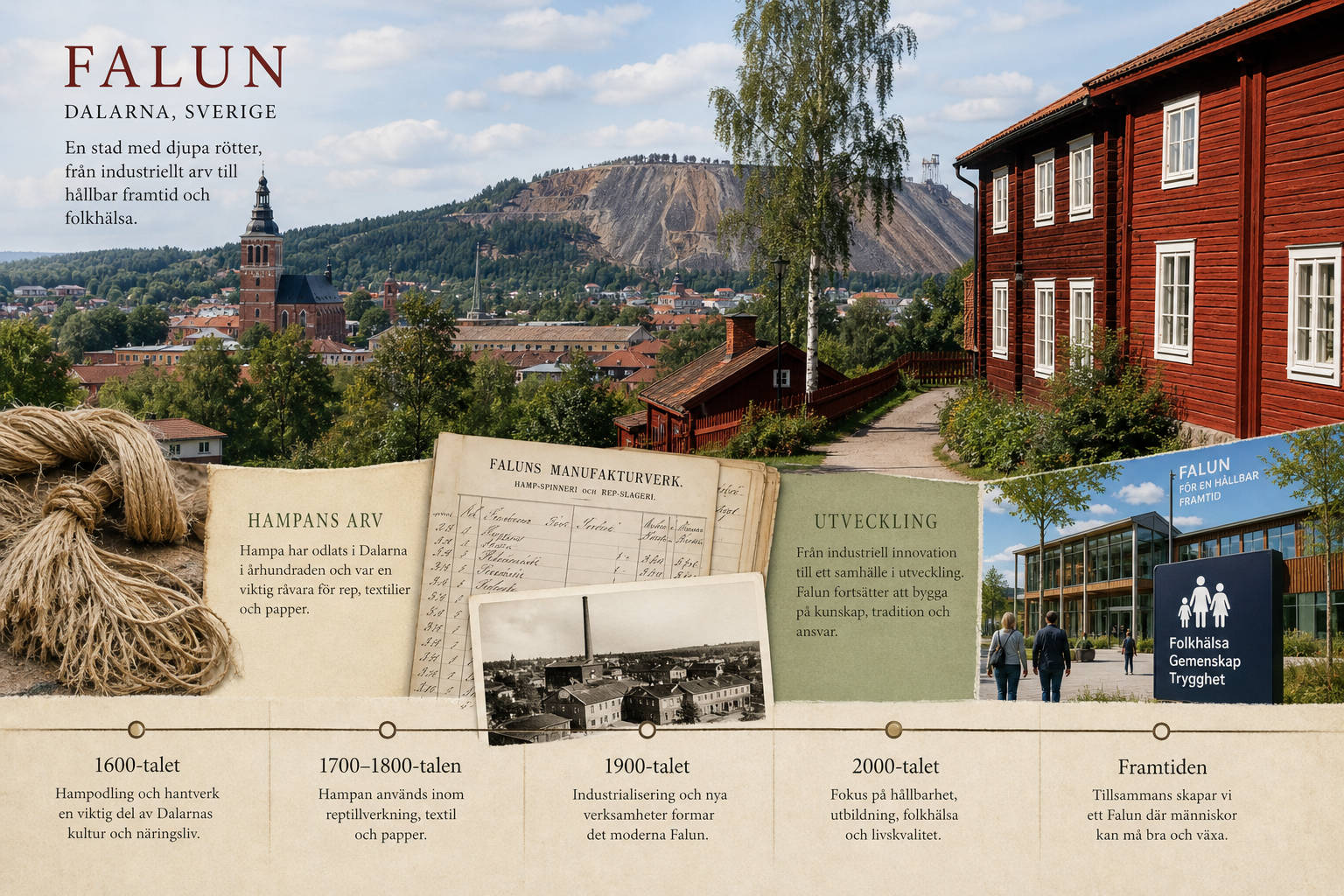
The cannabis history in Falun, Sweden is best understood as part of a wider Swedish and European story rather than as a separate, well-documented local timeline. Falun has long been an important cultural and administrative centre in Dalarna, but public records do not support a simple narrative of a distinctive local cannabis tradition. Instead, the subject connects older hemp uses, changing ideas about intoxicants, national drug policy, public health and the practical realities faced by residents today.
This article separates documented national developments from reasonable local context. It does not claim that every change in Swedish policy produced a specific event in Falun. For current legal questions, readers should consult official Swedish sources because the law applies nationally and can change over time.
Cannabis history in Falun, Sweden: why local context matters
Falun’s history is closely associated with mining, trade, education, crafts and regional administration. Those themes matter when examining cannabis because they show how substances usually enter local history: through wider systems of travel, commerce, migration, medicine, policing and public debate. There is no reliable basis for presenting Falun as an isolated cannabis centre or for assigning a single local origin to cannabis use.
Dalarna has also maintained strong traditions of local identity and rural culture. That does not mean older folk practices should be described as cannabis practices. Hemp, cannabis and traditional Scandinavian textile crops are related botanically, but their historical uses and legal treatment can differ substantially. Careful terminology is therefore important when discussing hemp history in Dalarna.
Hemp is not the same as modern drug cannabis
Hemp has been used in many societies for fibre, rope, seed and other practical purposes. Industrial hemp varieties are bred for very low levels of intoxicating cannabinoids, while drug cannabis is associated with varieties cultivated for higher levels of THC. Historical references to hemp cultivation should not automatically be interpreted as evidence of recreational cannabis use in Falun.
Swedish agricultural and household history contains references to useful plants and fibres, but a general history of hemp does not establish a cannabis market in a particular town. In Falun, the more defensible conclusion is that any older hemp-related activity should be discussed within agriculture and material culture, not presented as proof of a local drug tradition.
From medical plant to controlled substance in Sweden
Across Europe and North America, cannabis moved from being discussed as a medicinal or industrial plant to becoming a focus of international control during the nineteenth and twentieth centuries. Several forces shaped that change, including the development of modern pharmaceuticals, international drug-control agreements, changing medical opinions and concern about psychoactive substances.
Sweden developed a strongly restrictive approach to illegal drugs during the twentieth century. Cannabis became part of the country’s broader narcotics-control framework, and possession, use, production and supply came to be treated as legal matters rather than merely personal or medical choices. The Swedish Narcotic Drugs Penal Act is an important official reference for understanding the legal foundation of this approach.
This national framework shaped what cannabis could mean in Falun. A person’s location in Dalarna did not create a separate cannabis law. Local policing, courts, healthcare services and social organisations operated within national rules, even though enforcement experiences and public discussions could vary between communities.
Weed in Falun and the shift toward public-health debate
In everyday language, people may search for “weed in Falun” when they are looking for information about cannabis availability, law or safety. Historically, however, public discussion in Sweden has tended to use the language of narcotics policy, prevention and health rather than treating cannabis as an ordinary consumer product.
Over time, debate expanded beyond punishment alone. Researchers, clinicians and public agencies increasingly discussed dependence, mental health, impaired driving, adolescent development, accidental exposure and the effects of criminalisation. This did not amount to nationwide legalisation. It did mean that cannabis was increasingly examined through several lenses at once: criminal law, public health, social work, treatment and personal risk.
For Falun, this broader debate is more useful than trying to identify a uniquely local cannabis culture without evidence. Schools, families, healthcare professionals and municipal services encounter the consequences of national policy in local settings. The local story is therefore partly about how national rules are communicated and applied in a mid-sized Swedish community.
What can and cannot be inferred from local history
- National legislation can be described with reasonable confidence using official legal sources.
- Local institutions may reflect wider Swedish prevention and treatment policy, but their existence does not prove a specific level of cannabis use in Falun.
- Search interest, anecdotes or online claims are not reliable evidence of historical prevalence.
- Older references to hemp, herbal medicine or imported goods should not be converted into unsupported claims about recreational cannabis.
Cannabis in Falun today: law, medicine and practical reality
Modern cannabis in Falun remains governed by Swedish national law. Cannabis for non-authorised recreational use is not a legal retail product, and buying, possessing, using, cultivating or supplying illegal cannabis can create legal consequences. The exact consequences depend on the circumstances, substance, quantity and alleged offence.
Medical cannabis is a separate subject. Some cannabinoid-based medicines may be prescribed under Swedish healthcare rules, but this does not mean that patients may freely grow cannabis, obtain products from unlicensed sellers or treat any cannabis product as an approved medicine. A patient in Falun should speak with a licensed healthcare professional and use medicines only as prescribed.
CBD also requires caution. Products described as hemp or CBD are not automatically lawful or risk-free. Composition, THC content, product claims, food and medicine rules and the way a product is marketed can all matter. Consumers should not assume that a product sold online or labelled “natural” has been assessed as a medicine or is permitted under Swedish rules.
The Public Health Agency of Sweden provides a useful institutional starting point for information about public health, alcohol, drugs and prevention. It is preferable to rely on current official guidance than on old blog posts or informal claims about cannabis laws in Falun.
Falun within Dalarna’s wider information landscape
Falun does not exist in isolation from nearby towns. Residents study, work, socialise and seek services across municipal boundaries, so regional information can sometimes add context. For a related discussion of education, law and safer choices in a nearby Dalarna city, see this overview of marijuana education in Borlänge.
Comparisons should still be made carefully. A page about another municipality cannot establish cannabis prevalence in Falun, and differences in wording, service provision or local priorities do not necessarily indicate different laws. The useful comparison is how communities explain the same national framework and direct people toward appropriate support.
Why historical precision matters
Cannabis histories can easily become exaggerated. A dramatic account may combine global events, national legislation and local anecdotes into one story, even when the evidence only supports the first two parts. Precision improves the article in three ways: it avoids inventing local traditions, clarifies what the law actually covers and makes health information more trustworthy.
It is also important to avoid treating people who use cannabis as a single group. Occasional use, dependence, prescribed cannabinoid treatment, accidental exposure and exposure during adolescence raise different questions. A responsible local history recognises those differences while avoiding advice that could facilitate illegal purchasing or unsafe consumption.
How to research the cannabis history of Falun responsibly
Anyone researching the subject can build a stronger account by starting with primary and institutional material. Local newspapers, municipal archives, historical societies and library collections may reveal how intoxicants, medicine, policing and public health were discussed in different periods. Those sources should be checked against the date and context of each report.
- Begin with Swedish legislation and official government or public-health material.
- Search local archives for terms connected with narcotics policy, prevention, healthcare and courts, not only the word cannabis.
- Distinguish a report about a seizure or criminal case from evidence about general community behaviour.
- Check whether a historical source is discussing industrial hemp, medicinal preparations or intoxicating cannabis.
- Record uncertainty instead of filling gaps with assumptions about Falun.
This method produces a more credible history than repeating unverified claims about “secret” local scenes or supposed turning points. It also keeps the focus on people, institutions and policy rather than sensationalism.
What the history means for residents and visitors
The main practical lesson is that cannabis in Falun should be approached through Swedish law and public-health guidance, not through assumptions based on laws in other countries. Visitors should not bring cannabis across borders, and residents should be cautious about online sellers, unverified medicines and products whose contents are unclear.
Anyone worried about their own use or another person’s use can contact a healthcare professional or a local support service. Urgent symptoms such as severe confusion, chest pain, loss of consciousness or difficulty breathing require emergency medical attention. Historical knowledge cannot replace professional advice, but it can explain why Swedish institutions treat cannabis as a controlled-substance and health issue.
Conclusion
The history of cannabis in Falun is not a story of a uniquely documented local cannabis tradition. It is a regional expression of broader Swedish developments: older distinctions between hemp and intoxicating cannabis, twentieth-century international control, restrictive national drug policy and a more recent emphasis on public health and treatment. Falun’s local context matters, but it should not be used to manufacture evidence that does not exist.
For readers researching cannabis history in Falun, Sweden, the most reliable approach is to connect local archives and community history with official national law and current health guidance. That combination gives a clearer picture of what is known, what remains uncertain and how the subject affects people in Falun today.