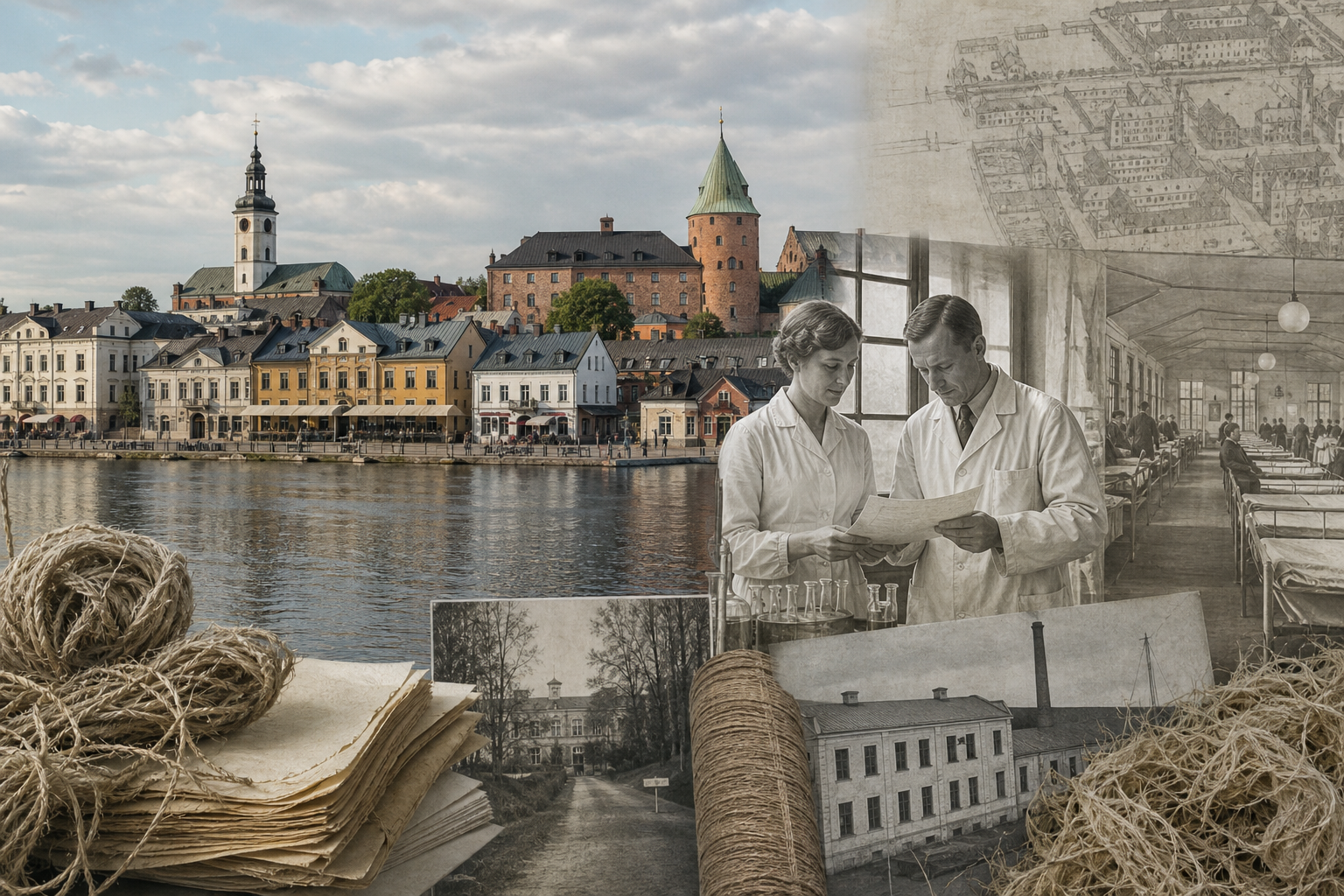
Marijuana history in Nyköping is best understood as part of Sweden’s wider story of hemp, medicine, drug control and public health. There is limited evidence of a separate, well-documented cannabis culture unique to Nyköping. However, the city’s position in Södermanland, its connections with Stockholm and other regional centres, and its participation in national institutions mean that Swedish cannabis policy has shaped local life just as it has elsewhere in the country.
This article separates documented national developments from reasonable local context. It does not treat isolated police reports, rumours or modern online claims as proof of a long-standing Nyköping marijuana tradition. Instead, it explains how attitudes and laws changed over time, what “weed in Nyköping” means in a Swedish legal setting, and why historical interpretation requires care.
Marijuana history in Nyköping begins with hemp, not modern marijuana
Hemp and marijuana are related but should not be treated as interchangeable. Hemp traditionally refers to cannabis varieties grown for fibre, seed or other low-intoxicating uses, while marijuana commonly refers to cannabis material used for its intoxicating effects. Historical references to hemp in Sweden therefore do not automatically demonstrate recreational cannabis use.
Across Europe, hemp was valued for rope, cloth, fishing equipment and other practical materials. Sweden’s agricultural and maritime communities used plant fibres in ways connected to transport, household production and trade. In a historic town such as Nyköping, these broader material networks are more relevant than claims that the city had a distinctive cannabis scene. Hemp’s importance was primarily industrial and agricultural, not equivalent to the modern drug debate.
Why local evidence is difficult to interpret
Older records rarely use today’s categories. A document may mention hemp cultivation, imported medicines, textile production or botanical preparations without identifying the plant’s chemical content or intended use. Conversely, the absence of a reference to cannabis does not prove that no one encountered it. Historians must therefore distinguish between evidence for hemp as a useful crop and evidence for psychoactive cannabis as a social practice.
Nyköping’s local archives, museums and regional histories can provide valuable information about trade, medicine, agriculture and everyday life. They should be read alongside national legal and medical records rather than used to infer a city-specific marijuana history from general European trends.
Medical cannabis and changing knowledge in Sweden
Cannabis preparations appeared in nineteenth-century Western medicine, when doctors and pharmacists investigated plant-based remedies for pain, spasms and other complaints. Their use was shaped by the limited scientific methods and inconsistent dosing of the period. These preparations were not the same as today’s regulated cannabinoid medicines, and historical medical use should not be presented as proof that cannabis was widely accepted or routinely used in Nyköping.
During the twentieth century, pharmaceutical development, concerns about intoxication and international drug-control agreements changed the position of cannabis. As modern medicines became more standardized, cannabis was increasingly discussed as a controlled substance rather than an ordinary pharmacy ingredient. Swedish policy developed within this wider international environment.
Today, a small number of cannabis-based medicines may be considered in specific medical circumstances, but that does not create a general right to possess or grow cannabis. Anyone seeking treatment in Nyköping should discuss symptoms and options with a licensed healthcare professional rather than relying on informal products or unverified health claims. General public-health information is available through the Public Health Agency of Sweden.
Sweden’s prohibition model and its effect on Nyköping
The most important chapter in cannabis laws in Nyköping is national rather than municipal. Sweden’s modern narcotics framework developed during the twentieth century and became increasingly restrictive. Possession, production, transfer and use of illegal narcotics can lead to criminal consequences, with the seriousness depending on factors such as the substance, quantity, conduct and circumstances.
Sweden introduced a specific narcotics law in 1968. The criminalization of personal use followed in 1988, and penalties were strengthened in the early 1990s. These changes helped establish the enforcement-oriented model that remains relevant in Nyköping, Stockholm and other Swedish municipalities. Local authorities do not create a separate recreational cannabis market by passing city-level legalization rules.
For current legal information, readers should consult the Swedish Police information on drugs and the law. Laws and official guidance can change, so historical summaries should not be treated as personal legal advice.
Municipal responsibility is broader than criminal enforcement
Although criminal law is national, municipalities influence how residents experience drug policy. Social services, schools, youth work, public-health initiatives and cooperation with regional healthcare providers all contribute to prevention and support. In Nyköping, these responsibilities are more useful for understanding everyday policy than the idea of a separate municipal cannabis law.
A local response may include early conversations with young people, support for families, referral to treatment and coordination between public agencies. The emphasis can vary over time, but the general framework is shaped by Swedish law and public-health policy rather than by local permission to use cannabis.
Cannabis in Nyköping during the late twentieth century
From the 1960s onward, cannabis became more visible in international youth culture, music, media and political debate. Sweden’s response was notably cautious. Public discussion often emphasized prevention, abstinence and the risks of normalizing illegal drugs. This national tone also affected how cannabis was discussed in towns such as Nyköping.
It would be misleading to describe this period as a simple shift from acceptance to prohibition. Cannabis was never an ordinary, unrestricted consumer product in modern Nyköping. Instead, attitudes developed through competing influences: international popular culture, Swedish drug education, policing, medical research and concern about dependence and mental health.
Nor should the presence of cannabis-related arrests or treatment cases be read as evidence of a stable local subculture. Administrative records usually reflect enforcement priorities and reporting practices as much as underlying use. Historical claims need comparable sources over time, and city-level data may be limited or difficult to interpret.
Weed in Nyköping today: history meets practical reality
Searches for weed in Nyköping may produce social-media posts, anonymous advice and commercial-looking pages. Those sources are not reliable indicators of legal status or product safety. In Sweden, a product’s label, online availability or claim to be “natural” does not by itself establish that possession or use is lawful.
Residents and visitors should be particularly cautious about three assumptions:
- That a product sold online is automatically legal to possess in Sweden.
- That CBD, hemp and intoxicating cannabis are legally identical.
- That a small amount has no possible criminal or health consequences.
Driving after using an intoxicating substance also creates serious safety and legal concerns. Cannabis can affect attention, reaction time, coordination and judgement. Combining it with alcohol or other psychoactive substances can increase impairment. Young people, pregnant individuals and anyone with a personal or family history of psychosis or other mental-health difficulties may face particular risks.
Medical cannabis in Nyköping
Questions about medical cannabis in Nyköping should be directed to Swedish healthcare services. A doctor must assess the condition, previous treatment and potential risks. Medical products are not equivalent to unregulated cannabis, home-grown material or products purchased from an unknown website.
People who are worried about their own use can seek confidential advice from healthcare or social-service professionals. A request for help does not require someone to adopt a particular political view about cannabis. It is a practical step toward assessing dependence, anxiety, sleep problems, impaired concentration or other concerns.
How Nyköping fits into Sweden’s wider cannabis story
Nyköping’s history is connected to national trends through travel, education, employment, media and healthcare. The city is not isolated from debates taking place in Stockholm or across Sweden, but connection does not mean that every national trend has a distinct local expression.
A responsible history of cannabis in Nyköping should therefore ask several questions:
- Is the source describing hemp, medical cannabis or intoxicating marijuana?
- Does it provide evidence specific to Nyköping, or is it making a general claim about Sweden?
- Is the information historical, legal, medical or anecdotal?
- Could changes in policing, reporting or terminology explain an apparent trend?
- Does the claim reflect current law, or only an earlier period?
This method avoids two common errors. The first is projecting modern recreational terminology backward onto historical hemp production. The second is assuming that national statistics provide a complete picture of a particular neighbourhood or town.
Readers interested in comparing local context can also examine the related history of cannabis policy and culture in Falun and the practical discussion of cannabis consumption in Eskilstuna. These comparisons are useful because they show how similar national rules can be discussed through different local settings.
Conclusion: a careful way to understand Nyköping’s marijuana history
The history of marijuana in Nyköping is not a story of a uniquely legalized or openly commercial local market. It is a local expression of a broader Swedish history: traditional hemp use, nineteenth-century medical interest, twentieth-century international drug control, strict national prohibition and an ongoing public-health debate.
The strongest conclusion is also the most cautious. Evidence about Nyköping should be kept separate from general claims about Sweden, and hemp should not be confused with intoxicating cannabis. Current questions about possession, medical treatment, driving or personal use require up-to-date official and healthcare guidance. Understanding that distinction makes the history more accurate and the practical information more useful.