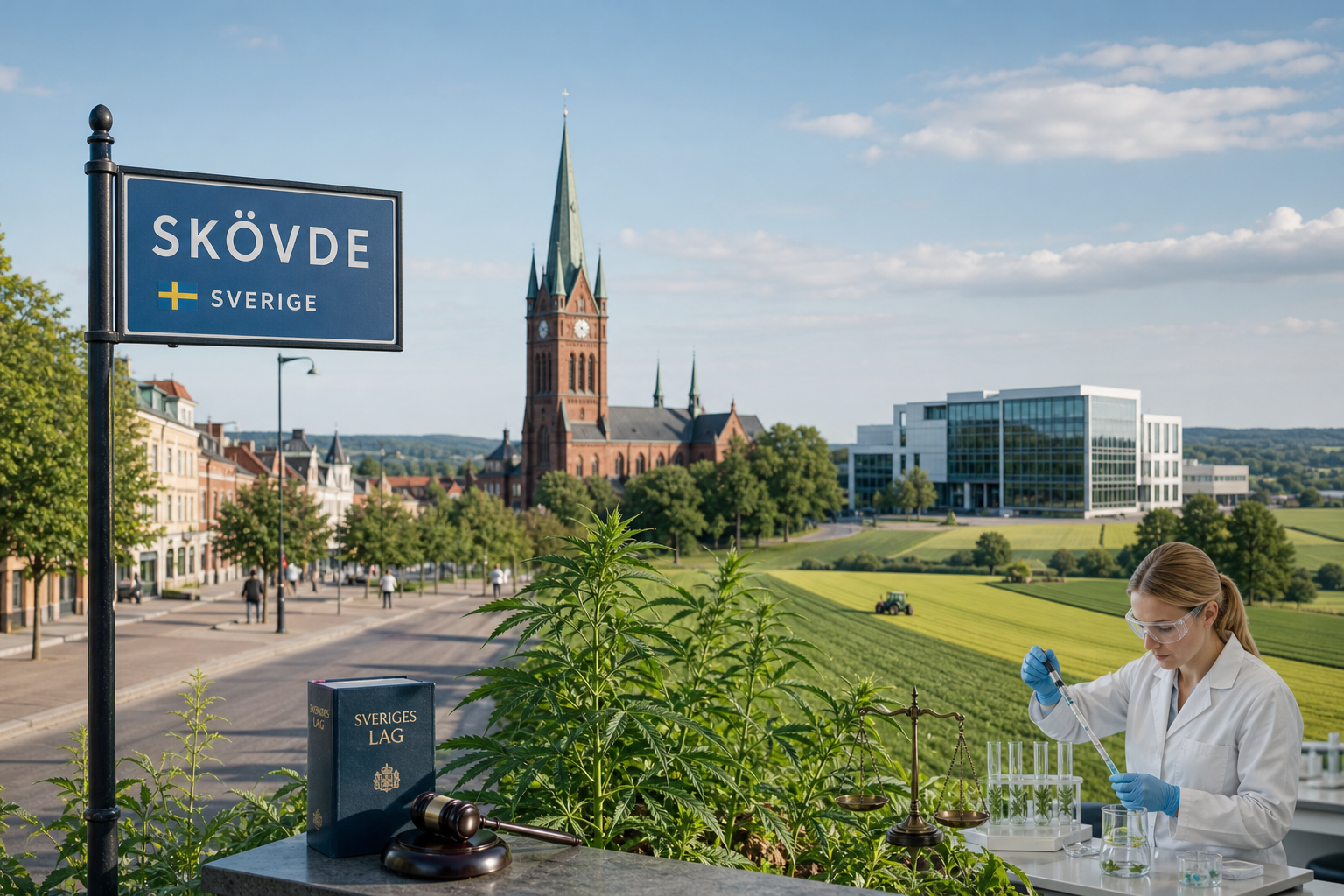
The marijuana industry in Skövde is best understood as a question of regulation, healthcare, research, industrial hemp and public policy rather than a conventional recreational retail market. Skövde is a regional city in Västra Götaland, positioned between larger urban centres such as Gothenburg and Jönköping. That location creates links to logistics, education, healthcare and manufacturing, but it does not change Sweden’s national drug laws.
For residents, students, business owners and visitors searching for weed in Skövde, the most important fact is that recreational cannabis is illegal. This article explains what the legal market can include, how medical access works, where hemp fits, and why public-health considerations matter when assessing cannabis in Skövde.
What the marijuana industry in Skövde actually includes
Sweden does not have a legal adult-use cannabis dispensary system. As a result, the local industry is not comparable with regulated recreational markets in parts of North America or elsewhere. A more accurate description includes lawful activities that may intersect with cannabis without involving illegal sales or possession.
- Prescription-based medicines containing cannabis-related substances.
- Pharmacy distribution and healthcare services connected with approved medicines.
- Industrial hemp cultivation and processing when applicable rules are met.
- Scientific, pharmaceutical and agricultural research conducted with the necessary permissions.
- Public-health education, prevention, treatment and harm-reduction services.
- Legal businesses selling compliant hemp-derived goods, subject to product-specific rules.
These areas can create professional opportunities in compliance, laboratory work, supply chains, farming, healthcare and product testing. They should not be confused with an authorised recreational market. A company operating in Skövde would need to assess Swedish narcotics, medicines, food, consumer-protection, advertising, environmental and employment requirements according to its activity.
Cannabis laws in Skövde and throughout Sweden
There is no separate municipal cannabis code in Skövde. The same Swedish national framework applies across the country. Cannabis and products containing prohibited narcotic substances are controlled, and unauthorised possession, use, production, cultivation, sale, transfer and import can lead to criminal consequences. The legal outcome depends on factors such as the substance, quantity, conduct and circumstances.
Swedish policy is often described as restrictive because both use and possession are criminalised. A person should not assume that a small amount, private consumption or cannabis purchased in another country makes possession lawful in Sweden. Bringing cannabis across a border can create additional customs and criminal-law risks.
For current information, readers should consult the Swedish Government’s official information on alcohol, tobacco and drugs and seek qualified legal advice for a specific business or personal situation. Online claims that cannabis is “decriminalised” or freely tolerated in a particular Swedish city can be misleading.
What this means for consumers and businesses
Consumers should not interpret the existence of hemp shops, CBD products or medical prescriptions as permission to buy ordinary marijuana. Businesses should also avoid marketing language that implies recreational legality. Advertising, labelling and product composition can all affect whether a product is regulated as a medicine, food, cosmetic, consumer item or narcotic.
Entrepreneurs considering cannabis in Skövde should begin with a legal classification of the product and activity. They should then identify the relevant regulator, document sourcing and testing, check claims used in marketing, and obtain specialist advice before investing in inventory or premises.
Medical cannabis in Skövde: access and limitations
Medical cannabis in Skövde is available only within Sweden’s healthcare and medicines framework. A patient cannot legally obtain cannabis simply by describing symptoms to a general retailer. Medical treatment requires an assessment by a licensed healthcare professional, and any medicine must be prescribed and supplied according to applicable rules.
Some cannabis-related medicines are approved for particular indications, while other treatments may require special regulatory arrangements. Availability can depend on the medicine, the patient’s condition, clinical judgement and supply circumstances. A prescription from another country should not automatically be assumed to authorise possession or import in Sweden.
Patients should discuss persistent pain, spasticity, sleep problems, anxiety or other symptoms with a qualified clinician rather than relying on unverified online sellers. Cannabis-based treatment can involve adverse effects, interactions with other medicines and impairment. It may be unsuitable for some people, particularly those with a history of psychosis, certain cardiovascular concerns or vulnerability to substance dependence.
The 1177 healthcare information service is a useful starting point for general Swedish healthcare guidance, although it cannot replace an appointment or individual medical advice. Pharmacies and healthcare providers can also explain whether a prescribed product is available and how it should be used.
Industrial hemp and CBD: the legal market next to marijuana
Industrial hemp is different from drug cannabis in purpose, genetics, cultivation controls and permitted uses. Hemp may be used for fibre, seed, food ingredients, textiles, construction materials and other industrial applications. However, legal status depends on the plant variety, THC content, cultivation arrangements and the final product.
CBD is not a simple legal shortcut. A CBD oil, edible, cosmetic or vape product can be subject to different rules, and a product’s label does not prove that it complies with Swedish requirements. Food products may raise novel-food questions, while therapeutic claims can cause a product to be treated as a medicine. Detectable controlled substances can also create serious legal problems.
Anyone exploring the hemp sector around Skövde should request reliable documentation, including ingredient information, laboratory testing where appropriate, supplier identity and evidence supporting the product’s regulatory category. Retailers should avoid claims that a product cures disease, replaces prescribed treatment or produces intoxicating effects.
Potential business opportunities
A compliant hemp or cannabis-related business may find opportunities in areas that do not involve recreational marijuana sales. These could include agricultural services, packaging, testing, logistics, regulatory consulting, pharmaceutical distribution and educational content. The strongest opportunities are likely to depend on technical competence and compliance rather than novelty branding.
Skövde’s connections to regional transport, manufacturing and public services may be relevant to supply-chain or research-oriented projects. That is a general economic observation, not evidence that a particular local cannabis company or licensed cultivation facility currently operates in the city. Businesses should verify local premises, permits and commercial partners directly.
Public health and safer decision-making
Discussions of the Swedish cannabis market should include health rather than focusing only on commercial potential. Cannabis can affect attention, memory, reaction time and judgement. Frequent or high-potency use may increase the risk of dependence and can worsen mental-health problems for some people. The risk profile varies with age, potency, frequency, personal health and whether other substances are used.
Driving after using cannabis is especially dangerous and may have legal consequences. Combining cannabis with alcohol or sedating medicines can increase impairment. People who feel unable to control their use, experience paranoia or hallucinations, or develop severe physical symptoms should seek medical help. In an emergency, contact Swedish emergency services.
Young people, pregnant individuals and those with a personal or family history of serious mental illness should be especially cautious and seek professional advice. Public-health information should be factual and non-judgemental: neither exaggerated claims nor casual assurances help people make safer choices.
How Skövde compares with other Swedish cities
Local interest in cannabis may look different from city to city, but the core legal framework remains national. Comparing Skövde with nearby regional centres can therefore be useful for understanding media coverage, healthcare access and business networks, not for finding a different legal regime.
For related national context, readers can review our guides to marijuana in Gothenburg and marijuana information in Borås. Those comparisons should still be read alongside current official Swedish guidance, since policies, product classifications and enforcement practices can change.
People travelling through the region should also avoid carrying cannabis between cities or across borders. A trip from Skövde to Gothenburg, Jönköping or another destination does not create an exception to national law.
Practical checklist for residents and entrepreneurs
- Check whether the product contains controlled substances, not just whether it is labelled “hemp” or “CBD”.
- Confirm the regulatory category before importing, manufacturing, selling or advertising anything.
- Use qualified legal and healthcare professionals for questions involving medicines or criminal law.
- Keep supplier records, certificates, testing documents and accurate product labels.
- Do not make medical claims without the required evidence and authorisation.
- Never drive or operate machinery while impaired.
- Seek help early if cannabis use is affecting health, work, finances or relationships.
Conclusion
The marijuana industry in Skövde is a limited and highly regulated field, not an open recreational marketplace. The lawful side is more likely to involve prescription medicines, industrial hemp, research, healthcare, testing, logistics and compliance than dispensary retail. Swedish national law applies in Skövde, and cannabis possession, use and supply outside authorised channels can carry serious consequences.
For anyone researching cannabis in Skövde, the safest approach is to separate marijuana from industrial hemp, distinguish medical treatment from self-medication, and verify every claim with an official source or qualified professional. A realistic view of the local market combines legal accuracy, public-health awareness and careful attention to product-specific rules.