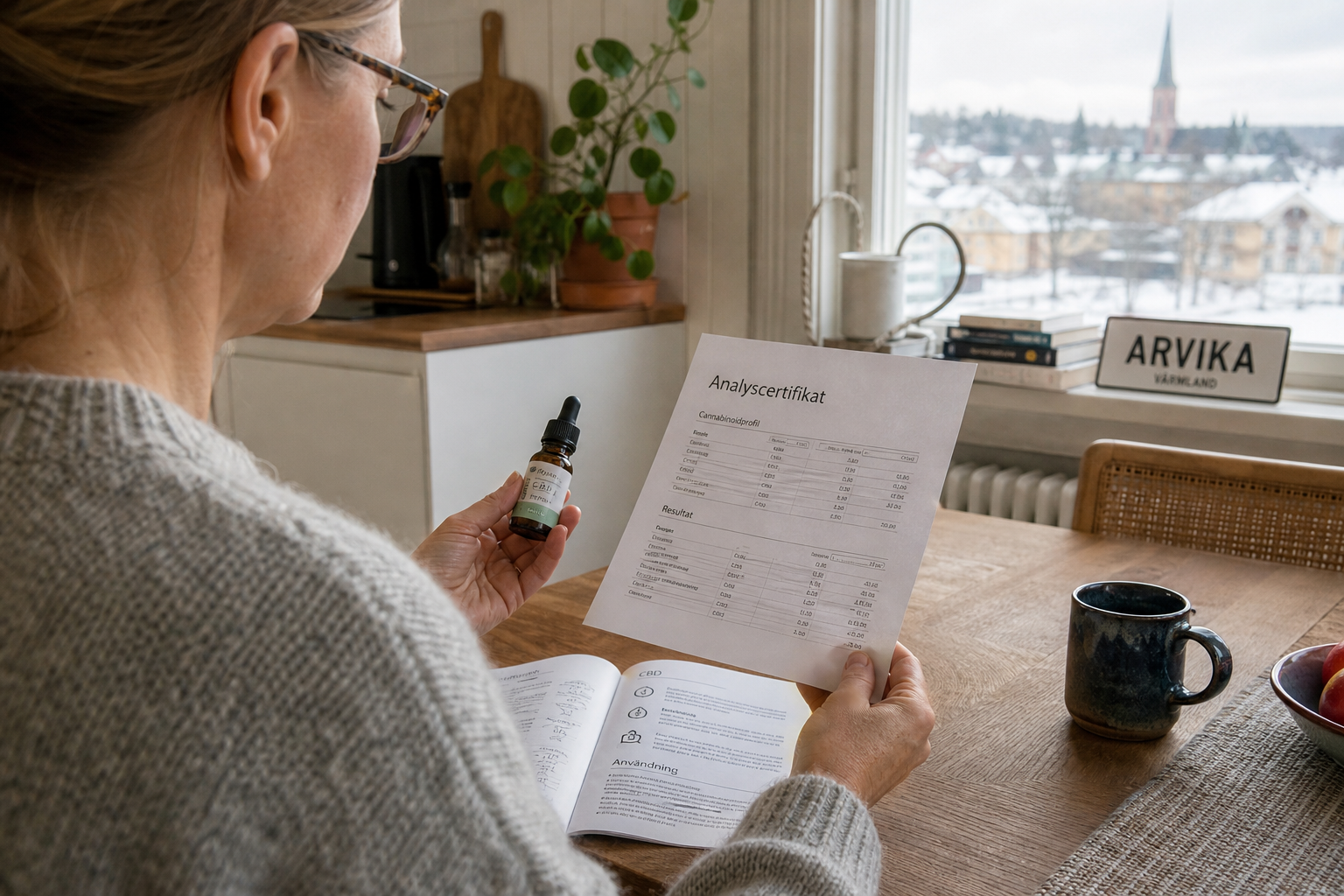
Understanding CBD legality in Arvika requires looking beyond whether a product is labelled “CBD.” Arvika follows Swedish national law, and there is no separate municipal rule that legalises cannabidiol products locally. The most important questions are whether a product contains tetrahydrocannabinol (THC), how it is marketed, whether it is intended for food, cosmetics or medical use, and whether it has been legally approved for that purpose.
CBD itself is not generally treated in the same way as intoxicating cannabis. However, a CBD product can still create legal problems if it contains THC, makes unauthorised health claims, or has been imported or sold under rules that do not apply to its category. This guide explains the practical position for residents, visitors and shoppers looking at CBD in Arvika.
Does Swedish law apply differently in Arvika?
No. Arvika is in Värmland County, but cannabis and CBD are regulated primarily under Swedish national legislation and European rules. Local shops, pharmacies, healthcare providers and police do not have the power to create a local recreational CBD exception.
That means the same principles apply whether someone is buying CBD oil in central Arvika, ordering a product online, travelling through the municipality or bringing it across the Swedish border. A product that appears acceptable in another country may not meet Swedish requirements.
For comparison, the legal position of hemp cultivation and hemp-derived material is discussed in this guide to hemp legality in Mjölby. The location differs, but the national framework is the key point.
CBD laws in Arvika: why THC content matters
The most important issue in Swedish CBD regulation is THC. THC is the main intoxicating cannabinoid in cannabis and is controlled under Sweden’s narcotics legislation. Swedish case law has treated CBD oil containing THC as a narcotic preparation, even when the amount of THC is very low. As a result, “only a trace” is not a reliable defence for consumers.
Consumers should not assume that “hemp-derived,” “full-spectrum” or “legal limit” wording guarantees that a product is lawful in Sweden. Labels can be incomplete, laboratory testing can be unreliable, and products may contain more THC than the packaging suggests.
Before purchasing or using a product, check whether the seller provides a recent, product-specific certificate of analysis from an identifiable laboratory. The report should identify the batch and show cannabinoid results, including THC. Even then, a laboratory report is not the same as Swedish regulatory approval.
CBD isolate, broad-spectrum and full-spectrum products
CBD isolate is intended to contain cannabidiol without other cannabis compounds, while broad-spectrum and full-spectrum products may contain additional cannabinoids. These labels describe formulation, not automatic legal status. Full-spectrum products deserve particular caution because they may contain THC.
A product described as THC-free may still be incorrectly labelled or contaminated. If the product is imported, the buyer may also be responsible for understanding whether its ingredients and intended use comply with Swedish rules.
Is CBD oil legal in Arvika?
The answer depends on the formulation, intended use and claims made about the oil. CBD oil in Arvika is not automatically legal simply because it is sold online or derived from industrial hemp.
Oral CBD products can raise several issues. A product promoted to help with anxiety, pain, sleep, inflammation or other medical conditions may be considered a medicinal product based on its presentation or claimed effects. Medicinal products generally require marketing authorisation or another lawful basis before they can be sold to consumers.
Food and supplements are also subject to specific requirements. CBD extracts and similar substances may be treated as novel foods in the European regulatory system, meaning that approval may be needed before lawful sale as food. A seller’s use of terms such as “supplement” or “natural wellness product” does not remove those requirements.
The Swedish Medical Products Agency provides regulatory information about medicines and products making medical claims. Its official medicines and product-safety guidance is a useful starting point when checking how a CBD product is classified.
Different rules for different CBD product categories
CBD medicines
Some cannabinoid medicines may be available through the healthcare system when they have the required authorisation and are prescribed or supplied through lawful channels. This is different from buying an unapproved oil from a general online retailer.
If you are considering CBD for a medical condition, speak with a licensed healthcare professional. A clinician can discuss approved treatment options, interactions and whether a prescribed medicine is appropriate. Do not stop an existing treatment because a product is advertised as a natural alternative.
CBD food and supplements
CBD added to drinks, sweets, capsules or oils intended to be eaten can fall under food law. Novel-food status, ingredient controls, labelling and health-claim rules may all matter. Food packaging that promises treatment or prevention of disease can also create a medicinal-product issue.
CBD cosmetics
Topical products such as creams, balms and lotions are assessed under cosmetics rules when they are genuinely intended for application to the skin and make cosmetic rather than medical claims. They must still meet ingredient, safety, labelling and responsible-person requirements. A cream marketed as treating eczema, arthritis or serious pain may be treated differently from a moisturiser.
Hemp seed products
Hemp seeds, hemp seed oil and certain hemp-derived ingredients are not the same as CBD extracts. They may be permitted in particular food or cosmetic uses when they comply with applicable limits and labelling rules. This does not mean that a high-CBD extract is automatically permitted simply because it comes from the hemp plant.
Buying CBD in Arvika: a practical checklist
There is no special Arvika licence that makes an otherwise unlawful CBD product acceptable. Whether buying locally or online, use a cautious process:
- Identify the seller and check whether the business provides a physical address, customer service details and clear product information.
- Read the full ingredient list rather than relying on the front-of-packaging claim.
- Look for batch-specific laboratory testing that reports THC and other cannabinoids.
- Be cautious with full-spectrum products, especially when the THC result is unclear.
- Check whether the product is marketed as food, a cosmetic, a medicine or another category.
- Question claims that promise to diagnose, cure, prevent or treat a medical condition.
- Do not assume that a product is lawful because it is sold on a Swedish-language website.
- Keep the packaging and purchase records if you need to ask a regulator or healthcare professional about the product.
A low price, attractive packaging or large number of online reviews does not establish legal compliance or product quality.
Travelling with CBD to or from Arvika
Travelling with CBD can be more complicated than buying it. Border authorities may assess the actual contents of a product, not merely the wording on its label. A bottle containing THC may be treated as a narcotic product, and a prescription or medical document from another country may not automatically authorise import into Sweden.
People arriving in Sweden should avoid carrying unverified oils, flowers, vapes or edibles. Keep any genuinely prescribed medicine in its original packaging and check the relevant import requirements before travelling. The Swedish Customs Service provides official information about bringing medicines and goods into Sweden.
Do not carry CBD products across a border for another person. You may not know the exact contents, and responsibility can still arise even when the product was purchased lawfully abroad.
For broader travel context, this overview of cannabis laws for visitors in Avesta explains why tourists should consider Swedish national rules rather than assumptions based on their home country.
CBD, driving and workplace concerns
CBD is not normally associated with the same intoxicating effects as THC, but products can be mislabelled or contain cannabinoids that affect alertness. Using an unverified product before driving is therefore a poor risk-management decision.
Prescription medicines can also have warnings about drowsiness, concentration or driving. Follow the instructions supplied with an authorised medicine and ask a healthcare professional or pharmacist if you are uncertain. Employers may additionally have workplace rules relating to impairment, safety-sensitive duties and drug testing.
Do not assume that feeling sober proves that a product contains no THC or cannot affect a test. If driving, operating machinery or working in a safety-critical environment, avoiding unverified cannabinoid products is the safest approach.
What can happen if a product contains THC?
Possession, importation or use of a THC-containing product can expose a person to criminal-law consequences under Swedish narcotics rules. The precise outcome depends on the substance, amount, circumstances and evidence. Police or customs may seize a product for analysis, and online orders can still be intercepted even when the buyer is in Arvika.
Do not try to hide, dilute or relabel a product. If authorities contact you about a suspected narcotics matter, obtain advice from a qualified Swedish lawyer. If you are concerned about an accidental exposure or an adverse reaction, contact healthcare services or poison-information professionals promptly.
How to check a CBD product responsibly
Regulatory information can change, and product categories are not always obvious from advertising. A sensible checking process is:
- Write down the exact product name, ingredients, concentration and intended route of use.
- Check the manufacturer, importer and batch number.
- Review current guidance from Swedish authorities rather than relying on foreign websites.
- Ask the seller which Swedish or European requirements the product meets.
- Get professional advice before using CBD alongside prescription medicines, during pregnancy or for a child.
For local questions, pharmacies and healthcare providers in Arvika may help with medicine-related concerns, but they cannot approve an unregulated commercial product. Classification and enforcement questions should be directed to the relevant Swedish authority.
CBD legality in Arvika: key points to remember
The practical answer to CBD legality in Arvika is that legality depends on the complete product and its use, not just the word CBD on the label. THC-containing CBD oil can fall under narcotics rules. THC-free products may still face medicine, food, cosmetic or novel-food requirements. Imported products create additional risks, and local availability does not prove compliance.
When assessing hemp products in Arvika, distinguish hemp seed goods from CBD extracts, check the intended product category, and treat therapeutic claims with caution. If a product’s ingredients or legal status are unclear, the safest choice is not to use or import it until reliable Swedish guidance has been obtained.
Conclusion
Swedish CBD rules apply in Arvika in the same way as elsewhere in the country. Consumers should pay particular attention to THC, product classification, medical claims, import rules and the reliability of laboratory information. A cautious buyer verifies the exact contents and seeks professional advice for medical use instead of relying on broad claims such as “natural,” “hemp-derived” or “legal everywhere.”
This article provides general information, not legal or medical advice. Regulations and product assessments can change, so confirm the current position with an official Swedish authority before buying, using or transporting a CBD product.