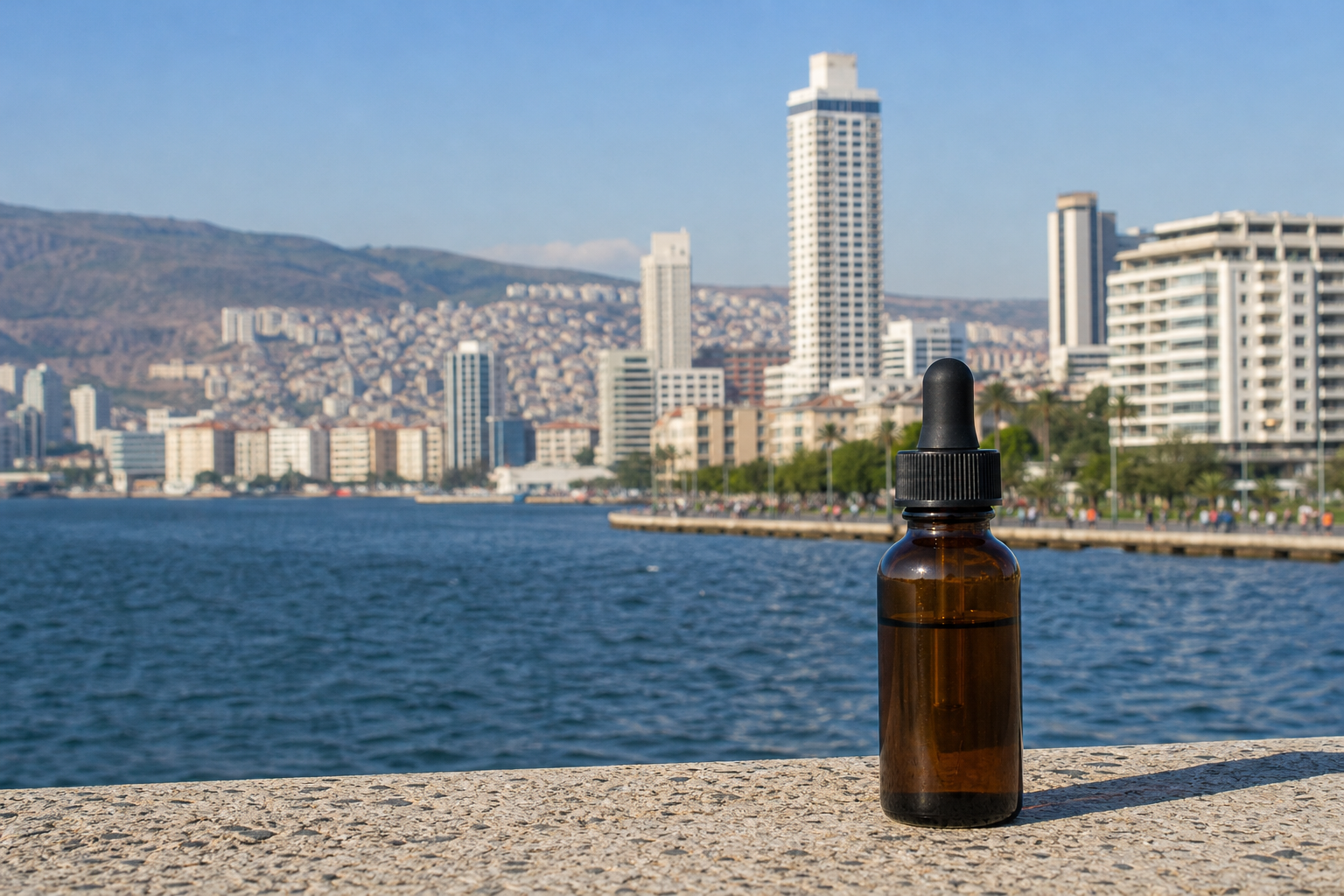
Understanding CBD in İzmir requires more than checking whether a bottle is sold online or displayed in a shop. Cannabidiol, commonly called CBD, is associated with hemp and cannabis, but Turkish law treats cannabis-derived substances within a tightly controlled legal framework. Product labels, THC content, intended use, import status and medical claims can all affect the practical risk.
This guide explains the main issues for residents, visitors and patients. It is general information, not legal or medical advice. Rules and enforcement can change, so confirm the current position with the relevant Turkish authorities before purchasing, carrying or using any CBD product.
What CBD means in İzmir
CBD is a non-intoxicating cannabinoid found in cannabis and some varieties of hemp. It is different from tetrahydrocannabinol, or THC, the cannabinoid primarily associated with the intoxicating effects of cannabis. That distinction matters scientifically, but it does not automatically make every CBD product legal in Turkey.
A product marketed as CBD oil may contain an extract, an isolate, a carrier oil, flavourings or other ingredients. Some products may also contain trace THC, while others may be inaccurately labelled. The word “hemp” on packaging is not, by itself, proof that the product is permitted for sale, import or possession.
In İzmir, the same national rules apply as elsewhere in Turkey. There is no separate İzmir licence or local exemption that generally permits consumers to possess cannabis-derived products. Local pharmacies, customs offices, police authorities and health professionals may have different responsibilities, but national controlled-substance rules remain the starting point.
CBD laws in İzmir and Turkey
Turkish controls distinguish between approved medicines, agricultural hemp materials, food or cosmetic products and controlled cannabis substances. The classification of a particular item can depend on its ingredients, concentration, presentation, claims and supply chain. As a result, a product described as “CBD” on a foreign website should not be assumed to have the same legal treatment in Turkey.
Turkey has permitted regulated cultivation and use of certain hemp materials under specific conditions, but this should not be confused with broad consumer permission to buy cannabis extracts. Industrial hemp, hemp seed, fibre and other authorised materials may be subject to different rules from cannabinoid extracts or products containing THC.
For current medicine-related information, consult the Turkish Medicines and Medical Devices Agency. For agricultural and hemp-related regulatory information, the Ministry of Agriculture and Forestry of the Republic of Türkiye is a more reliable starting point than an online retailer or social-media post.
Is CBD oil legal in İzmir?
The safest answer is that legality cannot be determined from the words “CBD oil” alone. A properly authorised medicine may follow one route, while a cosmetic, food supplement, vape liquid or imported extract may follow another—or may not be authorised for the Turkish market at all. Products with THC create additional legal concerns because THC is a controlled psychoactive substance.
Consumers should not rely on a seller’s claim that a product is “legal in Europe,” “THC-free” or “under the legal limit.” Foreign rules do not establish Turkish legality, and a certificate supplied by a seller may not be accepted by Turkish authorities. If the product is not clearly authorised for sale in Turkey, possession or import can carry avoidable risks.
Medical cannabis in İzmir
People searching for medical cannabis in İzmir may be looking for CBD to support pain, sleep, anxiety, epilepsy or another condition. Evidence varies considerably by condition and product. A product sold as a supplement is not equivalent to an approved medicine, and personal testimonials do not establish safety or effectiveness.
Speak with a licensed doctor in Turkey before using CBD, particularly if you take prescription medicines or have liver disease, are pregnant or breastfeeding, or are preparing for surgery. CBD can potentially interact with medicines because it may affect how the body processes certain drugs. A doctor or pharmacist can also help distinguish a clinically appropriate treatment from an unverified product.
What patients should ask a healthcare professional
- Whether CBD is appropriate for the specific diagnosis and treatment goal.
- Whether it could interact with current medicines, including sedatives, anti-seizure drugs, anticoagulants or medicines processed by the liver.
- What legally authorised treatment options are available in Turkey.
- Which symptoms require urgent medical attention rather than self-treatment.
- How to report suspected side effects or an inaccurately labelled product.
Do not stop a prescribed medicine suddenly in order to try CBD. If a doctor believes a cannabinoid-based medicine may be suitable, ask which product, dose, monitoring plan and legal supply route apply. A prescription or medical need does not automatically authorise importing an unapproved product from another country.
Buying CBD in İzmir: practical checks
Searches for buying CBD in İzmir may produce websites, social accounts and informal sellers offering oils, gummies, capsules, cosmetics or vape products. Availability is not proof of legality, quality or safety. Informal sales also make it difficult to verify storage conditions, contaminants and the true cannabinoid content.
Before considering any product, check the following:
- Regulatory status: Look for evidence that the product category is authorised for the Turkish market, rather than relying on a foreign label.
- Full ingredients: Avoid products that do not identify the amount of CBD, possible THC, carrier oil and other active ingredients.
- Independent testing: A recent certificate of analysis should identify the batch and test for cannabinoids, heavy metals, pesticides, solvents and microbial contamination.
- Medical claims: Be cautious of claims that CBD cures cancer, replaces prescribed treatment or guarantees relief from a named disease.
- Packaging and traceability: Missing manufacturer details, unclear expiry dates, broken seals or copied labels are warning signs.
- Administration method: Vapes, edible products and concentrated extracts can create different health and legal issues from topical cosmetics.
Even a laboratory report does not prove that a product is legally permitted in Turkey. It only provides limited information about the tested sample. Batch numbers, manufacturing standards and a verifiable seller are useful quality indicators, not a substitute for regulatory approval.
Travelling to İzmir with CBD
Visitors should be especially cautious when flying to İzmir through Adnan Menderes Airport or crossing a land border. Carrying CBD in luggage may raise questions about the product’s ingredients, purpose, origin and authorisation. Customs officials may treat an extract differently from hemp seed food or a cosmetic, and a label from another country may not resolve the issue.
Do not assume that a product permitted in the European Union, the United Kingdom, the United States or another country can be brought into Turkey. This includes oils, gummies, capsules, vape cartridges and products described as broad-spectrum or THC-free. Airport security and customs decisions can have serious consequences even when the traveller did not intend to carry an intoxicating substance.
Safer travel planning
- Check Turkish requirements before departure using official sources, not only the retailer or manufacturer.
- Ask the prescribing clinician whether an alternative treatment can be used during the trip.
- If carrying an authorised prescription medicine, keep it in its original labelled packaging and carry supporting medical documentation.
- Do not decant oils into unlabelled containers or combine CBD products with other supplements.
- If the legal status remains unclear, leave the product at home and seek advice before travelling.
For broader context on cannabis-related travel concerns in Turkey, see our guides to cannabis in Istanbul and Turkish visitor risks and marijuana laws and practical advice in Ankara. The details of a trip still depend on the specific product and current official rules.
CBD, THC and drug testing
A CBD product can create testing concerns if it contains THC or is contaminated during manufacturing. “THC-free” marketing is not a guarantee unless supported by credible batch testing, and even testing may not reflect every bottle from a production run. People subject to workplace, athletic, probationary or medical testing should discuss the risk with the relevant professional before using any cannabinoid product.
Driving after using cannabis or a cannabinoid product can also be unsafe. CBD itself is not generally considered intoxicating, but contaminated or mislabelled products may contain THC or other sedating substances. Avoid driving if you feel drowsy, impaired or otherwise unwell, and do not combine CBD with alcohol or sedative medicines without medical advice.
Common mistakes to avoid in İzmir
- Assuming that non-intoxicating means unrestricted.
- Confusing hemp seed oil with CBD extract or cannabis oil.
- Importing a product because a foreign seller says it is legal.
- Using CBD to replace diagnosis or prescribed care.
- Trusting dramatic health claims or influencer recommendations.
- Carrying an unlabelled bottle through an airport.
- Ignoring possible medicine interactions or side effects.
If you experience severe drowsiness, confusion, vomiting, an allergic reaction or another concerning symptom after using a cannabinoid product, seek urgent medical help and keep the packaging available for clinicians.
Conclusion: a careful approach to CBD in İzmir
CBD in İzmir sits at the intersection of Turkish controlled-substance law, product regulation, medical safety and travel rules. The safest approach is to identify the exact product, verify its Turkish regulatory status, avoid informal sellers and obtain professional advice before use. Hemp-labelled goods, CBD extracts, approved medicines and THC-containing products should not be treated as interchangeable.
For visitors, the lowest-risk option is generally not to bring cannabinoid products into Turkey unless their legal status and documentation have been confirmed through an appropriate official channel. For residents and patients, a licensed Turkish healthcare professional can help assess treatment options without relying on uncertain online claims. When information conflicts, prioritise current official guidance and professional advice over marketing language.