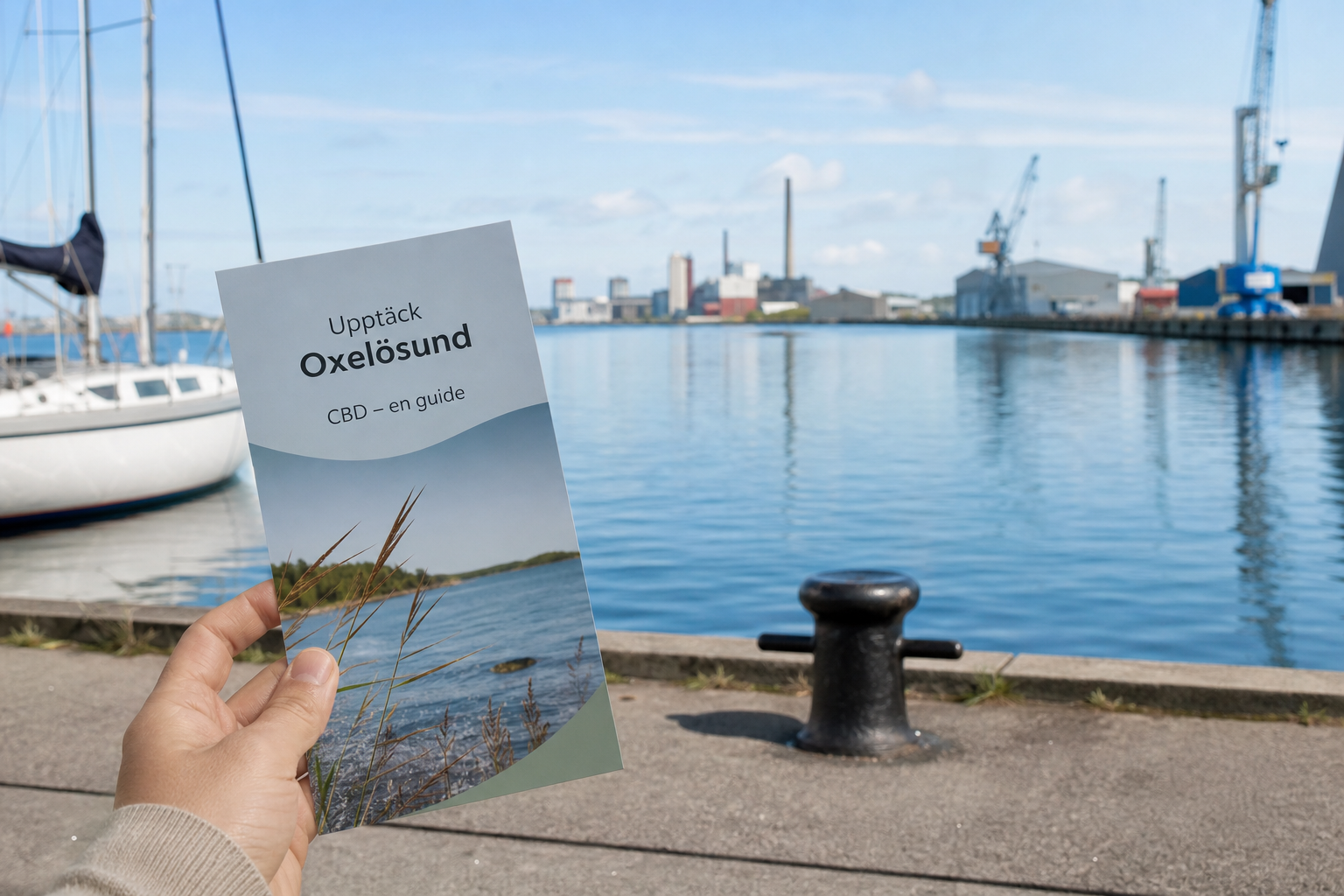
Oxelösund is a coastal municipality in Södermanland, close to Nyköping and the Baltic Sea. If you are researching CBD in Oxelösund, the most important point is that Swedish law focuses heavily on the product’s ingredients, intended use and marketing—not simply on the word “CBD” printed on the package. A bottle advertised as hemp oil is not automatically legal, and a product containing only trace amounts of THC can create significant legal and practical concerns.
This CBD guide 2026 Oxelösund, Sweden explains how to assess products, what Swedish rules mean for residents and visitors, how to approach health claims, and what to consider before carrying CBD through the town, around Sweden or across a border. It is general information, not legal or medical advice. Check current guidance before acting because rules and enforcement can change.
CBD laws in Oxelösund and Sweden
Oxelösund follows national Swedish law. There is no separate municipal CBD market with different possession rules. The central distinction is between cannabidiol (CBD), a non-intoxicating cannabinoid, and tetrahydrocannabinol (THC), the intoxicating cannabinoid controlled under Swedish narcotics legislation.
CBD is not the same substance as cannabis containing THC. However, a CBD product may still be legally problematic if it contains THC, is presented as a medicine without the required authorization, or falls under food and consumer-product rules that it does not satisfy. The product category and its claims matter. Oils, capsules, gummies, cosmetics, vape liquids and prescription medicines can be regulated in different ways.
Swedish court decisions have also made THC contamination a serious issue for CBD oils. Do not assume that “full spectrum,” “broad spectrum” or “legal hemp” means that a product is acceptable under Swedish law. Read the laboratory information and Swedish regulatory guidance instead of relying on a seller’s marketing language.
For official information about medicinal products, product classification and authorization, consult the Swedish Medical Products Agency. Its guidance is more reliable than a retailer’s statement that a product is “EU legal.”
Why THC content matters
THC may appear through the use of hemp extract, poor manufacturing controls, cross-contamination or inaccurate labeling. A product can look like an ordinary wellness item while still exposing the buyer to THC. This matters particularly for people subject to workplace drug testing, professional driving requirements, immigration checks or criminal-law scrutiny.
CBD isolate products may be less likely to contain THC than full-spectrum extracts, but “less likely” is not a legal guarantee. A recent, batch-specific certificate of analysis is more useful than a general certificate covering an entire brand or product range. Even then, laboratory testing does not replace the need to understand Swedish rules.
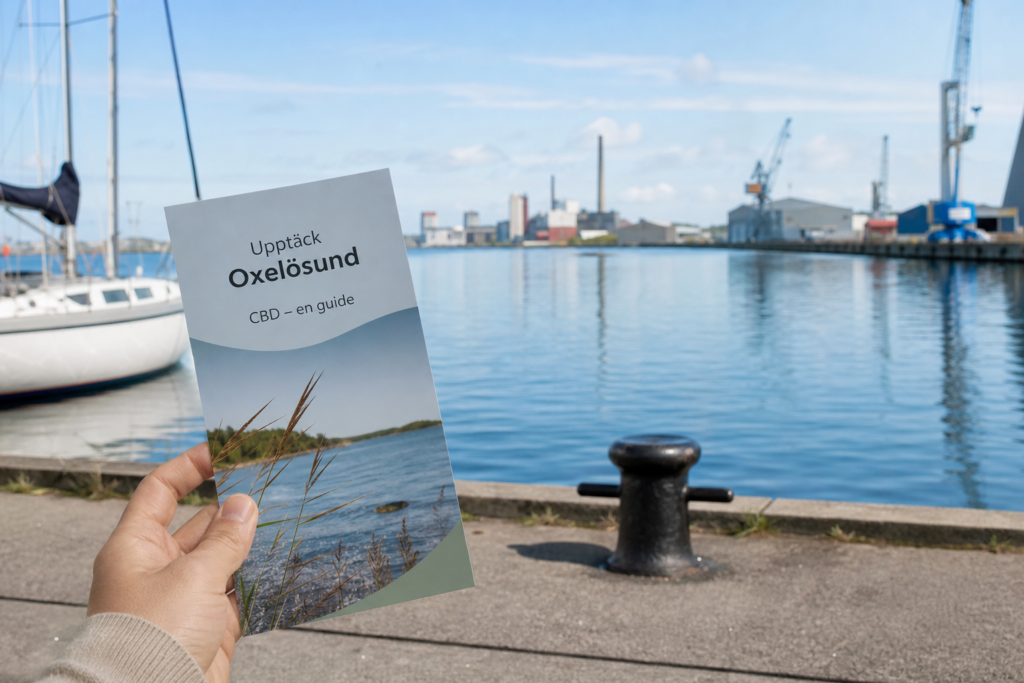
What types of CBD products might you see in Oxelösund?
Consumers may encounter CBD oils, creams, capsules, drinks, edibles, vape products and hemp-seed items online or through retailers in the wider region. These products should not be treated as interchangeable.
- CBD oils and tinctures: Check the complete ingredient list, cannabinoid profile, batch number and testing date. Avoid products that do not clearly disclose THC content.
- CBD cosmetics: A cream marketed for skin care is different from an oil advertised to treat anxiety, pain or insomnia. Medical claims can affect how the product is regulated.
- CBD foods and supplements: Food rules and novel-food requirements may apply. A product being sold online does not prove that it is authorized for sale in Sweden.
- Vape products: These introduce inhalation and product-safety issues in addition to CBD and THC questions. Unknown liquids may contain unwanted substances.
- Hemp-seed foods: Hemp seeds and hemp-seed oil are not the same as cannabinoid extracts. Their legal and nutritional treatment can differ.
For food-related questions, consult the Swedish Food Agency. It provides national information on food safety and helps clarify why a food product cannot be judged only by its CBD label.
Buying CBD in Oxelösund: a practical checklist
There is no reliable shortcut for identifying a lawful product. A responsible purchase starts with documentation and a realistic understanding of what CBD can and cannot do.
- Identify the seller. Look for a real business name, address, customer-service details and clear terms. Be cautious with anonymous social-media sellers and websites that hide their operator.
- Read the full label. Check the amount of CBD per serving, total contents, ingredients, recommended use, batch number and expiry date.
- Look for THC information. Prefer a batch-specific independent laboratory report that states the testing method and cannabinoid results. Treat “THC-free” as a claim to verify, not as proof.
- Separate wellness language from medical claims. Promises to cure cancer, replace prescribed treatment or treat serious disease are major warning signs.
- Check the product category. A capsule, cosmetic, food, vape liquid and medicine may have different requirements. Ask the seller what regulatory basis they rely on.
- Keep purchase records. Save the invoice, packaging, laboratory report and product page. This will not make a questionable product lawful, but it helps document what you bought.
When considering buying CBD in Oxelösund, avoid products promoted as a way to get high. That language suggests possible THC content or an unreliable supply chain. Also be skeptical of unusually cheap products, dramatic health promises, missing batch data and labels translated poorly into Swedish or English.
Health and safety considerations
CBD is often described as gentle because it is not intoxicating in the same way as THC. That does not mean it is risk-free. Possible unwanted effects can include tiredness, changes in appetite, diarrhea and interactions with medicines. The risk may be greater when the product is concentrated, inaccurately labeled or combined with alcohol or sedating substances.
Talk to a healthcare professional first
Ask a doctor or pharmacist before using CBD if you take prescription medicines, have liver disease, are pregnant or breastfeeding, or are considering CBD for a child. Do not stop prescribed treatment because a retailer claims that CBD is a natural alternative.
People using anticoagulants, anti-seizure medicines, sedatives or other medicines with a narrow safety margin should be particularly careful about possible interactions. A healthcare professional can consider the exact medicine, dose and reason for treatment rather than giving generic advice about CBD.
Drug testing and driving
CBD itself is not intended to produce intoxication, but contaminated or full-spectrum products may contain THC. That can matter for drug testing and for anyone driving or operating machinery. Do not drive if a product makes you sleepy, dizzy or less alert. If avoiding THC is essential, the safest approach is not to use a product whose composition cannot be verified.
Medical cannabis is not the same as over-the-counter CBD
Swedish patients sometimes use “medical CBD” as a broad phrase, but a prescription medicine and a wellness product are not equivalent. An authorized medicine has defined ingredients, dosing information, quality controls and professional oversight. A shop-bought CBD oil may not have those safeguards.
If you are seeking CBD in Oxelösund for chronic pain, epilepsy, sleep problems, anxiety or another condition, start with a healthcare professional. Discuss evidence-based options and ask whether an authorized treatment is appropriate. Do not import a cannabis-based medicine or obtain controlled products informally without checking the applicable rules.
For broader context on patient access and Swedish treatment pathways, see this practical guide to medical cannabis in Sala. The legal principles are national, although local healthcare contacts may differ.
Traveling with CBD around Oxelösund and Sweden
Carrying CBD on a domestic trip can still be risky if the product contains THC or if its status is unclear. Keep the item in its original sealed packaging with the label and purchase documentation. Do not transfer oil into an unmarked bottle.
International travel requires extra caution. A product accepted in the country where you bought it may be controlled in Sweden or in your destination country. Border authorities may assess the actual contents rather than the seller’s description. Check both countries’ official rules before taking CBD by car, ferry, train or plane.
Never assume that a prescription, a foreign certificate or the phrase “hemp-derived” automatically permits cross-border transport. When the legal position is uncertain, leaving the product at home is safer than trying to explain it at a border.
How to avoid misleading CBD claims
CBD marketing often uses scientific-sounding language without giving consumers enough evidence to judge it. Look for precise information rather than vague promises.
- Be cautious of claims that CBD works for every condition.
- Do not treat customer reviews as clinical evidence.
- Check whether a study involved the same formulation and dose.
- Do not confuse laboratory or animal research with proven human benefit.
- Remember that “natural” describes an origin, not a guaranteed safety profile.
A transparent seller should be able to explain the product’s ingredients, intended category, testing and return policy without pressuring you. If those details are unavailable, choosing not to buy is a sensible decision.
CBD guide 2026 Oxelösund, Sweden: key takeaways
The safest approach to CBD in Oxelösund is cautious and evidence-led. Swedish law does not turn every CBD-labeled product into a legal consumer item. THC content, product presentation, medical claims, food rules and cross-border restrictions can all affect the outcome.
- Use national Swedish rules as the starting point; Oxelösund has no separate cannabis law.
- Check the complete ingredient list and obtain batch-specific testing where possible.
- Do not rely on “hemp,” “full spectrum” or “THC-free” marketing alone.
- Ask a pharmacist or doctor about interactions and treatment decisions.
- Be especially careful with driving, drug testing and international travel.
- Recheck official guidance before purchasing or transporting a product in 2026.
Conclusion
This CBD guide 2026 Oxelösund, Sweden is designed to help readers distinguish a carefully documented product from an uncertain one. CBD is not automatically the same as intoxicating cannabis, but product labels and online claims do not settle legal status. Verify THC content, understand the product category, avoid unsupported medical promises and seek professional advice when health or medication is involved. If a seller cannot clearly explain what is in the product and why it can lawfully be sold, the most responsible choice is to walk away.