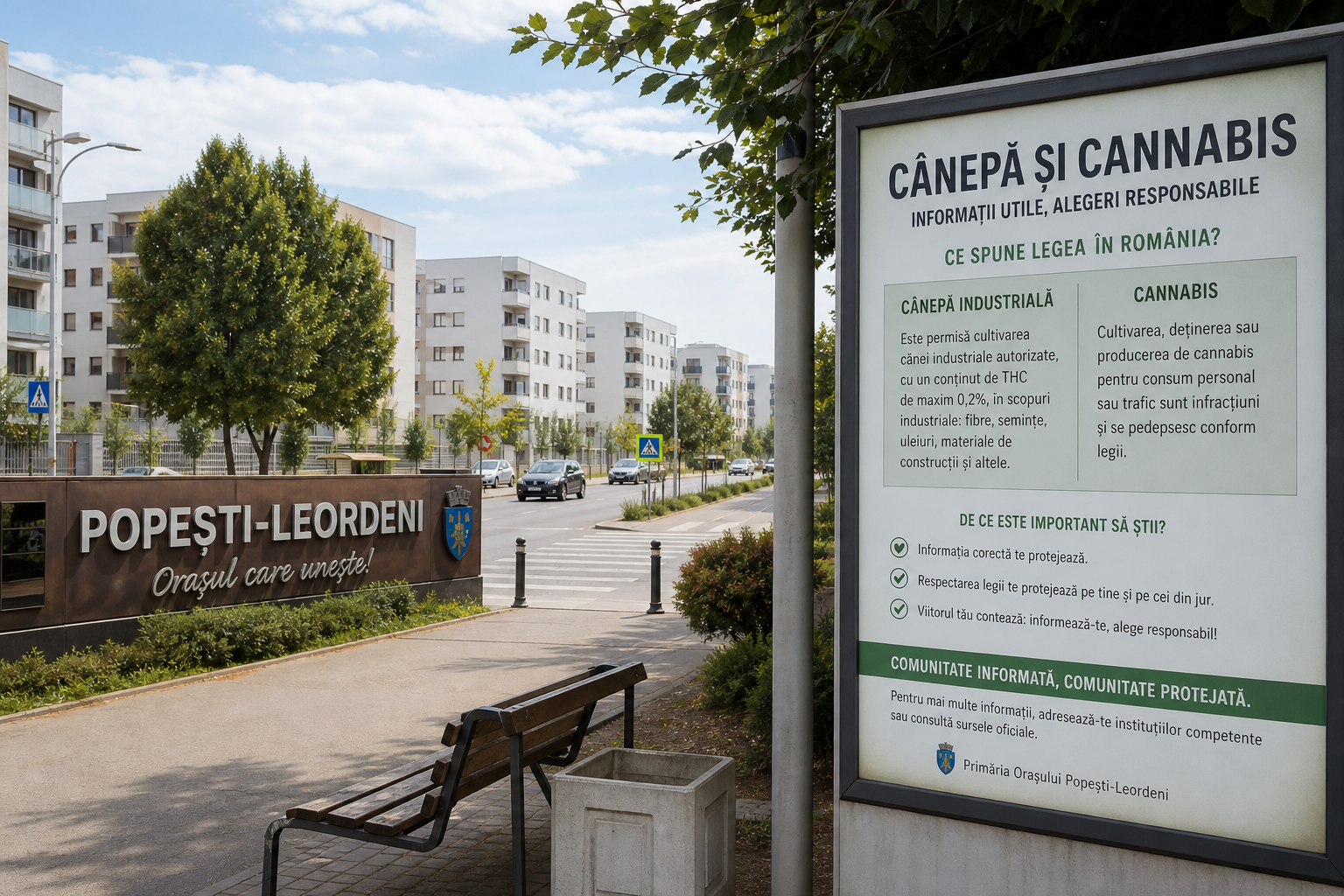
Cannabis trends in Popești-Leordeni are best understood through the town’s position in the Bucharest metropolitan area, changing consumer interest in CBD and hemp products, and Romania’s national legal framework. Popești-Leordeni is a growing urban community in Ilfov, closely connected to the capital, but it does not have a separate cannabis market or separate cannabis laws.
That distinction matters. Discussions about weed in Popești-Leordeni may involve social attitudes, online conversations, nightlife, health questions or interest in legal hemp goods. They should not be mistaken for evidence that recreational cannabis is legal, widely available or officially tolerated. A responsible local guide therefore needs to separate legal facts from assumptions, distinguish CBD from intoxicating cannabis and focus on practical health and safety information.
Cannabis trends in Popești-Leordeni: what is actually changing?
There is no reliable public dataset that measures cannabis consumption specifically in Popești-Leordeni. As a result, claims about a dramatic local rise or fall would be speculative. A more accurate approach is to identify broader influences that may shape conversations in the town and surrounding Ilfov area.
- Greater visibility: International media, social networks and online retail have made cannabis-related language more familiar, even when local laws remain restrictive.
- Interest in CBD and hemp: Consumers increasingly encounter oils, cosmetics, foods, textiles and other products marketed as hemp or CBD. These categories are not automatically equivalent to marijuana.
- Metropolitan connections: Residents may work, study or socialise across Popești-Leordeni and Bucharest. Information, products and attitudes can therefore circulate across municipal boundaries.
- More health-focused discussion: People are asking about anxiety, sleep, pain, dependence and drug interactions rather than treating cannabis only as a lifestyle subject.
These are social and informational trends, not proof of a local commercial cannabis industry. They also do not change the legal position of THC-containing cannabis in Romania.
Cannabis laws in Popești-Leordeni and Romania
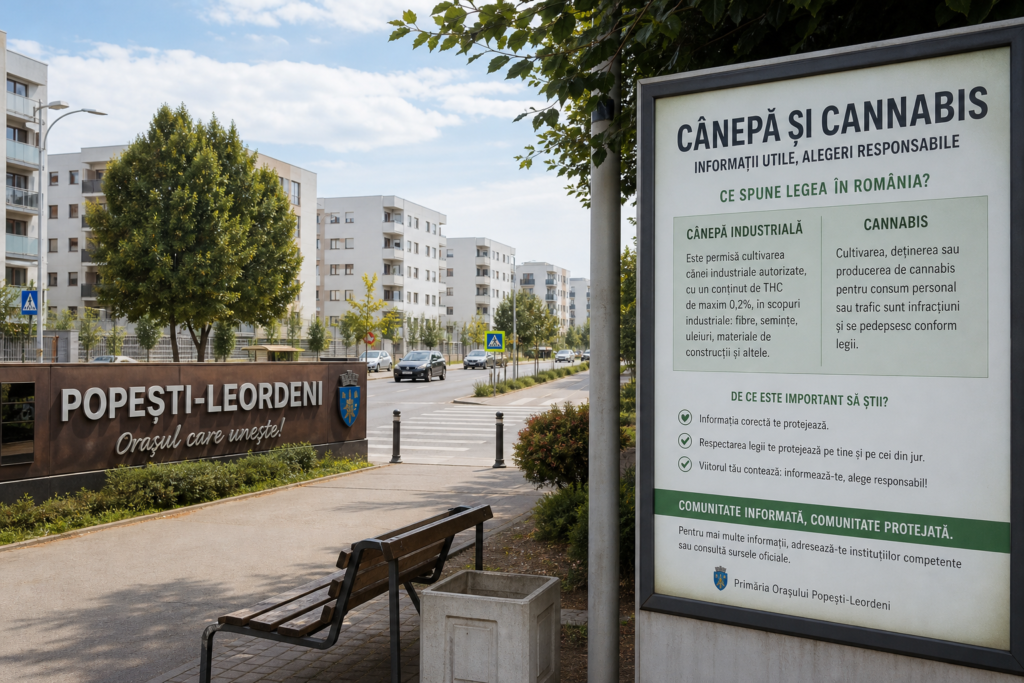
Romanian drug law is national. Popești-Leordeni follows the same rules as Bucharest, other towns in Ilfov and the rest of the country. Cannabis containing controlled psychoactive substances is regulated under Romania’s criminal and drug-control framework. Possession, cultivation, sale, distribution and trafficking can carry serious legal consequences, with penalties depending on the conduct, substance and circumstances.
For the current wording of Romanian legislation, consult the official Romanian legislation portal rather than relying on social media summaries or old travel advice. Legal interpretation can change, and a person facing an investigation should seek advice from a qualified Romanian lawyer.
Visitors and residents should also remember that public visibility is not the same as legality. Smell, possession, sharing with another person or transporting cannabis can create legal risk. Bringing cannabis across a border is especially risky because customs and controlled-substance rules may apply even when a product was purchased legally somewhere else.
Driving and public safety
Driving after using cannabis is unsafe and can create serious legal problems. Cannabis may affect reaction time, attention, coordination and judgement, while the effects and detection window vary by product, dose, frequency of use and individual factors. Anyone who may be impaired should not drive, cycle in traffic or operate machinery. Arrange a sober driver, use public transport or delay the journey.
In an urgent medical situation, call 112. Avoid trying to manage severe confusion, collapse, chest pain, breathing difficulty or a suspected poisoning alone.
CBD, hemp and intoxicating cannabis are not the same
One of the most important cannabis trends in Popești-Leordeni is the growing visibility of products labelled CBD or hemp. The label alone does not establish that a product is risk-free, legal in every context or free from THC. Product categories can differ substantially in ingredients, intended use, manufacturing standards and regulatory treatment.
Questions to ask before buying a hemp or CBD product
- Is the product clearly labelled with ingredients, quantity and batch information?
- Does the seller provide credible laboratory testing for cannabinoids and contaminants?
- Does the packaging make medical claims that sound exaggerated or unsupported?
- Could the product contain THC or another ingredient relevant to drug testing?
- Is the product intended as a food, cosmetic, supplement or another regulated category?
- Has a pharmacist or clinician checked possible interactions with existing medication?
People should be cautious with products sold as miracle treatments for pain, depression, insomnia or serious disease. A product described as “natural” may still cause side effects or interact with prescription medicines. Some online products may also be inaccurately labelled. Consumers looking for CBD products in Ilfov should verify the seller, read the full label and keep receipts and packaging.
Hemp seed foods and hemp fibre goods are different from high-THC cannabis. Hemp seeds generally do not produce an intoxicating effect, while fibre is used in textiles, building materials and other applications. However, a hemp label does not answer every question about a specific extract or finished product.
Medical cannabis in Popești-Leordeni: realistic expectations
Interest in medical cannabis in Popești-Leordeni often reflects genuine concerns about chronic pain, epilepsy, sleep problems or treatment side effects. It is important, however, not to assume that medical interest means there is a broad prescription cannabis programme or a local dispensary system comparable to those in some other countries.
Patients should discuss cannabis-related questions with a licensed doctor or pharmacist who can review symptoms, diagnoses, current medicines and the evidence for available treatments. Self-medicating with an unverified oil, flower or imported product can create several problems: uncertain dose, contamination, interactions, impaired driving and possible legal exposure.
Cannabis is not a universal treatment. Potential adverse effects may include anxiety, dizziness, impaired concentration, increased heart rate, nausea and dependence. Risk can be higher for adolescents, people with a personal or family history of psychosis, individuals with cardiovascular concerns and those who combine cannabis with alcohol or sedating medicines.
For broader context on responsible public discussion, readers can compare this local topic with guidance in the Cannabis Awareness guide for Focșani and the practical legal overview of cannabis in Ploiești. These comparisons are useful because national rules apply across Romania, while local questions often concern access to reliable information and health services.
How local conversations can become more responsible
A town’s cannabis culture is shaped not only by consumption but also by how people talk about it. In Popești-Leordeni, useful conversations should avoid both alarmism and casual normalisation. Calling every hemp product “marijuana” creates confusion, while presenting cannabis as harmless ignores real health and legal risks.
For families and young people
Parents and educators can start with factual questions rather than accusations. Explain that cannabis products vary in strength and composition, that developing brains may be more vulnerable to frequent use, and that impairment can affect school, work, relationships and road safety. Warning signs such as declining performance, secrecy, mood changes or withdrawal from normal activities do not prove cannabis use, but they may justify a calm conversation and professional support.
For adults considering use
- Check the law before carrying, using, growing or transporting any controlled substance.
- Do not combine cannabis with alcohol, sedatives or other drugs.
- Do not drive or supervise children while impaired.
- Avoid unknown products with unclear contents or exaggerated health claims.
- Seek medical advice if use becomes difficult to control or affects work, sleep, mood or relationships.
People who are already worried about dependence should approach a doctor or addiction-support service without waiting for a crisis. Asking for help is a health decision, not an admission of moral failure.
What to expect from future cannabis discussions in Ilfov
Future debate will probably focus on several issues: how Romania treats medical products, how authorities distinguish legal hemp goods from controlled cannabis, how drug testing affects drivers and workers, and whether consumers can identify trustworthy product information. These questions are national, but they have practical consequences for households and businesses in Popești-Leordeni.
Local reporting should be careful with anonymous claims about “dispensaries,” supposed cannabis clubs or alleged changes in enforcement. A shop selling hemp cosmetics is not necessarily a cannabis dispensary, and an online advertisement is not proof that a product is legal. Checking official legislation, consulting qualified professionals and separating verified facts from rumours will produce a more useful picture of cannabis in Popești-Leordeni.
Public-health information should also remain proportionate. Not every cannabis question signals a crime, and not every CBD purchase is a medical decision. The most helpful response is clear information about legality, product uncertainty, impairment, dependence and routes to support.
Conclusion
The most credible way to discuss cannabis trends in Popești-Leordeni is to recognise a changing information environment without inventing local statistics or treating online visibility as legal acceptance. Interest in CBD and hemp products is distinct from recreational THC cannabis, while medical questions require professional guidance rather than informal self-treatment.
Because Popești-Leordeni follows Romanian national law, residents and visitors should verify current rules, avoid controlled cannabis, use caution with poorly labelled products and never drive while impaired. A balanced local conversation can acknowledge curiosity and changing attitudes while keeping legal compliance, public health and personal safety at the centre.