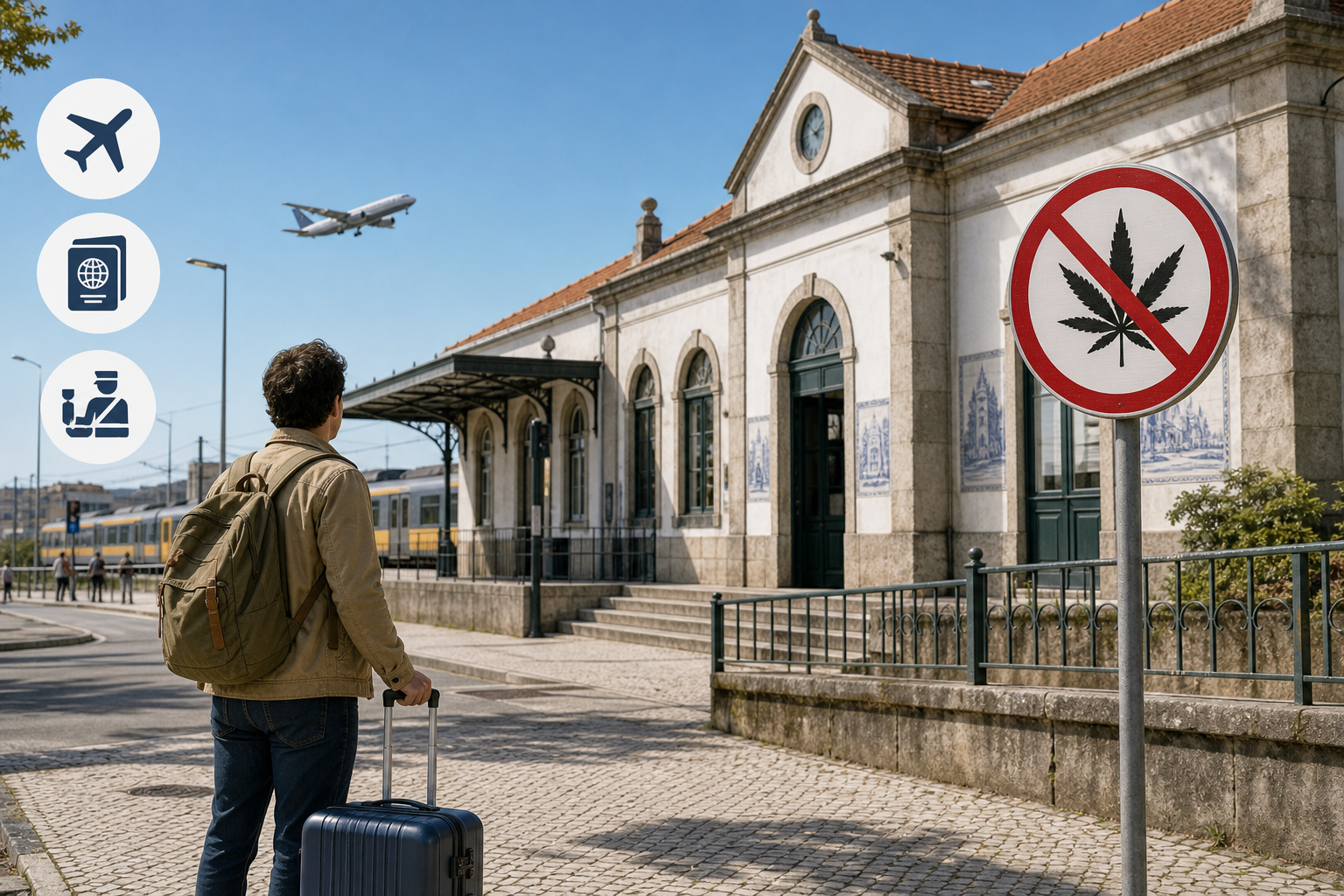
Understanding cannabis travel restrictions in São Mamede de Infesta matters whether you are visiting friends, changing trains, travelling to Porto Airport or commuting across the Matosinhos area. Portugal is often described as having a relaxed cannabis policy, but decriminalisation is not the same as legalisation. Rules still apply to possession, consumption, transport, driving and international borders.
São Mamede de Infesta is a civil parish in the municipality of Matosinhos, in the Porto district. It does not have a separate cannabis travel code that replaces Portuguese national law. In practice, the same national rules apply locally, while transport operators, police and border authorities may impose practical requirements that travellers should take seriously.
This guide explains the main risks without encouraging illegal activity. It is general information, not legal advice. Laws and administrative procedures can change, so check official information before travelling.
What cannabis decriminalisation means in Portugal
Portugal decriminalised the personal use and possession of limited quantities of drugs in an administrative framework. That policy does not create a recreational retail market, and it does not give travellers a general right to carry cannabis wherever they wish. Police may still identify, seize and report substances, and a person may be referred to the Commission for the Dissuasion of Drug Addiction or face other consequences depending on the circumstances.
The legal response can depend on factors such as the substance, amount, indications of supply, prior conduct and whether the conduct involved public safety. Possession connected to supply, commercial activity or distribution is treated much more seriously than a possible personal-use case.
For background on the distinction between possession rules and broader restrictions, see this practical guide to marijuana possession laws in nearby Gondomar. The local setting differs, but the national legal context is relevant.
Cannabis travel restrictions in São Mamede de Infesta
Moving around the parish and the Porto metropolitan area
Carrying cannabis while walking, using a taxi or travelling on public transport can create legal and practical problems even if the journey is short. A decriminalisation approach does not guarantee that a person can travel with cannabis openly or avoid police intervention. Public consumption may also lead to complaints, enforcement action or removal from a venue.
São Mamede de Infesta is connected to Matosinhos, Porto and other metropolitan municipalities by roads and public transport. Crossing from one municipality to another does not itself create a border offence, but the underlying Portuguese rules remain in force throughout the journey. Transport providers may also have terms that prohibit possession or consumption of illegal substances on their vehicles and premises.
For a related explanation of public-use concerns in the same wider area, read this guide to cannabis consumption in Matosinhos. Avoid assuming that a private accommodation, station or vehicle is automatically a safe place to consume.
Driving with cannabis
Driving after using cannabis is a separate safety and legal issue. Impairment can affect reaction time, concentration and judgement. Portuguese authorities can conduct roadside checks, and a driver may face consequences if found to be unfit to drive or associated with a prohibited substance. The safest approach is not to drive after using cannabis, including when travelling from São Mamede de Infesta to Porto Airport or another destination.
Passengers should also avoid creating a situation in which cannabis is visible, shared or consumed inside a vehicle. Drivers can be exposed to additional scrutiny when a vehicle contains drugs, particularly if officers suspect supply or impaired driving.
International borders are the biggest practical risk
Travelling with cannabis across an international border is substantially riskier than possessing a small amount for personal use within Portugal. This remains true when travelling between countries that have different approaches to cannabis. A product that is permitted, tolerated or prescribed in one country may be prohibited in another.
Do not assume that a flight, coach, train or car journey within the Schengen Area removes customs or criminal-law risks. Schengen arrangements concern movement and border controls; they do not harmonise drug laws or authorise travellers to carry cannabis between countries. Authorities may conduct checks, and a person remains responsible for complying with the laws of the country of departure, transit and arrival.
For most travellers, the safest rule is simple: do not take cannabis, cannabis flower, hashish, edible products, oils or vape cartridges across the Portuguese border. This includes products obtained legally elsewhere and products labelled as CBD. Product composition, THC content, documentation and import requirements can all matter, and a shop label is not a guarantee of lawful cross-border transport.
Travel to or from Porto Airport
São Mamede de Infesta is close to the Porto metropolitan transport network, so visitors may pass through the area on the way to or from Francisco Sá Carneiro Airport. Airport security and customs procedures do not create an exception for personal cannabis. Screening may result in seizure, delay, questioning or referral to authorities.
Do not conceal cannabis in checked luggage, hand luggage, clothing or toiletries. Concealment can make an encounter appear more serious and does not change the legal character of the substance. Travellers should also avoid carrying cannabis-related products for someone else, because claiming that the item belongs to another person does not necessarily remove responsibility.
Medical cannabis and travelling with prescribed products
Medical cannabis is not the same as recreational cannabis. A patient who has been prescribed a cannabis-based medicine should keep the product in its original pharmacy packaging and carry supporting documents that identify the medicine, dosage and patient. A prescription alone may not automatically authorise international transport.
Before travelling, contact the relevant authority, airline and destination-country embassy or consulate to confirm whether an authorisation, certificate or advance approval is required. Requirements can differ according to the product, THC content, quantity, destination and route. Do not rely only on a photograph of a prescription or an informal letter from a clinic.
Portugal’s medicines regulator, INFARMED, I.P., official medicines information, is an appropriate starting point for checking questions about authorised medicines and Portuguese regulatory procedures. Travellers should request current guidance rather than relying on an old travel forum or a retailer’s advice.
When flying, keep prescribed medicine in its original packaging and carry only the amount reasonably needed for the authorised journey. If the required paperwork cannot be confirmed, ask the prescribing clinician about a lawful alternative for the trip rather than improvising at the airport.
CBD, hemp and cannabis products
Many travellers assume that CBD products are automatically safe to carry. That assumption can be wrong. Oils, flowers, gummies, cosmetics and vape liquids may have different legal classifications, and some products can contain THC or fail to meet applicable requirements. A product marketed as hemp or CBD is not necessarily exempt from Portuguese rules or the rules of another country.
Before carrying a CBD product, check its ingredients, THC status, packaging and intended classification. Avoid loose flower, unlabelled oils and homemade edibles. If travelling internationally, verify the destination’s import rules as well as Portuguese requirements. When in doubt, leaving the product at home is safer than trying to explain it during a security or customs inspection.
Local shopping information should not be confused with permission to travel across borders. This guide to CBD shops in nearby Maia may help explain why product choice and labelling matter, but it is not a substitute for official import guidance.
What travellers should do if stopped
If police or security staff question you, remain calm and avoid arguing about local cannabis culture. Do not offer false information, destroy or transfer a substance, or attempt to leave the scene. Ask what is happening and request an interpreter if you do not understand Portuguese sufficiently.
- Carry valid identification and relevant travel documents.
- Keep prescribed medicines in original packaging with supporting documentation.
- Do not sign a document you do not understand without asking for clarification or legal assistance.
- Ask how to contact a lawyer and, where appropriate, your embassy or consulate.
- Follow instructions from airport, transport and police officials.
Being stopped does not automatically mean that the most serious offence has occurred, but the outcome depends on the facts. A lawyer qualified in Portugal can explain the available rights and procedures better than an online article.
Safer planning for visitors to São Mamede de Infesta
The easiest way to reduce travel risk is to separate cannabis decisions from transport decisions. Do not carry cannabis to an airport, across a border or onto public transport. Do not drive after use, and do not consume in public spaces, near children, at stations or in or around vehicles.
Visitors seeking health-related advice can consult Portugal’s national addiction and substance-use information services. The Portuguese SICAD information service provides an official starting point for public-health and drug-policy information. For urgent medical symptoms, contact emergency services rather than attempting to travel while impaired.
Keep in mind that hotels, rental properties, festivals and transport companies can apply their own conditions. A host’s informal permission may not override national law or a venue’s safety policy. Ask about the accommodation’s rules before booking, and never assume that smoking cannabis is permitted indoors.
Common misconceptions about cannabis travel in Portugal
- “Decriminalised means legal everywhere.” It does not. Personal-use cases can still involve intervention, referral, seizure and administrative consequences.
- “A small amount can cross any border.” There is no general traveller exemption for taking cannabis internationally.
- “CBD is always allowed.” Products differ, and labels do not automatically settle their legal status.
- “A medical prescription works in every country.” Prescriptions and authorisations may not be recognised across borders.
- “Schengen means there are no checks.” Drug laws remain national, and checks can still occur.
Conclusion
The key point about cannabis in São Mamede de Infesta is that local geography does not create a special exemption from Portuguese national law. Decriminalisation should not be treated as a licence to transport cannabis, consume it publicly, drive after using it or carry it across an international border.
For ordinary visitors, the lowest-risk choice is not to travel with cannabis. Patients using prescribed products should verify the current requirements with Portuguese authorities, the airline and the destination country before departure. Careful planning is especially important when a journey involves Porto Airport, public transport or an international connection.