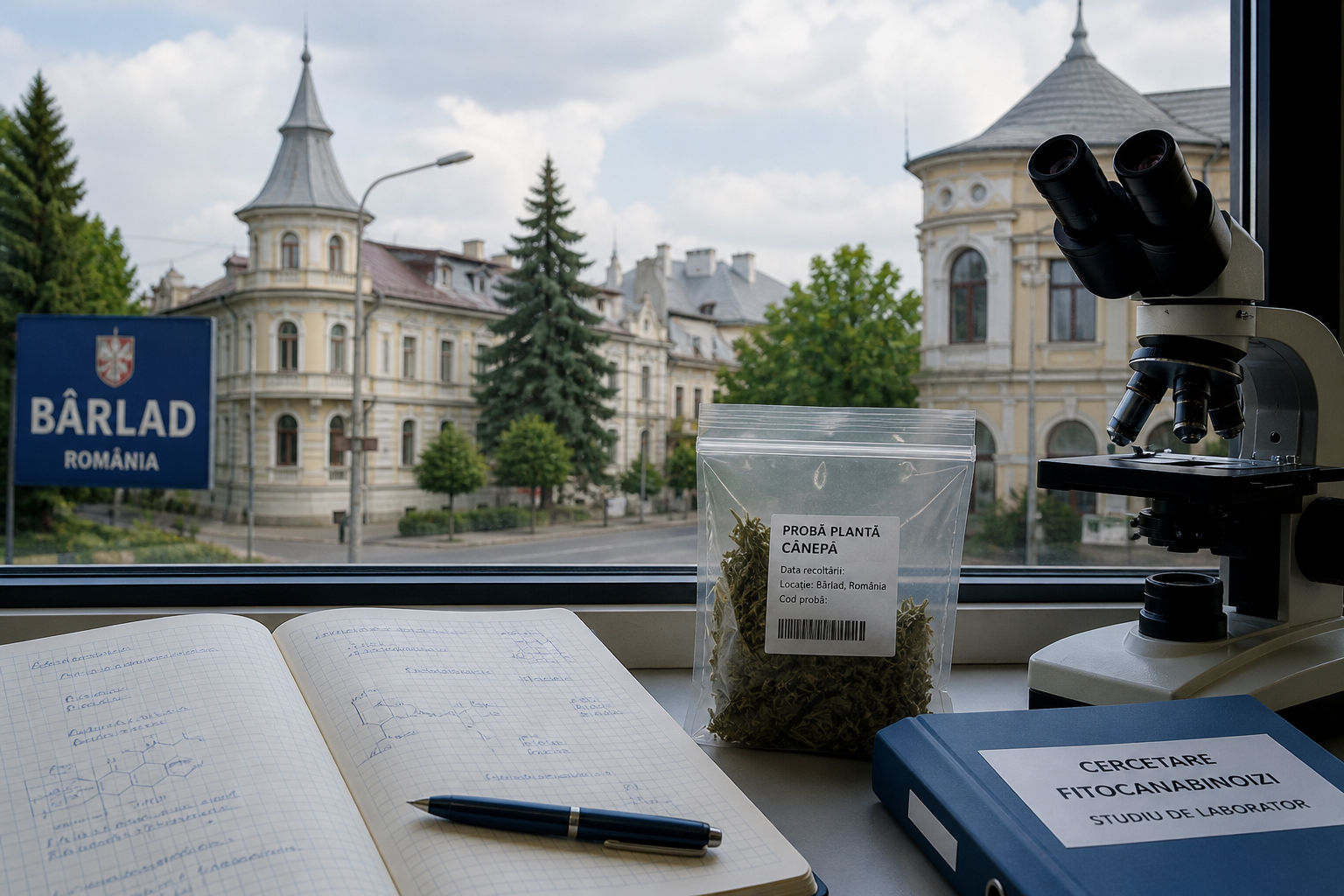
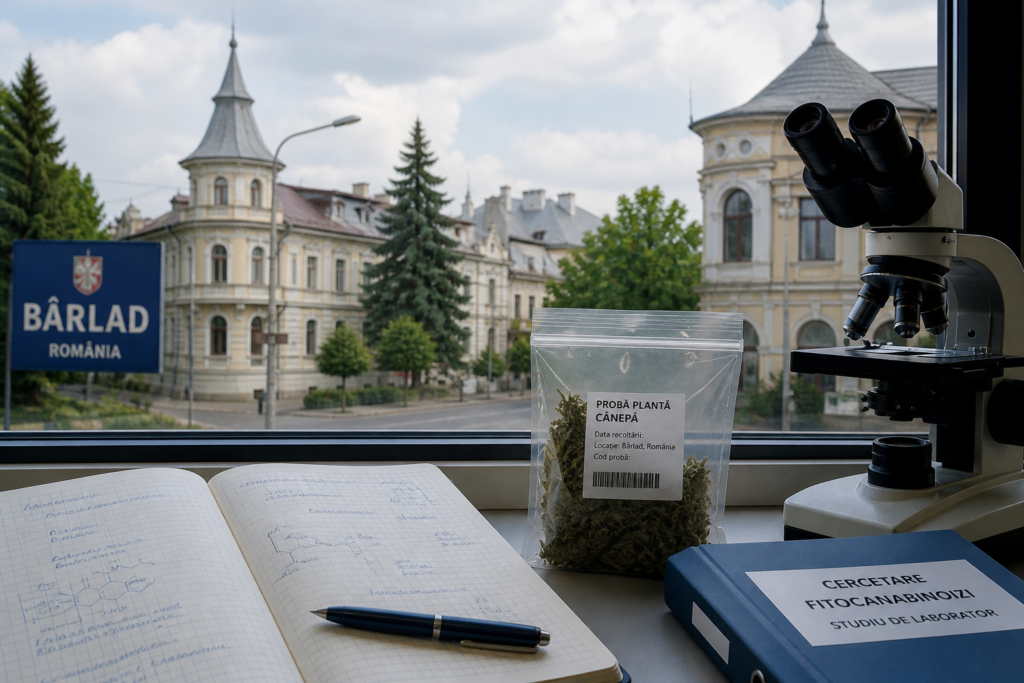
Cannabis research in Bârlad is best understood as part of Romania’s wider medical, legal and public-health research landscape. Bârlad does not have a widely documented, dedicated cannabis research centre, and there is no reliable basis for claiming that local institutions conduct a major cannabis trial or operate a specialised cannabis laboratory. That does not make the subject irrelevant. It means readers should distinguish between verified scientific work, local discussion, hemp-related activity, medical questions and unsupported online claims.
This guide explains what can reasonably be investigated in Bârlad, how Romanian law affects research and personal use, and where residents can look for dependable information. It does not provide a way to obtain controlled substances or replace advice from a qualified doctor, pharmacist or lawyer.
What cannabis research in Bârlad actually means
The phrase can describe several different types of work. A clinical study might examine a medicine containing cannabinoids under formal ethical and regulatory approval. A public-health project could study patterns of use, treatment needs or attitudes. Agricultural research may focus on industrial hemp varieties, fibre, seed or cultivation practices. Laboratory science can investigate cannabinoids, contaminants, extraction methods or pharmaceutical formulations.
These categories should not be treated as interchangeable. Industrial hemp is not the same as recreational cannabis, and a study of cannabidiol is not automatically evidence that cannabis is safe or effective for every condition. A news story about a national project also does not prove that participants, laboratories or researchers are located in Bârlad.
Why local evidence can be difficult to identify
Research is often organised through national universities, hospitals, contract research organisations or pharmaceutical companies rather than through a city-branded programme. Projects may recruit participants from several counties, while the published paper names the lead institution instead of every participating town. Conversely, a local survey or student project may exist without being indexed in major international databases.
For that reason, a careful search should check the study title, authors, institution, ethics approval, registration details, funding and publication status. A social-media post, product advertisement or clinic claim is not equivalent to a peer-reviewed study. If a source cannot identify who conducted the work and where its methods can be reviewed, its conclusions deserve caution.
Cannabis in Bârlad and Romania’s legal framework
Local authorities do not create a separate cannabis market for Bârlad. National Romanian law applies in the city and across Vaslui County. Cannabis, cannabis resin and many related substances are controlled, while unauthorised possession, supply, cultivation or trafficking can carry serious legal consequences. The precise outcome depends on the substance, conduct, quantity, evidence and other circumstances, so general internet summaries should not be treated as legal advice.
Research involving controlled substances is also different from personal possession. A legitimate project normally requires appropriate institutional oversight, qualified personnel, secure handling, documentation and the permissions required by Romanian authorities. Researchers cannot lawfully bypass those safeguards by describing an activity as an informal experiment.
Readers seeking primary legal information can consult the Romanian legislative portal. For medicine-related regulatory information, the National Agency for Medicines and Medical Devices of Romania is a more appropriate starting point than a commercial cannabis website.
These official sources may use formal legal and pharmaceutical terminology. When the consequences of a decision are significant, a Romanian lawyer, doctor or pharmacist can help interpret the rules for a person’s specific circumstances.
Medical cannabis research near Bârlad
Discussions about medical cannabis in Bârlad often combine several separate questions: whether a cannabinoid has evidence for a particular symptom, whether a medicine is authorised, whether a doctor can prescribe or recommend it, and whether a product obtained by a patient is legal and quality-controlled. Those questions require different answers.
What researchers may study
Medical research can examine purified cannabinoid medicines, combinations of cannabinoids, delivery methods, adverse effects, interactions with other medicines and outcomes for defined conditions. A credible study specifies the formulation and dose instead of treating all cannabis products as one intervention. It also records inclusion criteria, comparison groups, follow-up and adverse events.
Evidence may be stronger for some narrow clinical uses than for broad claims about pain, anxiety, sleep or cancer. Results from one preparation cannot automatically be transferred to untested oils, flowers, edibles or vaping products. The presence of cannabidiol or tetrahydrocannabinol on a label is not proof that a product has undergone the same testing as a licensed medicine.
Questions patients should ask
- Is the product a formally authorised medicine, a food supplement or an unregulated product?
- What exact ingredient, concentration and route of administration were studied?
- What are the known interactions with current medicines?
- Who is responsible for monitoring side effects?
- Can the product’s identity, strength and contamination testing be independently verified?
A patient in Bârlad should discuss symptoms and treatment choices with a qualified healthcare professional. Self-medicating with products of uncertain strength can complicate diagnosis, produce unwanted effects or delay effective care. This is particularly important for adolescents, pregnant people, people with a history of psychosis, and anyone taking medicines that affect the central nervous system or cardiovascular system.
Hemp research in Vaslui County
Hemp is another reason cannabis-related research may attract attention in the region. Industrial hemp can be studied for seed, fibre, food ingredients, construction materials, textiles and other agricultural or manufacturing uses. Such work may involve agronomy, soil conditions, plant breeding, processing or supply-chain analysis rather than psychoactive drug research.
Even when a hemp variety is marketed as low in THC, cultivation and processing remain subject to applicable rules. Farmers, processors and researchers should verify licensing, seed requirements, testing obligations and any limits that apply to the intended use. A product labelled “hemp” or “CBD” should not be assumed to be automatically lawful, safe or therapeutically effective.
For broader regional context, readers may also find the discussion of marijuana history in Vaslui useful. Historical references to hemp or cannabis do not, however, demonstrate that a current Bârlad organisation is conducting research.
How to verify cannabis studies in Bârlad
Anyone evaluating a claim about cannabis studies in Bârlad can use a simple verification process. Start with the original source, not a reposted headline. Then establish whether the work is a registered clinical trial, a peer-reviewed publication, a public report, a university dissertation or merely a promotional statement.
- Identify the institution. Look for a named hospital, university, laboratory or public agency with a verifiable website and contact details.
- Check the researchers. Search the authors’ institutional profiles and previous publications. Similar names and copied biographies can create confusion.
- Find the study record. Clinical projects should have an identifiable protocol or registry entry where applicable. A vague reference to “research” is not enough.
- Read the methods. Check the sample size, comparison group, duration, product tested and stated limitations.
- Separate results from interpretation. A preliminary finding does not establish a treatment recommendation, and laboratory results may not predict human outcomes.
- Look for conflicts of interest. Funding from a product manufacturer does not automatically invalidate research, but it should be disclosed and considered when assessing the conclusions.
Romanian-language sources are valuable for local context, while international databases can help locate peer-reviewed work. Readers should be wary of pages that promise guaranteed cures, use dramatic testimonials instead of data or imply that legal approval is unnecessary because a product is “natural.”
Cannabis public health research and local priorities
One realistic area for cannabis public health research in Bârlad would be prevention and service planning. Researchers could examine how young people receive information, whether residents understand legal risks, how clinicians discuss substance use, or what barriers prevent people from seeking help. These questions do not require promoting cannabis or assuming that every user has the same risk profile.
Local public-health work should protect privacy and avoid stigmatising people who use substances. Good research uses clear consent procedures, confidential data handling and appropriately trained staff. It should also distinguish occasional use, problematic use, dependence, medicinal treatment and exposure to products with unknown contents.
Practical harm-reduction messages
- Do not drive, cycle in traffic or operate machinery while impaired.
- Do not mix cannabis with alcohol, sedatives or other intoxicating substances.
- Keep any cannabis-related product away from children and pets.
- Do not assume an online product has the labelled strength or is free from contaminants.
- Seek urgent medical help for severe confusion, chest pain, breathing problems, loss of consciousness or other serious symptoms.
These points are general safety information, not an endorsement of illegal use. They also show why accurate local education matters: residents need practical, non-sensational information alongside clear explanations of Romanian law.
What the future may hold for research in Bârlad
Future work could connect Bârlad with wider Romanian research networks without requiring the city to host a standalone cannabis institute. A hospital might contribute anonymised data to a nationally coordinated study. A university or agricultural partner could investigate hemp materials. Public-health researchers could evaluate educational programmes or treatment pathways. Any such development should be announced through the responsible institution and supported by identifiable protocols, approvals and results.
Until evidence of a specific project becomes available, the most accurate description is that Bârlad is a local setting for questions about cannabis, health, law and hemp—not a confirmed centre of specialised cannabis science. This distinction protects readers from exaggerated claims while leaving room for legitimate research to emerge.
Conclusion
Cannabis research in Bârlad should be approached through evidence, legal accuracy and local relevance. There is no sound basis for inventing a dedicated Bârlad cannabis programme or treating general cannabis news as proof of local activity. Instead, readers should separate clinical medicine, public health, industrial hemp and controlled-substance regulation; verify institutions and study records; and seek professional advice for personal medical or legal questions.
Reliable information is more useful than speculation. By checking official Romanian sources, reading research methods carefully and considering the needs of the local community, residents can form a clearer view of cannabis in Bârlad and the possibilities—and limits—of future research.