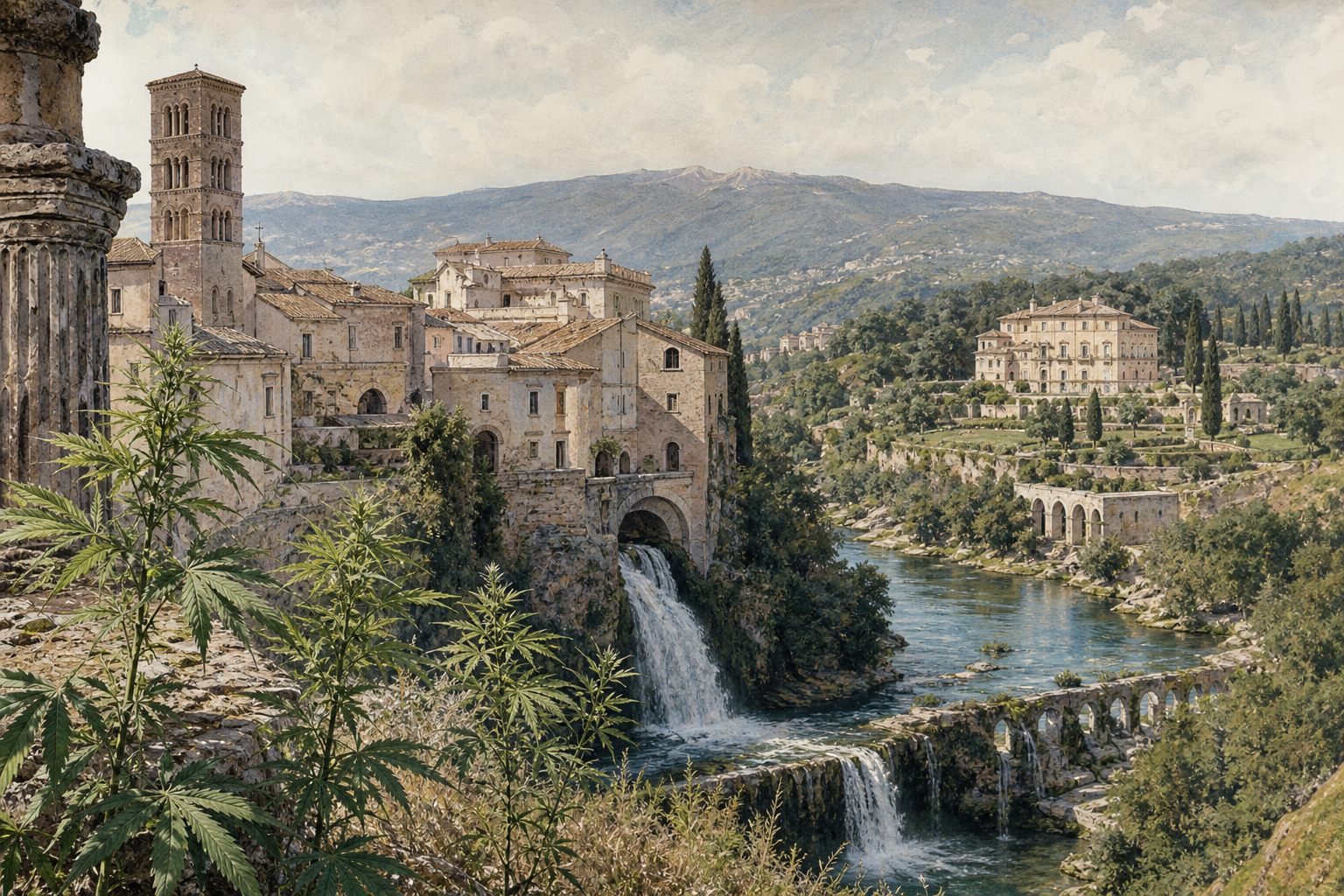
Cannabis history in Tivoli, Italy is best understood through the wider history of hemp, medicine, agriculture and national law. Tivoli, the historic town east of Rome, has a rich Roman and papal-era past, but there is no well-established evidence of a separate, uniquely Tivoli cannabis industry or a continuous local cannabis trade that can be documented in the same way as the town’s fountains, villas and stonework.
That distinction matters. A responsible local history should not turn general claims about ancient Rome or Italian agriculture into unsupported stories about Tivoli. Instead, the available context points to several overlapping themes: the ancient use of hemp across Mediterranean societies, the importance of plants and remedies in historical medicine, the development of modern prohibition, and Italy’s carefully regulated return to medical cannabis and industrial hemp.
For residents and visitors, the practical lesson is equally important. Cannabis in Tivoli is governed primarily by Italian national law, not by a separate municipal cannabis code. Local questions about possession, cultivation, medical access or hemp products therefore need to be answered within Italy’s national legal and public-health framework.
Why Tivoli provides a distinctive historical setting
Tivoli has long been connected to Rome through roads, commerce, political power and cultural exchange. Its location beside the Aniene River and its proximity to the capital made it an important settlement in Roman and later periods. The town is especially associated with sites such as Hadrian’s Villa and Villa d’Este, as well as historic gardens, water engineering and agricultural landscapes.
These features make Tivoli a useful place to examine the history of useful plants. Yet surviving accounts of Tivoli do not provide a clear, continuous record of cannabis cultivation or consumption. Historical landscapes contained many fibres, foods, medicines and aromatic plants, and the presence of hemp elsewhere in Italy cannot automatically prove that it was grown or used in a particular Tivoli household, estate or workshop.
The most accurate approach is therefore contextual. Tivoli participated in the wider economic and cultural systems of central Italy, while the specifically local evidence for cannabis remains limited. This is different from saying that cannabis was unknown in the area; it means that strong claims require primary sources, archaeological evidence or reliable local archival records.
Hemp and cannabis in the ancient Italian world
Separating hemp history from modern cannabis terminology
Modern discussions often use “cannabis” as a broad term, but historical sources may refer to hemp in ways that do not describe modern recreational products. Hemp was valued mainly as a fibre crop in many societies. Its uses could include rope, cordage, coarse cloth, fishing equipment and other practical goods. Historical references to a plant or fibre do not necessarily establish the use of intoxicating preparations.
This distinction is essential when discussing Roman Italy. The Roman world traded agricultural materials across a large area, and plant knowledge moved through military, commercial and medical networks. However, a general Roman awareness of hemp does not amount to proof that Tivoli had a cannabis market, local drug culture or standardized cultivation system.
What can reasonably be said about Tivoli
Tivoli’s Roman connections make it plausible that residents encountered a wide range of imported materials and medical ideas. Villas, estates and urban households depended on broader supply networks, while physicians and writers inherited knowledge from Greek, Roman and later Arabic traditions. Still, plausibility is not evidence of a specific local practice.
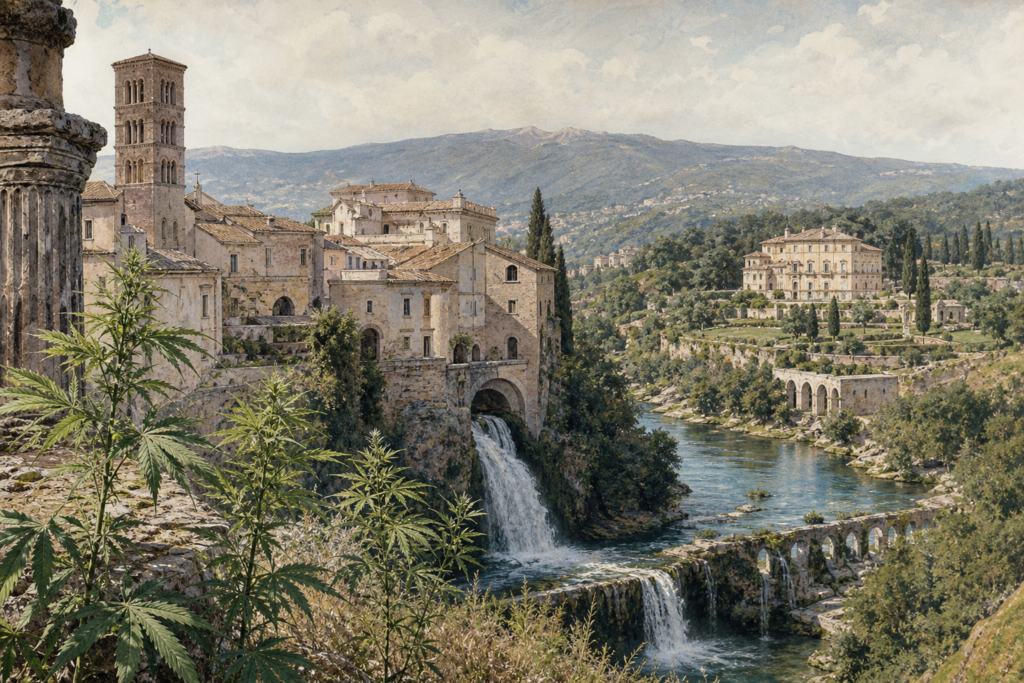
A careful account of hemp history in Tivoli should therefore describe the town as part of a wider central Italian landscape rather than claim an undocumented hemp tradition. Future research could examine agricultural contracts, botanical references, medical manuscripts, customs records and archaeological plant remains. Those sources would be needed to establish when, where and why hemp was cultivated or used around Tivoli.
From useful crop to controlled substance
Over the centuries, hemp continued to have practical value in Europe, while cannabis preparations were discussed in medical and botanical writing. The modern legal category of cannabis developed much later, as governments began distinguishing controlled psychoactive substances from industrial crops and medicines. This process was shaped by international agreements, national legislation, public-health concerns and changing views of intoxication.
In Italy, cannabis law is primarily national. The country’s main controlled-substances framework is associated with Presidential Decree No. 309 of 1990, which addresses narcotic and psychotropic substances, prevention, treatment and enforcement. Readers checking the current wording should consult the official Italian legal database, Normattiva, because regulations and administrative interpretations can change.
This national structure explains why cannabis laws in Tivoli do not operate as a separate local historical system. Municipal authorities may deal with public order, health initiatives and local services, but they do not create a general alternative to national rules on possession, supply, cultivation or medical authorization.
Cannabis policy in modern Tivoli
During the twentieth century, cannabis became increasingly associated with criminal law and international drug-control policy. At the same time, hemp remained relevant as an industrial crop in parts of Europe. These two strands were often treated together in public debate, even though fibre hemp and high-THC cannabis have different intended uses and regulatory issues.
Italy later developed limited legal routes for medical cannabis and renewed interest in industrial hemp. The result is not general legalization. Instead, the modern framework distinguishes among medical products, industrial hemp, unauthorized cannabis and products that may be sold under specific conditions. Product labels, cannabinoid content, intended use and supply chain all matter.
For current information, the Italian Ministry of Health is a more reliable starting point than informal social-media explanations. Its materials can help readers understand official health and regulatory information, while doctors, pharmacists and licensed services are the appropriate sources for individual medical questions.
Medical cannabis in Tivoli
Medical cannabis in Tivoli is not a walk-in retail category. Access depends on a medical assessment, an appropriate prescription and the dispensing procedures recognized by the Italian health system. A person should not assume that a product marketed online or described as “therapeutic” has the same status as a prescribed medicine.
Patients should discuss symptoms, existing medication, possible interactions and expected benefits with a qualified clinician. Medical cannabis may not be suitable for everyone, and a prescription does not remove the need to follow dosage, storage and driving guidance. Pharmacies and healthcare professionals can explain the current practical process, which may depend on the indication and regional arrangements.
Hemp, CBD and the modern local marketplace
Interest in hemp-derived foods, cosmetics, fibres and CBD products has added another layer to the story. These products are not automatically equivalent to medical cannabis or recreational cannabis. Their legal treatment may depend on the product category, composition, intended use, labeling and applicable national or European rules.
Visitors searching for weed in Tivoli should be especially cautious about informal sellers, unverified websites and products presented as legal without clear documentation. Buying, carrying or transporting cannabis across borders can create serious legal risks, even when a product was obtained lawfully somewhere else. A shop’s claim is not a substitute for an official rule or professional advice.
The same caution applies to low-THC hemp products. “Hemp,” “CBD” and “cannabis” are often used loosely in advertising, although they can refer to different goods and legal categories. Consumers should check ingredients, labeling, seller credentials and the intended use rather than relying on packaging alone.
How to research cannabis history in Tivoli responsibly
Because local evidence is limited, researching Cannabis history in Tivoli, Italy requires a method that separates documented facts from reasonable historical context.
- Start with local archives: municipal records, estate inventories, agricultural contracts and customs documents may reveal references to hemp, fibres or medicinal plants.
- Use archaeological caution: botanical remains can identify plants, but interpretation depends on preservation, dating and the location where samples were found.
- Compare regional sources: evidence from Lazio or central Italy can provide context, but it should not be presented as proof of a specifically Tivoli practice.
- Check terminology: historical references to hemp fibre, herbal preparations or medicinal plants may not describe modern recreational cannabis.
- Verify current law separately: historical practice does not determine what is legal today.
This approach also helps avoid a common mistake: treating the absence of published evidence as proof that nothing happened. Tivoli’s history is extensive, but many everyday activities were never recorded in surviving sources. The most honest conclusion may be that a local claim remains unconfirmed.
Tivoli in the broader Italian cannabis conversation
Tivoli’s story connects with wider Italian debates about public health, medical access, industrial agriculture and criminal justice. Other Italian cities have developed different conversations around education, safety, medical access and regulated products. For comparison, readers can explore this overview of cannabis awareness in Cuneo or the discussion of cannabis use and medical access in Fano.
Those comparisons should not be mistaken for local Tivoli evidence. They are useful because they show how national rules can be discussed through different local priorities. In Tivoli, the most relevant priorities are likely to include accurate visitor information, responsible medical guidance, protection from unverified products and a historically careful interpretation of the town’s Roman and agricultural connections.
What the historical record does and does not show
The available broad context supports several modest conclusions. Hemp was part of the wider history of useful plants in Europe and the Mediterranean. Roman Italy had extensive trade and knowledge networks. Tivoli was closely connected to those networks. Modern cannabis regulation in Tivoli follows Italian national law, while medical access and hemp-related products are subject to specific rules.
What cannot responsibly be claimed without stronger evidence is that Tivoli had a documented ancient cannabis culture, a continuous local hemp industry, or a historic tradition of recreational cannabis use. Those statements would require sources that are not established simply by the town’s Roman importance or proximity to Rome.
Conclusion
The history of cannabis in Tivoli is less a story of a distinct local industry than a case study in how broad plant history, Roman connectivity and modern national policy intersect. Hemp may be discussed within the wider agricultural and material history of Italy, but specific claims about Tivoli should remain evidence-based. Today, cannabis-related questions in the town are governed mainly by Italian law, with separate considerations for medical treatment, industrial hemp and consumer products.
For anyone researching the subject or seeking practical guidance, the safest path is to distinguish historical context from legal advice, verify current rules through official sources and avoid unsupported claims about local traditions. That approach produces a more useful and accurate account of cannabis in Tivoli—one that respects both the complexity of the past and the responsibilities of the present.