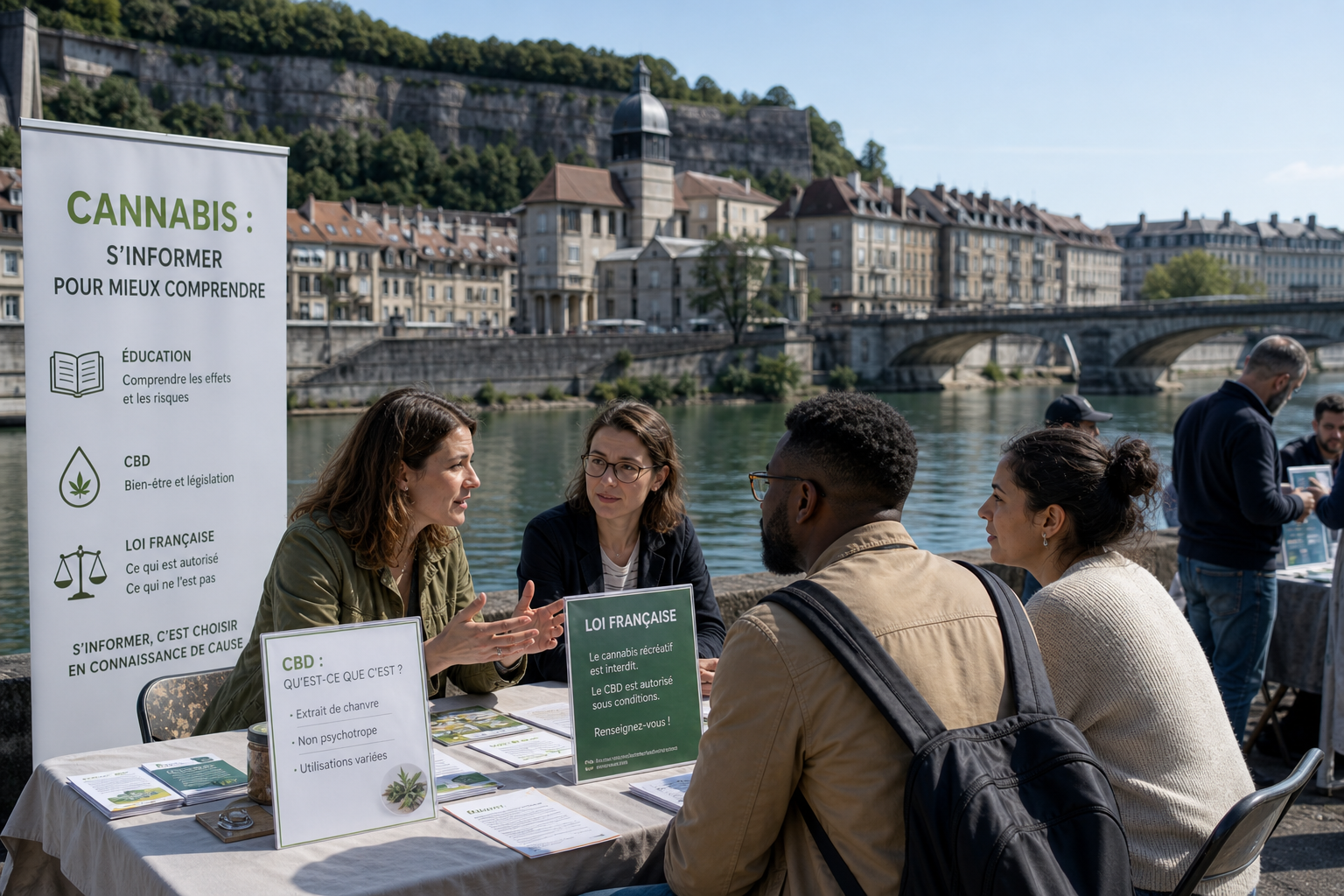
The cannabis community in Besançon is best understood as a broad network rather than a single organization or clearly defined scene. It can include adults who use cannabis, CBD consumers, health professionals, prevention workers, researchers, students, families, legal observers and residents interested in public policy. In Besançon, a city in Bourgogne-Franche-Comté on the Doubs, these conversations take place within the same national legal framework as the rest of France.
That distinction matters. Local culture and access to information may vary, but French law is national. A responsible discussion of cannabis in Besançon therefore needs to combine local context with accurate information about possession, use, driving, CBD, health risks and support services. This guide focuses on education and safer decision-making, not on finding illegal sellers or evading enforcement.
What the cannabis community in Besançon can mean
The phrase “community” does not necessarily refer to a formal club, dispensary network or public cannabis association. It may describe people connected by shared interests, experiences or concerns. Some participate in online discussions, while others engage through public-health events, student groups, patient advocacy, harm-reduction work or broader debates about drug policy.
Because recreational cannabis remains prohibited in France, many people keep their involvement private. This can make the local picture difficult to measure and increases the importance of reliable, non-judgmental information. A healthy community is not defined by consumption alone. It is also shaped by how people discuss risk, respect privacy, challenge misinformation and support anyone experiencing problems.
Different interests within one community
- Adult consumers: People may seek information about legal risks, dependence, potency and safer choices.
- CBD consumers: Some are interested in non-intoxicating products, but product quality and legal compliance still matter.
- Health and social-care professionals: Professionals may address problematic use, mental health, prevention or treatment referrals.
- Families and educators: Parents, teachers and youth workers often need practical ways to discuss cannabis without exaggeration or stigma.
- Policy and civic participants: Residents may follow national reforms, public-health debates and local prevention initiatives.
Cannabis laws in Besançon and across France
There is no separate municipal cannabis code for Besançon. The rules governing cannabis use, possession, supply and cultivation are set primarily at the national level. In general, recreational cannabis is illegal, and possession or use can result in legal consequences. The exact response may depend on the circumstances, the substance, the amount, previous history and the authorities involved.
The French public-service information portal provides current guidance on French rules concerning drug use. Readers should consult official information rather than rely on social-media claims, informal sellers or outdated travel pages. Legal procedures and enforcement policies can change, so a current source is especially important.
Driving deserves particular attention. Using cannabis before driving can impair reaction time, attention and judgment, and French enforcement also treats drug-impaired driving as a serious matter. Combining cannabis with alcohol can increase impairment. Anyone who may have consumed should avoid driving, cycling in traffic or operating machinery and should arrange a safe alternative.
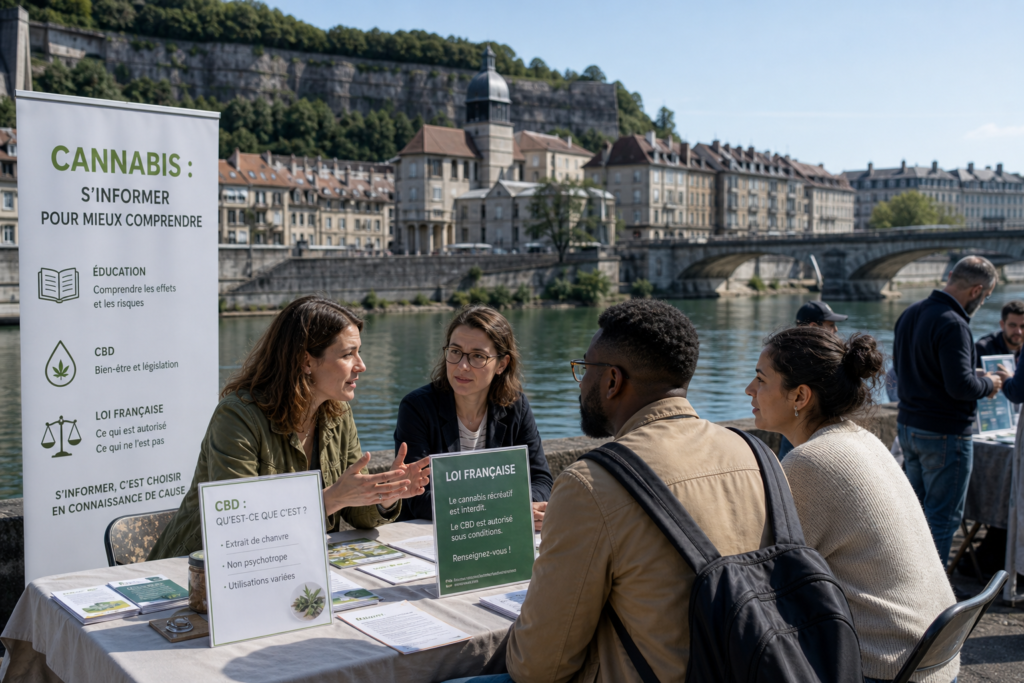
CBD is not the same as legal recreational cannabis
CBD products are often discussed alongside cannabis, but they are not interchangeable. CBD does not produce the same intoxicating effect as high-THC cannabis, yet products can vary considerably in formulation, labeling and quality. A product sold as CBD should come from a reputable retailer, display clear ingredient information and comply with applicable French and European requirements.
Consumers should be cautious with products making therapeutic promises, especially oils, flowers, vapes and edible products bought through informal channels. Even small amounts of THC or contamination may create problems for some people, including those subject to workplace testing or drug-driving controls. “Natural” does not automatically mean risk-free.
Local context for cannabis in Besançon
Besançon’s identity as a university, administrative and cultural centre creates several settings where cannabis-related questions may arise: student life, nightlife, healthcare, housing, workplaces and community services. These settings should not be treated as evidence that use is more or less common than elsewhere. They are simply places where residents and visitors may need clear information.
For visitors searching for weed in Besançon, the most important point is that tourism does not create an exception to French law. Buying from an unregulated source carries legal, financial and health risks. Products may have unknown strength, contain contaminants or be misrepresented. Public consumption can also create conflict with other residents and expose the user to additional enforcement attention.
For residents searching for cannabis in Besançon, a more useful starting point is to identify the question behind the search. Is the concern legal? Is it about sleep, stress or pain? Is someone worried about a family member? Different questions require different sources, and online anecdotes are rarely a substitute for a qualified professional.
Health, harm reduction and informed choices
Any discussion of cannabis should acknowledge possible harms without resorting to sensationalism. Risks vary according to age, frequency, potency, route of administration, mental-health history, other substances and personal circumstances. Frequent use can become difficult to control, while high-THC products may increase the likelihood of anxiety, panic or unpleasant psychological effects. Adolescents and young adults require particular caution because the brain continues developing during these years.
Harm reduction does not make illegal use legal, and it should not be confused with an endorsement of consumption. It means reducing foreseeable danger and encouraging people to seek help early. Practical principles include:
- Do not drive or operate machinery after using cannabis, and never combine it with alcohol or other intoxicants.
- Avoid products of unknown strength or origin, particularly concentrates and unlabelled edibles.
- Remember that edibles can take longer to produce effects and may last longer than expected; taking more too soon can lead to distress.
- Keep cannabis and CBD products away from children and pets, preferably in secure, clearly labelled storage.
- People with a history of psychosis, severe anxiety, substance dependence or medication interactions should seek medical advice before considering cannabis products.
- Seek urgent help for severe confusion, chest pain, loss of consciousness, dangerous agitation or thoughts of self-harm.
For wider prevention and addiction information, the official French government drugs and addiction information portal is a more dependable starting point than anonymous forums. Local healthcare professionals can also help assess symptoms, medications and patterns of use confidentially.
Medical cannabis in Besançon: questions to ask
Searches for medical cannabis in Besançon often reflect genuine needs involving chronic pain, neurological conditions, sleep or treatment side effects. However, cannabis is not a universal treatment, and self-medicating with products obtained online or from informal sellers can delay appropriate care. Medical access, where applicable, depends on the national framework, clinical assessment and authorized channels.
A patient should discuss the issue with a doctor or pharmacist, bringing a complete list of current medicines and describing symptoms honestly. Useful questions include:
- What diagnosis is being treated, and what evidence supports a cannabis-based option?
- What approved or established treatments should be considered first?
- Could cannabis interact with current medicines or worsen anxiety, memory or balance?
- Would treatment affect driving, work, pregnancy or daily responsibilities?
- How would benefits and side effects be monitored?
Anyone seeking care in Besançon can begin with their general practitioner, a pharmacist or an appropriate hospital service. If use has become difficult to control, addiction-support professionals can provide confidential guidance without requiring a person to wait for a crisis.
How to build a more useful local conversation
A constructive cannabis community is one that makes room for different experiences. Some people support stricter controls, while others favour reform or regulated access. Productive discussion does not require agreement on policy, but it does require accurate facts and respect for privacy.
Good practices for community groups and communicators
- Separate legal information from personal opinion and label uncertainty clearly.
- Avoid presenting individual experiences as medical proof.
- Do not publish addresses, names or identifying details without consent.
- Make age limits and safeguarding part of any public event or online group.
- Direct people toward doctors, pharmacists and recognized support services for personal health questions.
- Discuss CBD, THC, dependence and mental health together rather than treating cannabis as a single uniform product.
People comparing regional perspectives may also find useful background in our articles on cannabis awareness in Annecy, cannabis use in Angers and CBD in Lyon. These comparisons should supplement, not replace, current French official guidance.
Practical checklist for residents and visitors
Whether someone lives in Besançon, studies there or is only visiting, a few simple habits can reduce confusion and risk:
- Check the date and authority behind any legal claim.
- Do not assume that a product available in another country is legal to possess or transport in France.
- Keep cannabis out of public spaces, vehicles and situations involving children or professional responsibilities.
- Buy no unregulated product and do not share unknown substances with another person.
- Ask a healthcare professional about persistent symptoms, dependence or possible drug interactions.
- Use emergency services if someone is seriously unwell or presents an immediate danger to themselves or others.
Conclusion
The cannabis community in Besançon is diverse, partly private and connected to wider French debates about health, law, CBD and public policy. Understanding that community means looking beyond the question of access. It means recognizing the difference between THC cannabis and CBD products, knowing that national law applies locally, avoiding unsafe informal markets and making room for evidence-based support.
For anyone researching cannabis laws in Besançon, the safest approach is to check official sources and obtain personal health advice from qualified professionals. A better local conversation is possible when residents, visitors and organizations prioritize accuracy, consent, prevention and practical support over rumors or stigma.