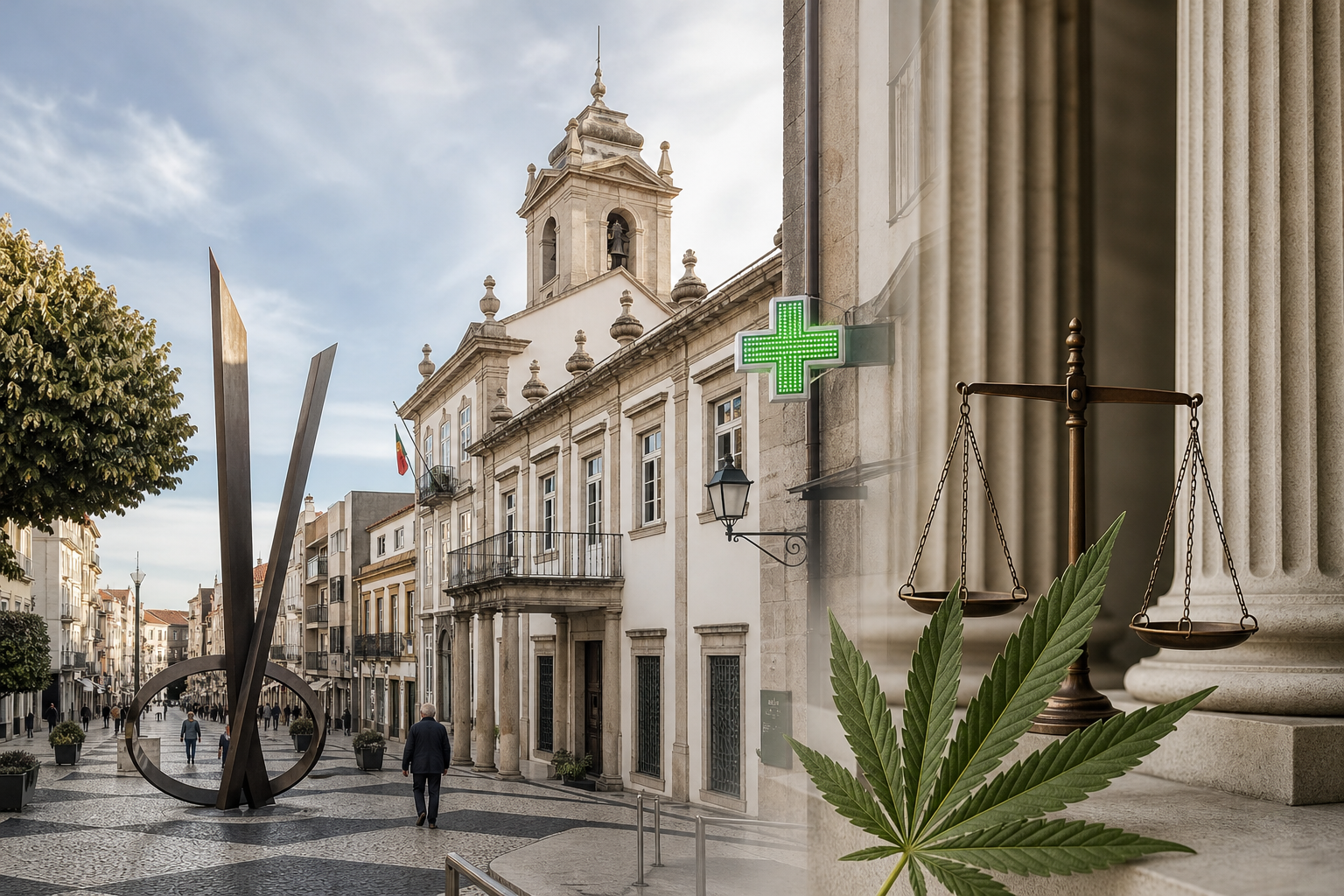
Understanding Cannabis access laws in São João da Madeira requires separating Portugal’s national rules from local practical realities. São João da Madeira does not have a separate municipal cannabis code that legalizes recreational sales or creates licensed dispensaries. Instead, the city follows Portuguese legislation on possession, consumption, cultivation, trafficking, driving and medical cannabis.
Portugal is often described as having “legalized” cannabis, but that description is incomplete. Personal use and possession within certain circumstances are generally treated as administrative matters rather than ordinary criminal offenses, while commercial supply remains prohibited outside regulated medical and industrial channels. This guide explains what that means for residents and visitors looking for weed in São João da Madeira, without confusing decriminalization with a retail market.
How Portuguese law applies in São João da Madeira
Portugal’s framework is national. The main distinction comes from the country’s decriminalization model, introduced by Law 30/2000. Under that system, the personal use, acquisition and possession of drugs for personal use can be handled by an administrative commission rather than automatically proceeding as a criminal prosecution.
Decriminalization does not mean that cannabis is freely legal. Police may still identify a person, seize the substance and refer the matter to the competent authorities. An administrative process can result in a warning, a fine or other measures, depending on the circumstances. The outcome is not guaranteed and should not be understood as permission to carry cannabis openly.
For a broader comparison of possession rules in the region, see this practical overview of marijuana possession laws in Gondomar. The legal principles are national, although enforcement circumstances can differ from one case to another.
Personal possession is not the same as legal supply
A person found with a small amount apparently intended for personal use may enter the administrative system. That does not create a right to purchase cannabis from an unlicensed seller, operate a delivery service or sell cannabis to another person.
Trafficking, distribution and commercial supply remain criminal matters. Indicators such as packaging, communications, cash, scales, repeated transactions or the quantity involved may affect how authorities assess a case. Quantity alone should not be treated as a complete legal test: the surrounding facts and alleged purpose matter.
Cannabis laws in São João da Madeira: possession and consumption
The practical meaning of the cannabis laws in São João da Madeira is that possession for personal use may be decriminalized, but cannabis can still be seized and public conduct can create additional problems. Smoking or consuming cannabis in a street, park, station, shopping area or other shared place may attract police attention and may breach other rules concerning public order, nuisance or protected premises.
Portugal has historically used a reference based on an amount considered consistent with personal use over a limited period. That reference is not a guarantee of lawful possession, and it should not be presented as a personal allowance. Legislative changes and judicial interpretation have also made it unsafe to rely on a simple quantity formula when assessing whether conduct indicates personal use or supply.
For practical context on public behavior, compare this guide to cannabis public consumption laws in Guarda. The same general caution applies in São João da Madeira: decriminalization does not provide a safe harbor for consuming wherever you wish.
What can happen after a police stop?
If police find cannabis, they may verify identity, confiscate the substance and record the circumstances. A person may be referred to a Commission for the Dissuasion of Drug Addiction, particularly where the matter appears connected to personal use. The commission can consider the individual situation and may apply measures such as a warning, a fine or requirements intended to reduce future harm.
Visitors should not assume that a foreign passport prevents referral or that an administrative matter can simply be ignored. Anyone questioned or formally notified should request an interpreter where needed and consider Portuguese legal advice. A local lawyer can explain the current procedure, deadlines and possible consequences more reliably than online summaries.
Is there a legal cannabis shop in São João da Madeira?
There is no general Portuguese system of recreational cannabis dispensaries comparable to regulated adult-use markets in some other countries. A shop advertising cannabis flower or THC products for recreational use is not automatically lawful merely because it operates openly or uses terms such as “club,” “wellness” or “collective.”
Products sold as cannabis, CBD or hemp can fall under different rules depending on their composition, intended use, labeling and route to market. A CBD product is not automatically suitable for inhalation or consumption, and a label does not by itself prove compliance. Consumers should be especially cautious with products claiming to contain THC, make medical promises or come from an unclear source.
Accordingly, cannabis in São João da Madeira is not available through a standard recreational retail channel. Buying from an informal seller can expose a person to criminal risk, unknown potency, contamination and products that are not what the seller claims.
Medical cannabis in São João da Madeira
Medical cannabis in São João da Madeira is accessed through Portugal’s regulated healthcare system, not through recreational dispensaries. Portuguese law allows certain cannabis-based medicines and preparations for approved therapeutic purposes. Access depends on a clinician’s assessment, the medical indication, the available product and a prescription issued under the applicable rules.
The process normally begins with a consultation with a qualified healthcare professional. A doctor must decide whether a cannabis-based treatment is clinically appropriate, taking account of the patient’s condition, previous treatments, possible interactions and risks. A prescription is not an entitlement on request, and a doctor may recommend another therapy instead.
Products supplied for medical use should be obtained through a lawful pharmacy channel. Patients should ask the prescribing clinician or pharmacist how the product is dispensed, how it should be stored and what to do if a dose is missed or side effects occur. More information about Portugal’s regulatory approach is available from INFARMED, Portugal’s medicines and health products authority.
Medical access is different from self-medication
Medical authorization does not make every cannabis product lawful. A prescription for one preparation does not necessarily authorize possession of unrelated flower, oils or imported products. Patients should keep the product in its original packaging and carry prescription or pharmacy documentation when traveling, especially if they may need to explain its origin.
People should also avoid sharing prescribed cannabis medicines. Sharing can create safety risks, and a medicine prescribed to one patient is not a legal substitute for another person’s medical assessment. Anyone who experiences severe anxiety, confusion, chest symptoms or other concerning effects should seek urgent medical help.
For related information on the national medical framework, this overview of medical marijuana in Bragança provides useful background, while the applicable rules remain Portuguese national rules rather than city-specific regulations.
Cultivation, home growing and supply
Home cultivation should not be treated as a loophole in Portugal’s decriminalization system. Growing cannabis for personal use can still create criminal exposure, even when the grower does not intend to sell the crop. Decriminalized possession and consumption therefore do not automatically extend to cultivation.
The same caution applies to processing, importing, exporting and supplying cannabis. A person who receives cannabis from another country, arranges delivery or passes it to friends may face issues that are different from simple possession for personal use. Cross-border movement is particularly risky because another country’s rules and customs controls may also apply.
Industrial hemp is a separate area governed by production and regulatory requirements. Hemp cultivation or a hemp-derived product should not be assumed to be legal simply because it contains little THC. Farmers, businesses and consumers should verify the current requirements with the relevant Portuguese authorities before planting, importing or marketing a product.
Driving, employment and public safety
Using cannabis and driving are incompatible with safe travel. Portuguese road rules can impose serious consequences where a driver is impaired or tests indicate the presence of substances. A person should not drive, cycle in dangerous traffic or operate machinery after using cannabis, even if the cannabis was obtained through a medical prescription.
Medical patients should ask their doctor or pharmacist about impairment, sedation and interactions with alcohol or other medicines. A prescription does not remove the responsibility to drive safely or follow workplace rules. Employers may also have safety policies that are especially strict for transport, manufacturing, construction and other high-risk roles.
For visitors arriving in the area, do not carry cannabis across borders, place it in checked luggage or assume that a prescription from another country is automatically recognized in Portugal. Travel documentation and medicine rules should be checked before departure with official authorities and the relevant airline or carrier.
Practical guidance for residents and visitors
- Do not interpret decriminalization as a legal recreational market.
- Do not buy cannabis from informal sellers, social-media accounts or unlicensed shops.
- Avoid consuming in public places, near children, at transport facilities or in other shared areas.
- Never drive or operate machinery after using cannabis.
- Keep prescribed medical products in their original packaging and follow the prescription.
- Do not grow, sell, share or transport cannabis across borders without confirming the applicable law.
- If police become involved, remain calm, provide accurate identification and request legal or language assistance where appropriate.
The safest way to assess a specific case is to speak with a Portuguese lawyer or a qualified healthcare professional. Online articles can explain the framework, but they cannot determine whether a particular quantity, product, message or set of circumstances will be treated as personal use, supply or another offense.
What to remember about access in São João da Madeira
Access to cannabis in São João da Madeira depends on the purpose and the route of access. Personal possession for apparent use may be processed administratively under Portugal’s decriminalization model, but cannabis can still be seized and the person can face official proceedings. Recreational sales, trafficking and informal supply remain unlawful.
Medical cannabis is the clearest regulated route, but it requires a clinical decision, an authorized prescription and lawful pharmacy supply. CBD and hemp products require their own checks and should not be confused with THC cannabis. Public consumption, driving, cultivation and cross-border transport create additional risks that decriminalization does not remove.
Conclusion
The key point in Cannabis access laws in São João da Madeira is the difference between reduced criminalization of personal use and full legalization. São João da Madeira follows Portugal’s national framework: personal-use cases may enter an administrative process, while commercial supply and many other activities remain prohibited. Medical access is possible through regulated healthcare channels, not ordinary recreational shops.
Residents and visitors should avoid informal purchases, public consumption, home cultivation and impaired driving. When the facts are complex or an official notice has been issued, current advice from a Portuguese lawyer, doctor, pharmacist or competent authority is the most reliable next step.