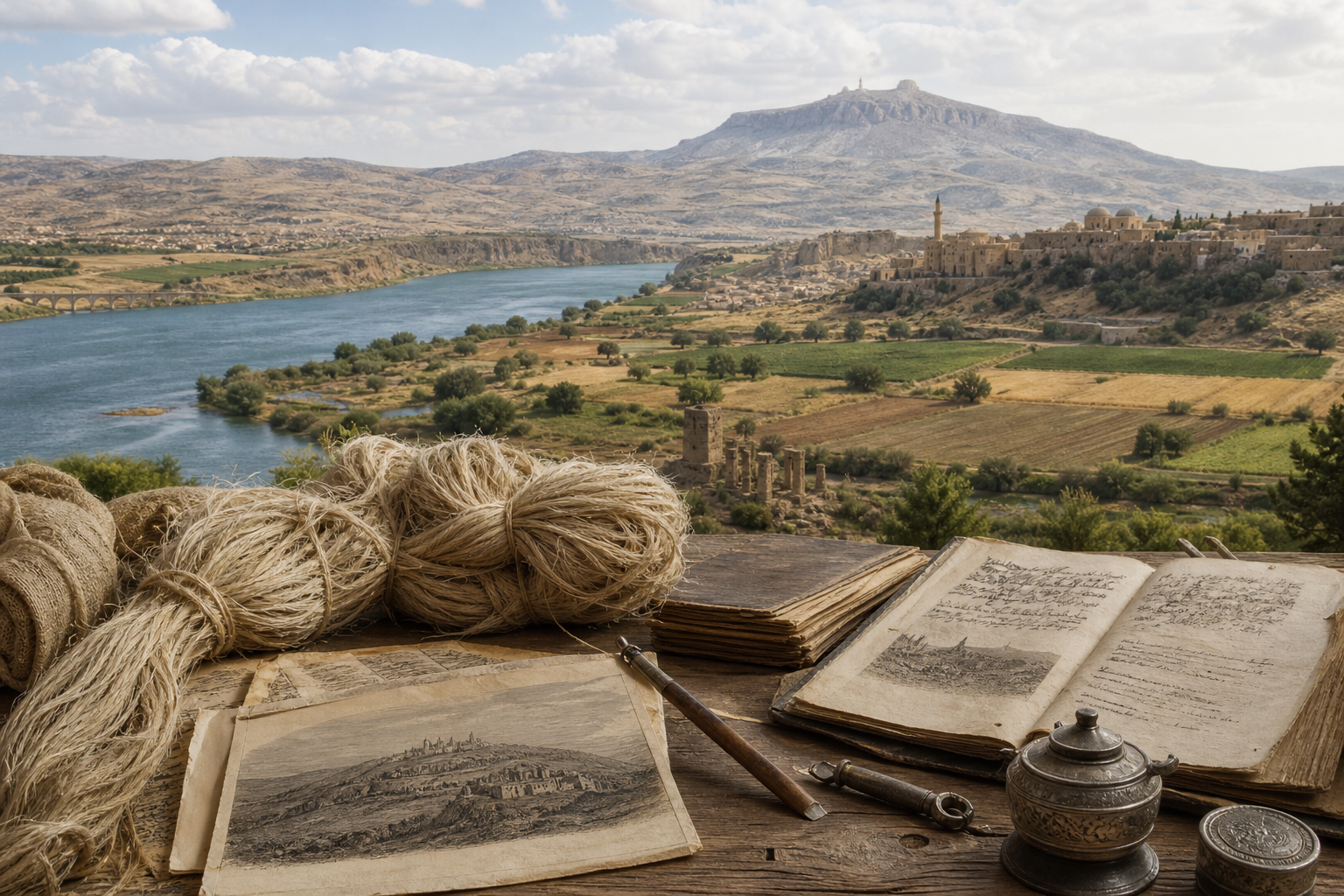
Cannabis history in Adıyaman is best understood through the changing meaning of the cannabis plant. In historical sources, the plant may appear as hemp, a fiber crop, or a medicinal ingredient rather than as the intoxicating drug discussed in modern law. Adıyaman’s location in southeastern Anatolia, its agricultural economy, and its connections with older Mesopotamian and Anatolian trade routes provide useful context, but they do not by themselves prove large-scale cannabis cultivation in the province.
This distinction matters. A careful local history should separate documented evidence from regional possibility, hemp from high-THC cannabis, and ancient plant use from present-day legality. The available public record does not establish Adıyaman as a major historical cannabis center. Instead, it shows how broader developments in agriculture, medicine, commerce, and drug control shaped the way cannabis could be understood and discussed in the region.
Cannabis history in Adıyaman: what can be established?
Adıyaman lies between the upper Euphrates basin and the plains of southeastern Turkey. The province is known for agricultural production, varied elevations, and the archaeological landscape associated with the ancient Kingdom of Commagene. These features make it a valuable setting for studying crops and trade, but archaeology alone cannot identify cannabis cultivation without direct evidence such as seeds, pollen, fibers, residue, or written records.
There is no reliable basis for claiming that cannabis played a defining role in Adıyaman’s ancient economy. Ancient communities in Anatolia and the wider Near East used many plants for food, fiber, medicine, ritual, and household purposes. However, references to plant use must be tied to a specific site, date, and source before they can be assigned to Adıyaman. A general statement about cannabis in the ancient world is not proof of a local tradition.
Why hemp and cannabis should not be treated as identical
Hemp is commonly used to describe cannabis varieties grown primarily for fiber, seed, or other industrial purposes. Drug-type cannabis is cultivated for higher concentrations of cannabinoids, especially tetrahydrocannabinol, or THC. The plants belong to the same broad botanical category, but their agricultural uses, legal treatment, and social histories can differ substantially.
When historical documents mention hemp, they may be describing rope, cloth, sacks, fishing equipment, paper, oil, or seed. They do not automatically describe recreational drug use. This is particularly important when interpreting older Ottoman or regional records, where crop names and administrative categories may not match modern terminology.
Adıyaman’s geography and agricultural setting
Adıyaman’s climate varies between river valleys, foothills, and higher inland areas. Historically, households and communities adapted farming to available water, soil, altitude, and market access. Crops such as grain, pulses, fruit, tobacco in some periods, and other regional products have had clearer documentary visibility than cannabis.
Hemp can grow in a range of environments, but suitability does not demonstrate cultivation. A historical account would need evidence from farm registers, tax records, seed remains, estate inventories, local newspapers, or official agricultural surveys. Without that documentation, it is more accurate to describe hemp cultivation in Adıyaman as a research question rather than a confirmed defining industry.
The province’s location nevertheless helps explain how agricultural knowledge could move across southeastern Anatolia. Merchants, seasonal workers, administrators, and religious or educational networks connected local communities with neighboring districts. These connections may have allowed information about fiber crops and medicinal plants to circulate, even when a crop was not commercially important in every location.
Hemp, medicine, and household use in historical Turkey
Across the Ottoman and earlier periods, plant materials were often valued for practical reasons. Strong fibers could be turned into cordage and textiles, while seeds and oils could have household applications. Medical knowledge also relied on plants, but historical references to a remedy do not necessarily indicate widespread local production.
For Adıyaman, the strongest responsible conclusion is that any hemp-related activity should be studied within the wider agricultural history of southeastern Anatolia. Researchers would need to compare provincial records with material from nearby cities, including agricultural reports, commercial documents, and museum collections. This approach is more reliable than assuming that a plant known elsewhere must have been central to Adıyaman.
Readers interested in the broader regional context can also compare discussions of marijuana information in Şanlıurfa and the agricultural and legal background of neighboring areas. Comparisons can reveal patterns, but they should not be mistaken for direct evidence about Adıyaman itself.
From Ottoman administration to the Turkish Republic
Under Ottoman administration, agricultural production was recorded through changing systems of taxation, landholding, and provincial management. A crop could be important to one district and nearly absent from another. Records might also focus on taxable output rather than household cultivation, leaving small-scale production poorly documented.
During the early Turkish Republic, agriculture became increasingly connected to national planning, state institutions, plant research, and regulated markets. The modern state classified crops more systematically and paid closer attention to substances considered medically or socially risky. This period helped separate industrial hemp, pharmaceutical materials, and illicit drug markets in administrative language.
It is therefore misleading to describe modern Turkish cannabis policy as a simple continuation of ancient practice. Legal categories changed as international agreements, public-health thinking, policing priorities, and agricultural policies developed. Local communities in Adıyaman were affected by these national changes even when the province was not a major cannabis-producing center.
Cannabis laws in Adıyaman today
Cannabis laws in Adıyaman are primarily national Turkish laws rather than a separate provincial system. Possession, production, sale, import, export, and cultivation of cannabis can carry serious criminal consequences. Local police, courts, customs authorities, and health institutions apply national rules within the province.
The legal position of a substance should not be inferred from historical use, traditional plant knowledge, or the availability of products online. Industrial hemp is also subject to regulation, and permission requirements may apply to approved cultivation or processing. Anyone considering agricultural production should consult current Turkish authorities and obtain formal guidance before planting, trading, or processing a crop.
For a comparative look at national rules as they affect another southeastern city, see this practical guide to marijuana laws in Gaziantep. The legal principles are national, although enforcement questions and local circumstances can differ.
Why online claims about weed in Adıyaman can be misleading
Searches for “weed in Adıyaman” may produce informal listings, social-media posts, or claims about local availability. Such material is not reliable evidence of history, legality, product safety, or official policy. It may also expose readers to scams, adulterated products, or legal risk.
A historical article should not turn into a buying guide. The phrase “cannabis in Adıyaman” can refer to an archaeological question, hemp agriculture, medical research, drug policy, or illicit use. Each meaning requires different evidence. Clear terminology helps prevent modern assumptions from being projected onto the past.
Public health and the modern meaning of cannabis
Modern cannabis discussions often focus on THC, CBD, dependence, impaired driving, interactions with medicines, and the risks of unregulated products. Historical interest does not remove these concerns. A plant’s traditional or industrial use cannot establish that every contemporary cannabis product is safe.
The World Health Organization’s cannabis information provides a public-health overview of potential risks and the need to consider dosage, product composition, age, mental health, and method of use. In Turkey, people seeking help with substance use or health concerns should speak with a qualified healthcare professional rather than relying on sellers or anonymous online advice.
Medical cannabis is another area where language must remain precise. A medicine approved or prescribed under a regulated system is not equivalent to an untested product marketed as therapeutic. Claims about medical cannabis in Adıyaman should be checked against current Turkish rules and guidance from licensed healthcare providers.
How researchers could build a fuller local history
A stronger account of Adıyaman’s cannabis and hemp history would combine several types of evidence. No single source is likely to answer every question, especially because household farming and informal plant use were often under-recorded.
- Archaeobotanical evidence: Seeds, pollen, fibers, and residues from carefully dated excavations could show whether cannabis was present at a particular site.
- Ottoman records: Tax registers, land surveys, court records, and commercial documents may identify crops, fibers, oils, or agricultural disputes.
- Republican-era archives: Provincial yearbooks, agricultural reports, newspapers, and government surveys could clarify whether hemp was cultivated or traded locally.
- Oral history: Interviews with older farmers and craftspeople may preserve knowledge of fibers and household materials, though memories should be checked against documentary evidence.
- Comparative research: Records from Malatya, Gaziantep, Şanlıurfa, and Diyarbakır can help identify regional patterns without automatically assigning them to Adıyaman.
Researchers should record the exact spelling and meaning of crop names in each source. A term translated as hemp, cannabis, fiber plant, or medicinal herb may have had a narrower or broader meaning in its original language. Dating, provenance, and laboratory confirmation are essential when physical remains are involved.
Adıyaman in the wider regional conversation
Adıyaman is part of a wider southeastern Anatolian landscape where agriculture, archaeology, trade, and public policy overlap. Its proximity to the Euphrates and to historically important urban centers makes regional comparison valuable. Yet a responsible history should preserve local specificity rather than turning geography into proof.
This method also helps distinguish cultural history from tourism or illicit-market narratives. There may be interest in cannabis in Adıyaman because of broader online attention to cannabis, hemp, and changing international policies. That interest should be answered with evidence about local records and current Turkish law, not with unsupported claims about hidden production or longstanding cannabis culture.
Conclusion
The history of cannabis in Adıyaman is not a story that can currently be reduced to a famous local crop or an uninterrupted tradition. The more defensible account is one of cautious interpretation: hemp and cannabis had different meanings, southeastern Anatolia supported diverse agricultural networks, and modern legal categories were shaped by national and international developments.
Future archival and archaeological research may clarify whether hemp was grown, traded, or used in particular parts of Adıyaman. Until then, readers should treat broad claims carefully, distinguish historical evidence from online rumor, and remember that present-day cannabis laws in Adıyaman follow Turkish national law. Understanding that distinction produces a more accurate and useful local history.