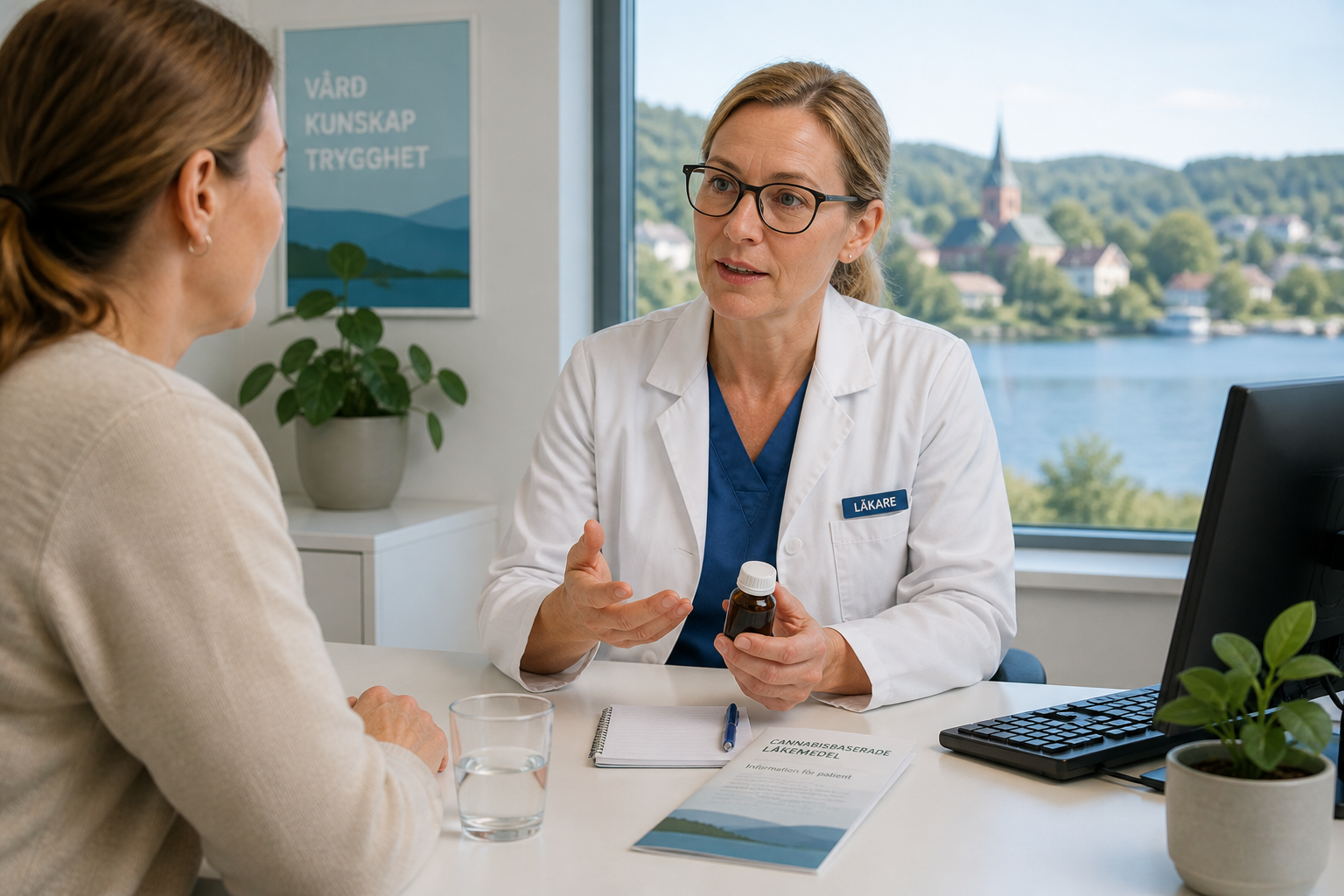
Questions about medical cannabis in Lerum are really questions about Swedish prescription medicine, specialist assessment and patient safety. Sweden does not operate a broad recreational cannabis market or a walk-in medical-cannabis dispensary system. Instead, cannabis-based medicines are handled through the ordinary healthcare and pharmacy systems, subject to Swedish medicines and narcotics rules.
That distinction matters for anyone searching online for cannabis in Lerum, weed in Lerum or a local cannabis clinic. A product advertised on a website, sold privately or described as “medical” is not automatically legal, quality-controlled or suitable for treatment. The safest route is to discuss symptoms with a licensed healthcare professional, obtain a valid prescription when clinically appropriate and collect the medicine through a legitimate pharmacy channel.
What medical cannabis means in Sweden
“Medical cannabis” is a broad everyday expression rather than one single Swedish treatment category. It can refer to an approved cannabis-based medicine, a medicine prescribed for a particular indication, or in limited circumstances a pharmacy-prepared product. The active substances, formulation, dose, indication and legal status all matter.
Swedish healthcare generally treats cannabis-based medicines as prescription products rather than as a separate patient entitlement. A doctor must consider the diagnosis, available evidence, potential benefits, interactions and risks. In some cases, a cannabis-based medicine may be an approved option. In others, a clinician may consider a less-established or specially managed treatment only after assessing whether it is medically justified and legally possible.
The Swedish Medical Products Agency provides official information about medicines, safety and regulatory matters. Product availability can change, so patients should not assume that a medicine discussed in another country is approved, routinely supplied or prescribed in Sweden.
Medical cannabis in Lerum and local healthcare access
Lerum is in Västra Götaland, but the key rules are national. A patient living in Lerum does not receive a separate municipal cannabis scheme. The practical starting point is the same as elsewhere in Sweden: contact a suitable healthcare provider, explain the condition and ask about evidence-based treatment options.
Where to begin
- Primary care: A vårdcentral can assess symptoms, review current medicines and decide whether referral or further investigation is needed.
- Specialist care: Depending on the condition, a specialist may be involved in decisions about complex pain, neurological symptoms, spasticity or other treatment-resistant problems.
- 1177 guidance: The regional healthcare service can help patients identify the right care route and understand how to contact services.
- Pharmacy: A pharmacy can provide information about dispensing, stock, substitutions and practical use after a prescription has been issued.
The 1177 healthcare guide is a reliable starting point for general Swedish healthcare information and contact guidance. It should not replace an individual clinical assessment, particularly when symptoms are severe, new or rapidly worsening.
Patients should bring a clear medication list, relevant diagnoses, previous treatment attempts and information about allergies or side effects. It is also useful to explain the specific goal of treatment. For example, “I want to explore options for persistent nerve pain” is more clinically useful than simply requesting cannabis by name.
Who may be considered for cannabis-based treatment?
Eligibility is not determined by living in Lerum or by having a particular interest in cannabis. A prescriber must decide whether a cannabis-based medicine is appropriate for the individual patient. The decision can depend on the underlying condition, symptom severity, previous therapies, expected benefit, contraindications and the strength of available evidence.
Some cannabis-derived medicines have specific approved uses, while other requests may involve treatment outside an ordinary approved indication. A doctor may decline a request if the expected benefit is uncertain, if safer established treatments have not been tried, or if the risks are too high. A patient cannot require a prescription simply because a product helped someone else.
Be cautious with clinics or websites that promise guaranteed approval, make broad claims about curing serious illness or offer a prescription without a meaningful assessment. A legitimate consultation should include questions about health history, mental health, other medicines, substance use, pregnancy where relevant and the possibility of impairment.
Cannabis laws in Lerum: possession, purchase and prescriptions
The cannabis laws in Lerum are Swedish national laws, not special local rules. Cannabis is classified as a narcotic, and possession, sale, transfer, cultivation and unauthorized use can create criminal-law consequences. A prescription medicine is not the same thing as loose cannabis obtained from an informal source.
A legal prescription applies to the medicine and the instructions provided by the prescriber. It does not make recreational cannabis lawful, and it does not authorize sharing medication with another person. Patients should keep the product in its original packaging and follow the prescribed dose. Buying cannabis from a private seller, social-media contact or an unverified online shop carries legal, quality and health risks.
This is also why searches for weed in Lerum can lead to confusing results. Informal “weed” listings are not evidence of a legal medical supply. They may involve unknown concentration, contamination, inaccurate labels or products containing more intoxicating THC than advertised.
CBD, THC and prescription medicines
CBD and THC are different compounds, although products may contain one, the other or both. THC is the component most associated with intoxication and impairment. CBD is not generally intoxicating in the same way, but CBD products are not automatically risk-free, legal in every formulation or medically effective for every condition.
Labels can be misleading. A product described as hemp oil, cannabis oil or CBD may have an unclear cannabinoid profile, and imported products may not meet Swedish requirements. Some products can also interact with prescription medicines or affect liver enzymes. “Natural” is not a substitute for quality control.
Patients considering CBD should tell their doctor or pharmacist exactly what they are taking, including oils, capsules, vape products and supplements. This allows the clinician to assess possible interactions and avoid duplicating treatment. Do not replace prescribed medicine with an unregulated cannabis product without medical advice.
What a responsible consultation should cover
A useful consultation is a two-way discussion rather than a request for a predetermined product. The clinician should be able to explain what is known, what is uncertain and how treatment would be monitored.
Important questions to discuss
- What diagnosis or symptom is being treated?
- What established treatments have already been tried, and what happened?
- What benefit would count as a successful trial?
- Which formulation and dose would be used?
- How long would the trial last before review?
- What side effects or warning signs require contact with healthcare services?
- Could the medicine interact with alcohol, sedatives, antidepressants, epilepsy medicines or other prescriptions?
- What rules apply to driving, work, machinery and travel?
Patients should not increase the dose on their own because the effect seems slow or mild. Cannabis-based medicines can produce dizziness, sleepiness, impaired concentration, anxiety, mood changes or other unwanted effects. THC-containing treatment may be particularly unsuitable for some people with a history of psychosis or serious mental-health vulnerability.
Driving, work and daily safety
Impairment is a practical concern even when a medicine has been prescribed. THC can affect reaction time, attention, coordination and judgment. The fact that a medicine is prescribed does not mean it is safe to drive immediately after taking it, and a patient must follow Swedish traffic rules and medical advice.
Ask the prescriber or pharmacist for specific guidance before driving, cycling in traffic, operating machinery or working at height. Avoid combining cannabis-based medicine with alcohol or other sedating substances unless a healthcare professional has explicitly advised you. Keep medicines secure and never give them to family members or friends.
Workplace policies may impose additional requirements, especially where safety-sensitive tasks are involved. If treatment affects alertness or performance, discuss adjustments with the relevant healthcare and workplace contacts rather than hiding the problem.
Buying and storing prescribed medicine
Use a legitimate Swedish pharmacy or another authorized supply route identified by your healthcare provider. Ask whether the product is currently available, whether an equivalent presentation can be dispensed and how it should be stored. Do not assume that a foreign prescription, imported product or online consultation automatically provides a lawful route to treatment in Sweden.
Store the medicine according to the label, keep it away from children and pets, and monitor the expiry date. Do not dispose of unwanted medicine in household waste or drains without checking the pharmacy’s collection advice. If a package appears damaged or the product differs from the prescription, contact the pharmacy before using it.
Evidence, expectations and follow-up
Cannabis-based treatment is not a universal solution for chronic pain, anxiety, insomnia or other difficult symptoms. Research findings vary by condition and product, and a result from one formulation cannot automatically be applied to another. A responsible clinician should explain whether the aim is symptom relief, improved function, reduced use of another medicine or something else that can be measured.
During follow-up, record benefits as well as problems. A simple diary can track pain or other symptoms, sleep, alertness, daily activity, dose timing and side effects. This helps the prescriber decide whether to continue, adjust or stop treatment. If there is no meaningful benefit, continuing indefinitely may expose the patient to risk without a clear reason.
Readers interested in the wider evidence and policy context can also review our overview of cannabis research in Vallentuna. Local location does not change the standard required for safe treatment, but research literacy can help patients distinguish clinical evidence from marketing claims.
When to seek urgent help
Contact healthcare services promptly if a cannabis-based medicine causes severe confusion, fainting, chest pain, extreme agitation, breathing problems, an allergic reaction or thoughts of self-harm. Acute symptoms after an unknown product should be taken seriously because the strength and contents may be uncertain.
For non-urgent questions about side effects, dosing or interactions, contact the prescribing service or pharmacy. In an emergency, use Sweden’s emergency services rather than waiting for an online seller or informal adviser to respond.
Conclusion
Access to medical cannabis in Lerum follows Swedish healthcare and medicines rules. There is no general right to cannabis on request, and a local dispensary or informal seller is not a substitute for licensed medical care. The safest path is to start with an appropriate healthcare provider, discuss evidence-based options, use only a legally supplied medicine and arrange follow-up.
Whether you are researching cannabis in Lerum, prescription cannabis in Lerum or the wider cannabis laws in Lerum, focus on the same essentials: a proper diagnosis, an individualized risk-benefit assessment, reliable product information and careful attention to driving, interactions and storage. Those steps offer far better protection than relying on unverified products or promises of guaranteed treatment.