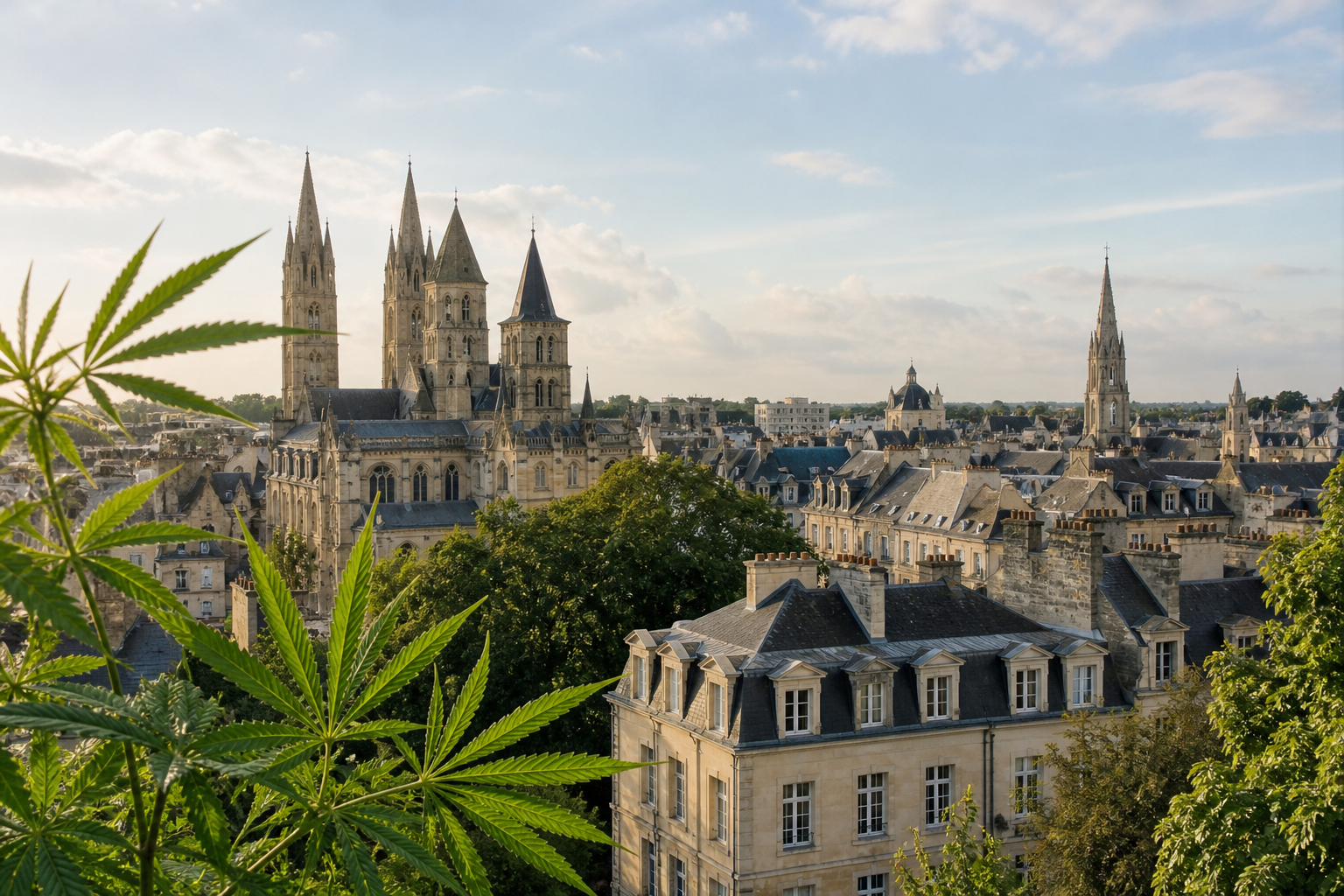
Marijuana trends in Caen reflect wider changes in France rather than a separate local market. Caen is a university city, a regional service centre and a gateway to Normandy, so conversations about cannabis can intersect with student life, nightlife, public health, tourism and changing attitudes toward CBD. However, local interest should not be confused with legal acceptance: French national law applies in Caen, and recreational cannabis remains prohibited.
This guide explains the main developments without promoting illegal purchasing or use. It covers the legal position, the difference between marijuana and CBD, health considerations, travel risks and the practical questions that residents and visitors are most likely to have. For broader regional context, readers may also find this overview of cannabis lifestyle in Rouen useful, while remembering that the same national rules apply across both cities.
Marijuana trends in Caen and the wider French context
The most important trend is a shift from treating cannabis as only a criminal justice issue toward a broader discussion involving prevention, addiction care, road safety and regulated medical research. That does not mean France has legalised recreational marijuana. Possession, use, supply and cultivation outside authorised frameworks can still lead to legal consequences.
In Caen, public discussion may be influenced by several overlapping communities: students, young professionals, nightlife audiences, families, healthcare workers and people interested in hemp-derived products. These groups do not necessarily share the same views. Some focus on personal freedom, while others are more concerned with dependency, impaired driving, exposure among young people and the effect of high-potency products.
It is also important to distinguish a visible conversation from reliable evidence about prevalence. Social media posts, informal observations and shop advertising cannot establish how common cannabis use is in Caen. A responsible local overview should avoid unsupported claims about the size of the market or the habits of particular neighbourhoods.
Cannabis laws in Caen: what residents and visitors should know
Cannabis laws in Caen are determined primarily at the national level. Recreational cannabis containing significant amounts of THC is illegal in France. Buying, selling, transporting, possessing or consuming it can expose a person to sanctions, and supplying another person creates additional legal risks.
French authorities may respond to simple drug use through a fixed criminal fine in qualifying circumstances, but the existence of that procedure does not make cannabis legal. The amount, circumstances, prior history and other factors can affect how a case is handled. A fine should therefore not be interpreted as a licence to carry or consume marijuana in public.
Public consumption can create further problems even apart from drug law. It may disturb other people, expose children or attract police attention. Consumption in accommodation can also breach a hotel, rental or residence agreement. Visitors should never assume that a relaxed atmosphere in another country or city changes French rules.
The official French public-service information portal is a useful starting point for checking current administrative and legal guidance. Rules and enforcement procedures can change, so official information is more reliable than social media claims or informal advice.
Driving and travel risks
Driving after cannabis use is especially risky. France applies strict rules concerning driving after drug use, and impairment is not the only issue: a positive test can have serious consequences. Do not drive, cycle in traffic or operate machinery after using cannabis. Visitors should also avoid carrying cannabis across borders, including between France and nearby countries, because import and export offences can be treated seriously.
CBD in Caen versus recreational marijuana
One of the clearest marijuana trends in Caen is the visibility of CBD products. CBD is a non-intoxicating cannabinoid, although products may contain trace amounts of THC or may be inaccurately labelled. CBD products are not the same as recreational marijuana and should not be assumed to produce the same effects.
French and European rules for hemp-derived goods are technical. Product legality can depend on the plant material, THC content, product category, labelling and how the item is marketed. Food supplements, cosmetics, flowers, oils and vaping products may be subject to different requirements. A product displayed in a shop is not automatically suitable for every use, and a product sold online may not comply with French standards.
- Check the ingredient list, batch information and manufacturer details.
- Look for credible laboratory testing rather than relying only on front-of-pack claims.
- Be cautious with products claiming to treat anxiety, pain, insomnia or other medical conditions.
- Ask a pharmacist or healthcare professional about possible interactions with medicines.
- Do not drive after taking a product if its effects are uncertain or if it contains THC.
CBD can cause unwanted effects and may interact with medicines. It is also possible for poorly controlled products to contain more THC than stated. People subject to workplace or road drug testing should be particularly cautious because even trace cannabinoids may create uncertainty.
Health and harm-reduction considerations
Discussions about cannabis in Caen should include health rather than focusing only on availability or lifestyle. Risk varies according to age, frequency, potency, method of use, personal health and whether cannabis is combined with alcohol or other drugs.
Frequent use can become difficult to control for some people. Possible warning signs include spending more time obtaining or using cannabis, using more than intended, neglecting responsibilities, continuing despite problems and feeling unable to cut down. Young people may face particular concerns because the brain continues developing through adolescence and early adulthood.
Inhalation also carries respiratory risks, especially when smoke is involved. Edibles create a different problem: effects can take longer to appear, which may lead someone to consume more before the first dose has taken effect. Mixing cannabis with alcohol can increase impairment and anxiety. Anyone experiencing severe confusion, chest pain, breathing difficulty, loss of consciousness or a serious panic reaction should seek urgent medical help.
People with a history of psychosis, severe anxiety, bipolar disorder or substance-use problems should discuss cannabis risks with a qualified clinician. Pregnancy and breastfeeding are additional situations in which avoiding cannabis is the safest approach. The French government’s official drug-information portal provides public-health information and routes to support resources.
When to seek support
A person in Caen who wants to reduce or stop cannabis use can begin with a general practitioner, pharmacist or local addiction-support service. French specialist services known as CSAPA provide confidential assessment, counselling and support for addiction-related concerns. Asking for help does not require someone to wait until their use has caused a crisis.
Medical cannabis in Caen: expectations and limits
Searches for medical cannabis in Caen often reflect interest in whether cannabis can help with chronic pain, sleep problems or other long-term conditions. Medical cannabis should not be confused with self-medicating using recreational marijuana or buying an unverified CBD product.
France has explored medical cannabis through a controlled framework and has discussed how a longer-term system might operate. Access has not amounted to general permission for patients to obtain cannabis products independently. Eligibility, prescribing, dispensing and reimbursement depend on the applicable national framework and clinical circumstances.
Patients should speak with their treating clinician rather than stopping prescribed medicine or sourcing cannabis informally. A doctor or pharmacist can consider interactions, driving implications, mental-health history and whether an authorised treatment is appropriate. Claims made by retailers or influencers are not a substitute for medical assessment.
How Caen’s local setting shapes the conversation
Caen’s identity as a Normandy city matters when interpreting local cannabis discussions. Its student population, central urban areas, transport links and proximity to coastal destinations create a mix of resident and visitor perspectives. That can make cannabis more visible in some social settings without proving that use is more common than elsewhere.
Local institutions are likely to approach the issue through prevention, policing, healthcare, education and community wellbeing. Schools and universities may focus on academic performance, mental health and support services. Healthcare providers may concentrate on dependence, sleep, anxiety and medication interactions. Residents may be most concerned about public consumption, nuisance or safe streets.
Comparing Caen with nearby cities can help readers understand the national pattern without exaggerating local differences. For example, our guide to cannabis information in Le Havre discusses similar legal and health questions in another Normandy setting. The key point is that city identity affects culture and services, while national law determines the basic legal position.
Practical advice for residents and visitors
- Do not buy, sell, carry or consume illegal THC cannabis in Caen.
- Do not take cannabis across the French border, even when travelling to a country with different rules.
- Never drive or cycle in traffic after cannabis use.
- Do not assume that a CBD product is THC-free or medically effective.
- Keep cannabinoid products away from children and pets.
- Check current official guidance before relying on claims about medical access or product legality.
- Seek professional help if use is affecting health, relationships, study, work or finances.
Visitors should also remember that accommodation providers may prohibit smoking or vaping, including on balconies and in outdoor areas. Respecting those rules avoids conflict and reduces exposure to other guests. A low-profile, lawful approach is safer than treating Caen as a destination for cannabis tourism.
What to watch in the coming years
Future marijuana trends in Caen will probably follow national developments in prevention, public-health messaging, CBD oversight, roadside testing and medical research. The most meaningful changes may be administrative and clinical rather than a sudden expansion of recreational access.
Readers should watch for official announcements, updated public-health guidance and changes to product standards. They should also be sceptical of headlines suggesting that France has broadly legalised cannabis when the underlying change may concern hemp products, a limited medical framework or a court decision with narrow application.
Conclusion
Marijuana trends in Caen are best understood through the combination of local culture and French national policy. CBD has increased the visibility of cannabinoid products, while public discussion increasingly includes health, dependence, road safety and medical research. None of those developments makes recreational THC cannabis legal.
For residents and visitors, the safest approach is straightforward: follow French law, avoid illegal purchasing and possession, do not drive after use, treat CBD claims carefully and seek qualified medical or addiction support when needed. That approach provides a more accurate picture of cannabis in Caen than speculation about a local market or assumptions based on trends elsewhere.