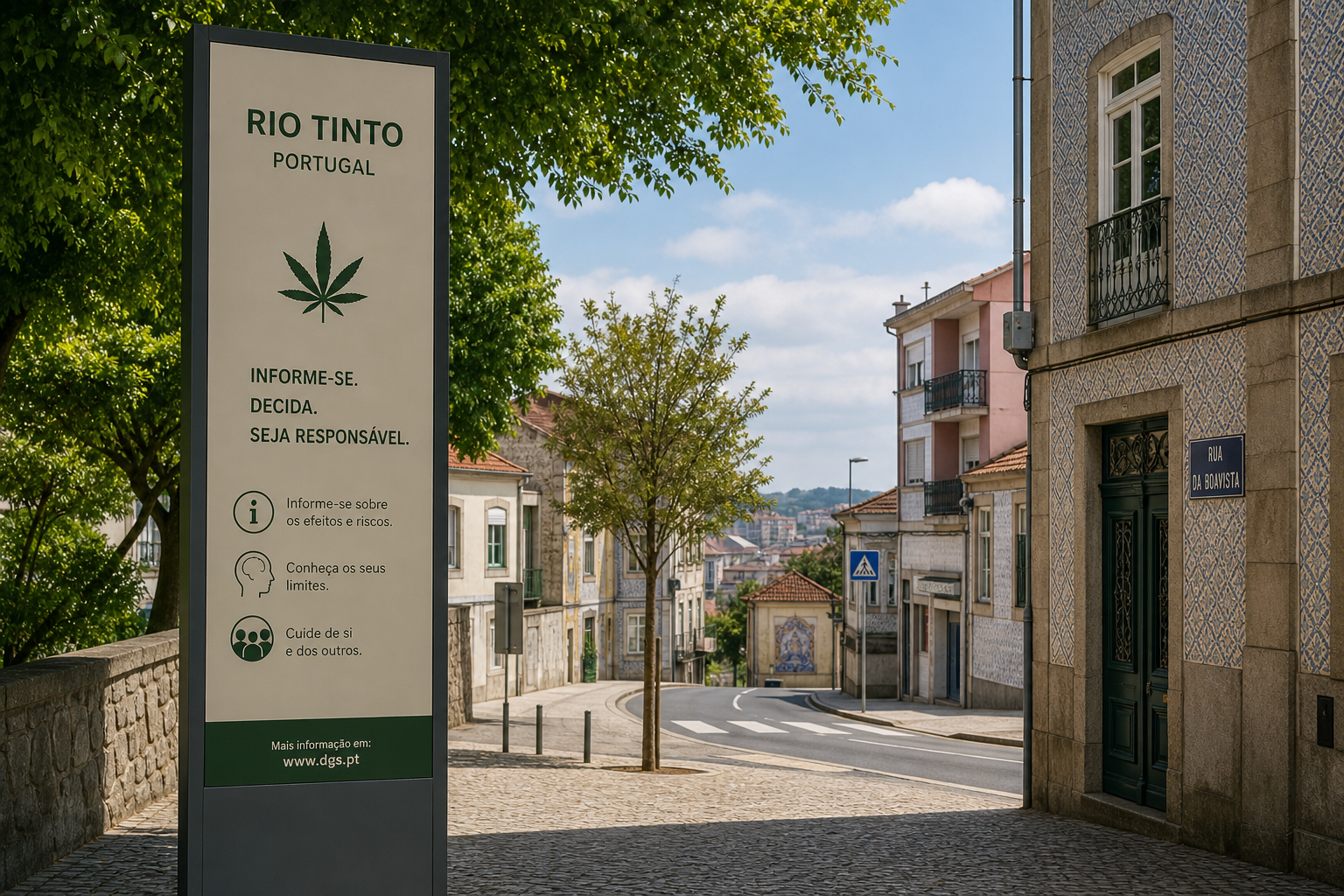
Understanding Marijuana Legality in Rio Tinto, Portugal requires separating decriminalization from legalization. Rio Tinto is a city and civil parish in the municipality of Gondomar, within the Porto metropolitan area, but cannabis rules are set mainly by Portuguese national law rather than by the local council. Portugal generally treats personal possession and use differently from commercial supply, trafficking, and unlicensed cultivation.
For residents and visitors, the practical message is straightforward: limited possession for personal use may be handled as an administrative matter, but marijuana is not generally legal to buy, sell, produce, or consume wherever you choose. This guide explains the main rules, medical access, travel concerns, and safety issues without treating decriminalization as permission.
How cannabis law applies in Rio Tinto
There is no separate Rio Tinto cannabis code. The same national framework applies in Gondomar as in other Portuguese locations, including Porto, Lisbon, and the Algarve. Local police and administrative authorities may enforce those rules, while courts and national regulators deal with more serious offenses and regulated medical products.
Portugal decriminalized the use and possession of limited quantities of drugs for personal use in 2001. Decriminalization means that conduct is generally removed from the criminal offense system and may instead lead to an administrative process. It does not create a legal retail market, and it does not authorize a person to possess unlimited quantities.
For background on Portugal’s public-health approach, readers can consult the official Portuguese national authority for addictive behaviours and dependencies. Laws and administrative practices can change, so a current official source is preferable to relying on informal advice.
Is weed in Rio Tinto legal?
The phrase weed in Rio Tinto can describe several different situations, and each has a different legal risk. Personal possession of a small amount may be treated as an administrative matter, while supplying another person, importing cannabis, or operating a commercial distribution network can remain criminal conduct.
- Personal possession: Limited possession intended for personal use is generally handled through Portugal’s decriminalization framework rather than as a standard criminal conviction.
- Public use: Decriminalization does not make public consumption acceptable. Police may intervene where use causes disturbance, creates a safety issue, or occurs in a prohibited or sensitive location.
- Sale and supply: Selling, distributing, or sharing cannabis can expose a person to criminal liability, even when no money changes hands.
- Commercial production: Growing or manufacturing cannabis outside an authorized framework is not made lawful by the personal-use rules.
- Import and export: Bringing cannabis across a border remains particularly risky and may involve serious criminal or customs consequences.
The amount involved is only one factor. Authorities may also consider packaging, communications, cash, scales, multiple substances, and other evidence suggesting supply rather than personal use. A person should not assume that being below a commonly discussed threshold guarantees that no action will be taken.
Cannabis laws in Rio Tinto and personal possession
Portugal commonly refers to an indicative amount corresponding to up to ten days of personal use when assessing possession. This is not the same as a guaranteed legal allowance. The quantity is used within an assessment process, and the circumstances of the case still matter.
If authorities believe the substance is for personal use, the matter may be referred to a Commission for the Dissuasion of Drug Addiction. Possible responses can include a warning, a fine, or other administrative measures. The commission may also consider whether health or social support would be useful. The precise outcome depends on the facts, the person’s circumstances, and the applicable law at the time.
Possession above an indicative personal-use amount is not automatically proof of trafficking, but it can increase scrutiny and may create a presumption or investigative concern that the substance is intended for distribution. Anyone questioned about cannabis should remain calm, avoid making assumptions about their rights, and seek qualified Portuguese legal advice if the matter is serious.
Is cannabis in Rio Tinto available for recreational purchase?
Cannabis in Rio Tinto is not sold through a licensed recreational dispensary system comparable to regulated adult-use markets in some other countries. A shop, street seller, social-media account, or private contact offering marijuana is not thereby operating legally.
Buying from an informal source carries several risks:
- The product may contain unexpected substances or have unknown potency.
- The transaction may expose the buyer to theft, fraud, coercion, or police action.
- Sharing, reselling, or transporting the product can create additional legal problems.
- Visitors may misunderstand Portuguese decriminalization and assume that purchase is protected.
It is also unwise to treat cannabis-related businesses in neighboring Porto as proof that recreational sales are lawful. For a broader regional comparison, see this guide to marijuana laws and safety in Porto. The same national restrictions generally apply, even though local settings and enforcement encounters may differ.
Medical cannabis in Rio Tinto
Medical cannabis in Rio Tinto is legal only within Portugal’s regulated medical framework. A doctor must determine whether a cannabis-based medicine is appropriate for a qualifying condition and whether authorized treatment is justified. Patients normally obtain prescribed products through the regulated pharmacy system rather than from an informal seller.
Medical cannabis is not a general authorization to possess recreational marijuana. A prescription or treatment record may help explain lawful possession of a prescribed product, but it does not automatically permit a patient to grow plants, buy unregulated flower, share medicine, or carry cannabis across an international border.
Portugal’s medicines regulator, INFARMED, provides official information about medicines and regulated cannabis-based products. Consult its official INFARMED website for current regulatory information, product requirements, and patient-related guidance. A patient should also follow the exact directions on the prescription and ask a pharmacist how the product must be stored, transported, and used.
What patients should check
- Whether the product is authorized and dispensed through a lawful channel.
- Whether the prescription is valid in Portugal and issued under the applicable rules.
- Whether driving or operating machinery is restricted by the medicine or by medical advice.
- Whether travel documentation is needed before crossing a border.
- Whether the treatment interacts with alcohol, sedatives, or other medicines.
Growing cannabis at home
Portugal’s decriminalization policy should not be read as a home-growing license. Cultivating cannabis without the required authorization can remain a criminal offense, including when a person claims the plants are for personal use. The location of the plants in Rio Tinto does not change that national rule.
Home cultivation can also create practical problems involving neighbors, landlords, children, fire safety, electrical equipment, and odor. Medical treatment does not automatically convert private cultivation into authorized production. Anyone considering cultivation should obtain advice from a Portuguese lawyer familiar with controlled-substance and medicines regulation.
Driving, public places, and responsible conduct
Driving after using cannabis is unsafe and can have legal consequences. Intoxication can affect reaction time, attention, judgment, and coordination. The safest approach is not to drive, cycle in traffic, or operate machinery after consuming cannabis, especially when the product’s strength or effects are uncertain.
Consumption in a street, park, transport facility, nightlife venue, workplace, or rented accommodation may breach local rules, house policies, or other laws even if personal possession is treated administratively. Smoke and odor can affect other people, and public use may attract police attention. Do not use cannabis around children, in healthcare settings, or near schools and other sensitive locations.
Edibles deserve particular caution because effects can be delayed and may last longer than expected. Combining cannabis with alcohol or sedating medicines can increase impairment. Anyone who develops severe confusion, chest pain, difficulty breathing, loss of consciousness, or a serious panic reaction should seek emergency medical help.
Traveling to or from Rio Tinto with cannabis
Travel is one of the areas where mistakes can become especially serious. Taking cannabis from Portugal to Spain or another country, bringing it into Portugal, or carrying it through an airport can involve border, customs, and trafficking laws. Portuguese decriminalization does not override the laws of the destination or transit country.
Do not place cannabis in checked or hand luggage, and do not assume that a medical prescription makes international transport automatic. Patients traveling with authorized medicines should check the requirements of every country on the itinerary well before departure and carry only properly documented medication when permitted.
Visitors who encounter cannabis in Rio Tinto should avoid transporting it for another person or accepting a package, even as a favor. The traveler may not know the contents, and cross-border movement can be treated far more seriously than possession for personal use within Portugal.
How Rio Tinto compares with other Portuguese cities
Because the core rules are national, the legal position in Rio Tinto is broadly comparable to that in other Portuguese cities. Differences are more likely to involve where an incident occurs, the conduct of the people involved, whether police suspect supply, and whether a venue has its own restrictions.
Readers comparing locations may also find useful context in this overview of CBD rules and product safety in Vila Nova de Gaia. CBD products are not interchangeable with high-THC marijuana, and a product labeled as CBD should still be checked for lawful composition, labeling, and intended use.
Practical checklist for residents and visitors
- Do not equate decriminalization with legalization or a right to buy cannabis.
- Never sell, distribute, share, import, or export cannabis without specific legal authorization.
- Keep away from driving, cycling in traffic, machinery, children, and public disturbances.
- Use only regulated medical products prescribed through the Portuguese healthcare system.
- Do not grow cannabis at home unless you have verified a specific authorization.
- For police, court, medical, or immigration concerns, consult a qualified professional in Portugal.
- Check current official guidance before acting because drug and medicines rules may be amended.
Conclusion
Marijuana legality in Rio Tinto reflects Portugal’s national balance between public-health decriminalization and continued restrictions on supply. Limited personal possession may lead to an administrative response rather than a conventional criminal prosecution, but recreational sales, unlicensed cultivation, trafficking, and cross-border transport remain serious risks. Medical cannabis is available only through regulated treatment pathways.
For anyone dealing with cannabis laws in Rio Tinto, the safest approach is to avoid informal purchases, public use, driving after consumption, and international transport. When the issue involves a prescription, police contact, or a possible criminal allegation, current advice from Portuguese authorities or a qualified lawyer is more reliable than assumptions based on the word “decriminalized.”