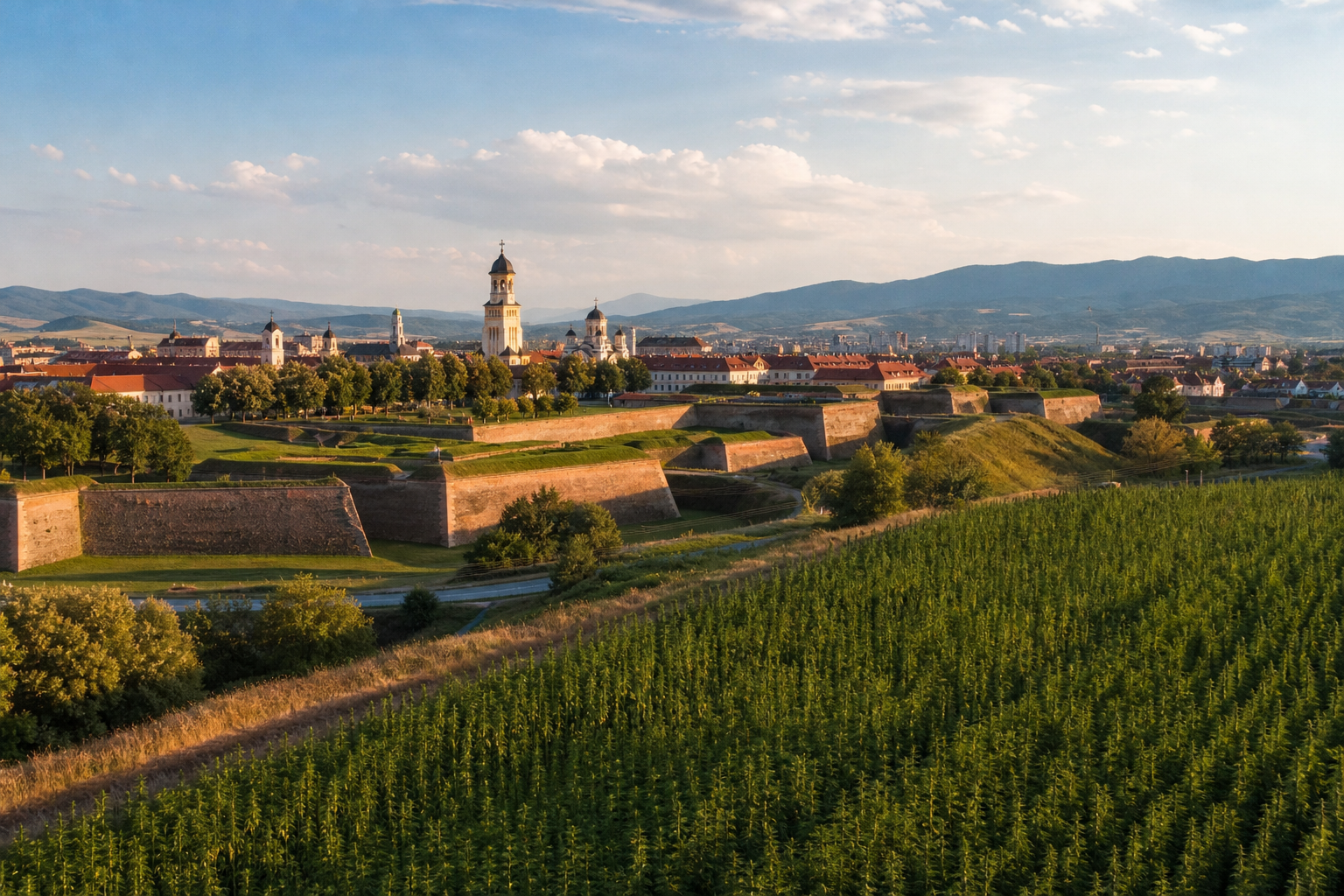
The Marijuana industry in Alba Iulia, Romania is best understood as an emerging discussion about hemp, CBD products, medical research, public health and future business opportunities—not as a legal recreational cannabis market. Alba Iulia is a historic city and the administrative centre of Alba County, with connections to agriculture, education, tourism and regional commerce. Those characteristics could support a carefully regulated hemp and wellness sector, provided that businesses and consumers follow Romanian law.
For residents searching for weed in Alba Iulia or information about cannabis in Alba Iulia, the most important distinction is between controlled cannabis, industrial hemp and products marketed as CBD. These categories may have different legal and safety implications. This guide explains the current landscape in practical terms, without presenting illegal supply as a normal retail industry.
What the marijuana industry in Alba Iulia actually includes
Romania does not operate a broad, licensed recreational marijuana retail system. As a result, discussion of the local marijuana sector should focus on lawful activity and realistic economic possibilities. Potential areas include licensed industrial hemp cultivation, fibre and seed processing, compliant food or cosmetic products, laboratory testing, medical education and research.
Alba Iulia’s position in central Romania may give local enterprises access to agricultural suppliers, nearby university communities and customers across Alba County. However, geography alone does not make cannabis-related activity legal. Any company working with hemp or cannabinoid products needs to identify the relevant plant material, product category, THC content, intended use and regulatory obligations before trading.
Industrial hemp is not the same as marijuana
Industrial hemp generally refers to approved cannabis varieties cultivated for fibre, seed, grain or other permitted purposes, while marijuana commonly refers to cannabis cultivated or supplied for intoxicating THC content. The difference is important, but a product cannot become lawful simply because a seller labels it “hemp.” Seed provenance, cultivation permissions, laboratory results, processing methods and the finished product all matter.
Businesses should also avoid assuming that a low-THC label resolves every legal issue. Rules can apply to cultivation, possession, extraction, importation, advertising, food presentation, cosmetics and medicines separately. A Romanian lawyer or compliance specialist should review a business model before investment or launch.
Cannabis laws in Alba Iulia: the national framework applies
There is no separate Alba Iulia cannabis regime that overrides Romanian national law. The same national rules apply in Alba County as elsewhere in the country. Possession, production, cultivation, sale and distribution of controlled cannabis can create serious criminal or administrative consequences depending on the conduct and circumstances.
Anyone assessing cannabis laws in Alba Iulia should consult the current text of Romania’s Law no. 143/2000 on preventing and combating illicit drug trafficking and consumption, while remembering that legislation and interpretation can change. The law is not a substitute for individual legal advice, especially in cases involving cultivation, transport, online sales or products that may contain controlled substances.
Visitors and residents should not treat informal offers, social-media advertisements or foreign descriptions of cannabis legality as reliable guidance for Romania. A product that is tolerated or regulated in another country may still be prohibited when brought into Romania, sold locally or carried across a border.
Why product testing and documentation matter
For lawful hemp and CBD businesses, documentation is central to risk management. A responsible operator should be able to identify the supplier, batch, ingredients, intended use and testing status of each product. Independent laboratory analysis may help verify cannabinoid content and screen for contaminants, although a test report does not automatically prove that a product is legally marketable.
- Check whether the product is intended as food, cosmetic, supplement, raw material or medicine.
- Request current batch documentation rather than relying only on a generic certificate.
- Review THC and other cannabinoid results using an appropriately accredited laboratory where possible.
- Do not make medical claims unless the product and advertising are authorised for that purpose.
- Keep invoices, supplier records, labels and compliance assessments available for inspection.
Hemp and CBD opportunities in Alba Iulia
The most plausible near-term opportunity is a broader hemp value chain rather than a recreational dispensary model. Local entrepreneurs might explore hemp seed foods, fibre-based materials, agricultural services, compliant cosmetics, packaging concepts, educational events and laboratory or logistics support. Each area has different rules, so a company should define its activity precisely before registering products or promoting them.
Interest in hemp products in Alba Iulia may grow through farmers’ markets, specialist retailers and online businesses, but demand should be matched by transparent labelling and realistic claims. Hemp seed products, for example, are not interchangeable with high-THC cannabis, and a CBD product is not automatically a medicine or a treatment.
Retailers should be especially careful with imported oils, flowers, gummies and vape products. Packaging created for another market may not meet Romanian requirements. Products containing novel ingredients may also raise additional food-safety questions. A cautious business will obtain a product-specific assessment before placing goods on the market rather than relying on a supplier’s marketing language.
How local businesses can build trust
Trust is a competitive advantage in a sector where consumers may struggle to interpret labels. Shops and manufacturers can support informed purchasing by publishing plain-language ingredient information, batch references, storage instructions and appropriate warnings. They should distinguish general wellness information from medical advice and avoid promising to treat anxiety, pain, epilepsy or other conditions without proper authorisation.
Businesses can also contribute to the local economy without normalising illegal consumption. Partnerships with agricultural organisations, universities, testing laboratories and public-health educators could support skills, research and quality assurance. Such collaboration is more sustainable than attempting to profit from legal ambiguity.
Medical cannabis access in Alba Iulia
Searches for medical cannabis in Alba Iulia can be misleading because “medical cannabis” is used broadly online. A person may be asking about an authorised medicine, a CBD wellness product, a prescription, a clinical study or an unregulated product advertised for a health condition. These are not equivalent.
Patients should discuss cannabis-related treatment questions with a qualified clinician who can review diagnosis, current medicines, contraindications and evidence-based alternatives. They should not replace prescribed treatment with a product bought from an unverified website or informal seller. Questions about authorised medicines, availability and regulatory status should be directed to healthcare professionals and the relevant medicines authorities. The National Agency for Medicines and Medical Devices of Romania is an appropriate starting point for official medicines information.
Doctors and pharmacists can help clarify whether a particular product is an authorised medicine, whether a prescription is required and whether it may interact with other treatments. Patients should also ask how to report suspected adverse reactions or quality problems. Online testimonials are not a reliable substitute for clinical evaluation.
Public health and safer choices
A responsible conversation about the cannabis industry in Alba Iulia must include health risks as well as commercial opportunity. Cannabis can affect attention, memory, coordination and reaction time. Some people may experience anxiety, paranoia or other unwanted psychological effects. Risk can be higher for adolescents, people with a personal or family history of certain mental-health conditions, and those who combine cannabis with alcohol or sedating medicines.
Driving after using cannabis is particularly dangerous and may have legal consequences. People should never drive, cycle in traffic or operate machinery while impaired. Mixing substances increases uncertainty, while high-potency products can make effects more difficult to predict.
- Do not use unknown products whose contents or strength cannot be verified.
- Keep cannabinoid products away from children and pets.
- Do not share products with minors or pressure anyone to use them.
- Seek medical help for severe confusion, chest pain, breathing problems, loss of consciousness or extreme agitation.
- Ask a healthcare professional about possible interactions with prescription medicines.
Public education should be factual rather than promotional. Schools, healthcare providers and community organisations can focus on delayed decision-making, mental health, impaired driving, dependence and how to seek confidential support.
Lessons from other Romanian cities
Alba Iulia does not need to develop its policy conversation in isolation. Readers can compare the legal and safety themes discussed here with the practical overview of cannabis information in Sibiu, a nearby regional reference point. Other local guides, including information about marijuana in Cluj-Napoca, can also help show why national law, medical access and consumer protection should be considered together.
These comparisons should not be treated as evidence that a product or activity is legal in Alba Iulia. Their value is contextual: cities may have different healthcare networks, commercial profiles and public conversations, but national Romanian rules remain the foundation.
What responsible development could look like
A realistic roadmap for the marijuana sector in Alba Iulia would begin with compliance rather than expansion. Local firms could map permitted activities, consult regulators and legal advisers, establish quality-control procedures and train staff before seeking customers. Public institutions could support neutral information, referral pathways and transparent discussion about agriculture, health and enforcement.
- Define the product or service: Identify whether it involves hemp seed, fibre, cosmetics, food, CBD, laboratory work, medicine or another category.
- Confirm permissions: Check cultivation, processing, import, labelling, advertising and sales requirements with qualified advisers and relevant authorities.
- Test and document: Maintain batch records, supplier information and credible laboratory evidence where appropriate.
- Use responsible marketing: Avoid unverified treatment claims, youth-oriented branding and language that encourages risky use.
- Review continuously: Monitor legal updates, product recalls, public-health guidance and changes in European or Romanian regulation.
This approach could create legitimate employment and innovation around hemp while reducing consumer confusion. It also recognises a basic commercial reality: long-term businesses depend on predictable compliance, quality products and public trust.
Conclusion
The marijuana industry in Alba Iulia is currently more accurately described as a developing hemp, CBD, medical-information and public-health conversation than as a legal recreational market. Opportunities may exist in compliant agriculture, processing, testing, education and wellness products, but Romanian law places clear limits on controlled cannabis and unauthorised sales.
For consumers, the safest approach is to verify product status, avoid informal supply, seek medical advice for health questions and never drive while impaired. For entrepreneurs, careful legal review, reliable testing and honest marketing are essential. Alba Iulia can participate in responsible sector development, but credibility will come from compliance and evidence—not from exaggerated claims or imported assumptions about cannabis legality.