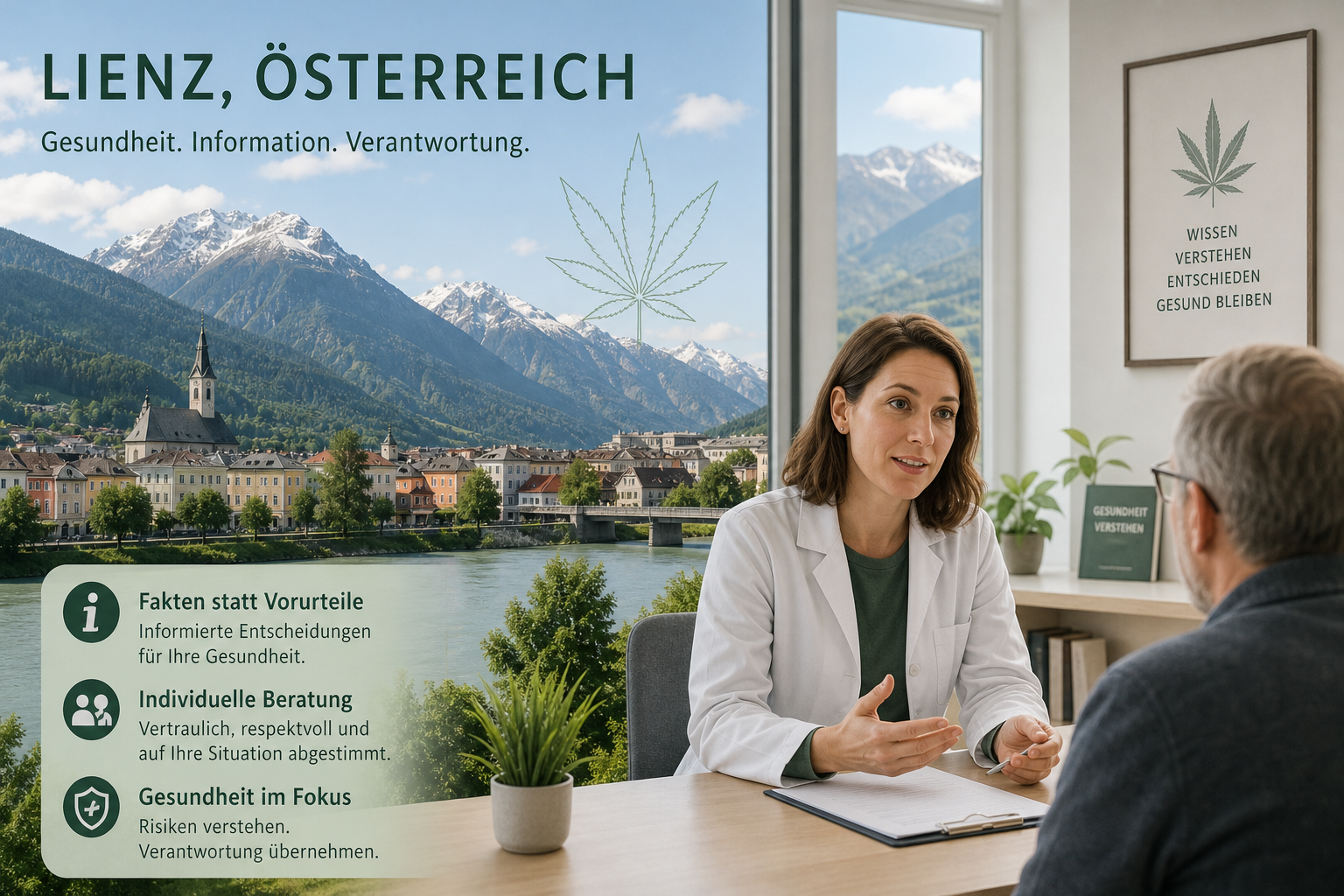
Reliable Marijuana health information in Lienz, Austria should distinguish health effects from legal assumptions and online marketing. Whether you are a resident, visitor or caregiver, questions about weed in Lienz may involve short-term impairment, dependence, prescription treatment, product strength, driving and when to seek medical help. This guide provides general health information, not a diagnosis or personal medical or legal advice.
Austria regulates cannabis under national law, so local surroundings in Tyrol do not create a separate recreational cannabis system. Rules can also change, and the legal position may depend on the substance, amount, purpose, prescription status and circumstances. For a broader comparison of regional legal issues, see this practical guide to cannabis laws and penalties in St. Veit an der Glan.
What cannabis does to the body and mind
Cannabis contains many compounds. The best-known are tetrahydrocannabinol, or THC, which is intoxicating, and cannabidiol, or CBD, which does not produce the same typical “high.” Effects vary according to dose, product potency, route of administration, previous experience, body chemistry, other medicines and whether alcohol or other drugs are involved.
THC can affect attention, reaction time, memory, coordination, perception of time and judgment. Some people feel relaxed or euphoric, while others experience anxiety, panic, dizziness, confusion or suspicious thoughts. A person may not accurately judge their own impairment, particularly after using a high-potency product or combining substances.
Inhaled products
Smoking or vaping can produce effects relatively quickly, but inhaling smoke exposes the lungs and airways to irritants. Vaping is not automatically harmless: devices and liquids can vary, and contaminated or unsuitable products may create additional risks. Never assume that a product described as natural, herbal or CBD-based has been tested to a consistent medical standard.
Edibles and oral products
Edibles can take longer to produce noticeable effects than inhaled cannabis. This delay may lead someone to consume more before the first dose has fully taken effect. Oral effects can also last longer and may feel less predictable. Keeping such products away from children, pets and anyone who could mistake them for ordinary food is important.
Health risks to consider in Lienz
The health considerations for cannabis in Lienz are broadly the same as elsewhere in Austria, although access to specialist services may differ between urban and rural areas. A local doctor, pharmacist or health service can help interpret symptoms and medication interactions without relying on informal advice.
- Impairment: THC can reduce concentration, coordination and reaction speed, creating risks at work, on roads, on bicycles and during outdoor activities.
- Mental health: Cannabis may worsen anxiety or trigger distress in some people. Frequent use and high-potency products are associated with greater concern, especially for people with a personal or family history of psychosis.
- Dependence: Some users develop difficulty cutting down, strong cravings or continued use despite problems at home, work, school or in relationships.
- Respiratory irritation: Smoking cannabis can irritate the airways. Mixing cannabis with tobacco adds exposure to tobacco smoke and may make stopping more difficult.
- Heart and circulation effects: Cannabis may temporarily increase heart rate and can cause light-headedness. People with cardiovascular conditions should ask a clinician about individual risks.
- Pregnancy and breastfeeding: Avoiding cannabis is the safest approach because cannabinoids can reach the developing infant and evidence does not establish a safe recreational dose.
Risk is not determined by the name on the package alone. THC concentration, frequency of use, age at first use, mental health, sleep, genetics and other substances all matter. Adolescents and young adults may be particularly vulnerable to effects on learning, motivation and mental health, so prevention and early support are preferable to waiting for a crisis.
Medical cannabis in Lienz: what patients should know
Medical cannabis in Lienz is not the same as buying a recreational product and using it for a health problem. A clinician must assess the condition, existing treatments, possible benefits and risks. Cannabis-based medicines may be considered in specific situations, but they are not a universal treatment for pain, insomnia, anxiety or stress.
Patients should tell their doctor or pharmacist about all medicines, supplements, alcohol use and previous reactions to cannabis. THC can affect alertness and may interact with other substances that cause sedation. Do not change a prescribed medicine, drive after taking an unfamiliar product or share medication with another person.
Questions to ask a healthcare professional
- What condition is being treated, and what evidence supports this option?
- What product, dose and schedule are appropriate for me?
- How long should treatment continue before it is reviewed?
- Could it interact with my current medicines or alcohol?
- What symptoms should prompt an urgent call or medical assessment?
- Can I safely drive, work at height or operate machinery?
For general public-health information, consult the Austrian health portal at Gesundheit.gv.at, Austria’s official health information portal. It is more dependable than social-media claims or anonymous product reviews.
Cannabis laws in Lienz and health-related decisions
Health information cannot be separated completely from cannabis laws in Lienz. Possession, acquisition, supply, cultivation and use may have different legal consequences, and a medical reason does not automatically make an unapproved product lawful. Product labels, informal seller claims and foreign rules should not be treated as proof of Austrian legality.
Do not carry cannabis across borders when travelling to or from Tyrol without checking the applicable rules. A product that is permitted in one country may be restricted in another, and a prescription or receipt may not solve every transport issue. Our guide to cannabis travel restrictions in Hollabrunn offers related travel-focused context, although readers should verify current rules for their own journey.
Official regulatory information is especially important for medicines and controlled substances. The Austrian Agency for Health and Food Safety provides information about medicines and regulatory responsibilities. For a personal legal question, seek qualified Austrian legal advice rather than relying on a general article.
Driving, work and outdoor activities
One of the most important practical issues for cannabis in Lienz is impairment during transport and recreation. Do not drive a car, ride a bicycle in traffic, use a cable car or operate machinery when affected. Feeling calm does not prove that reaction time and judgment have returned to normal. Combining THC with alcohol can increase impairment.
Mountain roads, winter conditions, hiking routes and water activities leave little room for slowed reactions or poor decisions. Plan transport before using any intoxicating substance. If you use a prescribed cannabis-based medicine, ask the prescriber specifically about driving and follow Austrian requirements; do not assume that medical use eliminates impairment concerns.
Recognising problematic use
Occasional use does not affect everyone in the same way, but warning signs deserve attention. These may include using more than intended, unsuccessful attempts to cut down, spending substantial time obtaining or recovering from use, neglecting responsibilities, needing more to achieve the same effect or continuing after anxiety, memory problems or relationship difficulties appear.
A non-judgmental conversation with a doctor, addiction service or trusted healthcare professional is a sensible first step. Support can focus on reducing risk, stopping use, managing sleep or anxiety, and treating any underlying condition. People do not need to wait until use becomes severe before asking for help.
Practical steps for lower risk
- Avoid cannabis if you are underage, pregnant, breastfeeding or at elevated risk of psychosis.
- Do not mix cannabis with alcohol, sedatives or other intoxicating substances.
- Choose a safe environment and avoid using alone if you are inexperienced or worried about a reaction.
- Do not drive, cycle in traffic, swim, climb or use machinery while impaired.
- Keep products locked away from children and pets.
- Be cautious with unknown strength, homemade preparations and products with unclear ingredients.
- Seek professional advice if use is frequent, difficult to control or affecting daily life.
When to seek urgent medical help
Call emergency services if someone has severe breathing difficulty, chest pain, a seizure, loss of consciousness, extreme confusion, dangerous agitation or cannot be awakened. A person who is panicking should be moved to a quiet, safe place, reassured and monitored without being left alone. Do not give alcohol or additional drugs to counteract cannabis effects.
In Austria, call 144 for ambulance assistance or 112 for the European emergency number. If the situation is not immediately life-threatening but remains concerning, contact a medical professional or local health service. Be honest about what was taken, how much may have been used and whether alcohol or medicines were involved; accurate information helps clinicians respond safely.
Finding trustworthy information locally
Searches for “weed in Lienz” may return sellers, lifestyle content and unverified claims alongside useful health information. Evaluate sources carefully. Prefer Austrian public-health services, licensed healthcare professionals, recognised medical institutions and official regulators. Check whether a page identifies its author, date, evidence and limits. Be especially sceptical of claims that cannabis cures a wide range of illnesses or that CBD products are risk-free.
For additional context, our article on cannabis awareness, health and safer choices in Ansfelden discusses how public education can address risks without exaggeration. Research developments should also be interpreted carefully; a study result does not automatically establish that a commercial product is effective or suitable for self-treatment.
Conclusion
Good Marijuana health information in Lienz, Austria is practical, balanced and aware of both medical uncertainty and Austrian rules. THC can impair coordination, judgment and mental well-being, while smoking, high-potency products, mixing substances and frequent use can increase harm. Medical cannabis requires professional assessment, and a prescription does not remove the need to consider driving, interactions or dependence.
If you are concerned about your own use or someone else’s reaction, seek qualified help early. Use official health and regulatory sources, avoid cross-border assumptions, and treat safety as more important than informal advice or marketing.