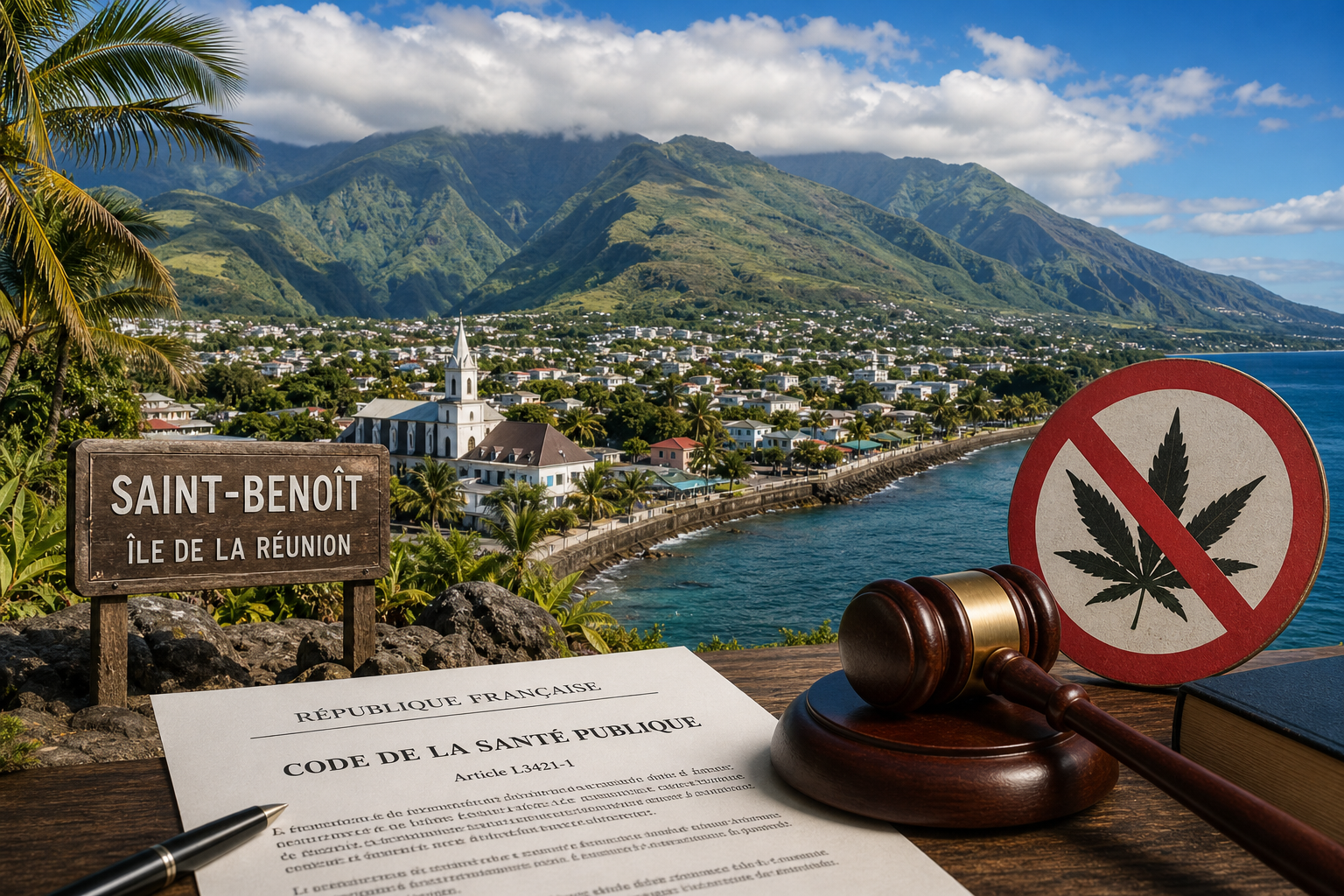
Marijuana decriminalization in Saint-Benoît (Réunion) is often used as a shortcut for describing France’s fixed-penalty system for drug use. It does not mean that recreational cannabis is legal in Saint-Benoît, that residents can buy it from licensed shops, or that possession is generally permitted. Saint-Benoît follows French national criminal law, including the rules that apply across Réunion.
The practical distinction matters. A person found using or possessing a small quantity may sometimes receive an immediate fixed fine rather than being taken through a longer criminal procedure. However, cannabis remains prohibited, and police and prosecutors may still use other legal procedures depending on the circumstances. This guide explains the position for residents and visitors without treating a fine as a licence to possess or consume marijuana.
Is cannabis decriminalized in Saint-Benoît?
No. Cannabis has not been legalized for recreational use in Saint-Benoît. French law prohibits the unauthorized use, possession, purchase, sale, transport and cultivation of cannabis. The same national framework applies in mainland France and in Réunion, which is an overseas department and region of France.
What changed in practice was the introduction of a forfaitaire délicate, commonly described in English as a fixed criminal fine, for certain straightforward cases involving drug use. This approach can make enforcement faster, but it does not remove the underlying offence. It is more accurate to describe the system as partial procedural decriminalization in limited circumstances rather than full marijuana decriminalization.
For an overview of the national penalties and procedures, consult the official French government information on drug-related offences and sanctions in France. Local police action in Saint-Benoît must be understood within that national framework.
What marijuana decriminalization means in Saint-Benoît
In everyday discussion, “decriminalization” can suggest that cannabis possession is treated like a minor regulatory matter. That is not the full picture in Saint-Benoît. A fixed fine can be issued for certain cases, but the conduct remains legally prohibited and can create further consequences.
The fixed fine
For eligible cases involving drug use, the standard fixed fine is generally €200. It may be reduced to €150 when paid within the applicable early-payment period and increased to €450 if it is not paid within the relevant deadline. The exact payment instructions and dates shown on the notice control, so anyone receiving a notice should read it carefully rather than relying on a general online summary.
The fixed-fine route is not guaranteed. Factors such as the person’s age, the quantity involved, the circumstances of the stop, prior history, suspected supply, or difficulty establishing the facts can affect how the case proceeds. A matter may instead be referred to prosecutors or handled through another judicial process.
A fine is not permission to possess cannabis
Paying a fixed fine does not make cannabis legal. It resolves the specific enforcement procedure under the terms stated on the notice; it does not authorize future possession, use, cultivation or purchase. A person who repeatedly attracts police attention may face more serious scrutiny, particularly where there are indications of supply or organized activity.
Cannabis laws in Saint-Benoît: possession, use and supply
The most important rule for cannabis in Saint-Benoît is that recreational possession and use remain unlawful. The legal response can vary according to the facts, but the following distinctions are useful.
- Personal use: using cannabis is prohibited, even in a private setting. A fixed fine may be available in some uncomplicated cases, but prosecution remains possible.
- Possession: possession is not automatically legal because the amount is small. Police may seize the substance and determine whether a fixed fine or another procedure is appropriate.
- Sale or supply: supplying cannabis to another person is treated far more seriously than simple personal use. Sharing with friends is not a safe legal exception.
- Cultivation: growing cannabis without the required legal authorization is prohibited. A plant grown at home can still create criminal exposure.
- Import and export: carrying cannabis across borders, including by air or sea, can lead to serious consequences even when the quantity appears modest.
Our related guide to cannabis law in nearby Saint-Joseph covers the same national framework from another Réunion location. The local address does not create a separate municipal cannabis regime.
Where public consumption creates extra risk
Using cannabis in a street, park, beach area, bus stop, market, hotel common area or other public place can attract attention even before questions about possession arise. Saint-Benoît includes residential neighborhoods, commercial areas and access routes used by visitors, so public visibility may quickly turn a private decision into a police matter.
Public consumption can also expose other people to smoke and create safety problems. Driving, cycling or operating machinery after using cannabis is especially dangerous and unlawful. French road rules impose serious penalties for driving after drug use, and the fact that cannabis was consumed hours earlier does not necessarily remove legal or safety risk.
Visitors should not assume that a secluded outdoor location is automatically safe. Land ownership, protected areas, local rules, complaints and the presence of families or children can all affect how authorities respond. The simplest way to avoid a public-use problem is not to consume cannabis.
What visitors should know about weed in Saint-Benoît
Searches for weed in Saint-Benoît may produce informal offers or social-media contacts, but buying from an unregulated source creates several risks at once. The product may be mislabelled, contaminated, stronger than expected or mixed with other substances. A purchase can also expose a visitor to possession, acquisition and potentially supply-related investigation.
Do not carry cannabis through Roland Garros Airport, onto a boat, between Réunion and another country, or in checked luggage. French territory does not provide a transit exception for recreational marijuana. The same caution applies to edibles, oils, resin, vapes and products described as “legal cannabis.” Their legal status depends on their composition and documentation, not simply on the seller’s description.
Anyone stopped by police should remain calm, avoid arguing about the law in public and ask for the written notice or explanation of the procedure. If the case involves more than a simple fixed fine, a minor, a foreign national, suspected supply or a disputed search, obtaining advice from a qualified French lawyer is sensible.
CBD and low-THC products in Réunion
CBD is not the same as recreational marijuana, but CBD products are not automatically risk-free. French and European rules distinguish lawful hemp-derived products from cannabis products containing prohibited levels or forms of THC. Product labels may be inaccurate, and a product bought elsewhere may not meet the rules that apply in France.
Consumers should check the ingredients, seller reliability and current French requirements before purchasing. Avoid carrying CBD flowers, oils or vapes across borders unless their compliance is clear. A product marketed as CBD can still create a police problem if it contains too much THC or cannot be properly identified.
For health-focused context, the discussion of marijuana risks and safer choices is relevant regardless of the city where a person lives. Cannabis can affect attention, memory, reaction time and anxiety, and mixing it with alcohol increases impairment.
Medical cannabis is a separate issue
Medical access should not be confused with recreational decriminalization. France has developed tightly controlled medical-cannabis arrangements and clinical or transitional pathways, but these do not create a general right to possess ordinary marijuana in Saint-Benoît.
A patient should use only a product supplied through an authorized medical route and follow the prescription, dispensing and transport instructions that apply. A foreign prescription or a product purchased online may not be accepted by French authorities. Before travelling, patients should confirm the rules with the relevant French health or customs authorities and carry appropriate documentation.
The official French government drug information portal provides national information on substances, prevention and public policy. It is a better starting point than social-media claims about a supposed local cannabis exception.
Practical steps for residents and visitors
- Assume that recreational cannabis remains illegal in Saint-Benoît.
- Do not buy, carry, grow, share or consume cannabis in public.
- Never drive or cycle after using cannabis, and do not combine it with alcohol.
- Keep away from unregulated products marketed as marijuana, CBD or THC.
- If issued a fixed-fine notice, check the amount, deadline and payment method printed on the document.
- Seek legal advice if the allegation involves supply, cultivation, importation, a serious accident or disputed police conduct.
- For medical treatment, obtain confirmation from an authorized French healthcare professional before carrying any cannabis-based medicine.
Conclusion
Marijuana decriminalization in Saint-Benoît is a misleading phrase if it is understood to mean legal recreational cannabis. The reality is a national French prohibition combined with a fixed-fine procedure that may apply in certain straightforward cases. Possession, use, cultivation, supply and cross-border transport can still lead to significant legal and personal consequences.
For anyone asking about cannabis in Saint-Benoît, the safest practical answer is to follow French national law, avoid unregulated products and treat any official notice seriously. Local geography may shape enforcement circumstances, but it does not turn Saint-Benoît into a cannabis-legal zone.