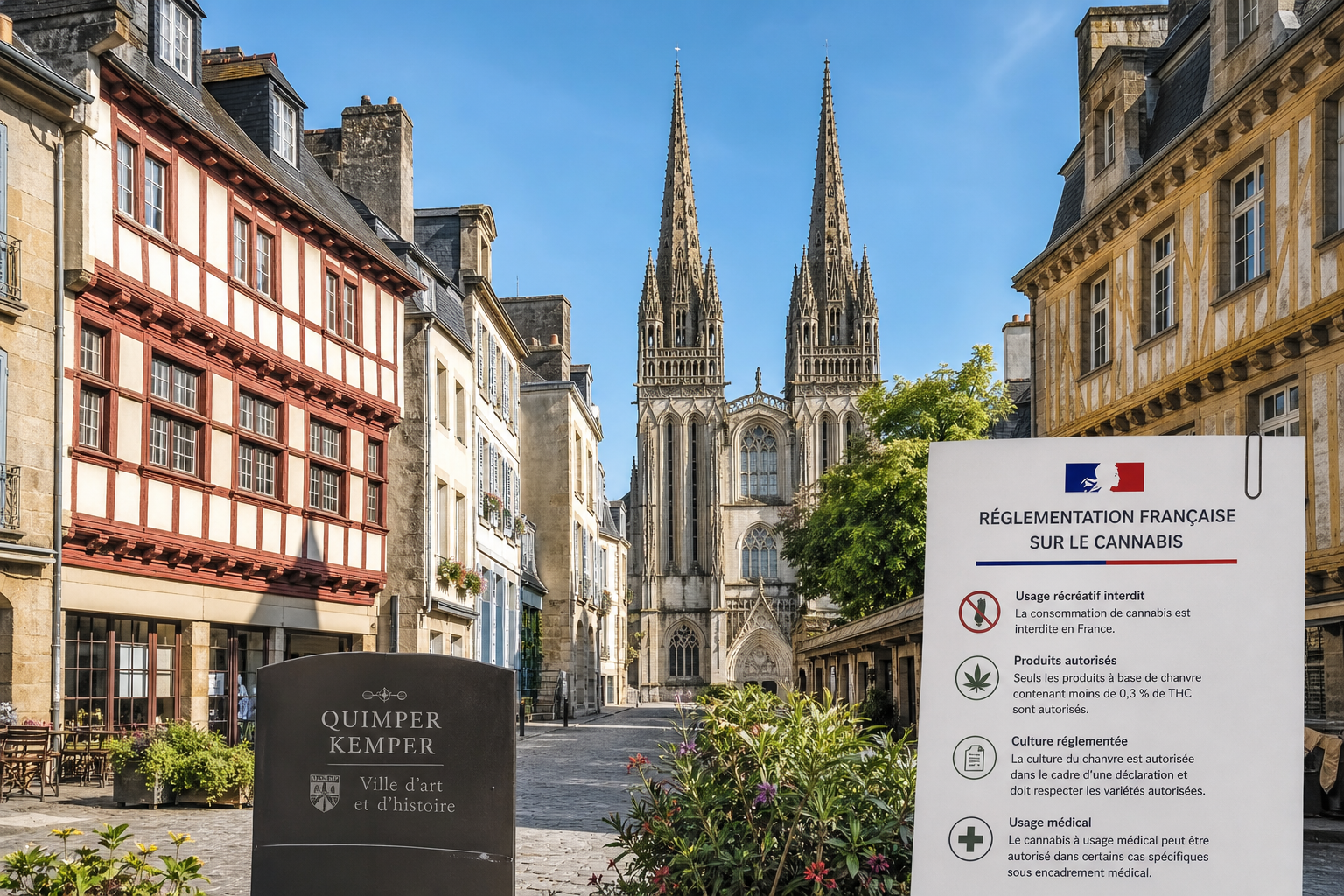
Marijuana decriminalization in Quimper is often misunderstood. France has introduced a faster penalty system for some drug-use offenses, but it has not created a legal recreational cannabis market. In Quimper, as elsewhere in mainland France, cannabis possession, use, sale and cultivation remain prohibited, subject to the circumstances and the authorities’ assessment.
The practical difference is that an adult found using or carrying a small quantity may receive a fixed criminal fine rather than being immediately taken through a conventional prosecution. That procedure does not make cannabis legal, and it does not guarantee that every case will be handled in exactly the same way. This guide explains how the national framework applies in Quimper, what residents and visitors should know, and why local setting does not override French law.
What marijuana decriminalization in Quimper actually means
France is better described as having a depenalization mechanism for certain straightforward drug-use cases, not full decriminalization or legalization. The fixed penalty for drug use, commonly called an amende forfaitaire délictuelle, allows law enforcement to issue a fine in eligible situations. Cannabis remains classified as an illegal narcotic, and the underlying conduct remains an offense.
The same national rules apply in Quimper as in other French cities. A municipal location, a quiet residential street, or a tourist area does not create a local exception. Police and prosecutors can still consider the quantity, packaging, suspected purpose, prior conduct, age of the person involved, and any aggravating circumstances.
For an overview of the official French approach to drug offenses and penalties, consult the French government information on drug use and penalties. The rules can change, so official guidance is more reliable than informal claims that cannabis has been “decriminalized everywhere.”
Cannabis laws in Quimper: possession, use and fines
Possessing or using cannabis in Quimper can lead to a fixed fine when the case meets the conditions for that procedure. The standard amount is generally €200. It may be reduced to €150 when paid within the applicable early-payment period and increased to €450 if it is not paid within the relevant deadline. The notice issued by the authorities controls the payment instructions and dates.
A fixed fine is not the same as a civil parking ticket. It concerns a criminal offense and may have consequences beyond the immediate payment. Depending on the circumstances, the matter can instead be referred to prosecutors or handled through another judicial process. A larger quantity, indications of supply, repeated conduct, refusal to cooperate, or other evidence can make a simple fixed penalty inappropriate.
Small quantities do not create a legal possession limit
France does not provide a general personal-use quantity that makes cannabis lawful. People sometimes assume that carrying a small amount is permitted because police may use a fixed fine in uncomplicated cases. That assumption is incorrect. A small quantity may affect how the case is handled, but it does not remove the offense.
There is also no Quimper-specific possession threshold that visitors can rely on. Cannabis may be seized, and a person may still face questioning or further proceedings even when the amount appears modest. Keeping cannabis in a bag, vehicle or accommodation does not change its legal status.
Weed in Quimper: public use and local practical risks
Using weed in Quimper in public places can attract attention and create additional problems even before a fine is considered. Public streets, parks, waterfront areas, transport facilities, nightlife districts and event spaces are not safe legal zones for consumption. Smoke or odor can prompt a report, and police may intervene where use is visible or affects other people.
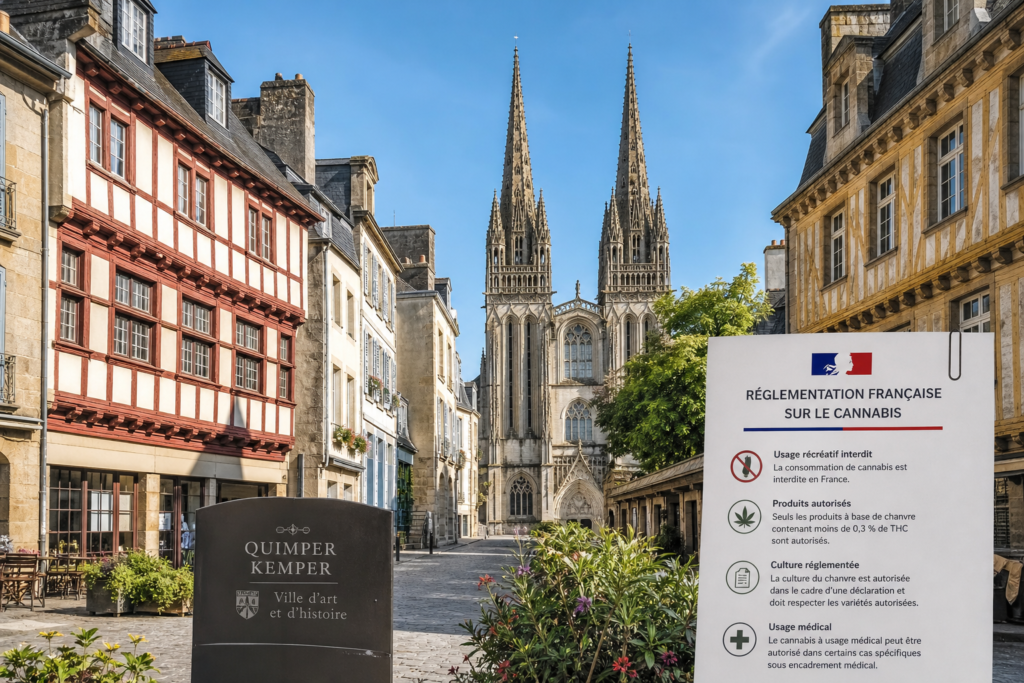
Quimper’s public spaces include busy pedestrian areas, historic streets, cafés, markets, parks and transport connections. Local residents, visitors and business owners may contact the police about suspected drug use. A private residence is not a blanket exemption either: possession and use remain unlawful, and smoke affecting neighbors can create separate disputes or public-order concerns.
Do not assume that consuming cannabis indoors at a hotel, holiday rental or shared accommodation is permitted. Accommodation providers can prohibit smoking, terminate a booking under their terms, or involve authorities when there are safety or nuisance concerns. French drug law and the property’s own rules are separate issues.
Cannabis in Quimper and the difference between use and supply
Cannabis in Quimper is sometimes obtained through informal networks, but buying, selling, transporting for sale, sharing, importing or helping distribute it can expose a person to much more serious consequences than a personal-use case. The amount involved is only one factor. Messages, cash, multiple packages, scales, customer contacts or repeated transactions may be treated as evidence of supply.
Sharing cannabis without charging money is not automatically harmless. Passing cannabis to another person can still create legal exposure, particularly if the recipient is underage or the incident occurs near a school or another protected setting. Selling through social media or arranging delivery also does not make the conduct less serious because the transaction occurs online.
Growing cannabis plants at home is not a lawful personal-use alternative. Cultivation is prohibited without the required authorization, and landlords, neighbors or visitors may report strong odors or visible plants. Seeds, equipment and messages may become relevant if authorities investigate suspected cultivation or distribution.
Driving after cannabis use in France
Driving after using cannabis is a separate and especially important issue. French road law prohibits driving after drug use, and enforcement can rely on roadside screening followed by confirmatory testing. The legal risk is not limited to situations where a driver appears obviously impaired; a positive result can be sufficient for an offense under the applicable rules.
Consequences can include criminal proceedings, loss or suspension of a driving license, vehicle-related measures, insurance complications and more severe penalties when a collision, injury, alcohol use or another aggravating factor is involved. A person visiting Quimper should not drive, cycle in traffic or operate a scooter while affected by cannabis. Waiting until the subjective effects fade is not a reliable way to determine whether driving is legally safe.
If police stop a driver, arguing that the cannabis was consumed earlier or was legally purchased elsewhere may not resolve the issue. The safest practical choice is to avoid driving after cannabis use and arrange a lawful alternative transport option.
CBD and medical cannabis: why the rules are different
CBD products
CBD products are not automatically equivalent to marijuana. Some products can be sold legally under French and European rules when they meet requirements concerning the source of the plant, authorized parts, THC content, labeling and presentation. However, not every product advertised as CBD complies with those requirements.
CBD flowers, oils, foods and vaping products can vary in quality and labeling. A product containing more THC than permitted may create legal and health risks. Even compliant CBD products may be unsuitable before driving, particularly if contamination or trace THC is possible. Travelers should keep packaging and purchase information and should not assume that a product bought abroad can freely be carried across borders.
Medical cannabis
Medical cannabis access in France has been tightly controlled and has not created a general retail system for recreational cannabis. Any medical pathway, prescription arrangement or government program has its own eligibility, product and dispensing rules. A personal claim that cannabis is being used for pain, anxiety or another condition does not by itself authorize possession.
Patients should speak with a qualified French healthcare professional and pharmacist about lawful treatment options. Visitors should obtain specific advice before bringing cannabis-based medicines into France, because prescription status in another country does not automatically settle French import or possession requirements.
What visitors and residents should do after a cannabis stop
A person who is stopped in Quimper should remain calm, avoid arguing in public and follow lawful instructions. Do not attempt to hide, discard or transfer cannabis during an encounter. Ask what document has been issued, check the payment deadline and keep a copy of any paperwork. If the matter involves a search, questioning, driving, a large quantity or an allegation of supply, legal advice is sensible.
- Do not treat a fixed fine as permission to continue possessing or using cannabis.
- Read the notice carefully, including payment methods, deadlines and any stated rights.
- Do not ignore correspondence from French authorities, especially if you live outside France.
- Do not drive after using cannabis or carry cannabis across an international border.
- Seek a French lawyer or qualified legal adviser if the case is contested or more serious than a straightforward fine.
Visitors can also review related guidance on French cannabis decriminalization and fixed fines for comparison with another municipality. The comparison is useful because it illustrates the national framework, but it should not be read as evidence of a different Quimper rule.
How the law may affect everyday life in Quimper
A cannabis incident can affect more than the immediate payment. Depending on the process and the facts, it may create issues involving travel, employment screening, immigration matters, professional licensing or future contact with law enforcement. The exact effect depends on the legal record, the type of procedure and the person’s circumstances.
People under 18 may be treated differently from adults, and parents or guardians may become involved. Schools and youth services can apply their own disciplinary or safeguarding policies. The presence of cannabis near children, schools or public events can also lead authorities to look beyond simple personal use.
For health concerns, people should contact a doctor, pharmacist or French public-health service rather than relying on unverified online advice. Information about dependence, anxiety, impaired concentration and interactions with medicines is particularly important for anyone using cannabis regularly.
Is Quimper likely to legalize marijuana soon?
Quimper cannot independently legalize recreational cannabis. Drug classification, criminal penalties and national health regulation are matters for the French state. The city may manage public order, events, local policing priorities and nuisance complaints, but it cannot authorize shops or public consumption contrary to national law.
Political debate about cannabis policy may continue, and enforcement practices can evolve. That debate should not be confused with a current right to buy or use marijuana in Quimper. Until French national law changes, the cautious assumption is that recreational cannabis remains prohibited.
Conclusion
Marijuana decriminalization in Quimper describes a limited penalty procedure, not legalization. A person caught with or using a small amount may receive a fixed fine, but cannabis possession and consumption remain offenses, and more serious facts can lead to prosecution. Public use, supply, cultivation, driving after use and cross-border transport carry additional risks.
The most practical approach is to understand the national rules, avoid public consumption and driving after use, treat CBD claims carefully, and respond promptly to any official notice. For current legal details, rely on French government information or qualified legal advice rather than assumptions based on the word “decriminalization.”