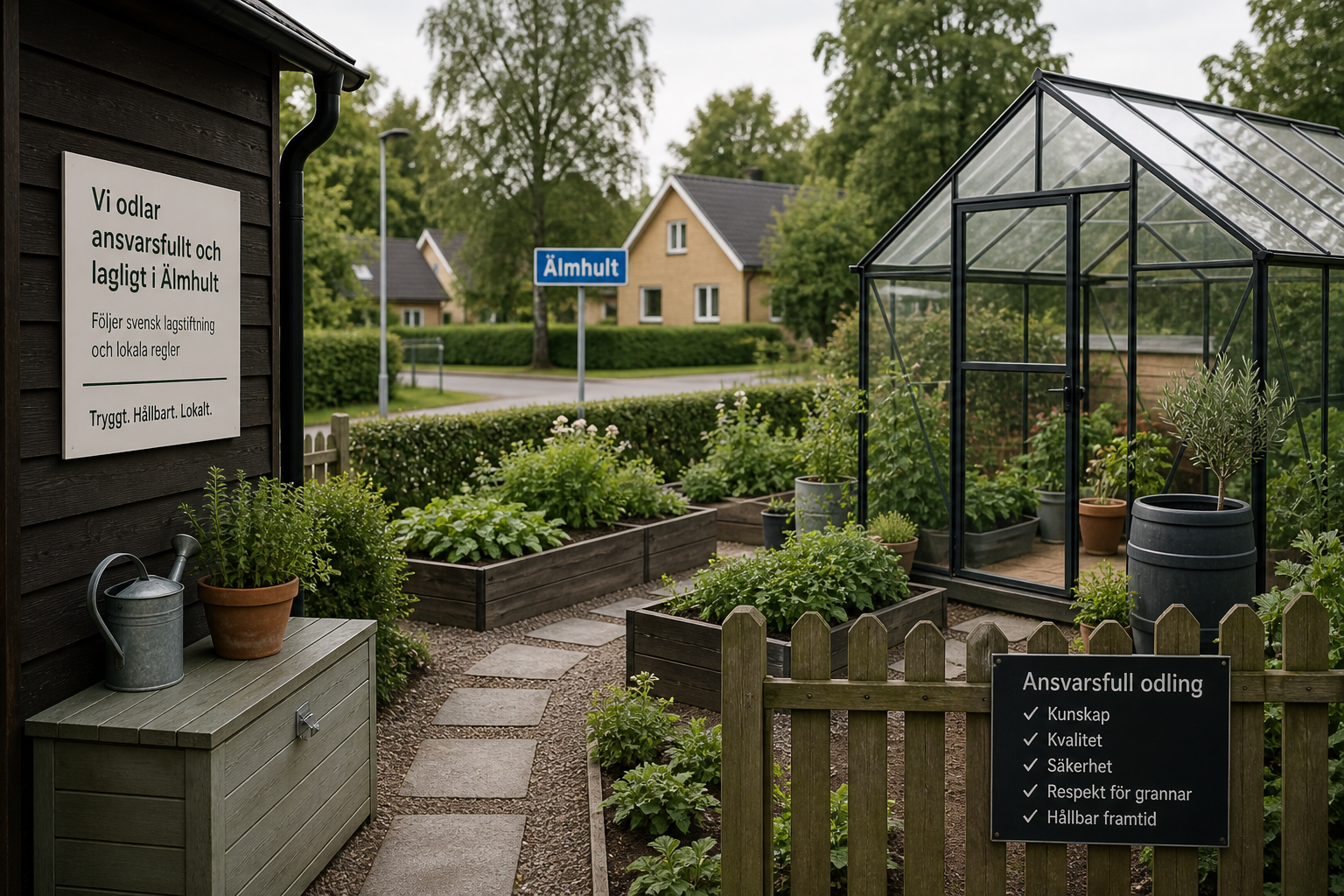
Understanding Marijuana cultivation laws in Älmhult, Sweden starts with an important point: Älmhult does not have a separate municipal cannabis code that permits home growing. Swedish national law applies in Älmhult, whether cultivation takes place in a private home, allotment garden, greenhouse, forested area or commercial premises. In general, cultivating cannabis plants that contain or are intended to produce narcotic cannabis is prohibited without a specific legal basis.
This guide explains the position for residents, property owners, visitors and businesses. It covers personal cultivation, industrial hemp, medical use, enforcement, possible legal consequences and practical steps to take if you discover plants on a property. It is general information, not a substitute for advice from a Swedish lawyer or a decision by a court.
What Swedish law means for cannabis cultivation in Älmhult
Swedish narcotics law treats unlawful cultivation as a potential narcotics offence. The relevant conduct is not limited to selling a finished product. Planting, tending or otherwise producing cannabis may be enough to create criminal liability, depending on the facts and the substance involved. The law can also apply when a person claims that the crop is only for private use.
The core rules are national rather than local. Älmhult Municipality, Kronoberg County and the police do not have authority to create a local exception for recreational cannabis cultivation. A homeowner cannot rely on a private garden, an isolated rural location or the absence of neighbours as a defence to an otherwise unlawful crop.
The Swedish Riksdag’s text of the Narcotic Drugs Penal Act is a useful primary source for the statutory framework. The exact legal assessment in a particular case can depend on the plant material, purpose, scale, evidence and the person’s role.
Is growing cannabis at home legal in Älmhult?
For ordinary recreational cannabis, home cultivation is not a lawful activity in Älmhult. A person does not need to sell the harvest or grow a large number of plants before the conduct becomes legally risky. A small indoor tent, a few plants in a greenhouse or plants grown outdoors can all attract attention if they are cannabis plants covered by the narcotics rules.
Claims such as “it is only for personal use,” “the plants have not flowered” or “the crop is not ready” do not automatically make cultivation lawful. Nor does growing from seeds necessarily avoid the issue. The plant’s characteristics and the circumstances of cultivation matter, and authorities may investigate the entire situation rather than looking only at the final harvested material.
Does private property change the rule?
No. Swedish criminal law generally applies on private property as well as in public places. A landlord, condominium association or neighbour may also have separate concerns involving damage, fire risk, unauthorised electrical work, odour, moisture or breach of a tenancy agreement. Those property and housing issues are distinct from the narcotics assessment but can make a cultivation investigation more complicated.
People searching online for weed in Älmhult may find informal claims that rural homes or small-scale gardens are unlikely to be noticed. That is not reliable legal guidance. Concealment, distance from roads or the use of ordinary gardening equipment does not create an exemption.
What penalties can apply?
Potential consequences depend on the offence classification and the evidence. Swedish law distinguishes between different levels of narcotics offences, and courts consider factors such as the quantity, concentration, purpose, organisation, previous conduct and the person’s overall role. Cultivation may be assessed together with possession, preparation, transfer or other alleged offences.
Possible consequences can include seizure of plants and equipment, questioning, a criminal investigation, prosecution, fines or imprisonment in more serious cases. A conviction may also have practical effects on employment screening, professional licences, immigration matters, firearms permissions or other legal interests. It would be misleading to promise a particular outcome based only on the number of plants.
Authorities may seek evidence from the growing area, messages, equipment, financial records or statements. Electricity use alone does not establish an offence, but it may form part of a broader investigation. If police contact you about suspected cultivation, you should avoid guessing, destroying evidence or making informal explanations without understanding your rights. Speaking with a Swedish criminal defence lawyer is the safest way to obtain case-specific advice.
Industrial hemp is a separate and tightly controlled issue
Industrial hemp should not be confused with recreational cannabis, but the distinction is not simply a label that anyone can apply to a crop. Cultivation may be lawful only when the relevant legal conditions are met, including the use of eligible varieties and compliance with the applicable agricultural and administrative rules. A person who buys seeds advertised as “hemp” should not assume that planting them in Älmhult is automatically permitted.
Rules can change and may involve requirements connected with certified seed, THC limits, agricultural support or notification and inspection procedures. The legal status of the seed, the variety and the purpose of the crop all matter. Products marketed online as low-THC cannabis are not a substitute for checking Swedish requirements before cultivation.
Farmers and businesses considering hemp should confirm the current position with the responsible Swedish authorities and keep documentation for the seed and crop. The Swedish Board of Agriculture is an appropriate official starting point for current agricultural rules and application information. If the crop may be used for food, cosmetics, extracts or another regulated product, additional rules can apply.
Medical cannabis does not create a home-growing right
Sweden allows certain cannabis-based medicines in regulated medical circumstances, but this does not generally give a patient permission to grow cannabis at home. A prescription concerns the authorised medicine and its use; it is not normally a cultivation licence. Patients should obtain medicines through lawful healthcare and pharmacy channels and follow the prescriber’s instructions.
Someone looking for medical cannabis in Älmhult should discuss symptoms and treatment options with a licensed healthcare professional. Do not assume that a prescription from another country authorises home cultivation or possession of every cannabis product in Sweden. Importation, travel with medicine and possession of preparations can involve separate rules.
There is also a difference between a cannabis-based medicine and an unregulated product sold as CBD, hemp oil or a wellness product. Ingredients, THC content, marketing claims and the product’s regulatory classification can affect legality. A label or internet description is not conclusive proof that a product is lawful to possess or cultivate.
How local enforcement may affect Älmhult residents
There is no special enforcement standard that makes cannabis in Älmhult legal or illegal in a different way from cannabis elsewhere in Sweden. Reports may arise from odour, visible plants, suspicious activity, a property dispute, a fire-safety concern or another police investigation. Local authorities may also become involved where there are concerns about children, vulnerable people, housing conditions or environmental hazards.
Älmhult’s rural and semi-rural surroundings do not remove the national rules. Outdoor cultivation can create additional practical risks, including discovery by passers-by, animals or neighbouring land users. Indoor growing may create fire, electrical, humidity and mould hazards. These risks are relevant even before a court determines whether a narcotics offence has occurred.
If you discover suspected cannabis plants
- Do not enter another person’s property or remove the plants yourself.
- If there is an immediate fire, electrical or medical danger, contact emergency services.
- For suspected criminal activity that is not an emergency, use the appropriate Swedish police reporting channel.
- If the issue concerns a rental or condominium, document property damage and contact the landlord or association through lawful channels.
- Do not post identifying photographs or accusations publicly while facts are uncertain.
Common misunderstandings about cannabis laws in Älmhult
“A few plants are automatically tolerated”
There is no general home-grow allowance based on a small number of plants. Quantity may affect the seriousness of an alleged offence, but it does not itself create permission.
“Growing for personal use is not cultivation”
Personal purpose and cultivation are separate questions. A person may still face an investigation even if there is no evidence of sales.
“CBD or hemp wording makes every plant legal”
Product marketing cannot replace the statutory requirements. Variety, THC content, intended use and compliance with applicable agricultural or product rules must be considered.
“A medical need allows a patient to grow medicine”
Medical need should be addressed through a healthcare professional and lawful treatment pathway. It does not, by itself, authorise home cultivation.
Practical legal and safety checklist
- Identify whether the issue concerns recreational cannabis, industrial hemp, a medicine or a commercial product.
- Do not plant, harvest, process or distribute cannabis unless you have verified a clear legal basis.
- For hemp farming, confirm current requirements with the Swedish Board of Agriculture before purchasing seed or preparing land.
- For medical questions, consult licensed Swedish healthcare providers rather than relying on online sellers.
- If contacted by police, preserve relevant documents and seek independent legal advice before providing a detailed statement.
- Check tenancy, insurance, fire-safety and electrical obligations separately from the criminal-law question.
Readers comparing local guides may also find useful context in this overview of cannabis laws in nearby Eksjö and the practical discussion of medical marijuana access in Vetlanda. The governing Swedish rules remain national, so local comparisons should not be treated as separate legal regimes.
Conclusion
The safest summary of Marijuana cultivation laws in Älmhult, Sweden is that recreational home cultivation is not generally lawful, and private land does not provide an exception. Industrial hemp may be treated differently only when the crop and the grower satisfy the applicable Swedish requirements. Medical treatment does not normally permit a patient to grow cannabis at home.
For current cases, the details matter: plant type, THC content, purpose, scale, evidence and related conduct can all affect the legal assessment. Before growing any cannabis-related crop in Älmhult, verify the rules with the relevant Swedish authority and obtain advice from a qualified lawyer where necessary.