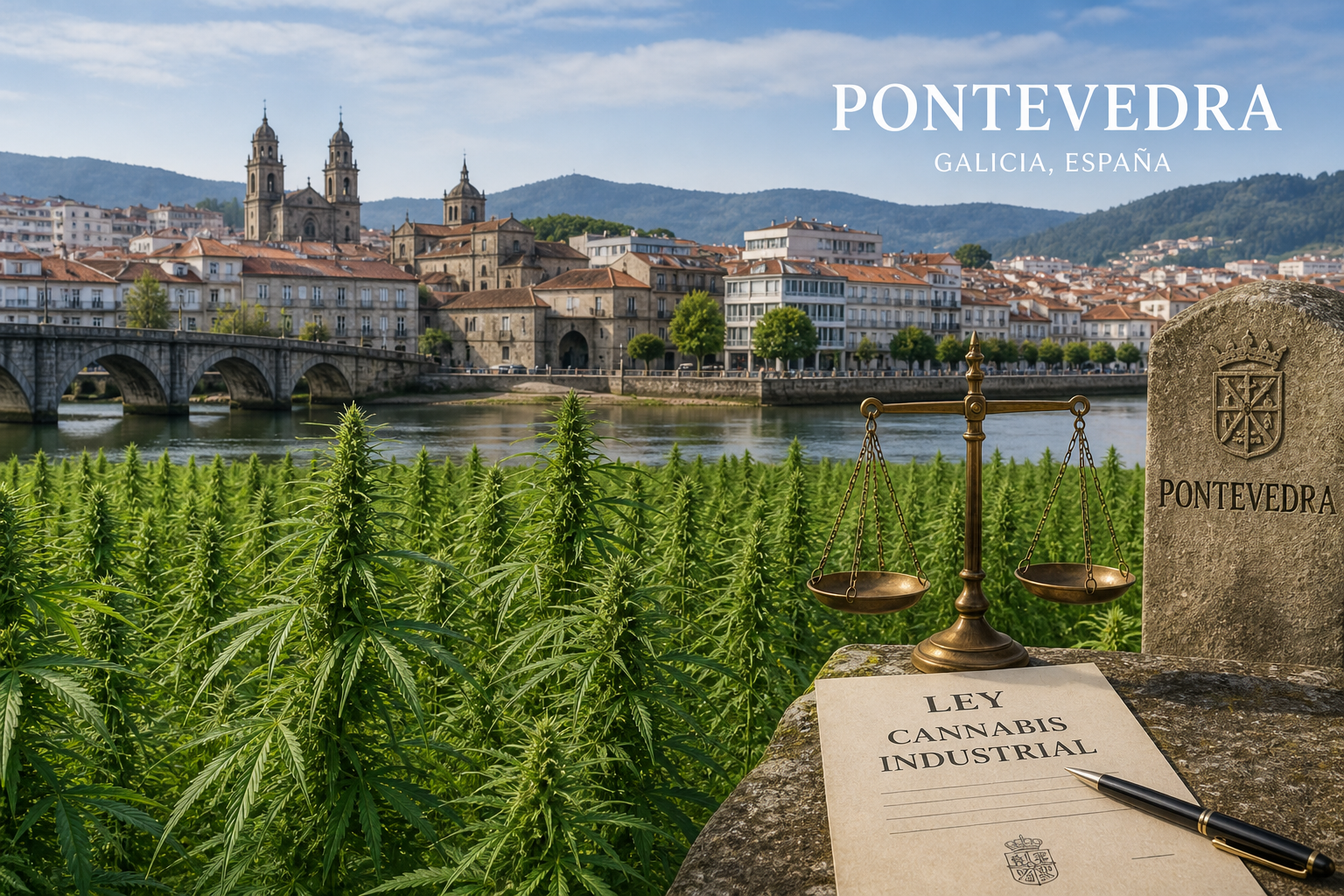
Understanding hemp legality in Pontevedra requires separating industrial hemp, CBD products and high-THC cannabis. Spanish law does not treat every cannabis plant or product in the same way. A crop grown for approved industrial purposes may follow agricultural rules, while flowers, extracts, possession and public consumption can raise different legal issues.
Pontevedra is in Galicia, but the main rules come from Spanish national law, European agricultural requirements and, in some situations, regional or local administration. There is no general city licence that makes recreational cannabis sales legal. This guide explains the practical position for residents, farmers, businesses and visitors without suggesting that hemp is automatically risk-free.
Hemp legality in Pontevedra: the basic legal distinction
In everyday language, hemp often means a cannabis plant bred for low levels of THC and used for fibre, seeds, food or other industrial purposes. Legally, however, the plant’s variety, THC content, plant part, intended use and method of sale can all matter.
High-THC cannabis is controlled under Spain’s narcotics framework. Recreational production and commercial supply are not generally legal simply because the activity takes place in a private setting or because the product is described as hemp. Industrial hemp is treated more favourably when it uses authorised seed varieties and is cultivated for recognised industrial purposes, particularly fibre or seed production.
That distinction is important in Pontevedra. A rural location, greenhouse or private plot does not by itself create an exemption. Anyone planning a crop should establish the applicable agricultural registration, notification, seed and land-use requirements before planting.
Industrial hemp cultivation in Pontevedra and Galicia
Industrial hemp cultivation can be lawful when the crop meets the relevant European and Spanish conditions. In practice, this normally involves using an approved variety, retaining documentation for the seed and growing the crop for an accepted industrial purpose. Agricultural inspections or testing may be possible, so records should be kept from purchase through harvest.
What prospective growers should check
- Whether the seed variety appears on the applicable authorised European catalogue.
- Which THC threshold and testing method apply to the specific crop and purpose.
- Whether the intended use is limited to fibre or seed rather than flowers or intoxicating extracts.
- Whether notification, agricultural registration, subsidy documentation or other regional paperwork is required.
- Whether the land has planning, environmental, water or tenancy restrictions.
- How harvested material will be stored, transported and transferred to a buyer.
Spanish rules and administrative practice can distinguish between traditional industrial hemp and cultivation involving flowering tops or cannabinoid extraction. A grower should not assume that a low-THC crop can be harvested, dried and sold in any form. For background on the separate issue of cultivation, see this guide to cannabis cultivation laws in Lugo; the same national framework is relevant, although local administration may differ.
Commercial operators should obtain written advice from the relevant agricultural authority in Galicia and, where controlled cannabis or medicinal production is involved, consult the Spanish Agency of Medicines and Medical Devices. The AEMPS official website provides the appropriate institutional starting point for regulated medicinal and pharmaceutical activities.
Are hemp flowers legal in Pontevedra?
Hemp flowers are one of the most legally sensitive parts of the market. Sellers may describe low-THC flowers as CBD hemp, but a label is not a substitute for compliance. Flowers can contain cannabinoids and may be viewed differently from seeds or fibre, particularly when they are dried, packaged for smoking or marketed for their effects.
Spanish enforcement does not depend only on a product’s advertising language. Authorities may examine laboratory results, packaging, intended use, possession circumstances and whether the product could be used as a narcotic. A product that is lawful for one commercial purpose may not be lawful when sold for inhalation or human consumption.
For buyers in Pontevedra, the safest approach is to avoid assuming that a shop display, online listing or certificate of analysis proves full legality. Check the product category, the seller’s business details, the stated intended use and whether the item complies with Spanish rules for food, cosmetics, tobacco substitutes or other relevant categories.
CBD legality in Pontevedra
CBD is not the same as THC, but CBD products are not automatically unrestricted. The legal position can depend on whether the product is a cosmetic, food, supplement, vape liquid, topical preparation or another type of good. Novel-food rules may affect products intended for ingestion, while cosmetics must meet their own safety and labelling requirements.
In Spain, CBD products marketed for oral consumption require particular caution. A product being available online or in a local shop does not necessarily mean that it has the required authorisation for food use. Consumers should be wary of unverified health claims, missing batch information and products that do not identify a responsible operator in the European market.
Topical CBD products may be subject to cosmetic requirements, but that does not make every CBD oil or balm compliant. Buyers looking for a broader comparison can read this CBD legality and buying guide for Telde, while remembering that product rules are national and can change.
Practical checks before buying CBD
- Look for a complete ingredient list, batch number and responsible seller.
- Check whether the product is intended for external use or ingestion.
- Do not rely solely on the phrase “legal hemp” or an isolated laboratory certificate.
- Avoid products making claims to diagnose, treat or cure a medical condition without authorised medicinal status.
- Ask how the product should be transported and stored, especially when travelling across borders.
Possession, use and public spaces
Low-THC hemp and high-THC cannabis should not be treated as interchangeable. Possessing recreational cannabis in a private setting is not the same as possessing it in public, and neither situation creates a legal retail market. Public possession or consumption can lead to administrative action under Spain’s public-security rules even where there is no allegation of trafficking.
The Spanish public-security law published in the BOE is the key official reference for offences involving drugs in public places and related administrative sanctions. The consequences can depend on the facts, including location, quantity, conduct and whether authorities suspect supply to others.
In Pontevedra, avoid consuming cannabis or smoking hemp-derived products in streets, beaches, parks, nightlife areas, public transport or other public venues. Private premises are not a universal safe harbour: landlords, hotels, accommodation providers and event organisers can impose their own rules, and nuisance or supply allegations can create additional problems.
Can businesses sell hemp or cannabis in Pontevedra?
A business may sell lawful hemp-derived goods only if the specific products meet the rules applicable to their category. A shop cannot turn recreational cannabis into a legal product by calling itself a wellness store, private club or hemp retailer. Selling high-THC cannabis, supplying it to customers or promoting it for intoxication can expose operators to serious criminal and regulatory risk.
Businesses should define their product range before opening and obtain advice on licensing, consumer information, tax, packaging, advertising and waste. Food, cosmetics and vaping products each have different compliance demands. Importing goods from another country also does not remove Spanish obligations; customs, product safety and controlled-substance rules may apply at the border.
Social clubs operate in a legally uncertain area and should not be confused with licensed dispensaries. Membership or private premises do not guarantee that cultivation, distribution or possession is lawful. Anyone considering a club-related activity should obtain specialist Spanish legal advice rather than relying on informal local practice.
Medical cannabis and hemp-based treatment
Medical cannabis is a separate subject from over-the-counter hemp products. A CBD oil sold as a supplement is not equivalent to an authorised medicine, and a patient should not assume that a hemp label provides access to prescription treatment. Medical use must follow the applicable Spanish healthcare and medicines framework.
Patients should speak with a qualified doctor or pharmacist about an authorised treatment, interactions and suitability. Importing cannabis-based medicines, carrying them on a flight or travelling with them across a border can require documentation and may be governed by the destination country as well as Spain.
Do not drive after using THC-containing products. Impairment and roadside testing create risks regardless of how the product was obtained. The same caution applies to operating machinery, working at height or combining cannabis with alcohol or sedating medicines.
Travel advice for visitors to Pontevedra
Visitors should not bring cannabis, hemp flowers, oils or edible products into Spain without checking the rules that apply to the exact item. Border controls can treat a product differently from a domestic purchase, and a foreign prescription or shop receipt is not automatically sufficient.
Do not take cannabis across the Portugal–Spain border or carry it on domestic transport based only on the belief that it is low THC. Keep lawful CBD goods in their original packaging, but remember that packaging cannot legalise a product that does not meet Spanish requirements. Hotel policies, event rules and transport conditions may also prohibit smoking or possession.
- Do not buy cannabis from street sellers or accept products from strangers.
- Do not assume that a private club is open to tourists or legally authorised to sell cannabis.
- Keep hemp and CBD products separate from prescription medicines and retain receipts where appropriate.
- Seek current advice before crossing a border, flying or carrying any cannabinoid product.
- Contact a Spanish lawyer or the relevant authority if a commercial project is involved.
How to verify the rules before acting
Laws and administrative guidance can change, and the facts of a particular crop or product matter. For a farm or business in Pontevedra, ask the Galician agricultural administration about cultivation and land requirements, then confirm product-specific obligations with the relevant Spanish regulator. For personal use, consult official public-security and health information rather than relying on social-media claims or retailer marketing.
Keep written records of advice, seed invoices, laboratory reports, product labels and transport documents. If authorities inspect a crop or shipment, clear documentation can help demonstrate the intended use, although it does not replace compliance.
Conclusion
Hemp legality in Pontevedra is possible for properly regulated industrial activities, but it is not a blanket permission for cannabis cultivation, flower sales or recreational use. Approved low-THC varieties, authorised purposes, product-category rules and administrative paperwork all matter. CBD products require separate scrutiny, while public possession, supply and cross-border transport carry additional risks.
The safest principle is simple: identify the exact plant material or product, confirm its intended use and check the current Spanish and Galician requirements before buying, growing, selling or travelling with it. When money, commercial cultivation, medicine or imports are involved, obtain advice from the competent authority or a qualified Spanish professional.