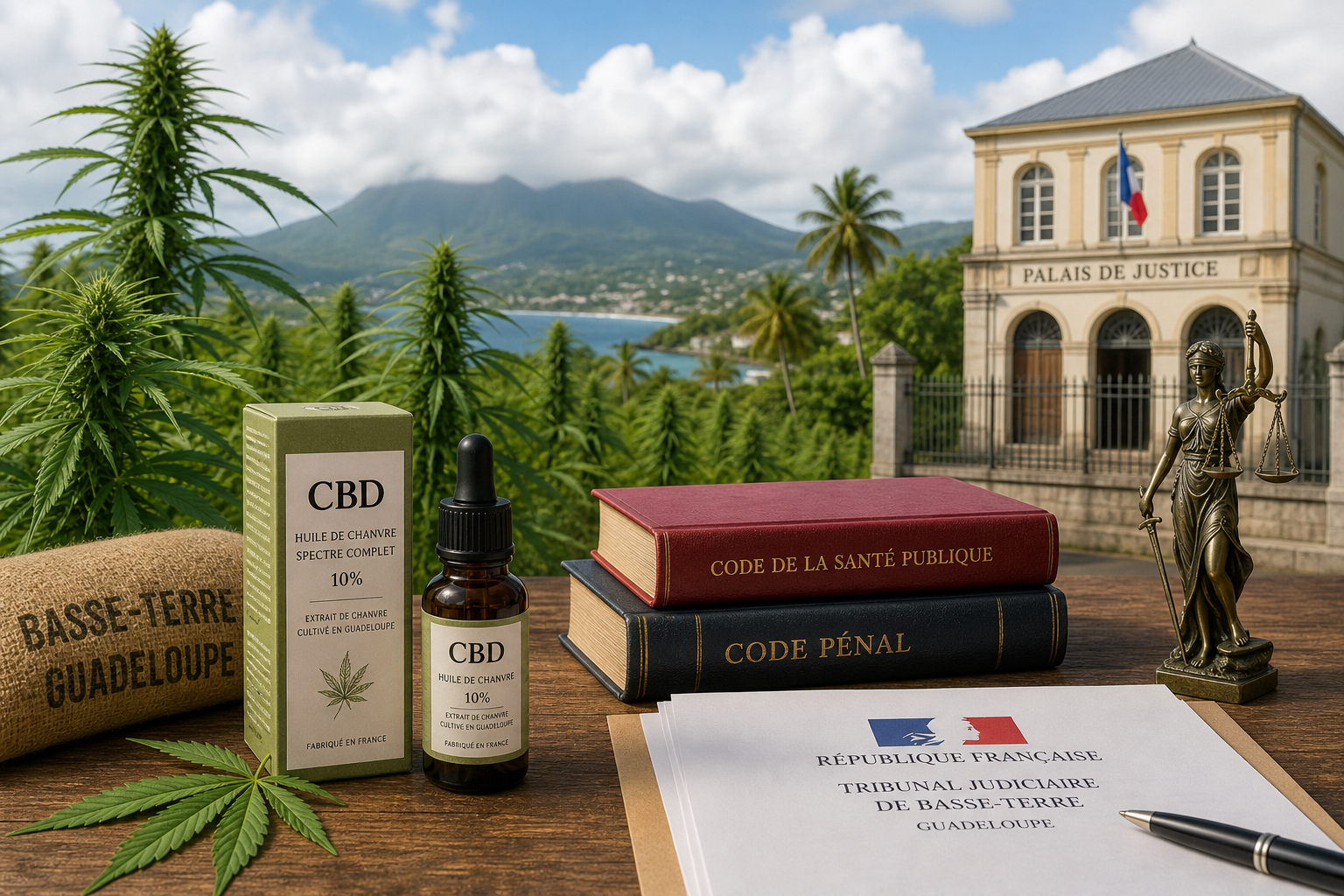
Understanding Hemp legality in Basse-Terre, France requires separating industrial hemp, CBD products and high-THC cannabis. Basse-Terre is in Guadeloupe, an overseas department and region of France, so French national drug and agricultural rules apply. The local climate does not create a separate cannabis market or a special exemption for residents, visitors or businesses.
In practical terms, approved low-THC hemp may be lawful when it is cultivated and sold under the applicable rules. CBD products can also be lawful, but only when their composition, presentation and sale comply with French and European requirements. Marijuana containing significant THC remains prohibited outside tightly controlled legal frameworks. This guide explains the main distinctions without treating hemp and cannabis as interchangeable products.
How French law applies in Basse-Terre
French national law governs cannabis laws in Basse-Terre, including possession, cultivation, importation, sale and use. Municipal authorities may regulate practical matters such as public-space use, business permits, markets or nuisance, but a town cannot legalize recreational cannabis that national law prohibits.
That means residents and tourists should not assume that Guadeloupe’s geography, Caribbean location or local customs change the legal position. The same basic rules apply in Basse-Terre as in mainland France, although enforcement, supply chains and customs checks can have particular importance on an island.
For primary legal materials, consult the official French legal database, Légifrance. Because rules can be amended and individual cases differ, current legislation should be checked before cultivating, importing, manufacturing or selling a hemp product.
Industrial hemp: what can be legal?
Industrial hemp is cannabis cultivated for approved agricultural purposes and low THC content. French rules generally permit professional cultivation of authorized varieties that meet the applicable THC limit and seed-certification requirements. This is not the same as permission to grow any cannabis plant at home.
Approved varieties and agricultural controls
Farmers and businesses need to use varieties included in the relevant authorized catalogue and comply with agricultural requirements. Depending on the activity, these can include certified seed, documentation, inspections, traceability and rules concerning the harvested parts of the plant. A crop that looks like hemp is not automatically lawful merely because it is described as “industrial.”
Anyone considering hemp cultivation rules in Guadeloupe should obtain advice from the relevant agricultural authorities before planting. Climate suitability is only one issue. Land use, professional status, seed sourcing, crop records and laboratory testing may also matter.
Private cultivation is not automatically covered
Buying hemp seeds or possessing a low-THC variety does not by itself establish a right to grow cannabis privately. French exemptions for industrial hemp are structured around authorized varieties and regulated agricultural activity. They should not be read as a general home-growing permission.
Growing plants intended to produce intoxicating cannabis can expose a person to criminal investigation even if the plants are small or intended for personal use. If a crop is discovered, authorities may assess the variety, THC content, purpose, quantity and surrounding evidence. Do not rely on online seed descriptions as proof that cultivation is lawful.
CBD in Basse-Terre: legal does not mean unrestricted
CBD is a non-intoxicating cannabinoid, but a CBD label does not automatically make a product lawful. The legality of CBD in Basse-Terre depends on the product’s THC level, ingredients, manufacturing, intended use, labeling and sales channel.
Following French and European legal developments, products derived from permitted hemp may be sold when they satisfy the applicable conditions. However, sellers still need to avoid misleading health claims, ensure accurate product information and comply with rules for the specific category. A flower, cosmetic, vape liquid, food supplement and food product may not be treated in exactly the same way.
CBD flowers and leaves
CBD flowers and leaves have been the subject of important French litigation and regulatory changes. The fact that a product contains only a small amount of THC does not remove the need for lawful sourcing, compliant testing and responsible marketing. Sellers should be able to identify the product’s origin and demonstrate that it meets the relevant THC requirement.
Consumers should be cautious with loose or unpackaged flowers, products with no batch information and items making claims that they can treat anxiety, pain, epilepsy or another disease. A seller’s statement that something is “legal everywhere” is not a substitute for product documentation.
Foods, supplements, cosmetics and vaping products
Different product categories bring different obligations. CBD food products and supplements may raise novel-food and food-safety issues. Cosmetics must comply with cosmetic-product rules and must not be marketed with unauthorized medical claims. Vaping products are subject to rules concerning ingredients, packaging, consumer information and nicotine where relevant.
For that reason, a product being sold in a Basse-Terre shop or online does not prove that every similar product is compliant. Buyers should look for a clear ingredient list, batch or lot information, responsible-business details and a credible THC analysis. Products with unclear composition are especially risky for people subject to drug testing or taking medicines.
High-THC cannabis and weed in Basse-Terre
Weed in Basse-Terre usually refers to cannabis intended to produce an intoxicating effect. Recreational possession, purchase, sale and cultivation of high-THC cannabis remain illegal under French law. CBD availability does not create a legal route to buy or possess ordinary marijuana.
French enforcement may use a fixed penalty for some straightforward personal-use possession cases, but this should not be misunderstood as legalization or a guaranteed outcome. The circumstances can lead to more serious proceedings, particularly where there are allegations of supply, repeat offending, cultivation, importation, driving impairment or involvement of minors.
Do not carry cannabis across borders, between islands or through an airport. A product purchased legally in one country may still be prohibited when brought into France or Guadeloupe. Customs and police may also examine packaging, quantity and evidence of distribution.
Medical cannabis and hemp-derived products
Medical use is not a general exception to French drug law. A person cannot lawfully possess recreational cannabis simply by saying it is for pain, sleep or another health condition. Access to medical cannabis, where available, operates through specific official arrangements and healthcare channels rather than ordinary retail sales.
CBD products are also not a substitute for prescribed treatment. They may interact with medicines, and product labels do not always accurately describe cannabinoid content. Anyone taking anticoagulants, sedatives, anti-epileptic medicines or other regular treatment should ask a doctor or pharmacist before using CBD.
For public-health information and current national policy, consult MILDECA’s official information on drugs and addictive behaviours. A healthcare professional can help distinguish a regulated medicine from a consumer CBD product.
Buying, selling or transporting hemp products
Advice for consumers
- Check whether the product is clearly identified as CBD, industrial hemp or another category.
- Look for ingredient information, batch details, a responsible seller and credible laboratory testing.
- Do not assume that “THC-free” or “natural” claims are accurate without supporting information.
- Avoid products that promise to cure or treat a medical condition.
- Do not drive or operate machinery after using a product that may contain THC.
- Keep receipts and original packaging when transporting lawful consumer products.
Advice for retailers and producers
Businesses selling Basse-Terre cannabis regulations-sensitive products should verify their supply chain before opening or advertising. They may need business registration, product documentation, compliant labels, appropriate storage and category-specific approvals. Marketing CBD next to illegal THC cannabis, using drug-themed claims or suggesting guaranteed therapeutic effects can create additional legal and reputational risks.
Online sales also require care. A website serving customers in Basse-Terre must still comply with French rules, and shipping a product from another jurisdiction does not bypass those rules. Importers should check customs, transport and documentation requirements before dispatching goods to Guadeloupe.
Public use, driving and travel considerations
Even where a hemp-derived product is lawful to possess, using it in public can create practical problems. Businesses, landlords, transport operators and event organizers may impose their own restrictions. Odour, smoking restrictions and public-order rules can apply independently of the product’s THC level.
Driving after using cannabis is particularly serious. French road law prohibits driving after cannabis use, and the issue is not limited to whether the driver feels impaired. CBD products containing trace THC may also create uncertainty for a person who is tested. The safest approach is not to drive after using a product that may contain THC and to seek professional advice if drug testing is a concern.
Visitors should also read broader local safety guidance, such as this Guadeloupe cannabis safety guide for Sainte-Anne. The same national legal framework applies, but the practical advice about public conduct, transport and travel is relevant across the island.
What hemp legality means for Basse-Terre residents and visitors
The clearest way to understand hemp laws in Basse-Terre is to ask four questions: What is the product? How much THC does it contain? Was it produced and sold through a compliant route? What is the person doing with it?
- Industrial hemp: potentially lawful when authorized varieties and agricultural conditions are followed.
- CBD: potentially lawful, but product category, THC level, labeling and claims matter.
- High-THC cannabis: recreational possession, supply and cultivation remain prohibited.
- Travel: crossing borders or transporting cannabis creates significant legal risk, even when the product was lawful where purchased.
When the facts are unclear, do not plant, sell, import or carry the product until its status has been checked. A French lawyer, pharmacist, agricultural adviser or competent government service can provide advice suited to the specific product and activity.
Conclusion
Hemp legality in Basse-Terre, France is based on national French rules, not a separate Guadeloupe cannabis regime. Authorized industrial hemp and some compliant CBD products may be lawful, while high-THC recreational cannabis remains prohibited. The safest approach is to verify the variety, THC content, product category, documentation and intended use before acting. For businesses, professional legal and regulatory advice is especially important because cultivation, importation and retail sales can involve several overlapping rules.