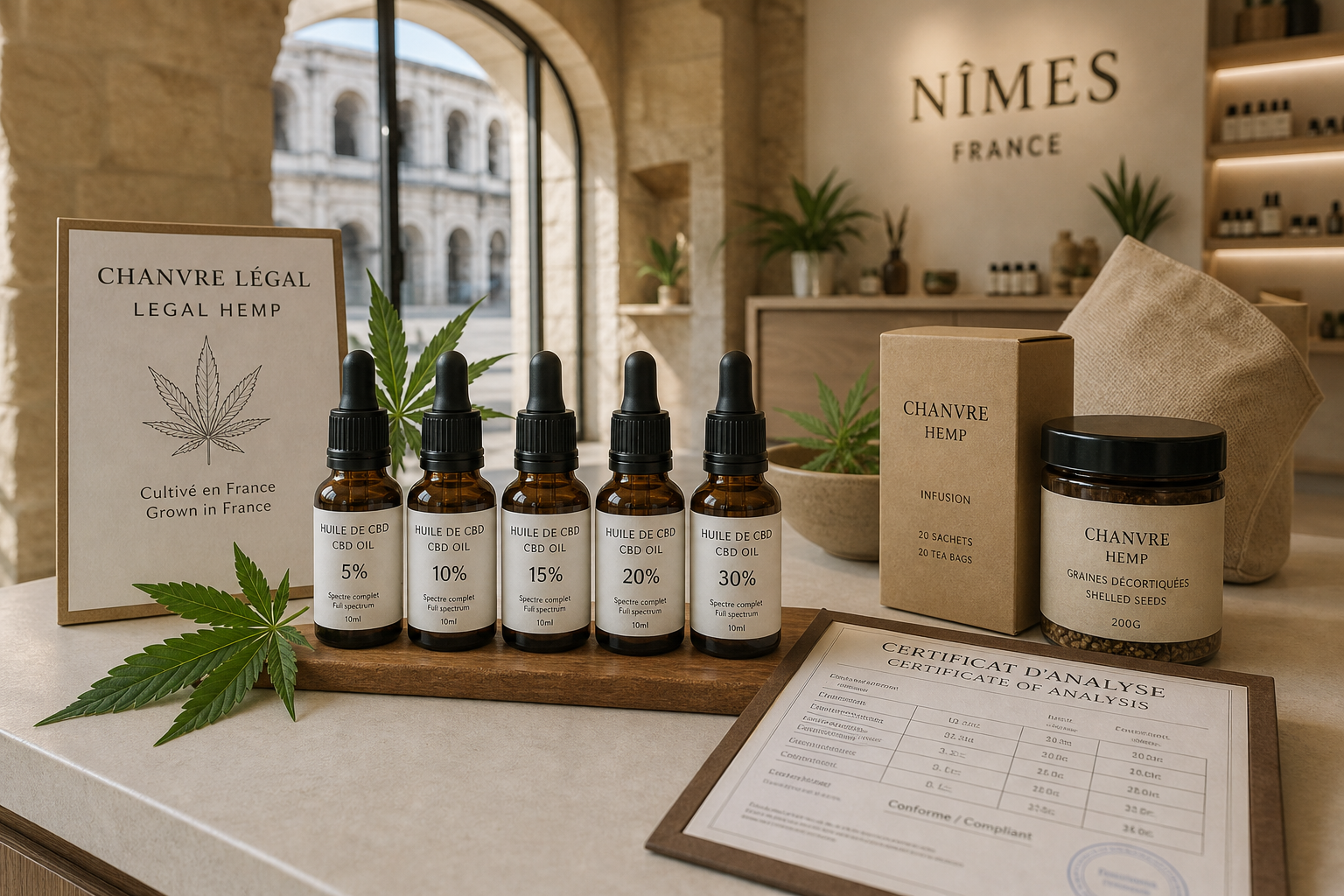
Nîmes has the same CBD rules as the rest of mainland France, but finding a suitable product still requires careful checking. CBD products in Nîmes are widely associated with hemp, wellness and relaxation, yet they are not automatically risk-free or legal in every form. Product composition, labelling, the amount of THC and the way an item is marketed all matter.
This guide explains how residents and visitors can approach CBD in Nîmes responsibly. It covers the difference between CBD and intoxicating cannabis, common product formats, French legal principles, questions to ask in a shop and practical precautions for travel and use. It is general information rather than medical or legal advice.
What CBD means in Nîmes
CBD, or cannabidiol, is one of the naturally occurring compounds found in the hemp and cannabis plant. Unlike THC, CBD is not generally associated with the same intoxicating effect. A CBD product should therefore not be treated as equivalent to recreational cannabis, even though both may come from related plants.
The phrase CBD in Nîmes can refer to oils, flowers, resins, capsules, cosmetics, drinks, edibles, vape liquids and other hemp-derived goods. These categories are not interchangeable. An oil intended for use on the skin is different from an oral product, while a vape liquid creates different practical and health considerations from a cosmetic.
Local availability does not change national law. A shop in central Nîmes, a specialist retailer elsewhere in the Gard or an online seller must still comply with French and European requirements. Customers should focus less on packaging and more on the product’s ingredients, intended use and supporting documentation.
CBD products in Nîmes and French law
French rules distinguish lawful hemp-derived products from cannabis products containing prohibited levels of THC. In general, products marketed as CBD must come from permitted hemp varieties and comply with the applicable maximum THC threshold, commonly presented as 0.3% under current French rules. This threshold concerns the product and its compliance, not merely what a retailer says on a label.
Rules can differ according to the product category. Cosmetics, food products, supplements, inhaled products and raw hemp materials may be subject to separate requirements. Some CBD items may also raise questions under food or novel-food rules. A product being displayed for sale is not, by itself, proof that every claim or formulation is compliant.
For an overview of France’s public policy approach to drugs and controlled substances, consult the official MILDECA information portal. For medical safety information and medicines-related guidance, the French National Agency for the Safety of Medicines is a more reliable starting point than social-media posts or seller testimonials.
CBD is not a prescription treatment
Retail CBD should not be confused with an authorised medicine. A bottle labelled “full spectrum,” “broad spectrum” or “isolated CBD” does not automatically have proven effectiveness for a particular condition. In particular, claims that CBD treats anxiety, chronic pain, epilepsy or insomnia should be approached cautiously unless they relate to an appropriately authorised medical product and professional advice.
If you take prescription medicines, are pregnant or breastfeeding, have liver problems, or are considering CBD for a child, speak with a qualified healthcare professional before use. CBD may interact with medicines, and a pharmacist can help assess the specific risks more effectively than a general product description.
Where to look for CBD shops in Nîmes
People searching for CBD shops in Nîmes may find specialist stores, general retailers and online sellers serving the city. The best option is not necessarily the shop with the largest display or the strongest marketing. A responsible retailer should be willing to explain what a product is, how it is intended to be used and what evidence supports its composition.
Before buying, look for a clear business identity, transparent contact details and packaging in French where required. A seller should not present CBD as a guaranteed cure, encourage excessive use or imply that a legal CBD product produces the same effect as high-THC cannabis. Be especially cautious when products are sold loose, in unlabelled bags or with claims that sound too good to be true.
Questions worth asking a retailer
- What is the exact CBD concentration and intended route of use?
- Does the product include a batch number, ingredients list, recommended use and expiry or best-before information?
- Is there a recent certificate of analysis from an independent laboratory?
- Does the analysis identify THC and other cannabinoids, rather than reporting only the CBD percentage?
- Are there allergens, carrier oils, sweeteners or other ingredients that could affect you?
- What should a customer do if the product causes unwanted effects?
A certificate of analysis is useful, but it should match the product name and batch number. A generic laboratory document copied across several products gives less reassurance. The result should make it possible to understand whether THC is within the relevant legal limit and whether contaminants such as solvents, pesticides or heavy metals were tested where appropriate.
Choosing between common CBD formats
Oils and capsules
CBD oils are popular because the concentration can be described clearly, but the label still needs careful reading. Check how much CBD is present per bottle and, where available, per serving. Capsules provide a more consistent measured format, although they may contain additional ingredients and are not suitable for everyone.
Do not assume that a higher percentage is better. A lower-strength product may be easier to evaluate, especially for someone who has never used CBD. Follow the manufacturer’s instructions and avoid increasing the amount simply because an immediate effect is not noticeable.
Flowers and resins
Hemp flowers and resins can look and smell similar to illicit cannabis. Their appearance is not proof of legality or THC content. Products should be sold with appropriate labelling and supporting test information. Smoking any plant material creates respiratory risks, and heating hemp can produce irritating compounds. A legal CBD flower is not automatically a healthy product to smoke.
Vape liquids
Vape products deserve extra caution because inhalation delivers ingredients directly to the lungs. Confirm that the liquid is specifically made for vaping and do not add CBD oil intended for oral or cosmetic use to a vape device. Avoid homemade mixtures, unclear ingredients and products with damaged or leaking packaging.
Cosmetics and topical products
CBD creams, balms and massage products are applied to the skin rather than taken orally. Read the full ingredient list and avoid applying products to damaged skin unless the label clearly permits it. Fragrances, essential oils and preservatives may cause irritation independently of CBD.
How to assess quality and value
Price alone says little about quality. Compare the amount of CBD in the whole package, the concentration per serving and the transparency of the testing. A large bottle with a low concentration may not offer better value than a smaller, clearly documented product.
Useful signs of a more responsible product include:
- A complete manufacturer or distributor name and contact address.
- A batch or lot number that matches laboratory documentation.
- Clear information about CBD, THC and other active ingredients.
- Instructions suited to the product’s intended use.
- No promise of guaranteed medical results or intoxication.
- Packaging that is intact, legible and appropriate for the product category.
Be careful with “THC-free” claims. Some products may contain trace cannabinoids, and testing methods have limits. Anyone subject to workplace drug testing should understand that a CBD product containing even small amounts of THC could create a risk of a positive result.
CBD, cannabis in Nîmes and public behaviour
Searching for cannabis in Nîmes can lead to information about recreational cannabis, but that is a separate legal and health issue from buying compliant CBD. CBD should not be used as a cover for possessing or consuming illicit cannabis. It is also unwise to use CBD products in a way that attracts attention in public spaces or suggests drug consumption.
Never drive, cycle in traffic or operate machinery if a product makes you drowsy, dizzy or less alert. Even when THC is within a legal limit, individual sensitivity and product quality can vary. Combining CBD with alcohol, sedatives or other substances may increase impairment or make side effects harder to interpret.
Visitors should also avoid carrying CBD across borders without checking the rules of the destination and transit countries. A product that is lawful in France may be restricted elsewhere. Keep items in their original packaging, retain purchase information and do not assume that a flower, vape cartridge or edible will be treated identically by another country’s authorities.
Understanding CBD laws in Nîmes before buying
The practical meaning of CBD laws in Nîmes is that local retailers operate within national French rules. Municipal location does not create a separate Nîmes CBD licence or a special tolerance for products that exceed national limits. Laws and enforcement guidance can change, so consumers should verify current information before buying large quantities, travelling or importing products.
It is also important to distinguish possession of a compliant retail product from possession of illicit cannabis. If a product is mislabelled, contaminated or above the permitted THC level, the customer may face practical problems even if they believed they bought ordinary CBD. When in doubt, choose a product with clear documentation rather than relying on scent, appearance or a verbal assurance.
For broader context on cannabis regulation in southern France, see our guide to cannabis laws in Montpellier. Readers interested in a CBD-specific comparison can also review the guide to CBD in Lyon, while remembering that the underlying national framework remains the key point.
A sensible buying checklist
- Decide whether you want a cosmetic, oral, inhaled or other product.
- Read the complete label before discussing price or strength.
- Check the THC information and ask for batch-specific testing.
- Review ingredients for allergens, medicines-related concerns and possible irritants.
- Start conservatively and follow the stated instructions.
- Store the product securely away from children and pets.
- Stop using it and seek professional advice if you develop worrying symptoms.
Conclusion
Buying CBD in Nîmes can be straightforward when you treat it as a regulated consumer product rather than a guaranteed remedy or a substitute for recreational cannabis. Choose transparent retailers, check the THC information, compare independent testing and select a format appropriate to your needs. If you use medicines, have a health condition or plan to travel, ask a healthcare professional or check official guidance first.
The most useful habit is simple: read beyond the front of the package. A clear ingredient list, batch information, realistic claims and responsible advice provide a better foundation for choosing CBD products in Nîmes than branding or promises of instant results.