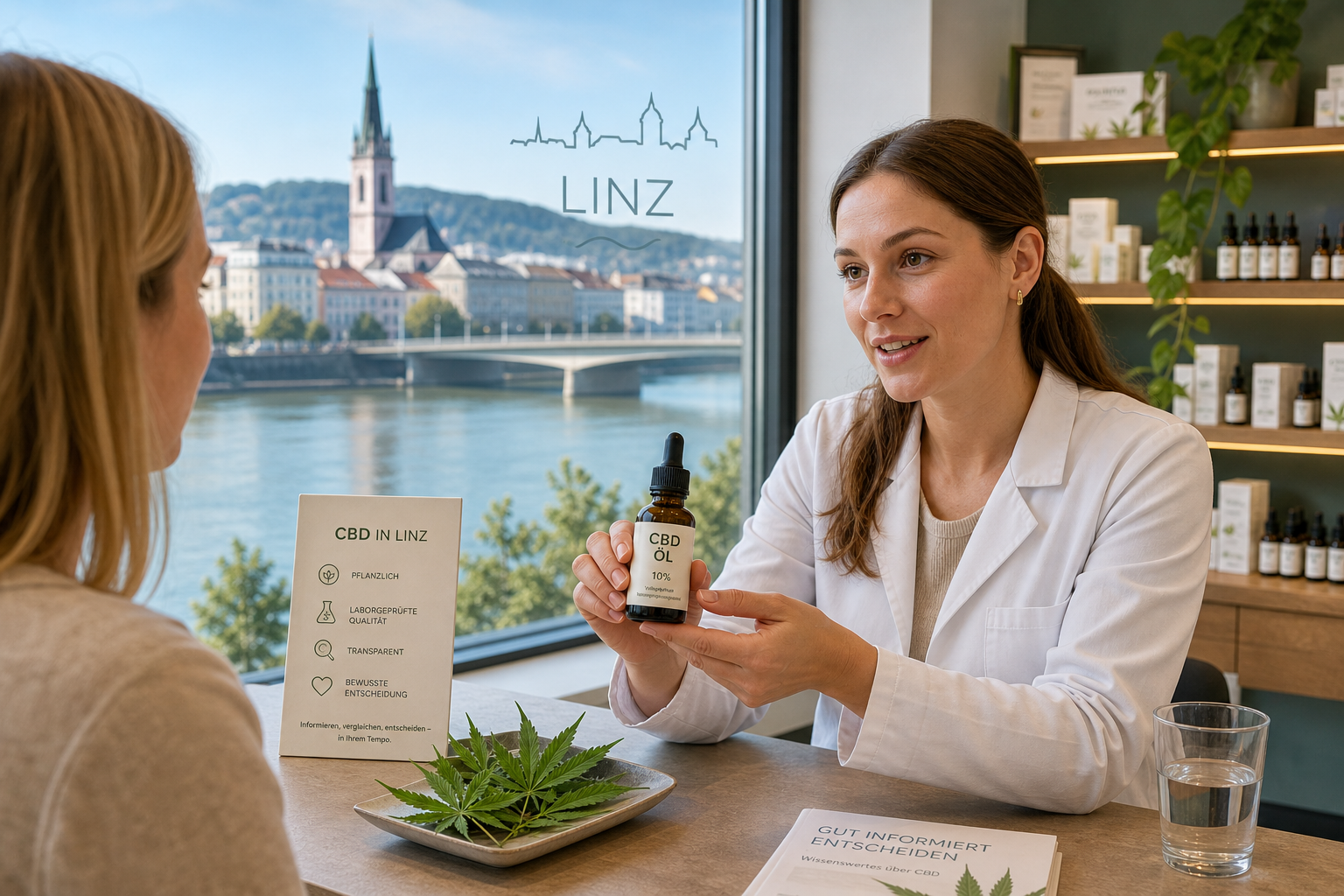
Finding CBD in Linz is relatively straightforward, but choosing a suitable product requires more than walking into the nearest shop. Cannabidiol, usually called CBD, is a non-intoxicating compound associated with the cannabis plant. It does not produce the same high as THC, the main psychoactive cannabinoid, yet CBD products can still raise questions about ingredients, safety, testing and Austrian regulation.
This guide explains how residents and visitors can approach CBD shops in Linz, what to look for on a label, how CBD differs from medical cannabis and why travelling with hemp products requires caution. Rules can change, and the legal classification may depend on the product’s THC content, intended use, ingredients and method of sale. Treat this article as practical orientation rather than individual legal or medical advice.
What CBD means in Linz
CBD is one of several naturally occurring cannabinoids found in hemp and cannabis. Unlike THC, CBD is not generally considered intoxicating. Products sold as CBD may include oils, capsules, cosmetics, flowers, extracts, gummies or other preparations. These categories are not automatically treated the same way under Austrian law.
The term “CBD” also says little about quality by itself. A product can contain different concentrations, carrier oils, flavourings and additional plant compounds. Some products marketed as hemp goods may contain trace amounts of THC, while others may be made from isolated CBD. Reading the full label is therefore more useful than relying on a prominent front-of-pack claim.
People searching for cannabis in Linz should also distinguish CBD from recreational cannabis. CBD products are not a way to obtain legal THC cannabis for intoxication, and the presence of hemp branding does not make every cannabis-derived product lawful.
Where to look for CBD shops in Linz
Specialist retailers, some pharmacies and selected health-oriented businesses may offer CBD-related products in Linz. Availability can change, so check the current opening hours, product category and seller information before making a journey. A responsible retailer should be willing to explain the product’s ingredients, intended use and testing documentation without making exaggerated health promises.
Questions to ask before buying
- What is the exact CBD concentration per bottle, capsule or serving?
- Does the product contain THC, and is the amount stated on reliable laboratory documentation?
- Is there a batch number, expiry date and clear manufacturer or importer information?
- Does the certificate of analysis identify the tested product and batch?
- Are allergens, additives and the carrier oil listed clearly?
- Is the product sold as a cosmetic, food supplement, technical product or another category?
A retailer’s confidence is not proof of legality or effectiveness. Be cautious when staff claim that CBD can cure a disease, replace prescribed treatment or guarantee a particular result. Such claims are a warning sign, especially when no evidence or product documentation is provided.
CBD laws in Austria: the points that matter
There is no single rule that answers whether every CBD product is legal. Austrian treatment can depend on THC concentration, the plant material or extract used, the product’s presentation, its intended use and the rules applying to foods, medicines, cosmetics or tobacco-related goods. For the wording of current Austrian legislation, consult the official Austrian Legal Information System rather than relying on an old shop listing or social-media post.
Products containing enough THC to fall within controlled-drug rules can create criminal or administrative consequences. A low-THC label is not a universal guarantee, particularly if the product is imported, incorrectly labelled or contaminated. Flowers and extracts deserve particular care because their legal treatment may differ from that of a cosmetic containing CBD.
Food and supplement marketing also has its own regulatory issues. A product being displayed in a shop does not necessarily mean that every health claim is approved. The Austrian Agency for Health and Food Safety provides public information through its official AGES website, while legal questions should be directed to a qualified Austrian lawyer or the relevant authority.
CBD and travelling through Linz
Visitors should avoid assuming that a CBD product bought legally in another country can be carried into Austria without difficulty. Border controls, transport rules and the product’s actual THC content can matter. Keep products in their original packaging with the label and purchase documentation, but remember that packaging alone cannot legalise a prohibited product.
Do not carry loose flowers, unlabelled oils or homemade extracts across borders. If you are flying from Linz Airport or continuing to another country, check the rules of every jurisdiction on your route. International cannabis rules are not harmonised, and a product accepted in one country may be restricted elsewhere.
How to compare CBD oil and other products
CBD oil is popular because the amount can be measured more easily than with some finished products. However, the label should state whether the listed amount refers to the entire bottle or to each serving. A bottle labelled with a total milligram amount is not the same as a serving containing that amount.
Product formats
- Oils and tinctures: Usually supplied in a dropper bottle and combined with a carrier oil such as hemp seed, olive or MCT oil. Confirm the serving instructions and storage advice.
- Capsules: Convenient and consistent when properly manufactured, but slower to take effect because they pass through the digestive system.
- Cosmetics: Intended for external use. They should not be treated as oral CBD products unless the label specifically and lawfully says so.
- Flowers and inhaled products: More difficult to assess for legal status and contaminants. Smoke can irritate the lungs, and heating may change the compounds present.
- Edibles: Require particular attention to serving size, ingredients and storage. Keep them away from children and pets.
Choose a product with transparent labelling rather than the highest advertised strength. Independent testing can help identify THC, CBD and contaminants, but a certificate should be recent enough, connected to the exact batch and issued by a credible laboratory.
Safety and responsible use
CBD is not risk-free. Possible unwanted effects include sleepiness, diarrhoea, changes in appetite and interactions with medicines. The risk may be more important for people taking medicines processed by the liver, including some treatments for epilepsy, blood clotting and other long-term conditions.
Speak with a doctor or pharmacist before using CBD if you take prescription medicine, have liver disease, are pregnant or breastfeeding, or are considering CBD for a child. Do not stop prescribed treatment because a retailer presents CBD as a natural alternative. Natural products can still have pharmacological effects and variable concentrations.
When trying a new product, use only the labelled amount and avoid combining it with alcohol or other sedating substances. Do not drive, cycle in traffic or operate machinery if you feel drowsy or impaired. If a product causes worrying symptoms, stop using it and seek medical advice. Severe symptoms require urgent medical attention.
What about drug tests?
Some full-spectrum or poorly controlled CBD products may contain trace THC. Even when the THC level is low, repeated use could matter for someone subject to workplace or sporting drug testing. No seller can responsibly guarantee a negative test unless the relevant testing conditions and product composition are fully known. People in safety-sensitive jobs should ask a healthcare professional or testing authority for specific guidance.
CBD, medical cannabis and “weed in Linz” are different questions
Searches for weed in Linz may refer to several unrelated topics: CBD, hemp products, illicit THC cannabis or prescribed medical treatment. These should not be treated as interchangeable. CBD products sold for general use are not the same as a doctor-prescribed medicine, and a prescription does not create a general right to buy or possess any cannabis product.
Medical cannabis in Linz should be discussed with a qualified Austrian doctor. A clinician can assess the condition, existing medicines, possible interactions and whether an approved treatment is appropriate. Do not attempt to self-treat serious pain, anxiety, epilepsy or another diagnosis with an untested retail product.
For broader regional context, our guide to marijuana in Graz and Austrian cannabis rules covers related legal and safety questions. Readers comparing cities can also review our article on cannabis in Vienna and practical Austrian guidance, while remembering that national law generally matters more than the city where a product is purchased.
A practical checklist for buying CBD in Linz
- Decide whether you need a cosmetic, a general CBD product or medical advice.
- Check the seller’s business details, product category and return or complaint process.
- Read the complete label, including CBD amount, THC information, ingredients and warnings.
- Ask for batch-specific laboratory testing where available.
- Avoid products promising guaranteed cures or unusually rapid results.
- Start cautiously, do not mix CBD with alcohol or sedatives, and monitor how you feel.
- Keep the product in its original packaging and review travel rules before crossing a border.
Conclusion
Buying CBD in Linz is best approached as a product-quality and legal-compliance question, not simply a shopping decision. Compare transparent labels, seek evidence of batch testing and distinguish CBD from THC cannabis and prescribed medical treatment. Austrian rules can depend on the exact formulation and intended use, so check current official information before buying, importing or travelling with a product.
If you use medicines or want CBD for a health condition, involve a pharmacist or doctor. A careful approach helps residents and visitors make more informed choices while avoiding unnecessary legal, health and travel risks.