
Understanding Cannabis public consumption laws in Avellino requires separating several issues that are often treated as one. Italian law regulates possession, supply, cultivation, driving and drug-related conduct differently. The act of smoking cannabis in a street, park or other open area may not be described by one simple national offence, but public use can still create legal and practical problems.
For residents and visitors, the safest approach is to avoid consuming cannabis in public and to understand what can happen if police find cannabis, observe use, or believe that other offences are involved. This guide explains the national framework, the role of local rules in Avellino, and the difference between personal possession and more serious conduct. It is general information, not a substitute for advice from an Italian lawyer.
What Italian law says about cannabis use and possession
Italy’s main drug-control framework is found in Presidential Decree No. 309 of 1990, commonly known as the consolidated law on narcotic drugs. The official text is available through Italy’s official Normattiva legislation portal.
The legal consequences depend heavily on the facts. Possession intended for personal use is generally handled through an administrative framework, while possession connected with supply, distribution, trafficking or other non-personal purposes can become a criminal matter. The substance, quantity, packaging, surrounding circumstances and evidence of intent may all matter.
Personal use is therefore not the same as a general permission to possess or consume cannabis wherever a person chooses. A person may avoid a trafficking allegation and still face seizure of the substance, identification, reporting to the competent authorities or administrative measures.
Is consuming cannabis in public itself a crime?
There is no simple rule stating that every act of cannabis consumption in an outdoor public place automatically produces the same criminal charge. However, that does not make public smoking risk-free. Police may intervene because of possession, disturbance, proximity to vulnerable people, suspected supply, impaired behaviour, trespassing, or another breach of public-order rules.
Public consumption can also make the facts look different from private possession. Visible use near a school, transport area, event, playground or busy pedestrian space may attract attention and increase the chance of a police check. If others are exposed to smoke or the conduct causes disruption, separate rules may become relevant.
Cannabis public consumption laws in Avellino and local enforcement
The national framework applies in Avellino, but local authorities can affect how public spaces are managed. Municipal regulations, public-order measures, event rules and instructions from police can restrict conduct in particular places or during specific periods. These measures may apply to smoking, littering, nuisance, access to public facilities or behaviour that creates a safety concern.
That means a visitor should not assume that a quiet-looking square, park or street is an acceptable place to consume cannabis. Rules may be displayed on site, issued for a particular event, or enforced through general public-order powers rather than a cannabis-specific sign.
For current local information, check official Comune di Avellino notices and signage, especially before attending festivals, demonstrations, sports events or crowded public gatherings. Local arrangements can change, and a general online article cannot confirm every temporary order.
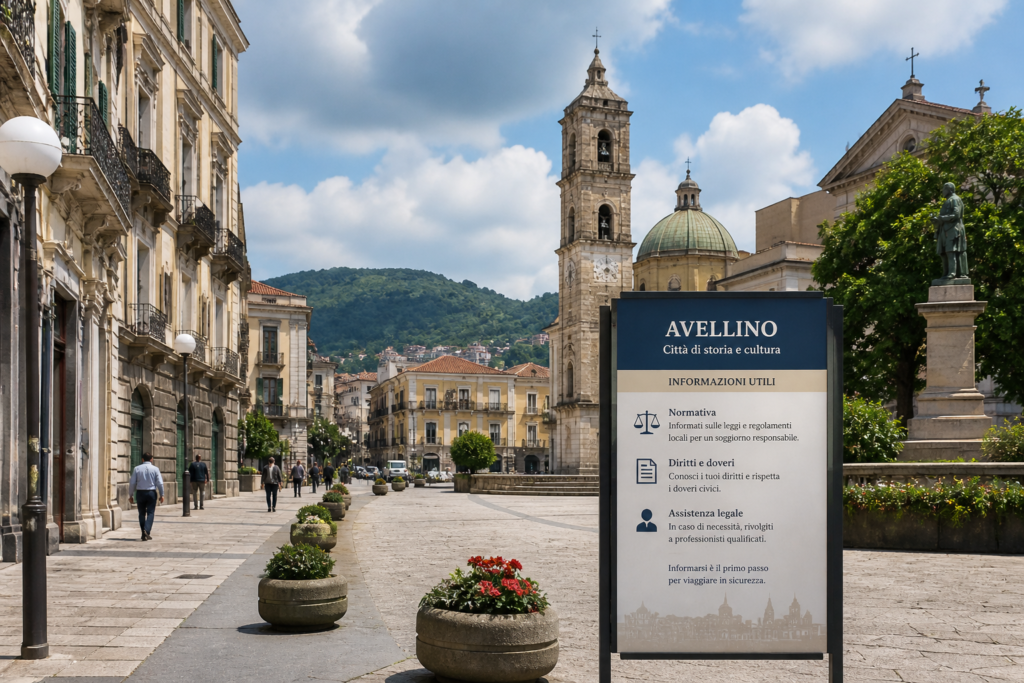
Where public use creates additional risk
- Near children or schools: visible smoking or smoke exposure can prompt intervention and complaints, even where no drug-supply allegation exists.
- At transport hubs: stations, bus stops and crowded waiting areas are closely supervised and leave little room for conduct that may disturb other passengers.
- At events: venue policies and event-security procedures may prohibit smoking or lead to removal from the site.
- In residential areas: smoke, smell, noise or discarded materials can generate complaints and possible action under other rules.
- On private property open to the public: a bar terrace, shopping area or accommodation provider may impose its own conditions and ask a person to leave.
Possession for personal use: what may happen
When authorities treat cannabis possession as intended for personal use, the response is generally administrative rather than the same criminal process used for alleged dealing. The substance may be confiscated, and the person may be reported to the prefecture. Possible administrative consequences can affect documents or privileges such as a driving licence, passport or firearms licence, depending on the circumstances and the applicable procedure.
These consequences are not automatic in identical form for every case. Authorities consider the substance, the person’s situation and the relevant legal provisions. A police report or referral does not mean that every possible sanction will necessarily be imposed, but it should be taken seriously.
Anyone stopped should remain calm, avoid arguing about legal conclusions in the street, and ask what procedure is being followed. If documents are presented for signature, request an explanation and obtain legal advice promptly where the matter is serious or unclear.
Why public smoking can escalate a minor situation
Open consumption makes several facts visible at once: the person may be seen holding or passing cannabis, smoking equipment may be apparent, and the smell can lead to a report. If several people are present, police may examine whether the situation involves sharing or supply rather than solitary personal use.
Italian drug law distinguishes personal possession from conduct intended for others, but the distinction is fact-specific. Sharing cannabis is not a reliable legal workaround. Giving or selling cannabis to another person can expose someone to substantially more serious consequences than simple personal possession.
Driving is another major concern. A person should never drive, cycle in traffic or operate machinery while impaired. A roadside stop or collision can lead to separate investigation, and drug-related driving rules are distinct from the rules on possession or public smoking.
Public cannabis use versus medical cannabis
Medical cannabis is not a general exemption from public-use or driving rules. A patient may have lawful access through Italy’s medical system, but the product, prescription, dispensing route and use must comply with the applicable medical framework. Carrying prescribed medicine does not automatically authorize smoking in a park, on public transport or inside a venue.
Patients should follow the instructions of their doctor and pharmacist, keep medicine in its original packaging where practical, and carry relevant documentation when travelling with prescribed products. Questions about treatment, interactions or administration should be directed to a qualified healthcare professional. Italy’s Ministry of Health information on medical cannabis is a more reliable starting point than informal social-media advice.
Medical use also does not remove impairment concerns. If a medicine affects concentration, reaction time or coordination, the patient should follow medical advice and avoid activities that could endanger others.
CBD, low-THC products and the importance of checking labels
People sometimes assume that every cannabis-related product is treated like high-THC marijuana or, conversely, that every product labelled CBD is automatically unrestricted. Neither assumption is safe. Italian rules can differ according to the product, cannabinoid content, intended use, presentation and current legislation or enforcement interpretation.
A CBD product sold lawfully through an appropriate channel does not necessarily mean that it can be smoked anywhere. Public-smoking restrictions, venue rules and nuisance provisions may still apply. Consumers should use reputable retailers, read the packaging, retain receipts and avoid products with unclear composition.
For broader context on how cannabis-related rules and safer choices are discussed in another Italian city, see this guide to cannabis consumption in Matera. Local facts differ, but the distinction between access, possession and public conduct remains important.
Practical advice for residents and visitors in Avellino
- Do not consume cannabis in public: choose not to smoke in streets, parks, stations, terraces, venues or other shared spaces.
- Do not carry cannabis casually: possession can still lead to seizure and administrative proceedings even when there is no allegation of dealing.
- Never share or sell it: passing cannabis to another person can create a much more serious legal issue.
- Respect signs and venue policies: private businesses and event organizers can impose stricter conditions than a person may expect.
- Avoid driving after use: impairment and drug-driving investigations create risks unrelated to the possession question.
- Check official notices: look for current Comune di Avellino measures before public events or visits to controlled areas.
- Seek legal advice after a police report: deadlines and procedures can matter, particularly where a driving licence or other document is at risk.
How Avellino compares with the wider Italian picture
The basic legal structure in Avellino is not a separate city cannabis code. National drug law supplies the core rules, while local authorities manage public spaces and particular situations. This is why online claims that cannabis is simply “legal” or “illegal” in a city are usually too broad to be useful.
For related reading, the guide to the cannabis industry in nearby Benevento illustrates why commercial activity, personal possession and public consumption should be treated as separate topics. A licensed or regulated activity does not turn public recreational use into an unrestricted right.
Frequently asked questions
Can I smoke cannabis on an Avellino street if I am not bothering anyone?
It is not a safe legal assumption. Even without obvious disturbance, possession remains relevant, and police may investigate the circumstances. Avoiding public consumption is the lowest-risk choice.
Can tourists receive the same consequences as residents?
Visitors can still be subject to Italian law and administrative procedures. Immigration status, travel plans and identity documents may make a stop especially inconvenient. Tourists should not assume that a small amount will be ignored.
Does a private balcony make consumption legal?
A private setting may reduce visibility and public-order concerns, but it is not an automatic defence to every issue. Rental agreements, condominium rules, smoke drifting into neighbouring homes and possession rules can still matter.
What should I do if police stop me?
Stay polite, provide accurate identification, avoid physically resisting, and ask what is happening. Do not make assumptions about the outcome. If you are asked to sign documents or receive a report, consider contacting an Italian lawyer promptly.
Conclusion
The practical answer to cannabis public consumption laws in Avellino is straightforward: public use carries avoidable legal and practical risks, even when the situation does not immediately look like a criminal case. Personal possession may lead to administrative consequences, while sharing, supply, driving or disorder can create more serious exposure.
Residents and visitors should avoid consuming cannabis in public, respect local notices and venue rules, keep medical products properly documented, and obtain professional advice if contacted by authorities. The safest interpretation of cannabis laws in Avellino is not that public use is freely permitted, but that the consequences depend on the setting, the substance, the person’s conduct and the evidence available.