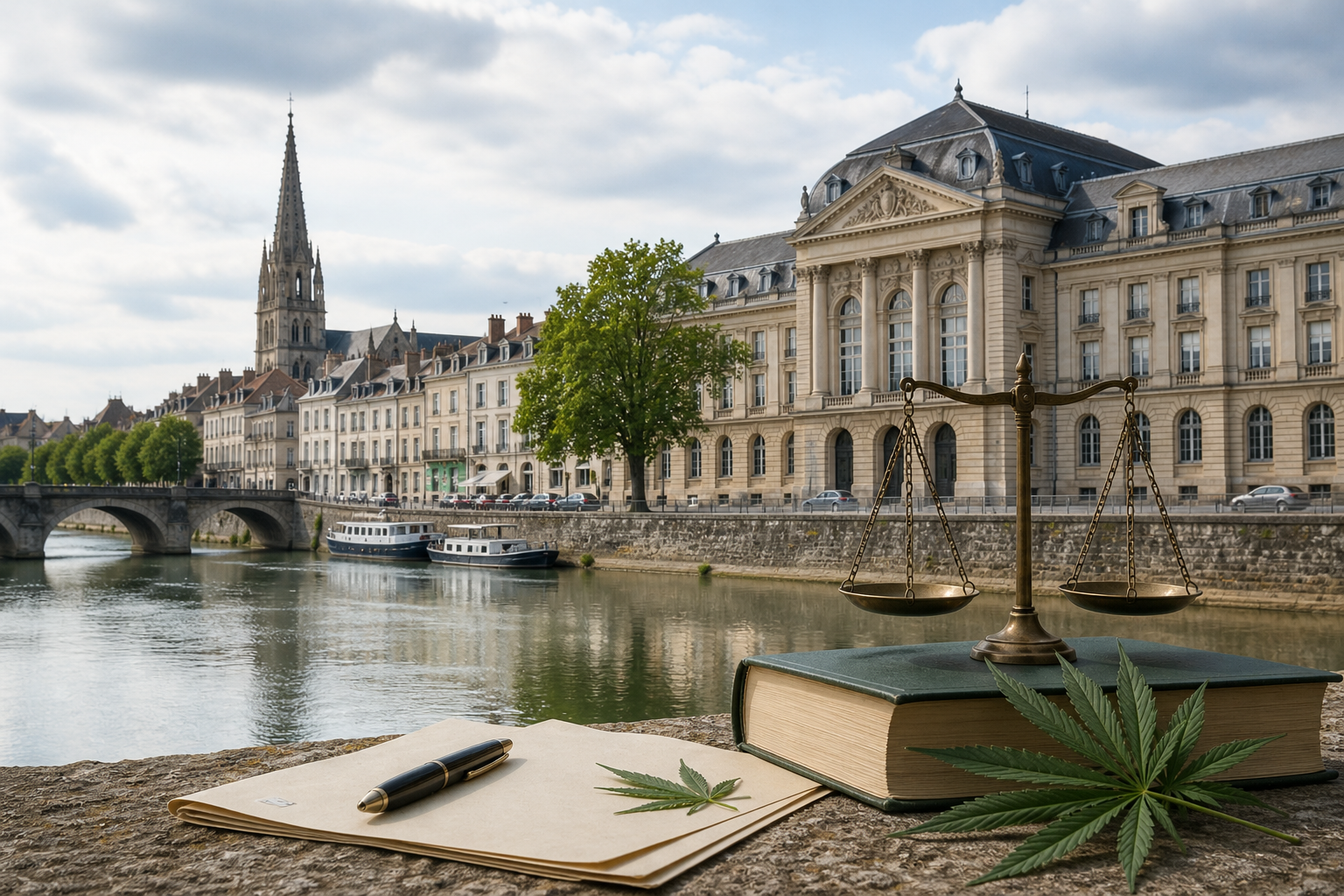
Understanding cannabis possession limits in Chalon-sur-Saône starts with one important point: France does not provide a lawful personal possession allowance for cannabis containing THC. Chalon-sur-Saône follows the same national rules as the rest of France. There is no city-specific quantity that makes recreational cannabis legal, whether the substance is kept at home, carried in a vehicle, or found in a public place.
For residents and visitors researching weed in Chalon-sur-Saône, the practical issue is therefore not how many grams are permitted. It is whether the conduct may lead to a police response, a fixed criminal fine, or more serious proceedings depending on the facts. This guide explains the main distinctions without treating a small amount as risk-free or assuming that every case is handled identically.
Cannabis possession limits in Chalon-sur-Saône: is any amount legal?
For recreational cannabis, the answer is generally no. French law prohibits the unauthorized use, acquisition, possession, transport, and supply of narcotic drugs. Cannabis is treated as an illegal narcotic when it contains prohibited levels of THC. A person cannot rely on a personal-use quantity as a legal exemption.
That means possessing a small amount of cannabis in Chalon-sur-Saône can still be unlawful. The absence of a published personal limit does not create a grey area in which a few grams are automatically acceptable. Quantity may influence how authorities assess the circumstances, but it does not turn prohibited cannabis into legal property.
The same principle applies to cannabis in Chalon-sur-Saône bought elsewhere and brought into the city. Moving it from another French town, keeping it in a bag, or storing it in a private residence does not create a possession right. Importing cannabis from another country can involve additional customs and drug-trafficking issues.
How French authorities may respond to possession
French procedure distinguishes between straightforward personal use and circumstances suggesting a more serious drug offence. The response can depend on the quantity, packaging, statements, previous history, location, and any evidence of resale or distribution.
Fixed criminal fine for some minor cases
In some cases involving drug use, including situations where possession is connected with personal consumption, police may issue a fixed criminal fine. The standard amount is commonly presented as €200, reduced to €150 when paid within the applicable period and increased to €450 if payment is late. These figures and procedures should be checked against current official guidance because payment deadlines and case circumstances matter.
A fixed fine is not the same as legalization. It is a criminal-law response available for eligible cases, not a personal cannabis allowance. Authorities may use another procedure where the facts do not fit the conditions for the fixed fine or where the suspected conduct is more serious.
The French government’s guidance on narcotics use explains the general legal treatment of drug use and the fixed-fine approach. It is a useful starting point, but it cannot predict the outcome of an individual police or court case.
When possession can become a more serious matter
Possession connected with supply, resale, transportation for distribution, cultivation, importation, or organized activity can expose a person to significantly more severe criminal allegations. Indicators may include multiple packages, scales, large amounts of cash, messages arranging sales, or statements from witnesses. The legal assessment is fact-specific.
It is also important not to assume that the absence of a sale proves that a case is minor. A quantity that appears inconsistent with immediate personal use may prompt further investigation. Conversely, the amount alone does not establish every element of a trafficking offence. Anyone questioned in a serious case should seek advice from a qualified lawyer rather than relying on informal internet interpretations.
Does Chalon-sur-Saône have different local cannabis rules?
Chalon-sur-Saône cannot create its own recreational possession limit that overrides national French narcotics law. Municipal measures may affect local policing priorities, public-space management, or safety enforcement, but they do not legalize THC cannabis.
In practical terms, a person should not expect a different possession rule in Chalon-sur-Saône than in another French city. Police checks may happen in streets, transport areas, nightlife districts, parks, or near events, but the underlying offences come from national law. Local context can influence where enforcement is visible without changing what is prohibited.
This is why searches for cannabis laws in Chalon-sur-Saône should be answered by looking first at French national legislation. Local assumptions, social media posts, or comparisons with countries that permit limited possession are not reliable evidence of a French exemption.
Public use, private homes, and driving
Possession is only one part of the legal risk. Using cannabis in a public place can attract enforcement and may create additional practical problems, especially around public order, schools, transport, workplaces, and crowded events. Smoking discreetly does not make possession or use lawful.
Private accommodation is not a safe legal exception. A private home may reduce public visibility, but it does not authorize the possession of prohibited cannabis. Tenants, hotel guests, and visitors may also face contractual, eviction, or police consequences if cannabis use causes nuisance, damage, or safety concerns.
Driving after using cannabis is particularly serious. French road rules prohibit driving under the influence of narcotics, and enforcement can be based on the presence of prohibited substances rather than a personal assessment that the driver feels capable. A positive test may lead to criminal and licensing consequences. Do not drive after consuming cannabis, and do not assume that waiting a short time removes legal or safety risk.
For broader safety context, readers can also review this related guide to cannabis safety and legal risks in Saint-Quentin. The city differs, but the practical warnings about impaired driving and exposure to legal consequences are relevant nationally.
CBD is not the same as prohibited cannabis
CBD products create frequent confusion because some are lawfully sold in France under conditions. A compliant CBD product is not automatically equivalent to recreational cannabis, but the distinction depends on the product’s composition, labeling, origin, and compliance with applicable rules.
Consumers should be cautious with flowers, resins, oils, edibles, and vape products that are sold as CBD. A product labeled “CBD” may still create problems if it contains prohibited THC levels or does not meet regulatory requirements. Packaging from an informal seller is not proof of legality.
There can also be testing concerns. Some products may contain trace amounts of THC, and a person cannot assume that a CBD product will be irrelevant to a roadside drug test. The safest approach is to avoid driving after using any product that could contain THC and to retain reliable product information when purchasing lawful CBD.
For a separate explanation of the distinction between hemp, CBD, and THC, see this guide to hemp legality and CBD rules in France. It should be read alongside current official guidance rather than treated as a guarantee for a particular product.
Medical cannabis in Chalon-sur-Saône
Searching for medical cannabis in Chalon-sur-Saône requires a different legal analysis from recreational possession. Medical access, where available under an authorized French framework, depends on medical supervision, eligibility, the product supplied, and the applicable national scheme. It does not mean that a patient may freely buy recreational cannabis or possess cannabis obtained from an unregulated source.
A prescription or medical condition should not be assumed to legalize every cannabis product. Patients should use only products supplied through the authorized route and follow instructions from their doctor or pharmacist. They should also ask about driving, workplace testing, interactions with medicines, and travel restrictions.
Visitors bringing cannabis-based medicine into France should check the rules before travelling. A foreign prescription may not by itself provide permission to import or carry a product. Original packaging, medical documentation, and advance confirmation from the relevant French authorities may be necessary, depending on the medicine and its origin.
What residents and visitors should do if stopped
If police find cannabis, stay calm and avoid making assumptions about the outcome based on the amount. Do not obstruct the search or attempt to discard substances. Ask what procedure is being used and request legal assistance if questioning becomes serious or if officers indicate a suspected supply or trafficking offence.
- Do not argue that a small quantity is automatically legal; France has no general personal possession allowance.
- Do not sign documents you do not understand. Ask for an interpreter if language is a problem.
- Do not make claims about medical use unless they are accurate and supported by genuine documentation.
- Do not drive after cannabis use, particularly if a vehicle or roadside test is involved.
- Keep any CBD packaging and purchase information, while recognizing that paperwork does not guarantee compliance.
- Contact a French lawyer promptly if there is a summons, custody measure, seizure, or allegation of supply.
The official French government information portal on drugs and addictions provides general public-health and policy information. For personalized legal advice, use a qualified French legal professional or an appropriate local legal-aid service.
Common misunderstandings about cannabis possession in Chalon-sur-Saône
“A personal-use amount is permitted.”
There is no simple statutory allowance that makes a stated number of grams lawful for recreational use. A small amount may be handled differently from evidence of trafficking, but it remains potentially unlawful.
“The fine means cannabis is decriminalized.”
The fixed criminal fine is an enforcement mechanism for eligible cases, not a declaration that cannabis is legal. A record, court process, or additional investigation may still arise depending on the circumstances.
“CBD flowers and cannabis flowers are always easy to distinguish.”
Appearance alone is unreliable. Product composition and legal compliance matter, and informal products can create uncertainty. A label or seller’s claim is not a substitute for verified compliance.
“Rules are different because Chalon-sur-Saône is not Paris.”
National drug law applies in Chalon-sur-Saône. Enforcement patterns may vary by situation, but the city does not have a separate recreational possession limit.
Conclusion
The clearest answer on cannabis possession limits in Chalon-sur-Saône is that France does not authorize a general personal-use quantity of THC cannabis. Any amount may create legal exposure, while fixed fines are possible in some minor use-related cases and more serious allegations can arise when circumstances suggest supply, importation, or other aggravated conduct.
Residents and visitors should distinguish recreational cannabis from compliant CBD and from properly authorized medical treatment. They should also avoid public use, never drive after consuming cannabis, and obtain current legal advice when contacted by police. The safest assumption is that national French law applies fully in Chalon-sur-Saône unless an official, current source confirms a specific exception.