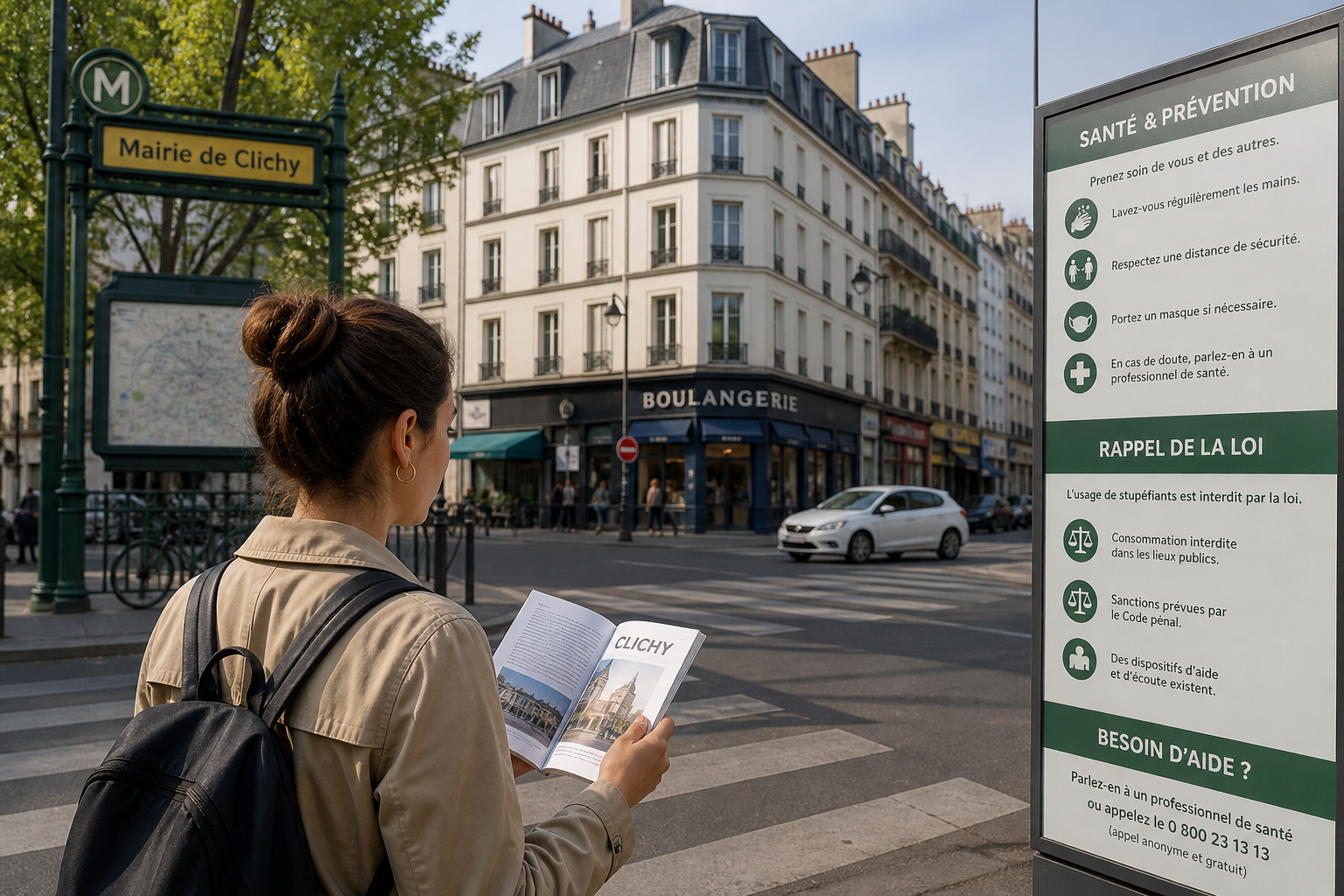
Understanding the Cannabis laws for visitors in Clichy is important before travelling to this suburb immediately northwest of Paris. Clichy is part of the Île-de-France region, but it does not have a separate visitor-friendly cannabis regime. French national law applies to possession, use, purchase, transport, driving and importing cannabis.
For visitors, the safest legal assumption is straightforward: recreational cannabis remains illegal in Clichy and throughout mainland France. A short stay, foreign passport, medical authorization from another country or the fact that cannabis is tolerated elsewhere does not create an exemption. This guide explains the main rules, likely consequences and practical decisions that can help travellers avoid legal and safety problems.
Cannabis laws in Clichy: the basic rule
France prohibits the unauthorized use, possession, acquisition, transport and supply of cannabis. The same national framework applies in Clichy as in Paris, Levallois-Perret, Saint-Ouen and other nearby municipalities. Local authorities may address public order issues, but they cannot legalize recreational cannabis within the city.
That means there is no lawful recreational dispensary, cannabis coffee shop or licensed social club for visitors to use in Clichy. A person offering cannabis on the street, in accommodation or through an informal delivery service may also expose the buyer to additional risks, including scams, theft, contaminated products and police attention.
Visitors should also distinguish between cannabis containing prohibited levels of THC and lawful hemp or CBD products. The appearance of a product is not a reliable way to assess its legal status. Packaging, laboratory compliance and the applicable THC threshold matter.
Does being a tourist change the law?
No. French law generally applies to residents and visitors alike. Tourists can be questioned, searched under applicable procedures, fined or prosecuted. Not speaking French does not remove the obligation to comply, although visitors should request an interpreter or legal assistance when necessary during formal proceedings.
A foreign identity card or passport can make identification and administrative follow-up more significant, particularly if an incident occurs close to an airport, railway station or international border. Visitors should not assume that leaving France will automatically cancel an unpaid fine or unresolved case.
Possession and use: what visitors may face
French law treats personal use and possession as offenses even when the quantity is small. In suitable cases, police may issue a fixed penalty notice for drug use or possession. The standard amount commonly associated with the fixed penalty is €200, with a reduced amount when paid promptly and an increased amount when payment is late. The precise amount, payment deadline and procedure stated on the notice control.
A fixed penalty is not the same as legalization or a guaranteed outcome. Authorities may refer a matter for prosecution instead, especially where circumstances are disputed, there are aggravating factors, the person cannot be identified, or the suspected conduct goes beyond simple personal use. Criminal penalties under French law can be more serious than the fixed fine.
For current information about the French fixed penalty for drug use, consult the official Service-Public.fr guidance on the drug-use fixed penalty. The notice issued by authorities remains the most relevant document for an individual case.
Public use in Clichy
Smoking or consuming cannabis in a street, park, station area, hotel entrance, rented apartment or other public-facing location can lead to police intervention. The legal problem is the unauthorized use itself, not merely whether the smoke bothers other people. Public consumption can also create separate practical issues involving nuisance, complaints, children, traffic and public order.
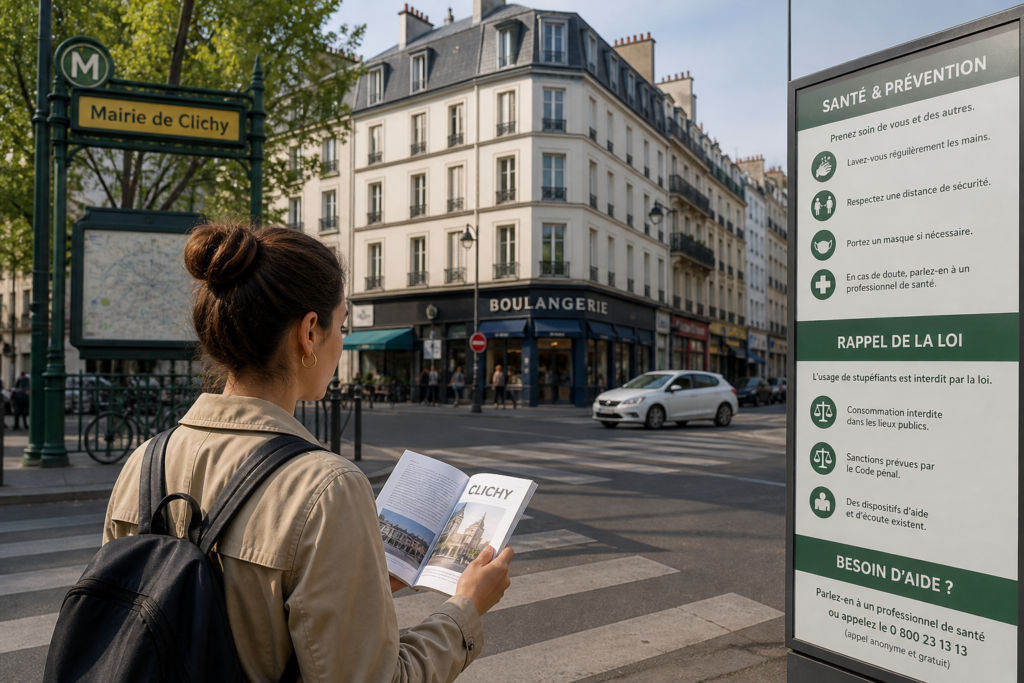
There is no reliable “safe place” in Clichy where a visitor can legally consume recreational cannabis. A private room is not a legalization loophole. Tenants, hotels and short-term rental hosts can prohibit smoking, possession or illegal activity under their own rules, and a host may ask a guest to leave or report damage and nuisance.
For visitors researching weed in Clichy, the key point is that local availability does not indicate lawful status. Seeing people consume cannabis does not make the conduct permitted, and buying from an unlicensed seller can increase both legal and personal safety risks.
Buying, sharing and transporting cannabis
Buying cannabis is illegal, including purchases arranged through social media, messaging apps or street sellers. Sharing cannabis with a friend is not automatically treated as harmless personal use. Supplying, selling or facilitating distribution can lead to substantially more serious consequences than simple possession.
Visitors should never carry cannabis for another person, accept a package from someone they barely know or agree to transport a bag through a station or airport. A claim that the package contains only a small amount, belongs to someone else or is intended for personal use may not prevent an investigation.
Transporting cannabis between France and another country is especially risky. Bringing cannabis into France, taking it out of France or crossing a border with it can create customs and criminal consequences. This applies even when cannabis was legally purchased in the departure country or is legal at the destination.
Airports, trains and border crossings
Do not pack cannabis, cannabis resin, THC oils, edible products or cannabis-infused products in checked or carry-on baggage. Do not assume that sealed packaging, a receipt or a product purchased legally abroad will protect you at French customs. Border controls focus on what is being transported, not only where it was purchased.
Travellers connecting through the Paris region should be particularly careful with luggage and personal belongings. If authorities discover a controlled substance, the consequences can include questioning, seizure, missed transport and formal proceedings. The same caution applies to cannabis seeds and products that may appear minor but can raise separate legal questions.
Driving after cannabis use in Clichy
Driving after using cannabis is a major risk. France prohibits driving after the use of drugs, and roadside testing can lead to further testing and enforcement. A visitor should not drive, cycle in dangerous traffic or operate a scooter after consuming cannabis, even if they feel alert or believe the effects have ended.
Drug-driving consequences may include criminal penalties, licence-related measures, vehicle complications and problems with insurance. A foreign driving licence does not make the rule irrelevant. Visitors using rental cars, scooters or shared vehicles may also face contractual charges and loss of access to the vehicle.
The safest choice is to avoid driving after cannabis use entirely. Use public transport, a licensed taxi or another sober driver only when the journey can be completed safely and lawfully. Do not combine cannabis with alcohol or sedating medicines, as impairment can become less predictable.
CBD and hemp products: why caution is necessary
CBD products are not the same as recreational cannabis, but not every product marketed as CBD is automatically lawful. French and European rules concern the plant material, THC content, product category, labelling and how the product is sold. Oils, flowers, vapes, sweets and cosmetics may be treated differently under consumer and product regulations.
A visitor should avoid assuming that a CBD flower looks legal simply because a shop displays it. Keep the original packaging and proof of purchase where available, and do not carry a product across an international border without checking both countries’ rules. A foreign product may not comply with French requirements.
CBD can also contain enough THC to create problems in some circumstances, including testing and transport. It is not a dependable way to avoid all legal or driving-related risks. For general government information about drugs and public-health policy, consult the official French government drugs information portal.
Medical cannabis for visitors
Medical cannabis is a specialized issue and should not be confused with recreational access. A prescription or medical authorization issued abroad does not automatically give a visitor permission to buy, possess or use a cannabis product in France. Rules may depend on the medicine, its THC content, the documents carried and current French health regulations.
Visitors who use prescribed cannabis-based medicine should contact the relevant French authorities, their doctor and their embassy before travelling. They should ask specifically about import permission, quantity limits, original packaging, translated documentation and border procedures. Do not rely only on a foreign prescription, a photograph of a prescription or a letter that does not identify the medicine clearly.
Travellers can also review our related guide to cannabis laws for foreigners in Antony for another nearby Île-de-France perspective. The legal principles remain national, but travel details and local surroundings can differ.
What to do if police stop you
Stay calm, remain polite and follow lawful instructions. Do not resist a search, attempt to hide or discard anything, or argue that cannabis is legal because it is permitted in another country. Ask what is happening and request an interpreter if you do not understand the procedure.
- Carry valid identification and keep travel documents secure.
- Do not sign a document you cannot understand; ask for an explanation or interpreter.
- Ask how and when a fine must be paid, and keep the paperwork.
- Contact your embassy or consulate if you are detained or face formal proceedings.
- Seek advice from a qualified French lawyer for a serious allegation or disputed case.
Do not hand over money to an unofficial person who claims to be able to make the issue disappear. Use only the payment instructions shown on official paperwork and keep proof of payment.
Practical visitor guidance for Clichy
The simplest way to avoid cannabis-related legal problems in Clichy is not to buy, carry, use or transport cannabis during the trip. This includes products obtained legally in another country. Visitors should also avoid accepting cannabis from acquaintances, posting about purchases online or storing another person’s substance in luggage.
If you are staying in a hotel or short-term rental, read the property’s smoking and conduct rules. Even tobacco smoking may be restricted, and cannabis can create additional eviction, cleaning or security issues. Keep all medicines in their original packaging and check travel requirements before arrival rather than trying to resolve them at the airport.
Readers comparing nearby locations can also review our guide to cannabis smoking regulations in Rueil-Malmaison. It reinforces an important point: nearby municipalities do not create a recreational cannabis exception to French national law.
Conclusion: the safest approach for visitors
The main message of the Cannabis laws for visitors in Clichy is clear: recreational cannabis is illegal, and visitors are subject to the same national rules as residents. Possession or use can result in a fixed penalty or more serious proceedings; selling, sharing, importing and driving after use can carry greater risks.
Do not treat local availability, CBD branding, a foreign prescription or private accommodation as permission to use cannabis. Avoid carrying cannabis across borders, obtain reliable advice before travelling with prescribed medicine, and follow official instructions if authorities intervene. Planning around the law is the most practical way to enjoy Clichy and the Paris region without turning a short visit into a legal or travel emergency.