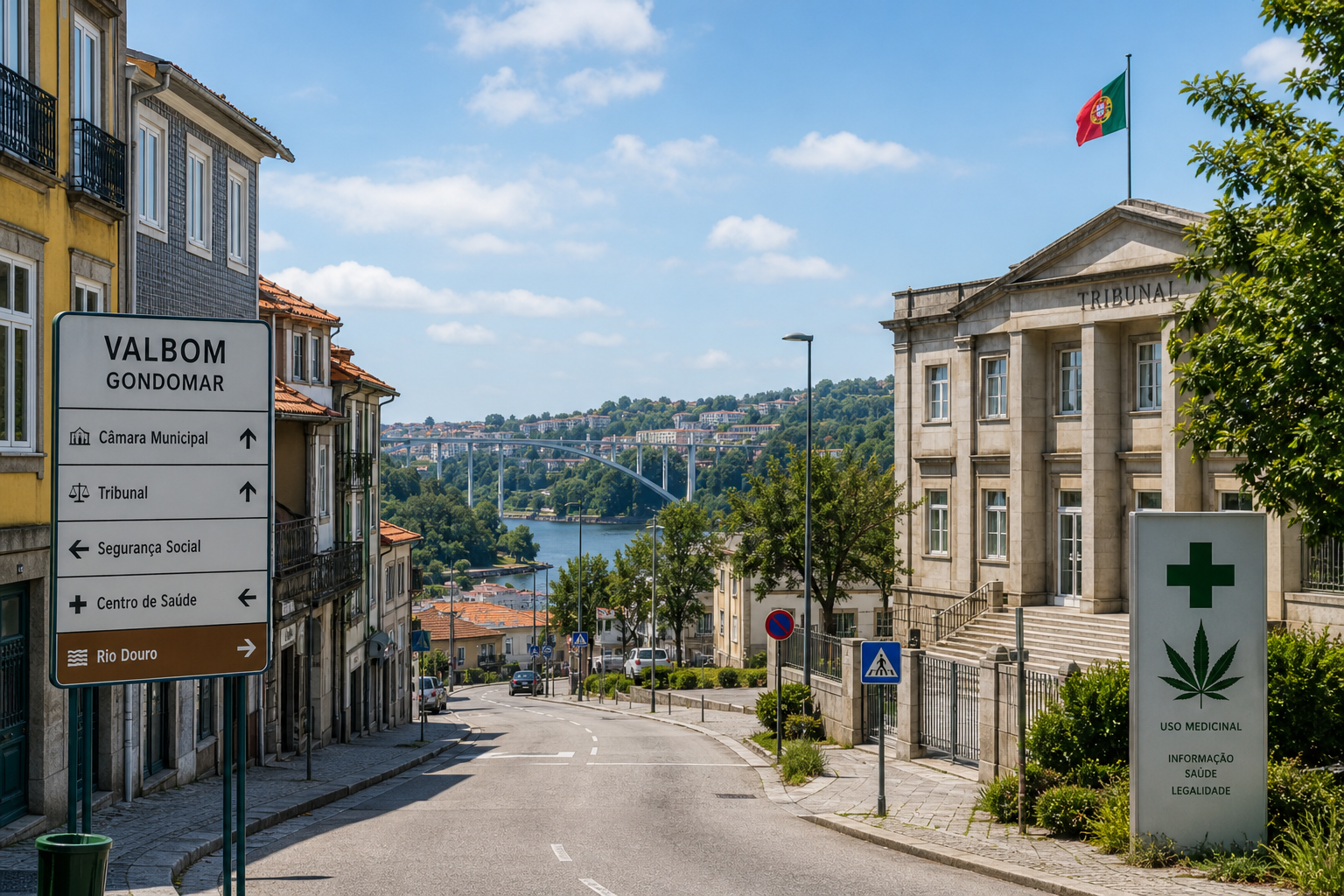
Understanding Cannabis laws in Valbom, Portugal requires looking beyond the city itself. Valbom is a parish in the municipality of Gondomar, within the Porto District, so the main rules come from Portuguese national law rather than a separate Valbom cannabis code. Local police, health services and municipal authorities apply those national rules in everyday situations.
Portugal is often described as having “legal cannabis,” but that phrase is misleading. Portugal decriminalized the personal use and possession of drugs in 2001; it did not create a legal recreational cannabis market. Possession for personal use is generally handled as an administrative matter, while trafficking, unauthorized supply and other conduct remain criminal offenses. The details matter, particularly for residents, visitors and anyone carrying cannabis in public.
Are cannabis laws different in Valbom?
There is no separate recreational cannabis regime for Valbom. The same national framework applies in nearby Gondomar, Porto and the rest of mainland Portugal. This means that asking about cannabis in Valbom involves the same core questions that arise elsewhere: why the person possesses it, how much is involved, whether there is evidence of supply, and whether the conduct creates a public-safety risk.
Portuguese police may identify a person, confiscate suspected drugs and refer a personal-use matter to the relevant Commission for the Dissuasion of Drug Addiction. These commissions are administrative bodies that assess the circumstances and may issue a warning, impose a fine or apply other measures. The response can depend on factors such as prior history, employment, health, dependency and whether the person appears to be a consumer.
For a useful comparison, see this overview of marijuana possession laws in Gondomar. Valbom falls within that municipality, although individual cases still depend on the facts and the authorities involved.
Personal possession and use
Portugal’s decriminalization model generally treats the acquisition and possession of drugs for personal consumption as an administrative offense rather than a criminal offense. Decriminalization is not the same as permission. Cannabis can still be seized, and a person may still be required to attend an administrative hearing or face a sanction.
Quantity thresholds are reference points
Portuguese law uses reference quantities based on an average ten-day supply. Commonly cited reference amounts for cannabis are approximately 25 grams of herbal cannabis, 5 grams of cannabis resin and 2.5 grams of cannabis oil. These figures should not be understood as a legal allowance or a guaranteed amount that can be carried without consequences.
The threshold is an evidential reference used when authorities assess whether possession appears intended for personal use. Possession above a reference amount may lead to greater scrutiny and can support suspicion of supply, but it does not automatically prove trafficking. Conversely, being below the reference amount does not make possession lawful or prevent police action. Packaging, messages, cash, scales, admissions and other evidence may be relevant.
In 2023, changes to Portuguese law reinforced the importance of examining whether possession is genuinely for personal consumption rather than relying only on the amount found. Anyone questioned about cannabis should avoid assuming that a small quantity guarantees a particular outcome. If there is an arrest, search, allegation of supply or dispute about the facts, speaking with a Portuguese lawyer is the safest course.
Buying, selling and sharing cannabis
There is no general legal retail system for recreational cannabis in Valbom. A shop, website or individual offering cannabis for recreational use is not operating under a Portuguese equivalent of a licensed adult-use dispensary system.
Sale, distribution, supply and trafficking can constitute criminal offenses. Sharing cannabis can also create legal risk, even when no money changes hands. The authorities may look at the circumstances, including the quantity, repeated transactions, communications and whether the conduct benefits another person. A visitor should not assume that giving a small amount to a friend is treated exactly like possessing cannabis for personal use.
Products advertised as “legal weed” should be approached cautiously. Labels may be inaccurate, and a product containing controlled cannabinoids can create problems at purchase, during transport or at the border. A commercial presentation does not establish that a product complies with Portuguese law.
Medical cannabis in Valbom
Medical cannabis in Valbom is legal within a regulated healthcare framework. Portuguese law allows certain cannabis-based medicines and preparations to be prescribed for approved medical situations when a healthcare professional considers them appropriate. Products are supplied through the authorized pharmacy system rather than through recreational cannabis shops.
Patients should obtain medical cannabis through a legitimate Portuguese medical pathway and follow the prescription, dispensing and dosing instructions. A prescription from another country may not automatically authorize possession or use in Portugal. Travellers who rely on cannabis-based medicine should confirm documentation and import requirements with Portuguese authorities before travelling, especially when carrying flowers, oils or other controlled products.
The national medicines regulator, INFARMED, Portugal’s medicines authority, provides the appropriate starting point for checking current information about authorized medicinal products, prescriptions and regulatory requirements. Medical eligibility and product availability can change, so online claims and informal advice should not replace guidance from a doctor or pharmacist.
Growing cannabis at home
Home cultivation is a separate issue from personal possession. Decriminalization of personal use did not create a general right to grow cannabis for private consumption. Unauthorized cultivation can remain a criminal matter, including when the grower says the plants are intended only for personal use.
The risks can increase when cultivation involves multiple plants, equipment suggesting commercial production, organized activity or distribution to other people. Indoor growing may also create separate issues involving electricity, fire safety, landlord rules or damage to a rented property. Anyone considering cultivation should obtain individualized advice from a Portuguese lawyer rather than relying on the idea that personal use makes growing lawful.
Using cannabis in public and private places
Personal possession rules do not mean cannabis may be used wherever someone chooses. Smoking in streets, parks, transport areas, cafés, beaches or other public spaces can attract complaints and intervention. A property owner, hotel, landlord or event organizer may prohibit smoking or vaping on the premises, even if the conduct is not treated as a criminal offense.
Valbom is an urban area connected to Gondomar and the wider Porto region, where public transport, roads, schools and commercial areas bring additional practical concerns. Avoid using cannabis near children, schools or crowded public settings. Do not assume that a private balcony, holiday rental or hotel room is automatically exempt from house rules or nuisance laws.
Cannabis and driving in Portugal
Driving after using cannabis is a serious legal and safety issue. Portuguese road rules prohibit driving under the influence of substances that impair driving ability, and roadside or subsequent testing can lead to proceedings. The fact that cannabis was consumed earlier does not by itself establish impairment, but a driver should not treat a prior use as risk-free.
There is also a practical distinction between a prescribed medical product and permission to drive while affected by it. Patients should ask their doctor or pharmacist about impairment, interactions and driving. Do not drive after using cannabis if there is any possibility of reduced attention, slower reaction time, drowsiness or altered judgment.
CBD and low-THC products
CBD is not automatically legal simply because a product is marketed as hemp-derived or contains little THC. Rules can depend on the product category, ingredients, intended use, labeling, manufacturing and whether it is treated as a medicine, food, cosmetic or another regulated product.
Consumers should be particularly careful with CBD flowers, vape liquids, oils and edible products bought online or carried across borders. A seller’s statement that an item is compliant may not be enough, and laboratory labels may not reflect the contents of the specific product. For current regulatory questions, consult official Portuguese health and medicines authorities before buying or importing a product.
What visitors to Valbom should know
Visitors sometimes confuse Portugal’s decriminalization policy with legalization. Tourists are not entitled to buy recreational cannabis, carry it freely through airports or borders, smoke it in public, or take it home. Customs and border rules can create additional consequences when controlled substances are imported or exported.
- Do not buy cannabis from street sellers or informal contacts.
- Do not carry cannabis across the Portuguese border, even if it was legally purchased elsewhere.
- Keep prescribed medicines in original packaging and carry supporting medical documentation.
- Do not drive, cycle on public roads or operate machinery after using cannabis.
- If approached by police, remain calm and seek legal advice if the matter goes beyond a simple identification or seizure.
The best answer to “weed in Valbom” is therefore not that it is legal or illegal in one simple sense. Personal-use possession is generally decriminalized, but cannabis remains controlled, recreational supply is not legally regulated, and several forms of conduct can still lead to criminal proceedings.
Where to verify current rules
Drug policy and medical regulation can change through legislation, court decisions and administrative guidance. For national policy information, consult Portugal’s SICAD drug policy information. For a specific situation involving a search, arrest, cultivation, driving allegation, imported medicine or suspected supply, official information should be supplemented by advice from a qualified Portuguese lawyer.
Conclusion
The practical position under the cannabis laws in Valbom is clear even if the legal framework is sometimes oversimplified. Portugal decriminalizes personal-use possession in many circumstances, but it does not legalize recreational cannabis sales or create a free right to grow, share, import or consume cannabis in public. Medical cannabis is available through a regulated system, while driving and border crossing carry particular risks.
Because Valbom is part of Gondomar, residents and visitors follow the national Portuguese rules rather than a special local cannabis code. Treat quantity thresholds as legal reference points, not permissions; avoid informal products and public use; and obtain professional advice whenever the facts involve cultivation, supply, driving, travel or medical treatment.