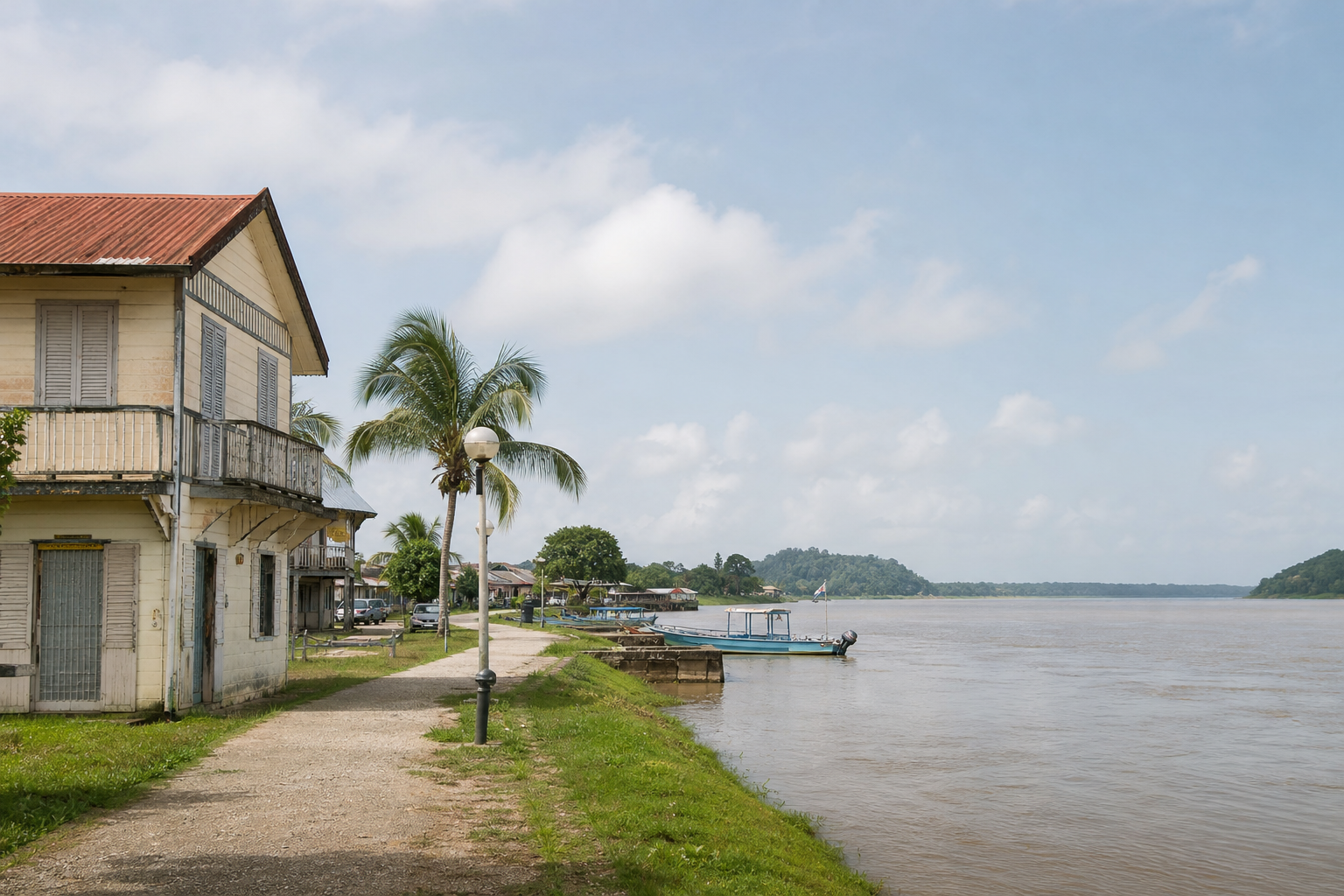
Understanding the Cannabis laws for foreigners in Saint-Laurent-du-Maroni is important before arriving in this border town in western French Guiana. Saint-Laurent-du-Maroni is part of France, so visitors are subject to French national drug law rather than a separate local cannabis regime. Being a foreign passport holder, tourist or temporary resident does not create an exemption.
In practical terms, recreational cannabis remains illegal. Possessing, buying, carrying, importing, selling or using cannabis can lead to legal consequences. Enforcement may vary with the circumstances, but visitors should not assume that a small amount is automatically permitted or that local familiarity with cannabis changes the law.
Cannabis laws in Saint-Laurent-du-Maroni: the national framework
French Guiana is an overseas department and region of France. The main criminal and public-order rules that apply in mainland France also apply in Saint-Laurent-du-Maroni, subject to specific local enforcement conditions. There is no tourist cannabis licence and no visitor exception for recreational use.
French law prohibits the unauthorised use and possession of narcotic drugs, including cannabis. Police and prosecutors assess each situation according to the amount, circumstances, prior conduct and any indication of supply or trafficking. A person who appears to be distributing cannabis may face far more serious proceedings than someone found with a small amount for personal use.
The official French government information on drug use and penalties explains the general legal framework, including the possible fixed penalty for certain cases of drug use. Rules and administrative procedures can change, so check the official source for the current position rather than relying on travel forums.
Does nationality change the consequences?
No. Foreigners are generally judged under the same French rules as French nationals. A passport does not make possession lawful, and a visitor cannot use a lack of knowledge of French law as a defence in ordinary circumstances.
However, immigration and travel consequences can make an incident more disruptive for a foreign visitor. Police contact, questioning, a court appearance, detention, an entry or residence issue, or difficulty completing a journey may affect a person who has a short itinerary. Serious drug offences can also create consequences for visas, residence rights or future border crossings.
Weed in Saint-Laurent-du-Maroni: possession, use and purchase
Searching for weed in Saint-Laurent-du-Maroni does not change the legal answer: recreational cannabis is not sold through a lawful retail market. Buying from an informal seller exposes a visitor to both possession risks and the possibility of fraud, violence, contaminated products or police action.
- Possession: carrying cannabis can result in enforcement even when the quantity is small.
- Use: smoking or consuming cannabis is prohibited, including in a private setting where other offences or complaints may arise.
- Purchase: buying cannabis supports an illegal supply chain and can place the buyer in situations involving surveillance, robbery or arrest.
- Sale or distribution: supplying another person is treated much more seriously than simple personal possession.
- Transport: moving cannabis between towns, across the border or through a port or airport creates additional risk.
In some cases, adults found using or possessing a small quantity may be offered an on-the-spot fixed fine rather than immediately sent to court. This is not a legal allowance, and it is not guaranteed. The matter can still be handled through criminal proceedings, particularly where the facts suggest repeated conduct, supply, a larger quantity or another offence.
Public use and private accommodation
Using cannabis in a street, park, beach area, vehicle, hotel, guesthouse or rented property can create separate practical problems. Smoke, smell and impaired behaviour may lead to complaints or removal from accommodation. A hotel’s house rules do not legalise cannabis, and a private balcony does not provide immunity from French drug law or other public-order rules.
Never use cannabis in or near a vehicle. Driving after consuming cannabis is a serious safety and legal risk, and French road enforcement can treat drug-impaired driving as an offence even when the driver does not feel impaired. Do not drive, cycle or operate equipment after using any intoxicating substance.
Cannabis in Saint-Laurent-du-Maroni and the Suriname border
Saint-Laurent-du-Maroni’s position on the Maroni River makes border awareness especially important. The nearby relationship with Suriname does not create a cannabis-free travel corridor. Crossing a national border with cannabis can turn a possession issue into an import or export matter, potentially involving customs and much more serious penalties.
Do not carry cannabis in luggage, clothing, vehicles, boats or packages when travelling between French Guiana and another country. The same warning applies to cannabis resin, edible products, oils, vape cartridges, plants, seeds and products marketed as therapeutic. A product bought legally or tolerated somewhere else may still be unlawful to import into France or Suriname.
The official French Customs website provides information about border controls and prohibited goods. Travellers should check current customs guidance before crossing, because border procedures and product rules can depend on the item, its ingredients, its origin and the route.
Boats, luggage and parcels
Visitors sometimes underestimate the legal significance of travelling by boat or sending a parcel. Customs or law-enforcement authorities may inspect baggage and shipments, and claiming that a package belongs to someone else will not necessarily remove responsibility. Do not accept luggage, envelopes or packages from strangers, and do not transport cannabis for another person.
CBD and medical cannabis for foreign visitors
CBD is not identical to recreational cannabis, but that does not mean every CBD product is lawful. French and European product requirements can involve THC content, product composition, labelling and how the item is marketed. Oils, flowers, gummies and vape products may be treated differently depending on their ingredients and presentation.
Visitors should not assume that a CBD product purchased abroad can be brought into French Guiana. Border officials may need to establish what the product contains, and packaging that says “CBD” is not a guarantee of compliance. The safest approach is to avoid carrying uncertain products across borders and to obtain current advice from French Customs or another competent authority before travel.
Medical cannabis is also not a general permission to bring cannabis into France. A prescription or medical authorisation from another country may not automatically allow import, possession or use in French Guiana. Travellers who rely on cannabinoid medication should ask their prescribing clinician and the relevant French authorities about the exact medicine, documentation, quantity and transport conditions before departure.
What to do if police stop you
If officers question you about cannabis, remain calm and respectful. Do not argue about local customs, attempt to hide or discard anything, or make false statements. You can ask what is happening and request an interpreter if you do not understand French well enough to follow the procedure.
- Carry valid identification and keep your travel documents accessible.
- Ask whether you are free to leave or whether you are being formally questioned.
- Request legal assistance if the matter becomes a formal investigation or detention.
- Contact your embassy or consulate if you are detained or need help communicating with family.
- Do not sign a document you cannot understand; ask for an explanation or translation.
- Follow instructions, but do not obstruct officers or interfere with an inspection.
Consular staff cannot cancel French proceedings or guarantee release, but they may explain practical support options and help you contact relatives or a lawyer. If you receive a fixed penalty notice, read the payment and challenge instructions carefully. Ignoring official correspondence can create additional problems.
Safer travel choices for foreigners
The simplest way to avoid legal trouble is not to buy, carry or use cannabis during your stay. This is particularly important for people staying briefly, travelling with children, crossing the Maroni, or continuing to another destination by air or land.
Keep these precautions in mind:
- Do not ask taxi drivers, hotel staff or strangers to find cannabis.
- Do not photograph, film or approach suspected drug transactions.
- Do not accept cannabis products as gifts or agree to carry them for another traveller.
- Use only medicines that are lawful and properly documented for your journey.
- Plan transport without driving after drinking alcohol or taking any intoxicating substance.
- Seek urgent medical help if someone has severe anxiety, confusion, chest pain, breathing problems or loss of consciousness after consuming a product.
For wider regional context, our guide to cannabis social clubs in Cayenne should not be read as evidence that such clubs are legal. French national law still governs the underlying conduct, including possession and supply. Likewise, our overview of cannabis laws and regulations in Le Tampon illustrates the same general point: municipalities do not independently legalise recreational cannabis.
Common misconceptions about cannabis in French Guiana
“A small amount is always ignored.”
Not necessarily. A small amount may be handled through a fixed penalty in some circumstances, but enforcement is not the same as legal permission. Officers may refer the matter for prosecution depending on the facts.
“Tourists cannot be arrested for personal use.”
Being a tourist does not prevent police action. The consequences depend on the circumstances, and a foreign visitor may face additional travel and immigration complications.
“CBD flowers are automatically safe.”
No. Product legality depends on composition and applicable rules. A label or shop display is not a substitute for checking current French requirements, especially before crossing a border.
“A prescription from home makes cannabis legal everywhere.”
Medical authorisation is jurisdiction-specific. It may not permit importation or possession in France, and travellers should verify the rules for their exact medicine before departure.
Conclusion
Cannabis laws for foreigners in Saint-Laurent-du-Maroni are based primarily on French national law. Recreational cannabis remains illegal, and visitors have no special exemption for possession, use, purchase, transport or importation. A fixed penalty may apply in some minor cases, but prosecution and more serious charges remain possible.
For a trouble-free visit, do not carry cannabis across the Suriname border, do not rely on informal sellers, and treat CBD or medical products as regulated items requiring careful verification. Check current official guidance before travelling, and seek qualified legal or consular assistance if authorities become involved.