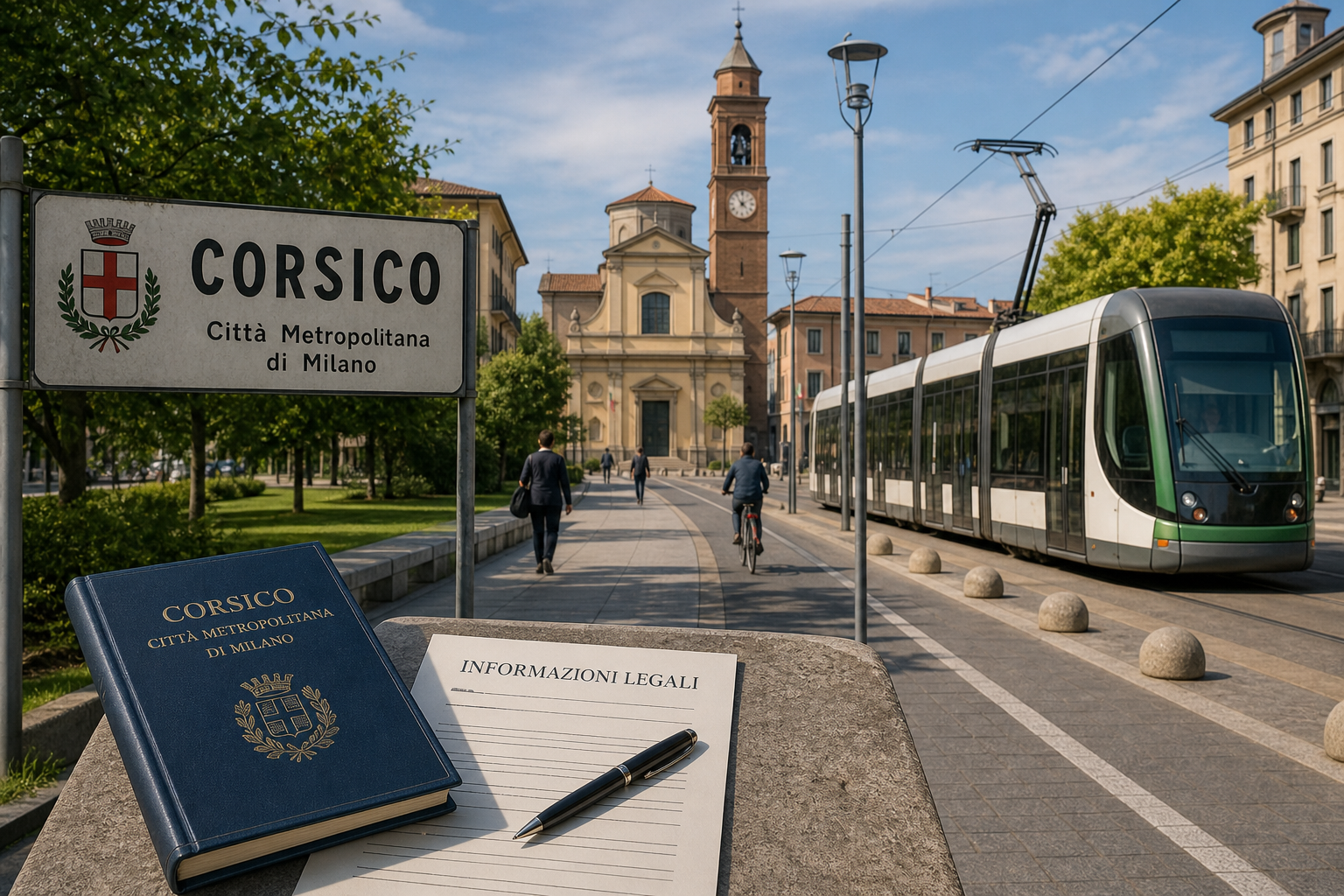
Understanding the cannabis laws and penalties in Corsico means looking mainly to Italian national law rather than a separate municipal cannabis code. Corsico, in the Metropolitan City of Milan, follows the same national rules on possession, supply, cultivation, medical use, driving and public conduct that apply elsewhere in Italy. Local police and municipal authorities may enforce those rules, while local ordinances can also address public order and the use of public spaces.
This guide explains what residents and visitors should know about weed in Corsico, without treating cannabis as risk-free or suggesting ways to avoid enforcement. Cannabis law can change, and an individual case may depend on the substance, quantity, conduct, prior history and evidence available. For a current legal assessment, consult a qualified Italian lawyer.
How cannabis is regulated in Corsico
Italy distinguishes between conduct connected with personal use and conduct that indicates supply, distribution or trafficking. The principal framework is the Consolidated Law on Drugs, Presidential Decree 309/1990. The relevant provisions include Article 75, which addresses possession for personal use through administrative measures, and Article 73, which covers more serious drug offences.
The full text of the national framework can be checked through the official Normattiva legislation database. Corsico does not have the power to legalise recreational cannabis independently of Italian national law. A local area can have its own rules about parks, streets, events or nuisance, but those rules do not turn unlawful possession or supply into lawful activity.
Cannabis possession and penalties in Corsico
Possession of a quantity considered intended exclusively for personal use is generally handled as an administrative matter rather than an ordinary criminal conviction. That does not mean possession is legal or consequence-free. Authorities may seize the substance, identify the person involved and report the matter to the competent administrative authority.
Under Article 75, possible administrative consequences can include suspension or restriction of documents and licences, such as a driving licence, passport or firearms licence, depending on the circumstances. The process may involve a notice, an interview or an opportunity to provide explanations. The precise result is not automatic: officials consider the facts, the person’s situation and whether the evidence supports personal use.
There is no universally safe amount that guarantees a person will be treated as a personal user. Weight is relevant, but so are packaging, multiple portions, scales, communications, cash, customer contact and other evidence. A quantity or set of circumstances suggesting supply can move the case into the criminal sphere.
When possession may become a criminal case
Possession linked to sale, delivery, distribution, importation or trafficking can lead to criminal prosecution under Article 73. Indicators may include drugs prepared for multiple customers, messages arranging sales, unexplained cash, records or conduct observed during a transaction. Criminal exposure depends on the facts and the applicable statutory classification.
Penalties can be severe and may include imprisonment and fines. The law also distinguishes between different substances and circumstances, and courts assess the seriousness of the conduct. A person questioned in connection with suspected supply should request legal assistance rather than assuming that a personal-use explanation will resolve the matter.
For comparison, the practical difference between administrative personal possession and criminal supply is also relevant in nearby municipalities. Our guide to cannabis possession regulations in Bollate explains the same national-law distinction in a neighbouring Milan-area context.
Public consumption and smoking in Corsico
Italian law does not make recreational cannabis smoking lawful simply because it happens outdoors or involves a small amount. Smoking in a street, park, station area, outside a venue or near other people can create additional problems even where the underlying possession is treated as personal use.
Public consumption may attract police attention, complaints or local public-order intervention. Conduct that causes disturbance, exposes children or affects entrances, transport areas and shared spaces can create separate issues from the drug-possession matter. Municipal rules may also regulate behaviour in parks, squares and other public places.
People should not assume that a private balcony, holiday rental or hotel room is automatically free from restrictions. Property owners can prohibit smoking, and neighbours may report smoke, nuisance or unsafe conduct. Cannabis use around children, schools or public facilities is particularly likely to prompt intervention.
For a more specific discussion of smoking restrictions elsewhere in northern Italy, see the guide to cannabis smoking laws in Pordenone. The same caution applies in Corsico: private setting does not remove all legal, contractual or safety consequences.
Driving after using cannabis
Driving after consuming cannabis is a major legal and safety risk. Italian road rules address driving under the influence of drugs, and police can use testing and investigative procedures when impairment or recent drug use is suspected. A driver may face licence-related consequences, criminal exposure or both, depending on the circumstances and the applicable rule.
Even if a person believes the effects have ended, reaction time, attention and judgement may remain affected. Combining cannabis with alcohol or sedating medicines increases the danger. The safest choice is not to drive, cycle in traffic or operate machinery after using cannabis. Use a sober driver or lawful public transport instead.
Do not treat a small amount of cannabis or a claim of personal use as protection from driving enforcement. Possession and road-safety rules address different conduct. A person involved in a collision, stopped for unsafe driving or found carrying cannabis may face several separate questions.
Medical cannabis in Corsico
Medical cannabis is not the same as recreational cannabis. In Italy, certain cannabis-based preparations may be prescribed within the national healthcare framework for recognised therapeutic situations. Access depends on a doctor’s assessment, the product and the applicable prescription and pharmacy procedures.
Patients should obtain medicines through lawful medical channels and retain the prescription, dispensing documentation and original packaging. A prescription does not create a general right to possess cannabis for non-medical use, share medicine with another person or grow plants without considering the relevant rules.
The Italian Ministry of Health provides official information about medicines, healthcare policy and regulated therapeutic products through its Ministry of Health website. Patients should ask their doctor or pharmacist how to carry a prescribed product and what documents may be needed when travelling.
Visitors can also review our practical guide to medical cannabis access in Rho, another nearby municipality. The local location does not replace the need for a valid prescription and compliant documentation.
Home cultivation and CBD products
Home cultivation is a legally sensitive area. Italian case law has recognised a narrow situation involving minimal domestic cultivation that is rudimentary, limited and incapable of affecting the drug market. That principle is highly fact-specific and should not be understood as a broad licence to grow cannabis in Corsico.
Plants, equipment, quantity, expected yield and the surrounding evidence can all matter. Cultivation intended to supply others is far more serious. Anyone considering cultivation should obtain advice from an Italian criminal lawyer before acting, rather than relying on summaries of court decisions online.
CBD products also require caution. Product labels, THC content, intended use and the applicable product category matter. A product sold as hemp-derived or CBD is not automatically lawful in every form, and a consumer may still face problems if the product contains prohibited levels or is incorrectly labelled. Keep receipts and packaging, and avoid carrying unverified products across borders.
Travelling with cannabis through Corsico or Italy
Corsico is close to Milan and connected to a busy metropolitan transport network. Travellers should not carry recreational cannabis on trains, buses, in taxis, through airports or across national borders. Moving cannabis can raise possession, transport, import or export issues, even when the intended destination is another European country.
Border controls and transport security can involve stricter scrutiny than an ordinary street encounter. A product purchased lawfully in another country may still be unlawful to bring into Italy. Likewise, Italian rules do not determine what is permitted at a foreign destination.
Medical travellers should carry only medication prescribed to them, in original packaging, with supporting documents. They should confirm the rules of every transit and destination country before departure. Travelling with someone else’s medicine or cannabis product creates avoidable legal uncertainty.
Our guide to marijuana travel rules in Paderno Dugnano offers related guidance for the wider Milan metropolitan area. The core precaution remains the same: do not assume that a short local journey is legally insignificant.
What to do after police intervention
- Stay calm and comply with lawful instructions. Do not resist a search or attempt to hide, discard or transfer a substance.
- Ask what procedure is being applied. Personal-use administrative proceedings and criminal investigations are not the same.
- Request an interpreter if necessary. Visitors should not sign documents they do not understand.
- Seek legal advice promptly. A lawyer can explain deadlines, statements, licence consequences and available responses.
- Keep relevant documents. Prescription records, pharmacy labels and travel evidence may matter in a medical-use case.
Do not post details of an active case online or rely on informal advice from sellers, social media groups or other travellers. A local lawyer can assess the actual notice, test results and evidence.
Practical risk-reduction guidance
- Do not buy, sell, share or transport recreational cannabis.
- Never drive or operate machinery after using cannabis.
- Avoid use in streets, parks, stations, venues and other shared spaces.
- Keep prescribed products in original packaging with current documentation.
- Do not assume CBD or low-THC labels guarantee compliance.
- Check current national rules before relying on older online articles.
Conclusion
The cannabis laws and penalties in Corsico are principally determined by Italian national law. Personal-use possession may lead to administrative measures, while evidence of supply, trafficking, unlawful transport or other aggravating conduct can result in criminal proceedings. Public use, driving, cultivation, CBD products and medical cannabis each create separate risks that should not be conflated.
For residents and visitors, the safest approach is straightforward: do not buy or share recreational cannabis, do not drive after using it, avoid public consumption and carry medical products only with proper documentation. When an incident has already occurred, prompt advice from a qualified Italian lawyer is more reliable than assumptions based on quantity, location or internet summaries.