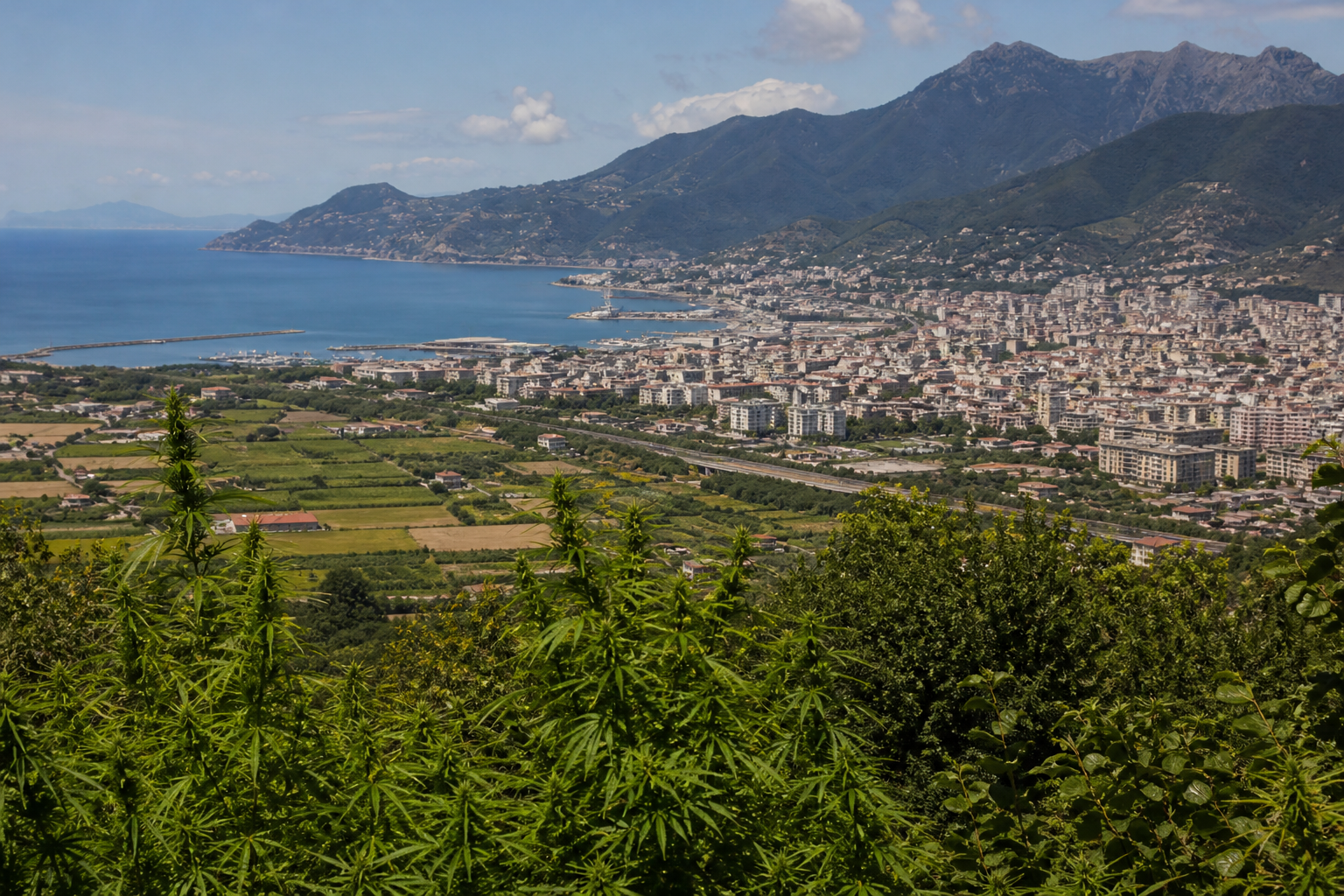
The Cannabis industry in Salerno, Italy is best understood as a developing network of hemp agriculture, CBD-related retail, medical access, research and regulated industrial activity rather than a recreational marijuana market. Salerno’s position in Campania, its agricultural surroundings, port connections and large student and tourism populations create opportunities for legitimate businesses, but national law remains the main influence on what can be grown, sold, prescribed or consumed.
For residents, entrepreneurs and visitors, the most important distinction is between industrial hemp, medical cannabis and non-medical cannabis. These categories are not interchangeable. A product’s legality can depend on its THC content, intended use, form, labelling, supply chain and compliance with Italian and European rules. Local availability does not by itself prove that a product is legal.
What the cannabis industry in Salerno, Italy includes
Salerno does not operate under a separate city-level cannabis framework. Businesses in the province generally work within Italian national law, regional health administration and ordinary rules covering taxation, consumer protection, agriculture, pharmacies, employment and commercial premises.
The local industry can include several connected activities:
- Industrial hemp: cultivation and processing of approved hemp varieties for fibre, seed, food, cosmetics and other lawful applications.
- CBD and hemp retail: shops and online businesses selling products whose composition and permitted use comply with current requirements.
- Medical cannabis: pharmacy-dispensed medicines supplied through a prescription and the regulated healthcare system.
- Ancillary services: laboratory testing, packaging, logistics, agronomy, compliance consulting and professional services.
- Education and research: activities involving plant science, public health, product quality and responsible consumer information.
These segments have different legal obligations. A hemp fibre company is not regulated in the same way as a pharmacy, and a CBD cosmetic is not automatically treated like a medicine. Businesses should obtain specialist legal and regulatory advice before investing in cultivation, importing products or opening a shop.
Cannabis laws in Salerno: the national rules that matter
The phrase cannabis laws in Salerno refers mainly to Italian national legislation. Recreational sale and supply of cannabis are not part of a legal adult-use retail system. Possession for personal use can still lead to administrative consequences, while conduct involving distribution, sale, trafficking or unlawful cultivation may create criminal liability. The exact outcome depends on the facts, the substance, the quantity and the relevant legal provisions.
Because rules and enforcement guidance can change, readers should check current primary sources rather than rely on shop advertising, social media or old travel articles. Italy’s official Normattiva legislation database is a useful starting point for consulting consolidated legal texts. The Italian Ministry of Health website provides public information on health policy, medicines and related regulatory matters.
Transporting cannabis across borders is especially risky. A product purchased legally in another country may still be unlawful to bring into Italy, and a prescription issued abroad does not automatically authorize possession or importation. Visitors should not carry cannabis, cannabis flowers, extracts or edible products through airports, ports or international borders without clear, official confirmation that the movement is permitted.
Industrial hemp and low-THC products
Industrial hemp is a separate commercial category, but it is not a blanket exemption from drug and consumer law. Growers must use permitted seeds and follow agricultural, traceability and product rules. Businesses making food, cosmetics, textiles or other goods must also comply with the regulations applicable to that product category.
CBD products require particular care. CBD itself is not a guarantee of legality, safety or therapeutic value. Products may contain other cannabinoids, contaminants or more THC than the label suggests. Food, supplements, cosmetics, vaping products and medical preparations can be subject to different rules. A responsible Salerno retailer should be able to explain the product category, provide batch information and avoid unsubstantiated claims about treating disease.
Cannabis in Salerno as a business opportunity
Cannabis in Salerno has potential as a specialized agricultural and service sector, but opportunity should not be confused with deregulation. The strongest prospects are likely to be businesses that solve practical problems: compliant cultivation, reliable testing, sustainable processing, professional packaging and transparent distribution.
Agriculture and processing
Campania has an important agricultural identity, which may support interest in hemp as a rotation crop or source of fibre, seed and other lawful materials. Any commercial project needs more than suitable land. Operators must assess seed certification, local planning, irrigation, neighbouring land use, harvesting equipment, storage, insurance and the destination market for the crop.
Processing can create more value than selling raw plant material. Fibre preparation, seed cleaning, food production, textile inputs and compliant cosmetic manufacturing each require different equipment and quality controls. Entrepreneurs should define the intended product before planting and confirm that the planned crop and processing method are compatible with current rules.
Retail and consumer services
A CBD or hemp shop in Salerno needs clear product sourcing, accurate labels and staff training. Retailers should avoid presenting non-medical products as substitutes for prescribed treatment. They should also maintain invoices, supplier documentation and test reports where appropriate, while monitoring regulatory changes affecting specific products.
Tourism may increase demand for information and convenience, but it does not relax the law. A shop that markets products to visitors should explain that public consumption, driving while impaired and cross-border transport can create serious legal or safety problems. Responsible businesses should never encourage customers to hide products from authorities or use them in prohibited settings.
Medical cannabis in Salerno
Medical cannabis in Salerno is accessed through the Italian healthcare framework, not through ordinary recreational dispensaries. Where a clinician considers cannabis-based treatment appropriate under applicable rules, the patient needs medical guidance and a prescription. Dispensing generally takes place through pharmacies able to supply the prescribed preparation.
Availability can vary. A patient may need to ask several pharmacies about stock, ordering times and the documentation required. Pharmacists and prescribing clinicians are the appropriate sources for advice about formulation, dosage, interactions and follow-up. Patients should not replace prescribed medicines, change doses or purchase unverified products online without speaking with a healthcare professional.
People researching treatment can also read our guide to CBD in Naples and the surrounding Campania context. It is useful for general orientation, but medical decisions should be based on advice from a qualified Italian healthcare professional.
Safety and driving
Cannabis-based medicines may cause drowsiness, impaired attention, dizziness or other effects, depending on the product and the individual. Patients should ask their clinician or pharmacist about driving, operating machinery, alcohol and other medicines. Driving after using cannabis recreationally or medicinally can create legal and safety consequences, even when the product was obtained through a legitimate channel.
How consumers can evaluate Salerno cannabis products
Consumers searching for weed in Salerno may encounter informal sellers, social media offers or products described with vague terms such as “legal cannabis.” These descriptions are not enough to establish quality or legality. A safer approach is to assess the seller and the product independently.
- Ask what category the product belongs to: food, cosmetic, supplement, medicine, textile or another lawful class.
- Check the label for ingredients, batch information, manufacturer details and intended use.
- Look for credible, recent laboratory documentation that identifies cannabinoid content and contamination testing.
- Be cautious of claims that a product cures anxiety, pain, cancer or other medical conditions without approved evidence and authorization.
- Do not assume that a product sold in a physical shop can be consumed anywhere or transported across a border.
- Seek medical advice before using cannabinoid products alongside prescription medicines or during pregnancy.
Consumers should also distinguish hemp-derived products from cannabis flowers or extracts sold for intoxication. The appearance of a product is not a reliable guide to its legal status. If the seller cannot provide basic information about origin, composition and intended use, choosing not to buy is the safer decision.
Salerno’s place in Italy’s wider cannabis market
Salerno’s sector is connected to national supply chains rather than isolated from them. Raw materials, laboratory services, packaging and finished goods may move between Campania and other Italian regions. This makes logistics and traceability important, particularly for businesses handling plant material, extracts or products intended for human use.
The city can also benefit from professional networks linking agriculture, universities, healthcare, port logistics and small manufacturing. Long-term growth is more likely to come from compliance and specialization than from aggressive retail claims. Businesses that document their processes, train staff and respond quickly to regulatory changes are better placed to build consumer trust.
For broader comparison, our articles on cannabis laws in Bologna and cannabis in Rome provide additional perspectives on how Italian residents and visitors should approach national rules in different urban settings.
Practical checklist for businesses and visitors
- Identify the exact product or activity before assessing its legal requirements.
- Check current Italian and European rules through official sources and qualified advisers.
- Keep contracts, invoices, batch records, test results and licences where applicable.
- Use marketing language that describes products accurately and avoids medical promises.
- Train staff to answer questions about age restrictions, use, storage, driving and travel.
- For medical needs, work through a prescribing clinician and an authorized pharmacy.
- For international travel, obtain specific official guidance before carrying any cannabis-related item.
Conclusion
The cannabis industry in Salerno, Italy is a regulated and evolving field built around hemp, CBD-related commerce, medical access, research and supporting services. It is not a legal recreational marijuana market, and local interest does not override national restrictions. The most reliable path for businesses is careful classification, documentation, testing and professional advice. For consumers and visitors, the priorities are equally straightforward: verify the product, avoid informal sellers, respect public-safety rules and consult official or healthcare sources when the situation involves medicine or travel.