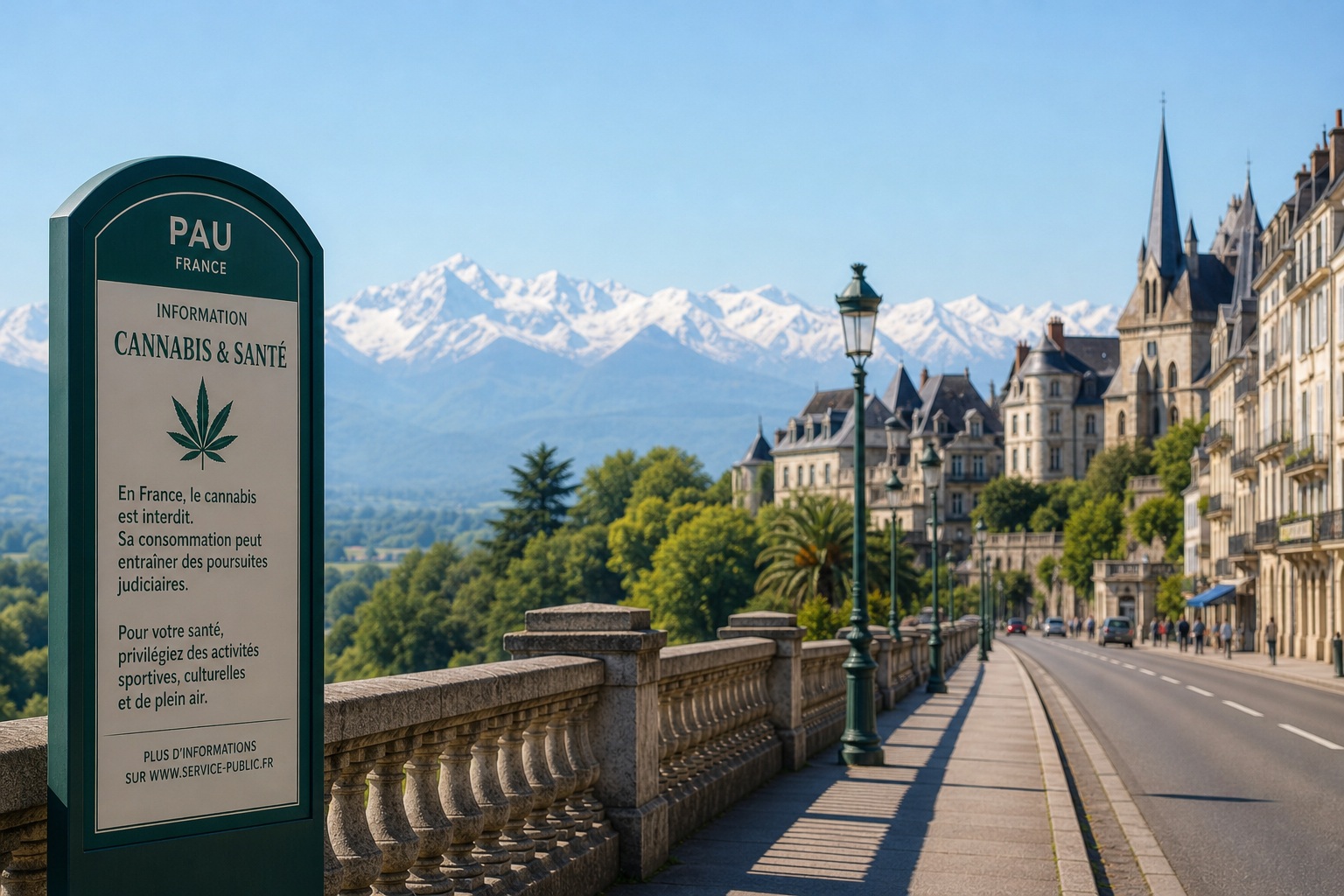
Understanding cannabis facts about Pau, France requires separating local reality from national law. Pau is a city in the Pyrénées-Atlantiques department, close to the Spanish border and surrounded by a busy student, tourism and outdoor culture. However, cannabis rules in Pau are not set by the city. Possession, use, sale, cultivation, driving and medical access are governed mainly by French national law.
This guide explains what residents and visitors should know about cannabis in Pau without relying on rumors or assumptions about local availability. It covers recreational cannabis, CBD products, health considerations, driving, medical use and practical safety steps. Local enforcement can vary according to circumstances, but the legal framework applies throughout France.
Cannabis facts about Pau, France: the legal context
Recreational cannabis remains illegal in Pau and across mainland France. Using, possessing, buying, selling or transporting cannabis outside an authorized legal framework can lead to legal consequences. The same rules apply whether cannabis is consumed in a private apartment, a hotel, a park, a festival area or another public place.
For some straightforward cases involving personal use or possession, police may issue a fixed criminal fine rather than immediately taking the matter through a full court process. The standard amount is commonly stated as €200, with reductions or increases possible depending on when it is paid. A fixed fine does not make cannabis legal, and more serious cases can still result in investigation, prosecution or imprisonment.
Authorities may treat supply, organized dealing, larger quantities, importation and cultivation much more seriously than simple personal possession. Bringing cannabis across the Spanish border is particularly risky because border crossings do not create an exception to French drug law. A product purchased legally or semi-legally elsewhere may still create problems when carried into France.
For a broader comparison of how French cannabis penalties can work in a different French territory, see this guide to cannabis laws and penalties in Saint-Pierre, Réunion. The location differs, but national French principles remain important.
Public use and private use
Consuming cannabis in public can attract attention from law enforcement and may create additional issues involving nuisance, public order or vulnerable places. Private consumption is not automatically legal simply because it occurs indoors. Possession and use remain regulated, and landlords, hotels and accommodation providers may impose their own rules.
Visitors should also remember that French law does not recognize a general tourist exemption. A foreign driving licence, residence abroad or short stay in Pau does not change the rules governing cannabis possession or use.
What to know about weed in Pau and local availability
Searches for weed in Pau may produce social-media offers, informal contacts or websites claiming to deliver cannabis. These sources should not be treated as proof that a product is legal, safe or accurately labeled. Informal cannabis can contain unexpected levels of THC, contaminants or other substances, and online sellers may be scams that also expose people to legal and financial risks.
There is no regulated recreational cannabis retail market in Pau comparable to licensed dispensary systems in some other countries. A shop selling hemp or CBD products is not necessarily authorized to sell intoxicating cannabis. Product packaging, branding or the presence of a physical storefront does not guarantee that the contents comply with French law.
Street purchases also create practical safety concerns. Buyers cannot reliably verify potency, origin, pesticide exposure or whether a product has been mixed with synthetic cannabinoids. Synthetic products marketed with cannabis-style names may be especially unpredictable and can cause severe reactions.
CBD in Pau: why “hemp” does not mean unrestricted
CBD products are widely discussed in France, but CBD is not the same as THC-rich cannabis. CBD itself is not generally treated as an intoxicating drug, while THC is the main compound associated with the cannabis high and remains tightly controlled.
French and European rules concerning hemp products are technical. Products sold as lawful CBD must meet applicable requirements, including limits on THC and rules related to product type, labeling and marketing. A product that appears compliant in a store may still be unsuitable for driving or may contain trace cannabinoids that complicate drug testing.
CBD flowers and resins can look and smell similar to illegal cannabis. Carrying them in public may therefore lead to questioning or testing, especially if packaging is missing. Keep products in their original packaging, retain proof of purchase where available and avoid assuming that a seller’s claim settles the legal position.
CBD can also interact with medicines and may cause side effects. Anyone taking prescription drugs, particularly medicines affected by liver metabolism, should ask a pharmacist or doctor before using it. Pregnant or breastfeeding people and those with significant liver problems should seek professional advice rather than relying on informal product recommendations.
Health facts about cannabis in Pau
The health effects of cannabis do not change because it is consumed in Pau rather than another city. THC may impair attention, reaction time, short-term memory and coordination. Some people experience anxiety, panic, confusion, vomiting or paranoia. Stronger products and edible forms can increase the likelihood of an unpleasant or delayed reaction.
Edibles deserve particular caution because effects may take much longer to appear than they do after inhalation. Taking more because the first dose seems ineffective can result in excessive intoxication later. Combining cannabis with alcohol or sedating medicines can increase impairment and other risks.
Frequent use can develop into dependence, especially when cannabis is used to manage stress, sleep problems or difficult emotions. Stopping after regular use may bring irritability, sleep disruption, reduced appetite or cravings. Adolescents and young adults may be more vulnerable to effects on learning, attention and mental health, particularly with frequent or high-THC use.
For a plain-language overview of cannabis effects and health concerns, consult the World Health Organization’s cannabis fact sheet. It provides general health information rather than personal medical advice.
When to seek urgent help
Call emergency services if someone who has used cannabis has trouble breathing, loses consciousness, has a seizure, develops severe chest pain, becomes dangerously agitated or cannot be kept safe. In France, 112 is the general European emergency number and 15 reaches medical emergency services. Do not leave a severely affected person alone, and tell healthcare professionals what was taken if that information is available.
Cannabis and driving around Pau
Driving after cannabis use is one of the most important legal and safety issues for anyone in Pau. France applies a strict approach to drug-impaired driving: the presence of prohibited substances can be enough to create an offence, even if the driver does not feel intoxicated. Waiting until the next morning is not a guaranteed safeguard because detection can outlast the subjective effects.
The rule applies to cars, motorcycles and other vehicles. It also matters on routes around Pau, including journeys toward the Béarn countryside, the Atlantic coast, ski areas in the Pyrenees or the Spanish border. A driver who has used cannabis should arrange a sober alternative such as a taxi, rideshare, public transport or a designated driver.
Passengers should also think about safety. Riding with an impaired driver can expose everyone in the vehicle to preventable danger. If a person appears unable to drive safely, offering another way home is more useful than arguing about whether the cannabis was legal, medical or sold as CBD.
Medical cannabis in Pau: access and realistic expectations
Medical cannabis in Pau is not the same as buying recreational cannabis from a shop. Access to cannabis-based treatment depends on French national rules, the approved product, the clinical situation and the prescribing and dispensing arrangements in force at the time. A doctor may discuss authorized treatments or other medicines, but a patient cannot simply designate ordinary cannabis as a prescription treatment.
People should not stop prescribed medication or substitute cannabis without speaking to a healthcare professional. Cannabis-based medicines may have side effects and interactions, and evidence differs by condition and formulation. A doctor or pharmacist can also help distinguish between regulated medicines, CBD products and unverified products marketed with medical claims.
Patients visiting Pau from another country should carry medicines in original packaging with appropriate documentation and check the rules before travel. Cannabis products that are lawful or prescribed in one country may not be accepted when crossing into France. Border requirements can be especially important for travelers arriving through Spain or using international transport.
Practical safety guidance for residents and visitors
- Do not buy THC cannabis from informal sellers, social-media accounts or unverified delivery services.
- Do not carry cannabis across the French-Spanish border or between countries without checking the applicable rules.
- Never drive, cycle in traffic or operate machinery after using cannabis or a potentially intoxicating cannabinoid product.
- Keep CBD products in original packaging and check the ingredient and THC information before purchase.
- Avoid combining cannabis with alcohol, sedatives or other drugs.
- Store products away from children and pets, especially edible products that resemble sweets or snacks.
- Seek advice from a pharmacist or doctor for medical questions, drug interactions or ongoing use.
- Call emergency services when symptoms are severe, unusual or rapidly worsening.
Why local context still matters
Although Pau follows national French law, the city’s geography and lifestyle shape how people encounter cannabis issues. Students, seasonal visitors, outdoor enthusiasts and cross-border travelers may receive conflicting information from different countries. Rules that apply in parts of Spain or elsewhere in Europe should not be assumed to apply in Pau.
Local services may also encounter cannabis alongside mental-health concerns, alcohol use, housing problems or road-safety issues. A nonjudgmental conversation with a healthcare professional is generally more useful than relying on anonymous online advice. People concerned about their own use can ask a doctor, pharmacist or addiction-support service for confidential guidance.
Reliable information should describe both legal limits and health risks. It should not promise a safe dose, guarantee that a product is legal or suggest that CBD automatically prevents a positive drug test. In Pau, the safest approach is to verify the current national rules, avoid impaired driving and treat unregulated products as a significant uncertainty.
Conclusion
The central cannabis facts about Pau, France are straightforward: recreational cannabis remains illegal, national law governs the city, CBD products must meet specific requirements, and driving after cannabis use carries serious legal and safety risks. Medical access is a regulated healthcare matter rather than a general retail option.
Visitors and residents should be particularly careful with informal sellers, cross-border travel, high-potency products and cannabis-related driving decisions. When health concerns arise, professional medical advice and emergency services are safer sources than product marketing or social-media claims. Pau offers no local loophole to French cannabis law, but accurate information can help people avoid preventable legal, health and road-safety problems.