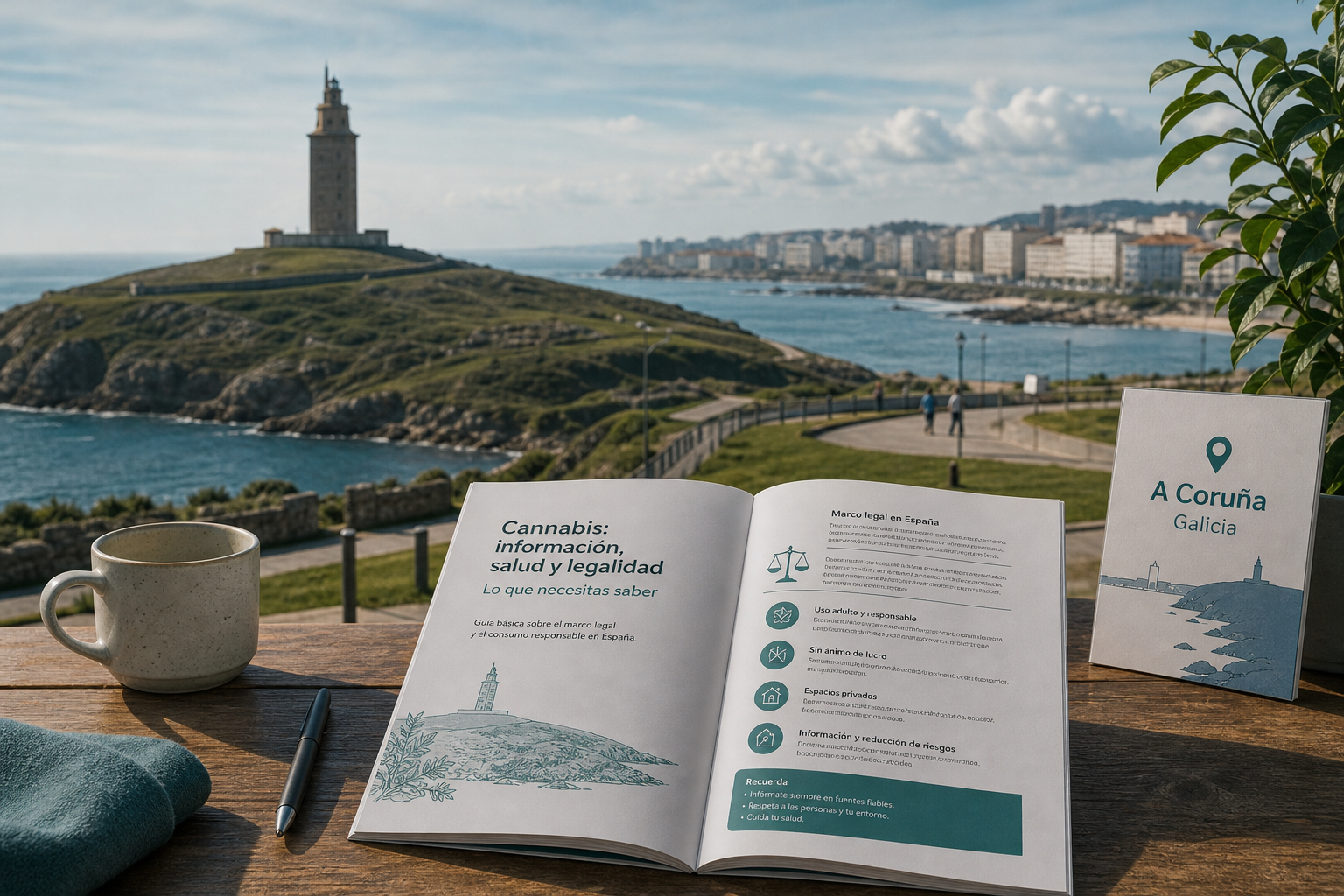
Cannabis education in A Coruña is most useful when it separates law, health, personal responsibility and common assumptions. A Coruña is a coastal city in Galicia with universities, nightlife, tourism and a strong local community, but it does not have a separate cannabis legal system. Spanish national law applies, while public-order decisions and practical risks can affect residents and visitors in everyday situations.
This guide explains the main issues without promoting consumption. It covers possession and use, public spaces, driving, medical access, cannabis products, social clubs and safer decision-making. Laws and health guidance can change, so anyone facing a specific legal or medical question should consult an appropriate professional or an official public authority.
Cannabis education in A Coruña: why local context matters
Searching for cannabis in A Coruña can produce a mixture of legal commentary, personal anecdotes and commercial claims. Those sources do not always distinguish between private conduct, public possession, supply and medical treatment. Education should begin with that distinction rather than treating cannabis as either completely legal or completely prohibited.
Local context also matters because the risks are different in a private residence, on a beach, in a public square, at a festival or behind the wheel. A person may understand one part of Spanish law and still make a costly mistake by carrying cannabis in public, sharing it with another person or driving after use.
What Spanish law means for cannabis in A Coruña
Private use is not the same as full legalization
Spanish law is often described as tolerant of private consumption, but that description can be misleading. Personal use in a private setting is treated differently from possession or consumption in public. The legal position does not create a general retail market in which adults can freely buy cannabis from licensed shops.
Public possession or consumption can lead to an administrative penalty under Spain’s public-security framework, even when there is no evidence of trafficking. The official text of Organic Law 4/2015 on public security should be consulted for the applicable legal provisions and current wording. Penalties and procedures can depend on the circumstances, so a legal professional is the right source for advice about a particular incident.
For practical purposes, people researching cannabis laws in A Coruña should remember four points:
- Public possession and public consumption can create legal and financial consequences.
- Supplying, selling or facilitating distribution is treated far more seriously than private personal use.
- Growing plants is not automatically risk-free; location, visibility, purpose and evidence of distribution may matter.
- Tourists and residents are subject to the same national rules while in Spain.
Where public-use problems can arise
Public places include more than streets. Beaches, promenades, parks, transport areas, nightlife districts, sports venues and festival grounds may all create exposure to public-order enforcement. A private apartment does not make every surrounding area private, and an outdoor terrace may have its own rules depending on the establishment and local conditions.
Never assume that a cannabis-friendly reputation makes a particular venue or neighborhood exempt from enforcement. Respect signs, staff instructions and local regulations. Avoid carrying cannabis into airports, ports, courts, schools, government buildings or other controlled environments.
Health information for people considering cannabis
Health education should be specific rather than alarmist. Cannabis can affect attention, coordination, reaction time, memory and judgment. The effects vary with the product, dose, route of administration, frequency of use, individual health and whether alcohol or other substances are involved.
Some people experience anxiety, panic, dizziness, nausea or confusion. Higher-potency products can make unwanted effects more likely, particularly for inexperienced users. Regular use can become difficult to control for some people, and adolescents or people with a personal or family history of psychosis may face particular concerns. Anyone who feels unwell, severely confused, unusually agitated or unsafe should seek urgent medical help.
Reliable information should come from health authorities rather than product sellers. Spain’s Spanish Agency for Medicines and Medical Devices, or AEMPS, is an appropriate official source for information about medicines, regulatory decisions and safety matters.
Lower-risk principles
No method makes non-medical cannabis use risk-free, but several measures can reduce foreseeable harm:
- Do not drive, cycle in traffic or operate machinery after using cannabis.
- Avoid combining cannabis with alcohol, sedatives or other drugs.
- Do not use unknown products with unclear strength, contents or contamination controls.
- Be cautious with edible products because effects can be delayed and last longer than expected.
- Keep products away from children and pets.
- Do not share inhalation devices or consume in crowded places where others may be exposed.
- Stop and seek help if use is affecting work, study, relationships, sleep, mood or finances.
Weed in A Coruña: products, labels and misleading claims
People searching for weed in A Coruña may encounter cannabis flower, resin, oils, edibles, vapes and CBD products. These categories are not interchangeable. A label may describe THC or CBD content, but labels are not always a guarantee of accurate strength, purity or legality.
CBD products also deserve careful attention. CBD is not the same as intoxicating THC, yet some products may contain trace or undeclared cannabinoids. Food, cosmetics, supplements and medicines can be regulated differently. Avoid assuming that a product is legal simply because it is displayed online or in a shop.
Be particularly wary of claims that a product is guaranteed to treat anxiety, pain, insomnia or another condition. A commercial statement is not the same as clinical evidence or authorization as a medicine. People taking prescription medicines should ask a doctor or pharmacist about possible interactions before using cannabinoid products.
Medical cannabis in A Coruña
Medical cannabis in A Coruña should be approached through the healthcare system, not through informal sellers or social media recommendations. A person with pain, epilepsy, nausea or another condition needs an assessment of the diagnosis, existing treatments, contraindications and evidence for the proposed therapy.
Medical access depends on Spain’s regulatory framework and the authorized medicine or preparation involved. It is not the same as obtaining recreational cannabis from a club or buying a product advertised on the internet. A doctor or pharmacist can explain whether an approved treatment is appropriate and how it should be monitored.
Do not stop prescribed medication or replace it with cannabis without medical supervision. Keep a record of any product used, the amount, the timing and any side effects. This information can help a healthcare professional assess whether symptoms are related to the product or to another condition.
Social clubs and private cannabis spaces
Social clubs are sometimes presented as dispensaries, but that comparison can create false expectations. Their legal status and operation can be complex, and a club’s existence does not mean that all possession, supply or consumption is lawful. Rules may also differ between private associations, municipalities and the circumstances of a specific case.
Visitors should not assume that membership guarantees protection from police checks, public-possession penalties or other legal consequences. A responsible club, if operating within the law, should not pressure anyone to consume, sell to minors or ignore safety concerns. Be cautious of organizations that promise guaranteed legality, advertise openly to tourists or make medical claims without professional oversight.
For wider context, compare local questions with our guides to cannabis consumption in nearby Vigo and marijuana laws in Gijón. These comparisons can help readers see that national law applies across Spain, while local environments and practical advice may differ.
Travel and everyday safety in A Coruña
A Coruña’s port, airport connections, roads and busy public spaces make travel planning important. Do not carry cannabis across international borders, even if possession appears tolerated in a private setting. Import and export issues can trigger serious consequences, and a product purchased legally elsewhere may not be lawful to transport into Spain.
Keep accommodation rules in mind. Hotels, hostels, rental properties and student residences may prohibit smoking, vaping or possession on the premises. Smoke can affect neighbors and may lead to complaints, cleaning charges or eviction. Never consume around children, in shared indoor spaces or near people who have not consented to exposure.
Driving after cannabis use is especially dangerous because impairment can affect road performance, while Spanish roadside enforcement may also involve drug testing. Arrange a sober driver, use public transport or wait until you are fully fit to travel. Do not rely on feeling normal as proof that your driving ability has returned.
How to evaluate cannabis information online
Good cannabis education should make its limits clear. Before trusting a webpage, check who published it, when it was updated, whether it distinguishes law from opinion and whether it links to an official source. Be skeptical of pages that promise immunity, guaranteed medical benefits, instant cures or effortless access.
- Identify whether the information concerns Spain, Galicia, A Coruña or another country.
- Check whether the source is discussing possession, use, sale, cultivation or medical treatment.
- Look for an update date and confirm important legal claims with an official authority.
- Separate evidence about health effects from promotional language.
- Seek professional help when the question involves a criminal allegation, a serious symptom or a prescription medicine.
Support, prevention and responsible choices
Education is not only for people who use cannabis. Parents, teachers, hospitality workers, health professionals and visitors may all benefit from clear information about impairment, consent, storage and warning signs. A calm conversation is generally more useful than relying on stereotypes or threats.
If cannabis use is becoming hard to control, contact a healthcare professional or local addiction-support service. Warning signs can include repeated unsuccessful attempts to cut down, using more than intended, neglecting responsibilities, needing cannabis to feel normal or continuing despite physical, emotional or social problems. Early support can prevent a more serious pattern from developing.
In an emergency, call Spain’s emergency services on 112. If someone is unconscious, having a seizure, experiencing severe breathing problems or showing extreme confusion, do not leave them alone and tell medical staff what may have been taken.
Conclusion
Understanding cannabis in A Coruña requires more than knowing whether private use is treated differently from public possession. Residents and visitors should understand Spanish law, avoid public consumption and impaired driving, question commercial claims, and use qualified healthcare advice for medical concerns. A careful approach also means respecting accommodation rules, protecting children and pets, and seeking help when use begins to interfere with daily life.
The most reliable path is informed decision-making: verify legal information through official sources, assess health risks honestly and avoid assumptions based on social media or local rumors. That approach supports safer choices in A Coruña without overstating what Spanish law permits.