Understanding Cannabis cultivation laws in Boadilla del Monte requires separating private conduct from public visibility, possession, supply and property rules. Spain does not operate a simple system in which growing a few plants is universally legal. Instead, the legal consequences depend on factors such as where the plants are located, whether they can be seen from public areas, the apparent purpose of the crop, its scale and whether authorities identify evidence of distribution.
This guide explains the national framework that applies in Boadilla del Monte, a municipality in the Community of Madrid. Local location does not create a separate cannabis regime, but residents must still consider municipal nuisance rules, building regulations, rented-home conditions, fire safety and the practical consequences of a visible grow. The safest approach is to treat private cultivation as legally sensitive rather than automatically permitted.
How cannabis law applies in Boadilla del Monte
Most rules governing cannabis in Boadilla del Monte come from Spanish national law. The municipality cannot legalise conduct that national criminal or administrative law prohibits. At the same time, a private home grow may raise different issues from cannabis displayed, consumed or possessed in a public place.
Spanish law generally distinguishes between actions connected to personal use and conduct that promotes, facilitates or supplies illegal drug use. That distinction is not a guaranteed exemption. Police, prosecutors and courts may assess the complete circumstances, including the number and maturity of plants, the quantity that could be produced, packaging, weighing equipment, communications, money, visitor activity and other indications of distribution.
For the statutory framework, consult the Spanish Penal Code on the official BOE website and the Organic Law on public security on the official BOE website. These official texts are more reliable than social-media summaries or claims that a particular number of plants is always lawful.
Is growing cannabis at home legal?
There is no universally safe plant limit that guarantees legality throughout Spain. A small private cultivation intended solely for personal use may be treated differently from a commercial or distributive operation, especially when it is genuinely private and not visible from public spaces. However, that does not mean every home grow is lawful or immune from investigation.
Private use is not the same as legalisation
The idea that “personal use is allowed” is often overstated. Spanish law has historically treated private consumption and possession differently from public possession, supply and trafficking. A person may avoid a criminal trafficking conviction in circumstances pointing to personal use, yet still face administrative action, seizure of plants or other consequences depending on the facts.
A court can also consider whether cultivation exceeds what appears consistent with personal consumption. There is no universally applicable calculation that converts plant count, yield or harvest into an automatic legal answer. Indoor and outdoor conditions, plant size and the surrounding evidence all matter.
Visibility from public areas matters
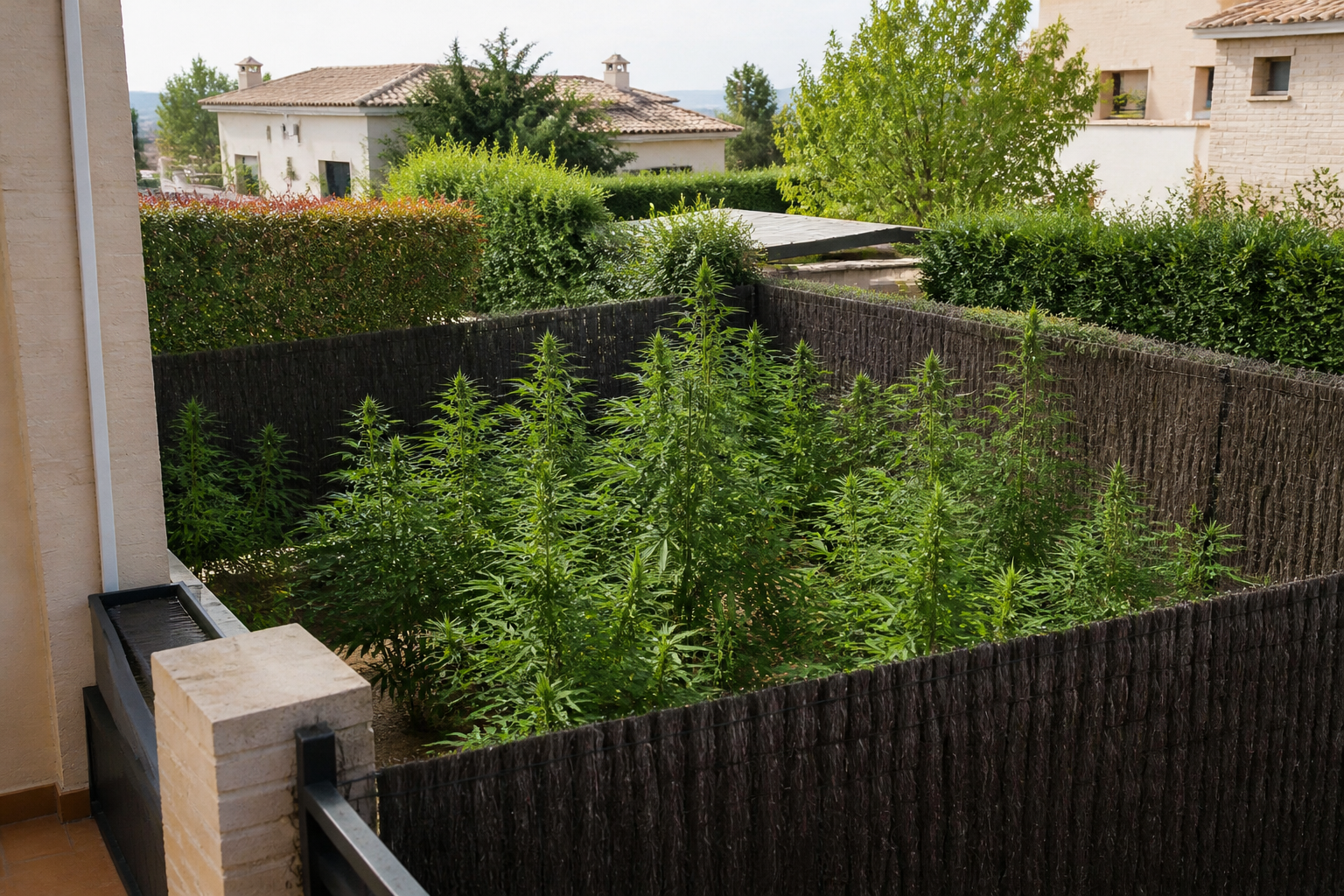
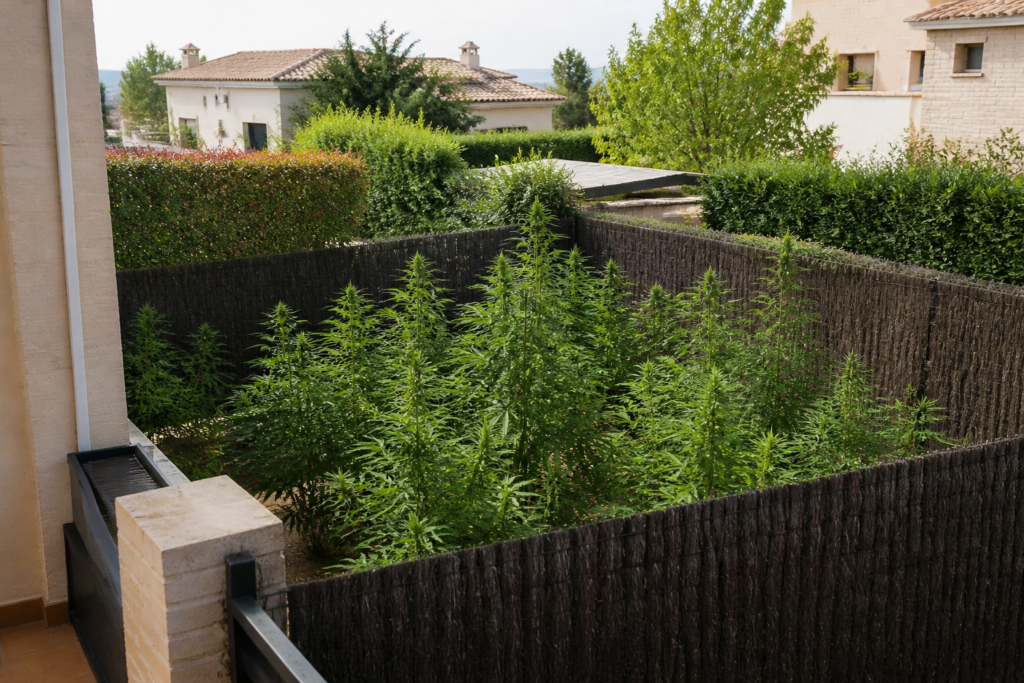
One of the most important practical issues for cultivation rules for cannabis in Boadilla del Monte is visibility. A crop that can be seen from a street, public path or other publicly accessible location can create a separate administrative problem, even if the grower says it is for personal use. Outdoor balconies, terraces, gardens and roof spaces therefore require particular caution.
Screening a plant from public view does not solve every legal issue, and it should not be understood as a way to conceal commercial cultivation. It simply illustrates why privacy and public visibility are treated differently. Odour, noise, lighting, electrical modifications and regular visitors can also generate complaints or attract attention.
Public possession, use and transport
Public possession or use of cannabis can lead to an administrative offence under Spain’s public-security framework. The relevant issue is not only whether a person is consuming. Carrying cannabis in a public place, on public transport or in other publicly accessible settings may also create risk, even when there is no allegation of sale.
In practical terms, a person growing cannabis at a home in Boadilla del Monte should not assume that moving plants, harvested material or cultivation equipment through public areas is consequence-free. Transport can become especially problematic when the quantity, packaging or communications suggest supply to another person.
Driving after using cannabis creates separate road-safety concerns. Drug-driving rules and testing procedures are distinct from the question of whether cultivation occurred at home. Never drive while impaired, and do not treat private cultivation as permission to carry cannabis across Spain, through airports or across international borders.
When cultivation can become a criminal matter
Spanish criminal law addresses cultivation when it is connected to acts that promote, encourage or facilitate illegal drug use, including trafficking-related conduct. A grow may attract criminal investigation where the evidence suggests supply rather than exclusive personal use. The assessment is fact-specific, and a large crop is not the only possible warning sign.
- Multiple plants or harvests that appear inconsistent with personal consumption.
- Packaging, scales, lists, cash or messages suggesting sales.
- Frequent visitors connected with exchanges of cannabis or money.
- Advertising, delivery arrangements or online offers.
- Electrical installations or property alterations that create safety risks.
- Involvement of other people, particularly vulnerable individuals or minors.
These indicators do not automatically prove an offence, but they can change the legal character of the situation. Anyone contacted by police or investigated should obtain advice from a qualified Spanish criminal lawyer before making detailed statements or consenting to searches where legal advice is appropriate.
Apartment buildings, rentals and neighbours
Living in a detached house does not remove all obligations, and apartment residents face additional practical restrictions. A lease may prohibit cultivation, alterations, excessive humidity or activities that disturb neighbours. A homeowners’ association may also take action where a grow causes nuisance, damage or safety concerns, subject to the applicable property rules.
Odour, mould, pests, water leaks, heat and modified wiring can lead to civil disputes or complaints independently of criminal law. Strong lights may be visible through windows, while ventilation equipment can create noise. A landlord or community may respond to property damage or a breach of contractual duties even if authorities do not establish a drug offence.
Fire and electrical safety
Indoor cultivation can involve high electrical loads, timers, lamps, fans and humidity-control equipment. Improvised wiring, overloaded sockets and unsafe power connections can create fire or electrocution hazards. Do not bypass meters, interfere with shared installations or make unauthorised changes to a rented property.
Safety issues can also affect insurance claims. A policy may contain conditions about illegal activity, negligent alterations or fire prevention. Keep the legal and safety dimensions separate: even where a person believes the cultivation is private, unsafe equipment can expose occupants and neighbours to serious harm.
Medical cannabis and personal cultivation
Medical need does not automatically create a right to grow cannabis at home. Patients should not assume that a prescription, diagnosis or recommendation permits cultivation, possession of any preparation or use of products obtained outside an authorised channel.
Spain’s medical-cannabis framework and authorised medicines are matters for health authorities and healthcare professionals. The Spanish Agency for Medicines and Medical Devices provides official information about medicines and regulatory matters. Patients should discuss lawful treatment options with a doctor or pharmacist and keep documentation for any authorised medicine.
Searching online for medical cannabis in Boadilla del Monte can produce informal advice that confuses CBD products, prescribed medicines, cannabis flower and unregulated preparations. Those categories are not interchangeable. A product’s label or a seller’s claim does not establish that it is lawful, safe or medically suitable.
What residents should do if there is a complaint or police visit
A complaint about odour, visibility or noise does not itself establish guilt, but it can prompt an inspection or investigation. Stay calm, avoid obstructing officials and ask what authority they are acting under. Do not destroy, move or distribute material after learning of an investigation.
- Request identification and record the basic details of the incident where lawful and safe.
- Ask for legal advice before answering detailed questions about ownership, purpose or distribution.
- Do not sign documents you do not understand; request an interpreter if necessary.
- Contact a lawyer experienced in Spanish criminal or administrative law.
- Preserve rental agreements, prescriptions and relevant property documents without altering potential evidence.
Procedural rights can depend on whether the matter is an administrative allegation, a search, a detention or a criminal investigation. Local police and Guardia Civil procedures may also differ in practice, so general internet advice cannot replace case-specific legal representation.
Common misconceptions about weed in Boadilla del Monte
Searches for weed in Boadilla del Monte often bring together very different questions: where cannabis may be consumed, whether a person may grow it, whether a cannabis club is lawful and whether CBD products are regulated. Each issue has separate rules. A private setting does not automatically legalise supply, and a cannabis club’s existence does not create a general right to cultivate or distribute cannabis.
- “A few plants are always legal.” No universal plant number guarantees that result.
- “If plants are at home, police cannot act.” Home privacy does not eliminate legal investigations or safety inspections in every circumstance.
- “Medical use permits home growing.” Medical need and cultivation authorisation are different questions.
- “If nobody is paid, there is no risk.” Public visibility, possession and property issues can still matter.
- “A local shop or online post is proof of legality.” Sellers’ claims are not a substitute for official law or professional advice.
How to approach cannabis laws in Boadilla del Monte responsibly
The most reliable approach to cannabis laws in Boadilla del Monte is to start with the national rules, then consider the property and public-order context. Check current official legislation rather than relying on old articles, especially because drug policy, medical regulation and enforcement guidance can change.
Residents should avoid public possession and use, never supply cannabis to others and never drive after consumption. They should also consider lease terms, community rules, fire safety, odour and visibility before taking any action. If the question involves a seizure, police contact, a tenancy dispute or a proposed grow, obtain advice from a Spanish lawyer who can examine the specific facts.
For broader regional context, readers can compare this topic with the guide to cannabis regulations for tourists in nearby Majadahonda and the overview of cannabis laws in Collado Villalba. Those articles should be treated as general educational material, not as a substitute for current legal advice.
Conclusion
The legal position on home cultivation is more nuanced than the claim that cannabis is simply legal or illegal in Boadilla del Monte. Private, non-visible conduct intended for personal use may be treated differently from public cultivation, supply or trafficking, but no fixed plant limit provides automatic protection. Visibility, quantity, evidence of distribution, public possession, tenancy conditions and safety risks can all affect the outcome.
In short, anyone researching cannabis in Boadilla del Monte should distinguish personal privacy from legal permission, avoid public exposure and seek qualified advice before cultivating or responding to official action. Use current Spanish sources and focus on the facts of the particular property and conduct.