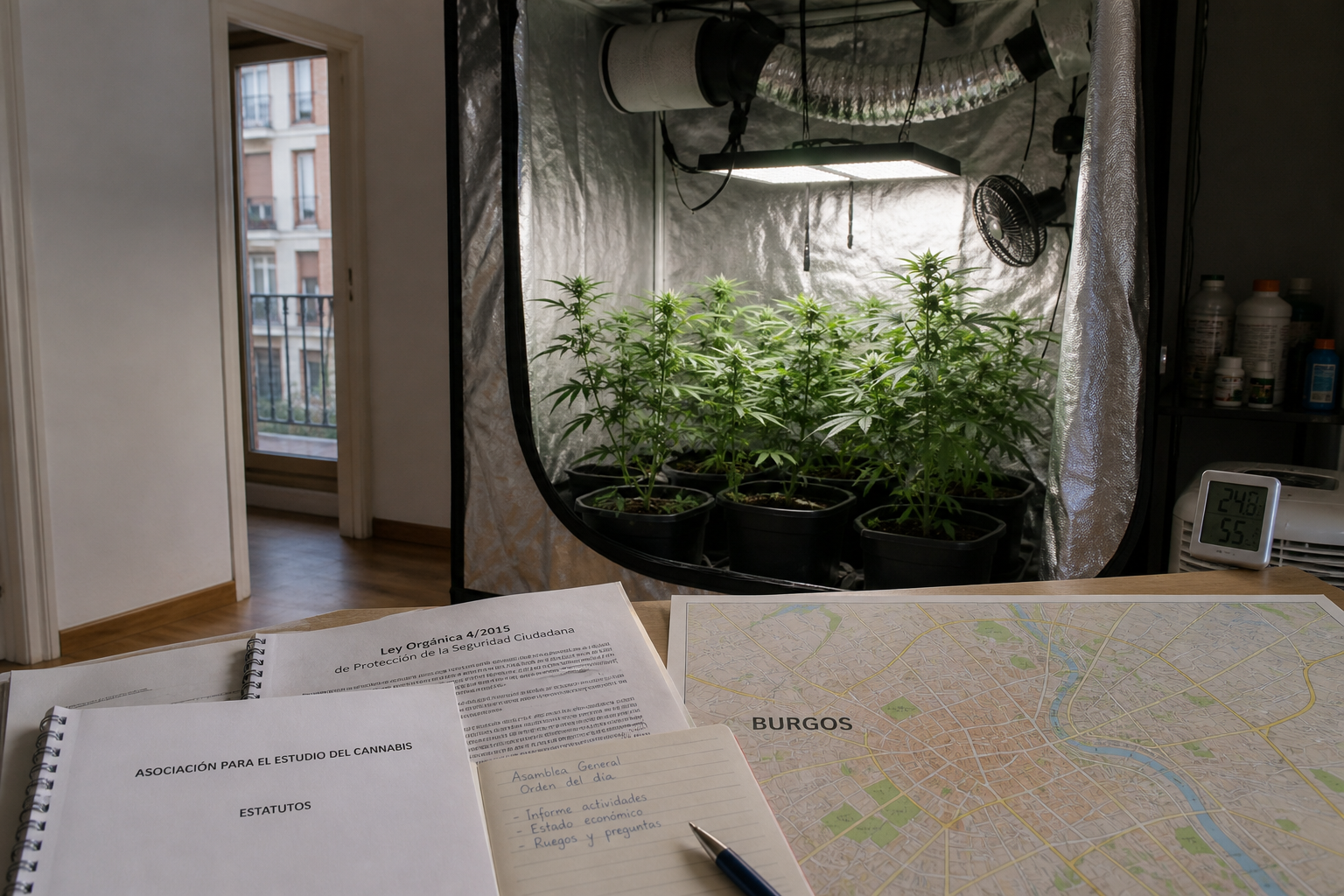
Understanding Cannabis cultivation laws in Burgos requires separating Spanish national law from local practical issues. Burgos does not have a separate cannabis cultivation code that replaces the national framework. Instead, growing, possessing, transporting or supplying cannabis is assessed mainly under Spanish criminal law, public-security legislation, and rules governing authorised industrial or medical production.
The most important distinction is between a private situation that remains outside public view and conduct that suggests distribution, creates a public-order issue or involves commercial activity. That distinction does not make personal cultivation automatically legal, however. Spanish law is fact-specific, and outcomes can depend on the number and maturity of plants, the location, visibility, equipment, intended use, statements made to authorities and evidence of supply to other people.
This guide explains the position in plain language for residents, property owners and visitors researching cannabis in Burgos. It is general information, not legal advice. Anyone facing a search, seizure or criminal investigation should speak with a qualified Spanish lawyer.
What cannabis cultivation laws in Burgos actually cover
The rules applying in Burgos are primarily national. Castilla y León and the city of Burgos may affect planning, nuisance, licensing or enforcement procedures, but they do not create a broad local right to grow cannabis for personal use. A private balcony, terrace, garden or indoor room therefore remains subject to Spanish national rules.
Spanish law does not treat every cannabis plant in exactly the same way. The legal analysis may consider whether the cultivation is intended for personal consumption or for other people, whether it is visible from a public place, and whether it forms part of a larger supply operation. Because there is no simple nationwide plant-count exemption that guarantees legality, relying on an assumed maximum number of plants is unsafe.
For the statutory framework, readers can consult the official Spanish Penal Code and the official text of Organic Law 4/2015 on public security. These sources are more reliable than informal claims that cannabis is simply “legal” or “illegal” in every circumstance.
Is growing cannabis at home legal in Burgos?
Home cultivation in Burgos occupies a legally uncertain area rather than a clear permission. A small private grow intended exclusively for the grower’s own consumption may not lead to the same treatment as cultivation for sale, but the absence of an obvious public offence does not create a guaranteed entitlement to cultivate. Authorities may still investigate the circumstances, and prosecutors or courts may interpret the evidence differently depending on the case.
Private cultivation and personal use
Personal use in a genuinely private setting is generally treated differently from supplying cannabis to another person. That does not mean that a private grow is automatically lawful. Evidence such as packaging materials, scales, multiple cash transactions, customer messages, unusually large quantities or distribution networks can support an allegation of trafficking or unlawful promotion.
People considering a private grow should not assume that a rented home, shared flat or private garden removes all legal risk. Tenancy agreements, building rules, fire safety, electrical safety, odour complaints and the rights of co-occupants can create separate problems. A landlord or neighbour may also take action where cultivation causes damage, persistent odour, humidity or a disturbance.
Visibility from public areas
Visibility is especially important. Plants that can be seen from a street, public path, neighbouring property or another publicly accessible location may create public-security consequences even where there is no proof of sale. The legal concern is not only the plant itself but also public exposure and the effect on public order.
For that reason, an outdoor grow in a front-facing balcony or an exposed garden carries different risks from a private, non-visible space. Screening a plant should not be understood as a guaranteed legal solution, and it does not protect cultivation connected with supply or other offences.
How public possession and cultivation can lead to penalties
Spanish law distinguishes between criminal conduct and administrative offences. Cultivation connected with trafficking, facilitation or promotion of illegal drug use can be prosecuted under the Penal Code. Public possession or consumption, and some forms of visible cultivation or conduct affecting public safety, may instead trigger administrative proceedings under public-security legislation.
The consequences can vary substantially. Authorities may seize plants, growing equipment or harvested material. Administrative cases can involve a financial penalty, while criminal proceedings may bring more serious consequences, including a criminal record and possible imprisonment in cases that meet the relevant legal elements. The eventual result depends on the facts and the applicable legal classification.
- Private context: A private setting may be relevant, but it is not an automatic exemption from prosecution or other action.
- Public visibility: Visible plants or conduct in public areas can create separate administrative concerns.
- Supply evidence: Messages, packaging, scales, cash records and customer contact can suggest distribution.
- Scale and organisation: Extensive equipment, numerous plants or a structured operation may increase suspicion and legal exposure.
- Other risks: Electrical faults, water damage, odour and unsafe installations can produce civil, tenancy or public-safety disputes.
Anyone who receives an administrative notice should check the deadline for submitting allegations. Anyone questioned as a suspect or whose home is searched should request legal assistance rather than relying on online assumptions about weed in Burgos.
Commercial, medical and industrial cultivation
Commercial cultivation is not covered by a general personal-use tolerance. Businesses seeking to grow cannabis for lawful industrial, research or medical purposes need the appropriate authorisations, registrations and controls. Depending on the intended product and activity, this may involve national regulators, security measures, traceability, premises requirements, quality systems and restrictions on the permitted cannabis material.
Medical or research cultivation should not be confused with a home grow for personal symptoms. A patient cannot ordinarily create a private medical-cannabis production licence simply by obtaining a prescription or medical recommendation. Authorised operators must comply with the specific regime that applies to their activity.
Industrial hemp is also not a universal loophole. Hemp varieties and products may be governed by agricultural, food, cosmetic, medicinal or controlled-substance rules. Seeds, flowers, extracts and finished products can be treated differently, and THC limits or permitted uses may matter. Anyone planning a hemp enterprise near Burgos should obtain specialist regulatory advice before planting or importing material.
Practical issues for growers and property owners in Burgos
Odour, neighbours and shared buildings
Odour is one of the most common ways a private cultivation issue becomes a dispute. In an apartment building, vapour, fans, humidity or persistent smells can affect corridors and neighbouring homes. Community rules and general nuisance principles may apply even where the cultivation is not prosecuted as a drug offence.
Property owners should document legitimate maintenance concerns without entering a tenant’s home unlawfully. Tenants should review their lease, avoid alterations that damage the property and seek legal advice before responding to a formal complaint. A dispute about odour or humidity can be handled separately from any question about criminal liability.
Electrical and fire safety
Indoor growing equipment can involve lamps, ventilation, timers and high electrical loads. Improvised wiring, overloaded circuits and heat-generating equipment can create fire risks. Damage to a building or injury to another person may lead to civil liability, insurance problems or criminal investigation independent of the cannabis issue.
Do not bypass electricity meters, tamper with wiring or connect equipment in a way that endangers other occupants. If there is a suspected electrical fault, turn off unsafe equipment and contact a qualified professional.
Transport and travel
Moving plants, harvested cannabis or cultivation equipment through public areas can change the context and create additional questions about possession, supply or transport. Carrying cannabis across the Spanish border is particularly risky, even when the material was grown privately or obtained in a place where a different legal regime applies.
Visitors should not assume that a cannabis club, private residence or informal social arrangement in another Spanish city authorises cultivation or transport in Burgos. For broader travel considerations, see this practical guide to cannabis travel safety in Getafe and the overview of cannabis laws and safer travel in Valladolid.
What to do if authorities discover a grow
Remain calm and avoid arguing about legal interpretations at the scene. Do not destroy plants, move material, delete messages or ask another person to give a false account. Those actions can create further problems and may affect the evidence.
- Ask what procedure is taking place and whether you are being treated as a witness, an investigated person or a detained suspect.
- Request a lawyer before making substantive statements if you may be implicated.
- Do not sign documents you do not understand; request an interpreter where necessary.
- Keep copies of notices, inventories and seizure records.
- Contact a Spanish criminal or administrative lawyer promptly, especially if there is a search, detention or allegation of supply.
Legal advice is particularly important where plants are visible from public space, more than one person uses the premises, the property is rented, or authorities claim that the cultivation was intended for sale.
Safer legal planning for cannabis in Burgos
The safest approach is not to treat internet plant-count rules or social-media advice as a licence. Before growing, assess whether the activity could be visible, whether other residents consent, whether the lease or community rules restrict it, and whether the proposed equipment is safe. Do not sell, gift, advertise or transport cannabis based on the assumption that personal cultivation rules protect those activities.
For health concerns, avoid self-medicating with unregulated products and discuss symptoms with a qualified healthcare professional. Products labelled CBD or hemp are not automatically lawful in every format, and food, cosmetic and medicinal claims may trigger separate regulation. Consumers can also review our practical guide to CBD products and responsible buying for related product considerations.
Because legislation and enforcement practice can change, check current official sources and obtain individual advice before making decisions involving cultivation, sale, importation or a commercial application.
Conclusion: the key rules to remember
Cannabis cultivation laws in Burgos are mainly determined by Spanish national law, not by a broad local cultivation permission. A private grow intended for personal use may be treated differently from a commercial operation, but it is not automatically legal or risk-free. Public visibility, evidence of supply, the size and organisation of the grow, property disputes and safety hazards can all change the legal position.
In practical terms, avoid treating cannabis in Burgos as an unregulated activity. Do not cultivate for sale, expose plants to public view, transport cannabis across borders or operate unsafe equipment. If authorities become involved, preserve documents and seek advice from a qualified Spanish lawyer as early as possible.