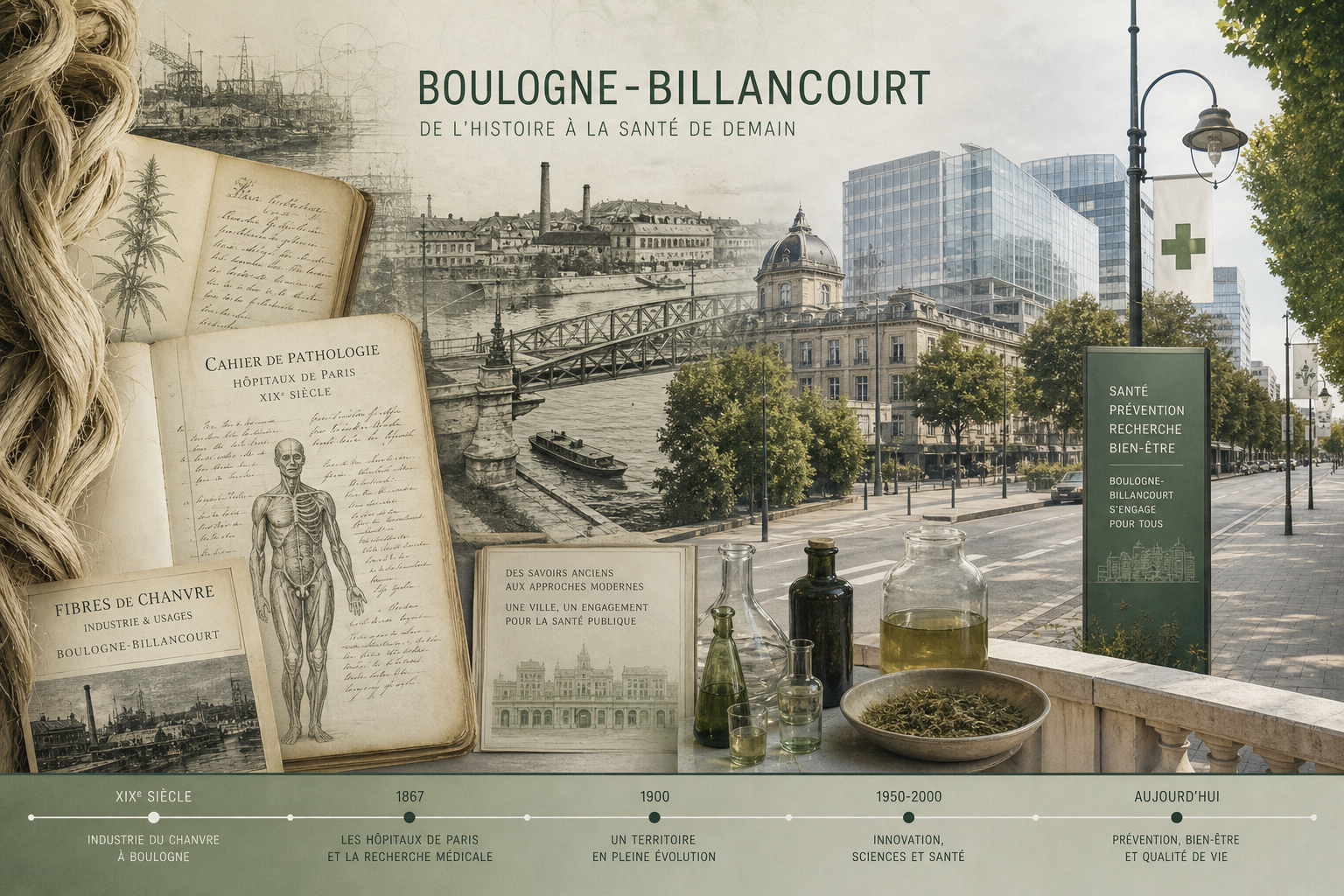
Marijuana history in Boulogne-Billancourt is best understood through the wider story of hemp, cannabis, medicine and drug policy in France. The city does not have a separately documented cannabis tradition comparable to a historic agricultural region or a famous countercultural destination. Instead, its experience has been shaped by its location beside Paris, its dense urban population, changing public-health debates and national law.
This distinction matters. Searching for weed in Boulogne-Billancourt can suggest a local market history that is difficult to document reliably. A more accurate approach connects the city’s modern urban development with national developments: the older uses of hemp, nineteenth-century interest in cannabis preparations, twentieth-century prohibition and the recent visibility of CBD and medical-cannabis discussions.
Why Boulogne-Billancourt’s history is tied to France’s national story
Boulogne-Billancourt is a highly urbanized commune in the Hauts-de-Seine department, immediately west of Paris. Its industrial and residential growth, transport connections and proximity to the capital have made it part of the Paris metropolitan system for generations. These characteristics influence how cannabis-related issues appear locally, but they do not create a separate legal framework.
For residents and visitors, cannabis in Boulogne-Billancourt is governed primarily by French national law. Police enforcement, criminal penalties, public-health messaging and rules for therapeutic experimentation are established at the national level. Municipal services may address local concerns such as public nuisance, prevention or youth support, yet they cannot legalize recreational possession or sales.
The city’s history is therefore less a story of a unique local cannabis culture and more a case study in how national policy reaches a dense suburb of metropolitan Paris.
Hemp before modern marijuana debates
Hemp and marijuana are forms of the cannabis plant, but their historical uses and legal treatment have not always been identical. Traditional hemp varieties were valued for fiber, rope, sailcloth, paper and seed. These industrial uses were associated with low-intoxicating varieties and should not be confused with the modern recreational meaning of marijuana.
France has a long agricultural and manufacturing history involving hemp, although production was concentrated in areas with suitable rural conditions rather than in an intensely urban commune such as Boulogne-Billancourt. The city’s relevance to this early history is indirect: goods, people and ideas moved through the wider Paris region, while urban consumers encountered hemp-based materials through trade and industry.
That distinction remains useful today. Modern discussions of CBD in Boulogne-Billancourt often involve hemp-derived products, but a product’s label or plant origin does not automatically establish that it is lawful, safe or non-intoxicating. Composition, THC content, intended use and current French and European rules all matter.
Nineteenth-century interest in cannabis in France
During the nineteenth century, European physicians, writers and travelers showed interest in cannabis preparations, particularly hashish. French intellectual circles in Paris famously discussed the effects of hashish in the 1840s, and some doctors investigated cannabis as a possible medicinal substance. These experiments belonged to a very different medical and social context from today’s regulated medicines.
The historical record often focuses on Paris because it was the country’s cultural and scientific center. Boulogne-Billancourt was not yet the large modern suburb familiar today, so it would be misleading to describe these Parisian experiments as a distinct Boulogne-Billancourt movement. Nevertheless, the city later became part of the same metropolitan environment in which national attitudes toward intoxicants, medicine and morality developed.
From curiosity to caution
By the late nineteenth and early twentieth centuries, concern about intoxicating substances was increasing across Europe. Cannabis did not follow a simple path from acceptance to prohibition, but it gradually became part of wider debates about public order, addiction and the control of psychoactive products. These debates eventually influenced French regulations and public attitudes.
Prohibition and the formation of modern cannabis laws
French controls on cannabis tightened during the twentieth century. A key milestone was a 1916 decree restricting several substances, including cannabis. The most important modern foundation is the French law of 31 December 1970, which established strict controls over narcotics and made unauthorized use a criminal matter.
These national rules shaped cannabis laws in Boulogne-Billancourt just as they did in Paris and other French communes. Possessing, using, cultivating or selling illicit cannabis can carry legal consequences, while driving after using cannabis creates additional risks. Penalties and enforcement procedures may change, so readers should consult current official guidance rather than rely on old accounts or informal local advice.
The French public-service portal provides current information about French rules on drug use and possession. For broader policy context, the national information service maintained by the French government’s interministerial mission on drugs and addictive behaviours is another useful reference: the official French drugs and addiction information portal.
Postwar urban life and changing perceptions
After the Second World War, Boulogne-Billancourt experienced major social and economic change. The former industrial city became increasingly associated with offices, housing, media, services and metropolitan commuting. As in other urban areas, cannabis became connected to youth culture, music, nightlife and changing ideas about personal freedom.
It is important not to turn these broad trends into unsupported claims about local consumption levels. Publicly available data may describe departments, regions or France as a whole rather than provide a reliable historical series for Boulogne-Billancourt alone. Local impressions, police reports and media stories can also reflect enforcement priorities rather than actual prevalence.
A careful history therefore separates three questions:
- How national law defined cannabis and prohibited use;
- How urban communities discussed health, culture and risk;
- What can genuinely be documented about Boulogne-Billancourt itself.
Medical cannabis and CBD in Boulogne-Billancourt
Recent public discussion has become more nuanced. People increasingly distinguish recreational cannabis from medical research, pharmaceutical preparations and hemp-derived CBD. That does not mean France has broadly legalized marijuana. Instead, it reflects continuing debate about evidence, patient access, product quality and the appropriate role of doctors and pharmacists.
Interest in medical cannabis in Boulogne-Billancourt should be approached through the French healthcare system. Patients should speak with a qualified healthcare professional and should not replace prescribed treatment with an unregulated cannabis product. Medical claims made by shops, websites or social-media accounts are not a substitute for clinical advice.
CBD has also become more visible in metropolitan France. However, buyers should check product labeling, avoid products making unsupported therapeutic promises and remember that driving after consuming a product containing detectable THC can create legal and safety problems. The presence of a CBD shop does not indicate that recreational marijuana is legal in the city.
For comparison, readers can explore how broader French questions about cannabis, CBD and local context are discussed in our article on CBD in Lyon and French regulation. The legal principles remain national, even though retail environments and public conversations may differ between cities.
What local history can and cannot tell us
The phrase Boulogne-Billancourt cannabis history can refer to several different subjects: the history of hemp as a material, the spread of hashish culture from Paris, the criminalization of cannabis, local policing, or the recent growth of CBD retail. Combining all of these into one narrative risks confusing evidence with assumption.
A responsible local account should avoid claiming that a particular street, neighborhood or business was historically associated with cannabis unless reliable archival or official evidence supports that claim. It should also avoid presenting anecdotal reports as population statistics. Boulogne-Billancourt’s proximity to Paris makes cultural exchange plausible, but proximity alone is not proof of a distinctive local tradition.
In this respect, the city can be compared with other French urban areas without treating them as identical. Our overview of cannabis history in Perpignan illustrates why regional geography and local documentation matter when interpreting national trends.
Reading the present through the past
The history of marijuana in Boulogne-Billancourt helps explain why current conversations contain several overlapping ideas. Some people think of cannabis as an old agricultural plant; others associate it with twentieth-century prohibition, contemporary harm reduction or the emerging CBD market. Each perspective captures part of the story, but none should be treated as the complete history.
Today, the most practical lessons are straightforward:
- French national law applies in Boulogne-Billancourt and does not provide a recreational cannabis market.
- Hemp, CBD, medical preparations and high-THC marijuana are not interchangeable categories.
- Product labels and online marketing may be incomplete or misleading.
- Using cannabis before driving can create serious safety and legal consequences.
- Health concerns, dependence or questions about treatment should be discussed with a healthcare professional.
Conclusion
The history of cannabis in Boulogne-Billancourt is primarily a metropolitan and national history rather than a separately documented local tradition. Older hemp uses, nineteenth-century French interest in hashish, twentieth-century prohibition and current debates about CBD and medical cannabis all provide context for the city’s present-day landscape.
Understanding that context makes it easier to discuss weed in Boulogne-Billancourt accurately. The city reflects France’s wider legal and public-health framework, while its dense urban setting makes questions about information, safety and enforcement especially relevant. For anyone researching the subject, the strongest approach is to distinguish documented local facts from national trends and to check official sources whenever laws or health guidance may have changed.