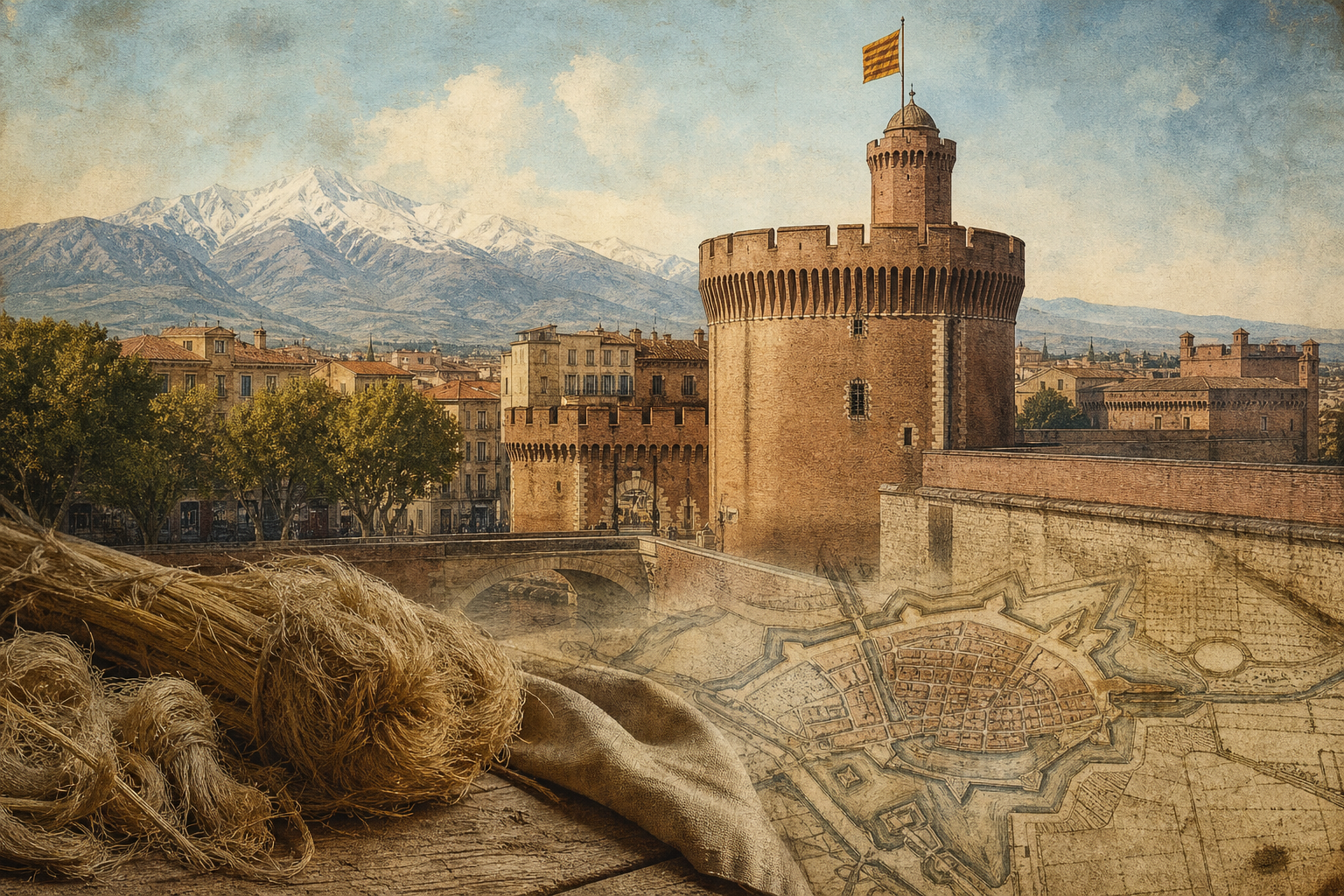
Cannabis history in Perpignan is best understood through the wider story of hemp, Mediterranean exchange, French drug policy and changing public attitudes. Perpignan, the capital of the Pyrénées-Orientales, sits close to the Spanish border and within a region shaped by Catalan culture, agriculture and cross-border movement. Those characteristics make the city an interesting place to examine cannabis history, but they should not be mistaken for proof of a unique local tradition.
The historical record does not establish an uninterrupted Perpignan cannabis culture stretching from antiquity to the present. Instead, it shows how broad European developments reached a southern French city with strong links to Catalonia and the Mediterranean. Today, discussions about weed in Perpignan are governed primarily by national French law, while local questions tend to concern health, enforcement, CBD products and the future of medical access.
Early hemp traditions around the Mediterranean
Hemp, the non-intoxicating form of the cannabis plant cultivated for fibre and seed, has a long history across Eurasia. People used hemp fibre for rope, textiles, fishing equipment and other practical goods. Cannabis plants and their preparations also moved through trade networks, although the evidence varies greatly by period and location.
It is important to distinguish hemp from modern discussions of recreational cannabis. Historical references to a plant do not automatically demonstrate the widespread use of high-THC products. For Perpignan and Roussillon, surviving evidence is stronger for the region’s participation in Mediterranean and agricultural networks than for a documented, city-specific cannabis trade in ancient times.
Perpignan’s geographic setting
Perpignan developed in a borderland between the Pyrenees, the Mediterranean coast and the Catalan world. Its position connected the city to inland markets, coastal routes and movement across what is now the France-Spain border. Such connections mattered for the circulation of crops, fibres, medicines and ideas.
That setting provides useful context for the history of cannabis in Perpignan, but geography alone cannot prove what residents cultivated, sold or consumed. A careful account separates documented local history from reasonable regional context and avoids presenting modern stereotypes as historical fact.
From useful crop to controlled substance
During the nineteenth and early twentieth centuries, European attitudes toward cannabis became more complicated. Industrial hemp remained associated with fibre and agricultural production, while cannabis preparations appeared in some medical and pharmacological settings. At the same time, international drug-control efforts increasingly grouped cannabis with substances considered socially or medically dangerous.
France’s modern framework was significantly shaped by the law of 31 December 1970, which established strict controls around narcotic drugs and penalised unauthorised use. This national change affected Perpignan just as it affected Marseille, Toulouse, Paris and other French cities. It also marked a decisive shift away from treating cannabis solely as an agricultural or medicinal subject.
For a broader comparison, readers can explore the regional context in the history and regulation of hemp in Toulouse. The comparison is useful because it shows how national rules can shape local conversations even when cities have different agricultural and cultural identities.
Cannabis history in Perpignan after French prohibition
After prohibition became entrenched, cannabis was discussed less as a crop and more as an illicit drug. Like other French cities, Perpignan experienced the effects of national enforcement, changing patterns of youth culture and public debate. However, publicly available historical material does not support a precise, continuous timeline of local cannabis use or a claim that Perpignan was uniquely associated with the plant.
The city’s border location can encourage speculation about cross-border supply. Yet proximity to Spain does not make possession, purchase or transport legal in France. Cross-border movement also creates additional risks because separate national rules may apply on either side of the border, and transporting controlled substances can lead to serious legal consequences.
Separating local history from popular claims
Several distinctions help keep accounts of Perpignan cannabis history accurate:
- Regional access is not proof of local production. A border region may experience movement of products without having a documented historic cultivation industry.
- Hemp is not the same as intoxicating cannabis. Industrial hemp varieties are regulated differently from products containing substantial THC.
- Public discussion is not legal recognition. Media attention, political debate or visible use does not change the law.
- Modern anecdotes are not historical evidence. Personal stories can describe experience but cannot establish a long-term citywide pattern.
Modern cannabis in Perpignan: law, health and public debate
Today, cannabis in Perpignan remains subject to French national law. Unauthorised possession, use, sale, cultivation and supply can carry legal consequences. Enforcement practices and case details may vary, but the underlying rules are not replaced by local custom or by the city’s proximity to Spain.
The French government provides current information about drug-related offences, penalties and public guidance through the official Service-Public.fr information on drug use. Because regulations and administrative procedures can change, this type of official source is more reliable than informal social-media claims or outdated travel advice.
Health is another important part of the modern story. Cannabis can affect attention, memory, coordination and reaction time. Risks may be greater for adolescents, people with a personal or family history of certain mental-health conditions, and anyone combining cannabis with alcohol or other drugs. Driving after use is especially dangerous and can create legal as well as safety consequences.
CBD and the changing marketplace
The growth of CBD products has made cannabis-related terminology more confusing. CBD is not the same as THC, and a product marketed as hemp or CBD is not automatically risk-free. Labels, product quality and compliance with French and European requirements matter. Products can also contain trace amounts of THC or be inaccurately labelled.
Consumers researching CBD in Perpignan should avoid assuming that a shop’s claims are a substitute for legal or medical advice. They should check packaging, avoid products with unclear ingredients and remember that CBD products may still have effects or interact with medicines. The national public-health perspective remains more useful than judging safety by branding alone.
Medical cannabis in Perpignan and the French policy debate
Medical cannabis in Perpignan should be discussed separately from recreational use. France has explored tightly controlled medical-cannabis access through national policy and clinical or regulatory frameworks, rather than creating a general local market. Eligibility, products, prescribing arrangements and supply rules depend on national decisions and can change over time.
Patients should speak with a qualified healthcare professional about approved treatments and should not replace prescribed medicines with products bought informally. A doctor or pharmacist can consider the condition being treated, possible interactions and the evidence for a particular therapy.
The French Observatory for Drugs and Addictive Tendencies offers research and monitoring on drug use, public policy and related health issues. Its work helps place local questions in a national evidence base instead of relying only on isolated reports from Perpignan or other cities.
Perpignan in the wider southern French context
Perpignan’s cannabis story is connected to wider developments in southern France. Marseille has long been discussed in relation to drug markets and urban policy, while Toulouse has a distinct history of agricultural and industrial activity. Montpellier, another major city in the region, provides a useful comparison for current legal questions through its national-law perspective.
Readers interested in that comparison can consult the guide to cannabis laws in Montpellier. Such comparisons should not be used to claim that one city’s experience automatically describes another. They are valuable because they show how the same French legal framework interacts with different populations, institutions and local concerns.
What can be said with confidence?
A responsible summary of cannabis laws in Perpignan and local history can make several defensible points:
- Hemp belongs to a much older European and Mediterranean history than modern drug prohibition.
- Perpignan’s location made it part of a region shaped by trade, agriculture and cross-border connections.
- The available evidence does not establish a uniquely Perpignan-based cannabis tradition extending continuously through history.
- Since 1970, French national law has been the main framework governing cannabis use and supply in the city.
- Current debate includes enforcement, harm reduction, CBD regulation, medical access and public health.
How to research the subject responsibly
Anyone studying cannabis history in Perpignan should compare several kinds of sources. Local archives, agricultural records and historical scholarship can illuminate hemp and regional commerce. Legal sources explain prohibition and current offences. Public-health institutions provide evidence on use, dependence and risk. These sources answer different questions and should not be treated as interchangeable.
It is also useful to define terms before searching. “Hemp,” “cannabis,” “marijuana,” “CBD” and “THC” can refer to different products, legal categories or historical contexts. Search results that combine them without distinction may create a misleading picture of the past.
Conclusion
The story of cannabis in Perpignan is not a simple tale of an ancient local tradition or a modern border-city exception. It is a layered history shaped by hemp’s practical uses, Mediterranean connections, French prohibition and contemporary debates about health and regulation. Perpignan’s Catalan and cross-border setting adds important context, but national law remains decisive.
Understanding cannabis history in Perpignan therefore requires caution. The most useful approach distinguishes documented history from speculation, hemp from intoxicating products, and medical research from informal claims. For residents and visitors, current official guidance and qualified health advice are more dependable than assumptions based on geography, tourism or local anecdotes.