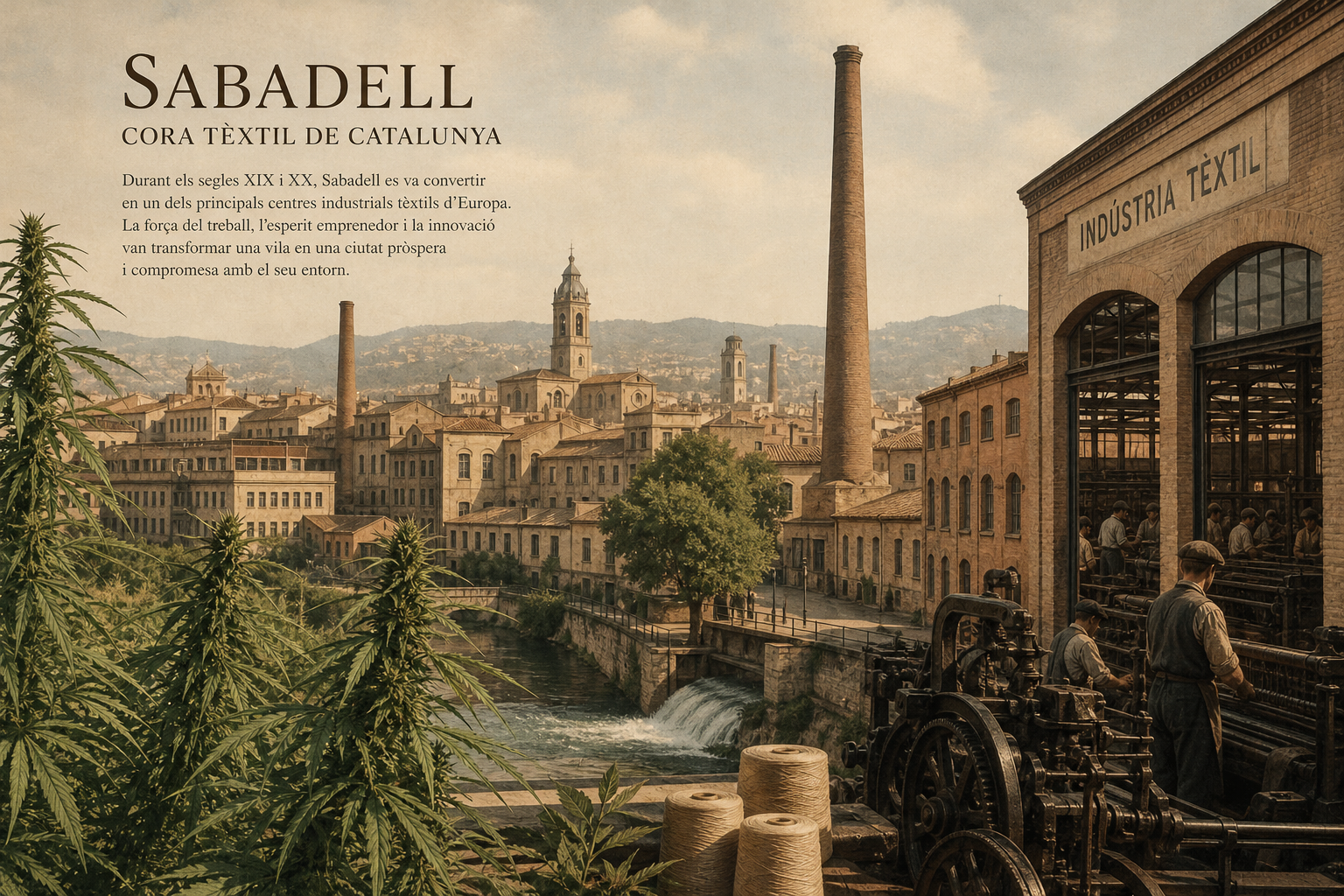
Cannabis history in Sabadell is best understood as part of two overlapping stories: the wider history of hemp and cannabis in Catalonia, and the changing Spanish rules that govern possession, cultivation, supply and consumption. Sabadell does not have a single, well-documented cannabis origin story comparable to a major agricultural region or a famous political movement. Its history is instead connected to the Vallès landscape, Catalonia’s industrial transformation, Spain’s twentieth-century drug policies and the city’s modern urban culture.
This distinction matters. Historical references to hemp do not automatically describe psychoactive cannabis use, while present-day discussion of cannabis in Sabadell must account for national law rather than assuming that local attitudes change the legal position. The result is a nuanced timeline: useful for residents and visitors who want context without romanticising the past or overlooking current risks.
Early hemp connections in Catalonia
Hemp and cannabis are related forms of the Cannabis sativa plant, but traditional hemp was generally cultivated for fibre and seed rather than for intoxicating effects. Across Europe, hemp had practical uses in rope, sailcloth, textiles, paper and other durable materials. These uses formed part of a broader agricultural and manufacturing history, including in Mediterranean regions.
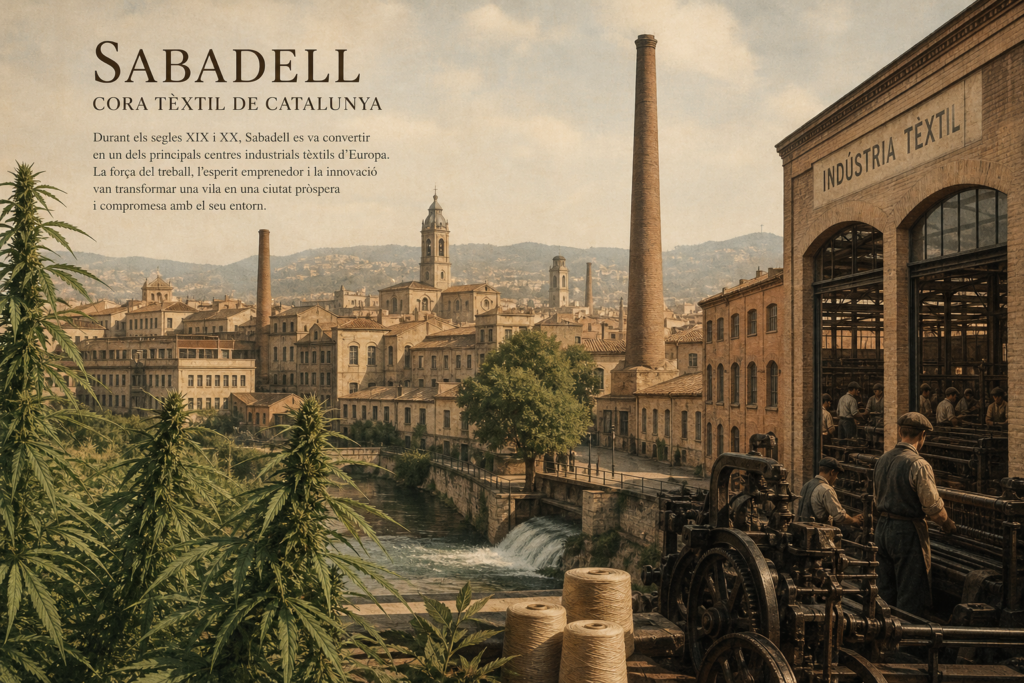
Catalonia’s long-established textile economy provides an important background for understanding why hemp belongs in a regional history of materials and labour. However, Sabadell’s industrial identity became especially associated with wool, textile mills and industrial production. That does not establish that hemp was a defining crop of the city, nor that local factories were primarily involved in cannabis-related production. A responsible account should separate the documented importance of textiles from assumptions about hemp cultivation or psychoactive cannabis.
Sabadell, the Vallès and industrial change
During the nineteenth and early twentieth centuries, Sabadell grew as one of Catalonia’s major industrial centres. Its expansion was shaped by mills, migration, transport links, housing growth and the concentration of industrial employment. This urban setting is relevant to cannabis history because it changed how products, ideas and social practices moved through the region.
Industrialisation also weakened the link between everyday consumers and the agricultural origin of plant materials. A fibre crop, a pharmaceutical preparation and a psychoactive substance could enter separate commercial and regulatory systems. Looking at Sabadell through this lens helps explain why a local history cannot be built simply by searching for the word “cannabis” in older accounts: earlier records may discuss hemp, medicines, fibre or commerce without using modern terminology.
Cannabis history in Sabadell and the Spanish twentieth century
In the early twentieth century, cannabis was not yet governed in Spain by the same public debate that surrounds it today. International drug-control agreements gradually encouraged governments to regulate psychoactive substances more closely. Spain’s rules developed over time through a combination of criminal law, administrative sanctions, public-health policy and international commitments.
The social meaning of cannabis also changed. In different periods, cannabis was associated with medicine, industrial hemp, colonial trade, counterculture or illicit drug use. These categories should not be treated as interchangeable. A historical reference to cannabis may describe a plant, a preparation or a social practice without providing evidence about who used it in Sabadell or how widely it circulated.
From counterculture to public policy
From the 1960s onward, cannabis became increasingly visible in European and Spanish youth cultures, music scenes and political discussions. In Catalonia, as elsewhere, debates about personal freedom, policing and public health developed alongside changing social attitudes. Sabadell’s proximity to Barcelona and its dense metropolitan connections made it part of this broader cultural environment, but proximity alone cannot prove a specific local trend or a precise level of use.
By the late twentieth century, cannabis policy was increasingly discussed in terms of prevention, treatment, harm reduction and enforcement. The emphasis shifted from viewing drug use only as a criminal or moral issue toward recognising health, social and economic factors. That shift still leaves a complex legal framework, because personal possession, public possession, consumption, cultivation and supply do not have identical legal consequences.
What the historical record can and cannot show
Researching the history of cannabis in Sabadell requires care with sources. Municipal archives, newspaper collections, industrial records, oral histories and public-health documents may reveal how the subject appeared in local life. Yet the availability of records is uneven, and older sources may use outdated or ambiguous language.
For example, a newspaper report about a seizure can demonstrate that authorities encountered cannabis in the area. It cannot, by itself, measure ordinary use across the city. Similarly, a reference to hemp fibre can document an economic material without proving that psychoactive cannabis was cultivated nearby. Good local history therefore distinguishes between evidence, context and interpretation.
- Documented fact: a dated municipal, legal, medical or newspaper record that identifies a place and event.
- Regional context: information about Catalonia, the Vallès or Spain that helps explain local developments but does not prove a Sabadell-specific pattern.
- Unverified anecdote: a personal memory or repeated local story that may be valuable but needs corroboration.
- Modern interpretation: a conclusion about culture or policy that should be presented as analysis rather than as an established historical fact.
Cannabis laws in Sabadell today: the national framework
Current cannabis laws in Sabadell are primarily determined by Spanish national law. Local authorities can enforce public-order rules and regulate aspects of municipal space, but Sabadell does not operate under a separate city-wide cannabis code that replaces Spanish legislation.
Spain generally distinguishes between conduct connected to personal use and conduct involving trafficking or supply. Public possession or consumption can lead to administrative consequences, while conduct interpreted as drug trafficking may be treated as a criminal matter. The legal assessment depends on the facts, including location, quantity, intent and other evidence. Private settings are not a blanket exemption from every rule, and possession can still create legal or practical problems.
The official Spanish Penal Code is a primary source for criminal-law provisions, while public-administration sanctions and health policy may involve other legislation. Because regulations and official interpretations can change, readers should verify current information through Spanish public institutions rather than relying on social-media summaries or informal advice.
Why “weed in Sabadell” can be a misleading search
People searching for weed in Sabadell may be looking for history, legal information, medical guidance or access. These are different questions. A search term does not establish that a product is legal, safe, tested or suitable for a particular person. It is especially important not to confuse private cannabis clubs, where they exist under specific legal interpretations and conditions, with ordinary retail dispensaries operating under a fully harmonised national licensing system.
Visitors should also avoid assuming that rules familiar from another country apply in Sabadell. Public consumption, driving after using cannabis, carrying products across borders and supplying another person can create serious legal or health consequences. The safest approach is to check current Spanish guidance, avoid public use and never drive while impaired.
Medical cannabis, CBD and changing public debate
Modern cannabis history in Sabadell also includes the separation of three often-confused subjects: recreational cannabis, medical cannabis and low-THC or CBD products. They involve different evidence, products and regulatory questions. A product sold as CBD is not automatically risk-free, and labels do not always provide a complete picture of ingredients or contamination risks.
Medical decisions should be made with qualified healthcare professionals. People taking prescription medicines, living with cardiovascular or psychiatric conditions, or who are pregnant should be particularly cautious about self-medication. Cannabis can affect attention, reaction time and memory, and frequent use may create dependence or worsen problems for some people.
For public-health information and national policy context, the Spanish National Plan on Drugs provides an authoritative starting point. Its resources place cannabis within a wider framework that includes prevention, treatment, research and harm reduction rather than treating the topic as a simple question of fashion or personal preference.
Readers interested in the broader legal picture can also compare this local history with the practical overview of weed law in Spain. For regional context, the article on marijuana in Barcelona illustrates how metropolitan proximity can shape public discussion without changing the national framework.
How to research Sabadell’s cannabis past responsibly
A stronger local history would combine several kinds of evidence rather than rely on one dramatic story. Municipal archives and local newspapers can show when cannabis appeared in public debate. Industrial and agricultural records may clarify whether hemp was grown, processed or traded in the surrounding area. Public-health reports can reveal official concerns, although they often measure services or reported cases rather than the complete population.
- Start with a clear date range, such as the industrial expansion of the nineteenth century, the post-war period or the democratic era.
- Search for related terms including hemp, fibre, hashish, cannabis, drug prevention and public health.
- Separate records about Sabadell from those concerning the wider Vallès or Barcelona metropolitan area.
- Check whether a source describes law, commerce, health, policing or personal experience.
- Compare newspaper claims with official documents and contemporary research before presenting them as fact.
This method avoids two common errors: projecting current cannabis categories onto the past and treating isolated incidents as proof of a city-wide culture. It also leaves room for future research. Local historians may uncover relevant oral histories, business records or public-health material that can refine the picture.
From industrial city to contemporary conversation
The story of cannabis in Sabadell is not a straight line from traditional hemp to modern recreational use. It is a layered history involving plant materials, industrialisation, metropolitan mobility, international drug policy, Spanish law and changing ideas about health. Sabadell’s textile heritage provides valuable regional context, but it should not be exaggerated into evidence of a cannabis economy without documentation.
For residents, the most useful lesson is practical: local identity and cultural discussion do not override national law. Understanding cannabis in Sabadell means recognising historical uncertainty, checking current official guidance and distinguishing between hemp, CBD, medical products and psychoactive cannabis. That approach produces a more accurate history and supports safer decisions in the present.
Conclusion
Cannabis history in Sabadell reflects the city’s place within Catalonia’s industrial and metropolitan development, while its legal present is shaped mainly by Spain-wide policy. Hemp belongs to the region’s wider history of materials and agriculture, but evidence for specifically local cannabis traditions must be assessed carefully. The modern discussion is equally complex, involving public health, private conduct, public-order rules, medical questions and changing social attitudes.
Whether researching the past or trying to understand today’s rules, readers should use reliable sources, avoid unsupported local claims and treat cannabis products with caution. Sabadell’s story is most informative when it connects local context with documented evidence rather than turning uncertainty into myth.