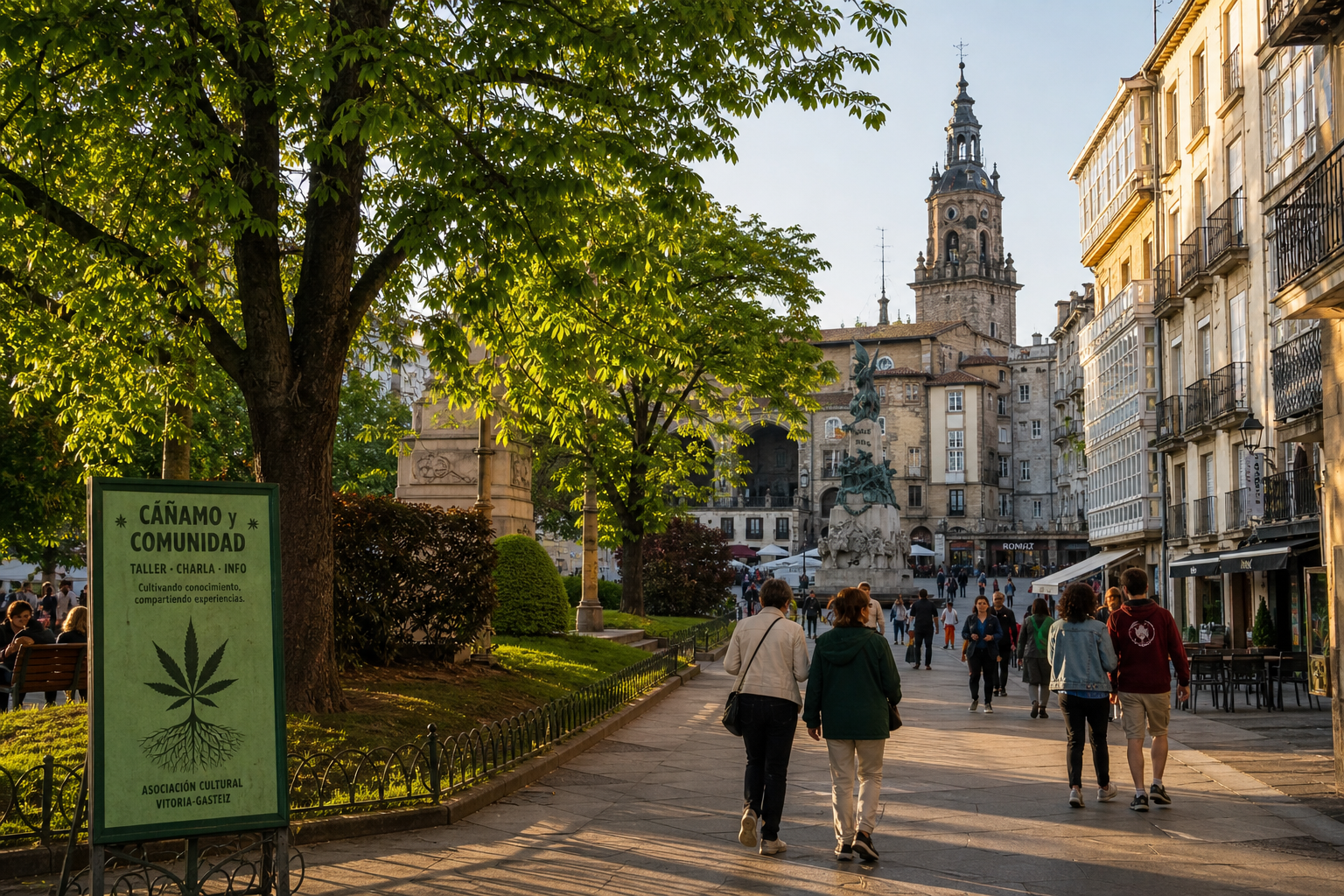
Understanding Cannabis culture in Vitoria-Gasteiz requires more than looking for places to buy or consume cannabis. The capital of Álava has a distinct urban identity shaped by its compact city centre, extensive green spaces, student population, neighbourhood associations and wider Basque social culture. Cannabis exists within that environment, but it is also regulated by Spanish law and influenced by public-health concerns.
This guide explains the local context without treating cannabis use as risk-free or assuming that all private venues operate in the same way. It covers the legal framework, social attitudes, private clubs, CBD, medical access, safer decision-making and practical considerations for residents and visitors. Rules can change, so anyone making a decision about cannabis should check current official information rather than rely on informal advice.
Cannabis culture in Vitoria-Gasteiz and the Basque context
Vitoria-Gasteiz is often associated with quality of life, cycling, environmental policy and a strong network of civic organisations. Those characteristics help explain why conversations about cannabis may be connected to broader themes such as harm reduction, personal autonomy, community responsibility and public space. They do not, however, create a special local exemption from Spanish law.
In everyday conversation, people may use terms such as cannabis, marihuana or weed in Vitoria-Gasteiz interchangeably. The legal position depends on what is happening: possession, use, cultivation, sharing, sale and transport can raise different issues. The setting also matters. Conduct in a private home is treated differently from consumption or possession in a public place.
Local culture should therefore be understood as varied rather than uniform. Some residents may view adult cannabis use as a private matter, while others focus on dependency, youth exposure, driving risks, nuisance or the impact of smoke on neighbours. A balanced view recognises both the existence of cannabis communities and the legitimate concerns of people who do not want to encounter it.
Cannabis laws in Vitoria-Gasteiz: the national framework
Vitoria-Gasteiz follows Spanish national law, alongside the rules and enforcement practices that apply in the Basque Country and the municipality. Spain is not a general recreational retail market. There is no standard system of licensed shops selling cannabis for adult use in the way regulated dispensaries operate in some other countries.
Private consumption and possession for personal use have historically been treated differently from trafficking, but that does not mean cannabis is legal in every circumstance. Possession or use in public places can lead to an administrative sanction under Spain’s public-security legislation. Offering, selling, distributing or facilitating supply can create much more serious criminal consequences. Growing cannabis may also become legally problematic depending on its purpose, visibility and other facts.
The official text of Spain’s public-security law is the best reference for the rules concerning public consumption and possession. It is written in legal language, so readers facing a real incident should obtain advice from a qualified lawyer rather than interpret one provision in isolation.
Public and private settings
Public parks, streets, transport areas, festivals and building entrances are not appropriate places to consume cannabis. Even where a person believes possession is for personal use, public visibility can create legal and practical problems. Police may also intervene when there are concerns about disorder, driving, minors or suspected supply.
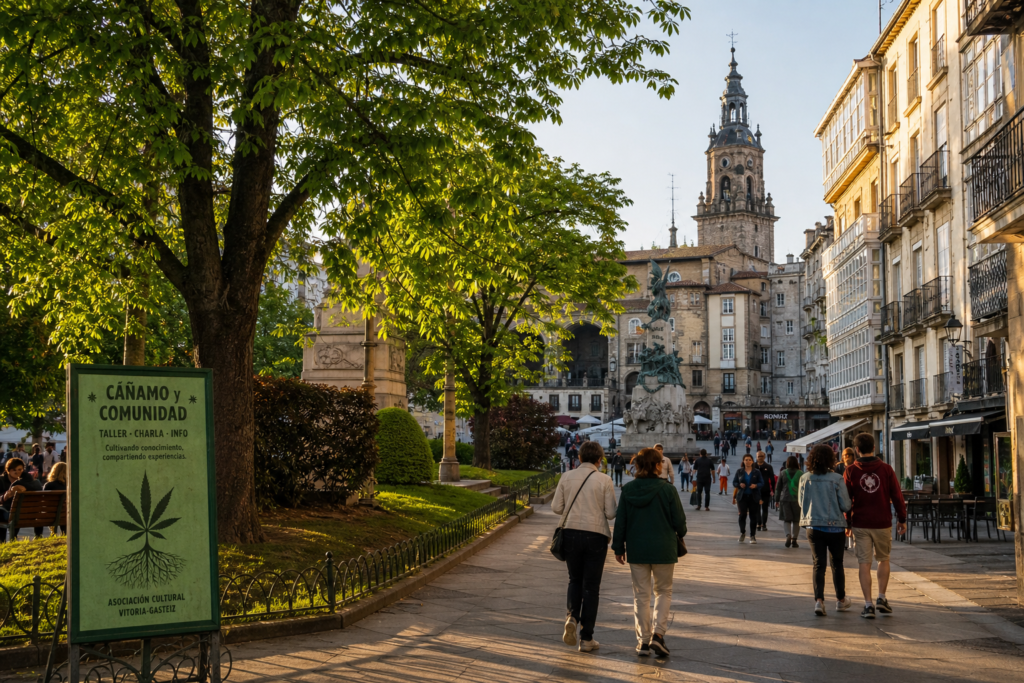
Private premises are not a blanket safe zone. Tenants must consider rental agreements, neighbours and building rules, while hosts remain responsible for what takes place in their property. Smoking in shared stairwells, balconies or communal courtyards can affect others and may breach local or building regulations. Privacy, ventilation and consent are important, but they do not erase every legal risk.
For a wider explanation of Spain’s general position, readers can compare this local context with our guide to weed law in Spain. The key point is simple: informal descriptions such as “decriminalised” can be misleading because administrative penalties, criminal offences and private conduct are separate questions.
Social clubs and community spaces
People searching for cannabis social clubs in Vitoria-Gasteiz may encounter references to private associations. Spanish cannabis clubs have operated in a legally complex environment, often relying on arguments connected with private collective use. Their status is not equivalent to a government licence for commercial cannabis sales, and a club’s existence does not guarantee that every activity is lawful.
Anyone considering a private association should verify its current rules, membership conditions and approach to age checks, privacy and responsible conduct. A venue that openly advertises street sales, encourages public consumption or makes unrealistic legal promises deserves particular caution. Visitors should also avoid assuming that a club in one city has the same policies, legal position or culture as a club elsewhere.
What responsible club practice should look like
- Clear membership procedures and age restrictions.
- No encouragement to consume in public or drive after using cannabis.
- Accurate information about potency, products and possible adverse effects.
- Respect for neighbours, staff, non-consumers and local communities.
- Practical support when someone feels unwell, anxious or overwhelmed.
- No pressure to buy, consume more or share products with others.
These are indicators of a safer environment, not a guarantee that a venue is legally approved. The absence of regulation can make product testing, labelling and accountability inconsistent, which is one reason caution remains important.
CBD, hemp and the changing product landscape
CBD products are visible in many European cities, including Vitoria-Gasteiz. CBD is not the same as intoxicating cannabis: products marketed as CBD generally contain little or no THC, although composition and labelling can vary. A product described as hemp-based is not automatically suitable for consumption, and “natural” does not mean risk-free.
Consumers should inspect the label, intended use, ingredients, batch information and seller details. Products sold as cosmetics, food supplements, flowers or extracts may be subject to different rules. Avoid products with exaggerated claims about treating anxiety, pain or other medical conditions. If a product is being considered alongside prescription medicine, a pharmacist or doctor is the appropriate source of advice.
Travellers should be especially careful when carrying CBD or cannabis products across borders. Rules can differ between countries, and a product purchased legally in one place may still create problems during transport. Keeping packaging and receipts does not guarantee that cross-border possession is permitted.
Medical cannabis in Vitoria-Gasteiz
Searches for medical cannabis in Vitoria-Gasteiz often reflect confusion between medical research, prescription medicines, self-medication and products sold through general retail channels. A doctor should assess symptoms and treatment options rather than relying on a club, shop or social-media recommendation.
Some cannabis-based medicines have recognised medical uses in appropriate circumstances, but the evidence and indications differ by product. Cannabis can affect attention, memory, coordination, mood and the cardiovascular system. It may also interact with medicines or worsen certain mental-health conditions. Pregnant people, adolescents and anyone with a history of psychosis or serious cardiovascular problems should seek professional advice before considering cannabis.
The Spanish Agency for Medicines and Medical Devices provides official information about medicines and regulatory developments. Its material is more reliable than promotional claims that promise universal benefits or suggest that medical use makes recreational products medically appropriate.
Harm reduction for adults who choose to use
People make their own decisions, but responsible cannabis culture depends on reducing avoidable harm. The safest option for someone who does not use cannabis is not to start. For adults who choose to use, lower-risk behaviour includes understanding potency, using less, waiting before taking more and avoiding combinations with alcohol or other drugs.
- Do not drive, cycle in traffic or operate machinery after using cannabis.
- Avoid using alone if there is a history of panic, severe anxiety or other vulnerability.
- Keep cannabis and edibles away from children and pets.
- Remember that edible products can take longer to produce effects and may last much longer than expected.
- Do not share cannabis with minors or pressure anyone to consume.
- Use discreetly and respect smoke-free rules, neighbours and public spaces.
- Seek urgent help if someone has chest pain, difficulty breathing, a seizure, severe confusion or cannot be woken.
Potency is another important consideration. High-THC products can increase the likelihood of anxiety, impaired judgement and unpleasant psychological effects. People who feel unwell should move to a calm environment, avoid taking more substances and ask a trusted person for help. Emergency services should be contacted when symptoms are serious.
Visitors, nightlife and everyday etiquette
Visitors sometimes approach cannabis in Vitoria-Gasteiz as part of nightlife or alternative tourism. That approach can create avoidable problems if it leads to public consumption, street purchases or carrying products through transport hubs. A visitor should not assume that local acquaintances, online posts or a private association can protect them from Spanish law.
Good etiquette is straightforward: do not smoke near children, entrances, queues or crowded terraces; do not leave cannabis waste in parks; do not photograph people consuming without permission; and do not treat Basque neighbourhoods as a backdrop for behaviour that would be unacceptable at home. Vitoria-Gasteiz’s green spaces are shared civic resources, not designated cannabis areas.
Language and privacy matter as well. Conversations about cannabis may be welcome in some circles and unwelcome in others. Asking before consuming, keeping odour away from shared spaces and accepting a clear refusal are basic forms of respect. These habits support a culture based on consent rather than assumption.
How the local conversation may evolve
The future of cannabis policy in Vitoria-Gasteiz will be shaped by national legislation, court decisions, public-health evidence and local attitudes. Debate may focus on regulation, access to medical treatments, youth prevention, the role of private associations and the effects of commercialisation. Whatever policy changes occur, credible information and transparent enforcement will matter more than slogans.
Residents can contribute by supporting evidence-based education, asking for clear product information and separating personal stories from general medical claims. Community organisations, health professionals and public authorities also have a role in making help available without stigma. A mature cannabis culture does not require everyone to consume; it requires people to understand risks, respect boundaries and know where reliable information comes from.
Conclusion
Cannabis culture in Vitoria-Gasteiz is part of a broader social conversation about privacy, public space, health and personal responsibility. The city’s progressive reputation should not be confused with unrestricted cannabis legality. Public possession and consumption can bring administrative consequences, supply remains a serious legal matter, and private clubs operate within a complex and changing framework.
For residents and visitors, the most responsible approach is to check current official information, avoid public use, never drive impaired, treat CBD and medical claims critically, and seek professional help when health or legal questions arise. Understanding the local culture means recognising both the people who use cannabis and the wider community that shares Vitoria-Gasteiz’s streets, homes and green spaces.