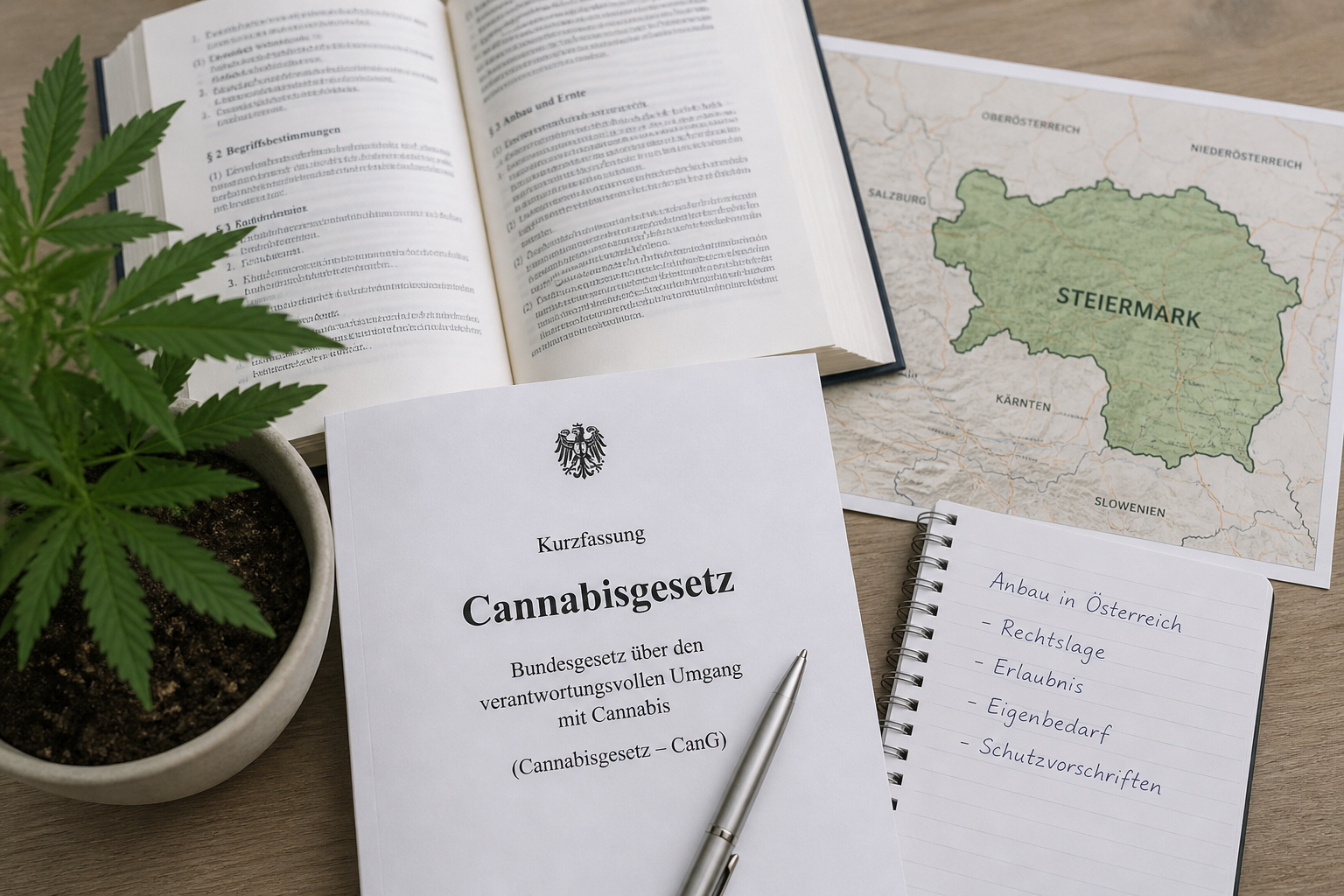
Understanding Cannabis cultivation laws in Fürstenfeld, Austria means looking primarily at Austrian federal law rather than a separate municipal rulebook. Fürstenfeld is in Styria, but the core rules on cannabis plants, narcotic drugs, hemp, possession and supply are established at national level. Local authorities may still matter for matters such as public order, nuisance, building use or enforcement, yet they cannot generally create a local exemption from Austria’s controlled-substances rules.
This guide explains what residents, visitors and property owners should know about growing cannabis in Fürstenfeld. It distinguishes prohibited cultivation from industrial hemp, discusses medical access, outlines practical legal risks and identifies safer ways to avoid an accidental breach. The information is general and not a substitute for advice from an Austrian lawyer or a current decision from the competent authorities.
What cannabis cultivation laws in Fürstenfeld, Austria actually cover
The central issue is not simply whether a plant is called cannabis. Austrian law focuses on the plant, its usable parts, its THC content in relevant contexts and, importantly, the purpose of cultivation. Growing cannabis to produce a narcotic drug can create criminal-law exposure even when the grower says the crop is only for personal use.
That distinction is important for anyone searching online for cannabis cultivation laws Fürstenfeld. A private garden, balcony or indoor room does not become exempt merely because it is not visible to the public. The same national framework generally applies in a rented flat, an owner-occupied home, an allotment garden and agricultural land.
The official Austrian legal database, RIS version of the Austrian Narcotic Drugs Act, is the best starting point for checking the wording of the applicable provisions. Because legislation and administrative practice can change, readers should confirm the current text before planting, buying seeds or importing products.
Is growing cannabis at home legal in Fürstenfeld?
For ordinary THC-producing cannabis, the safe answer is that home cultivation should not be treated as generally legal in Austria. Cultivation intended to produce cannabis for use as a narcotic drug is restricted under the Austrian Narcotic Drugs Act. Personal consumption does not automatically turn prohibited cultivation into a lawful activity.
In practice, the legal assessment can depend on facts such as the number and maturity of plants, whether flowering has begun, the apparent purpose of the crop, the presence of harvested material, cultivation equipment, communications, sales indicators and any connection with supply to another person. These factors do not create a guaranteed legal threshold. A small grow is not necessarily lawful, and a large grow may attract more serious suspicion.
Seeds, seedlings and flowering plants
Seeds do not always receive the same treatment as harvested cannabis, but buying or possessing seeds should not be confused with permission to cultivate a drug-producing plant. A seed can germinate, develop into a prohibited crop and create legal consequences depending on the circumstances.
Seedlings and vegetative plants can also raise questions about intended use. The idea that only flowering plants matter is an unreliable basis for planning a home grow. Anyone considering cultivation should obtain individual legal advice before taking action, especially if the plant is intended to produce THC-rich flowers.
Does personal use make cultivation acceptable?
No general personal-use exception should be assumed. Austrian law may distinguish between cultivation, possession, personal consumption and supply, but those are separate legal questions. Even if there is no plan to sell the crop, cultivating cannabis for narcotic-drug production can remain problematic.
For residents researching weed in Fürstenfeld, this is one of the most important practical points: private location and private intent do not by themselves remove the possibility of investigation or prosecution.
Industrial hemp is different, but not automatically risk-free
Industrial hemp can fall outside the narcotic-drug rules when it meets the applicable legal conditions, including requirements concerning approved varieties, THC limits and the purpose of cultivation. This does not mean that every cannabis plant with a label such as “hemp” is lawful.
Commercial growers must be especially careful about seed certification, agricultural rules, plant material, testing, record keeping and the intended use of the harvest. A crop that exceeds the relevant limit, uses unsuitable seed or is cultivated for drug production may be treated very differently from compliant industrial hemp.
For a household in Fürstenfeld, growing a few plants marketed as low-THC hemp is not a substitute for checking the exact Austrian requirements. Product descriptions from online sellers are not legal certification. If a plant’s status is uncertain, do not rely on appearance, packaging or a seller’s promise.
Private gardens, balconies and indoor rooms
The setting may affect evidence and practical enforcement, but it does not itself create permission. Outdoor plants can be visible to neighbours, passers-by or police officers, while indoor cultivation may involve lights, ventilation, odours, electricity use or landlord concerns. A balcony can also create disputes involving smoke, smell, building rules or access to shared property.
Separate legal issues may arise where electrical modifications, water damage, fire hazards or unauthorised changes to a rented property are involved. Even when a cannabis question is the starting point, a dispute can expand into tenancy, safety or property law.
Medical cannabis and licensed cultivation
Medical need does not normally give a private patient permission to grow cannabis at home. Austria’s medical framework allows certain cannabis-based medicines and preparations under regulated conditions, but access depends on the product, indication, prescriber and dispensing route. A patient should ask a doctor and pharmacist about lawful treatment rather than assume that a diagnosis authorises personal cultivation.
Licensed cultivation for medical, scientific or other authorised purposes is a separate category. It involves regulated operators, approvals and compliance obligations. A private grower cannot rely on the existence of licensed producers as evidence that personal cultivation is permitted.
People comparing medical cannabis in Austria should also distinguish between approved medicines, pharmacy-dispensed preparations, CBD products and unregulated cannabis flowers. These categories can have different rules, quality controls and prescribing conditions. The Austrian government’s Federal Ministry of Social Affairs, Health, Care and Consumer Protection provides official health-policy information and points users toward current government resources.
Possession, harvesting and sharing: separate risks
Growing is only one part of the legal picture. Once a plant is harvested, possession of cannabis may create an additional issue. Giving some to a friend, selling part of a crop, exchanging it for another product or storing it for another person can raise more serious concerns than private possession alone.
Transport also matters. Moving plants, flowers, extracts or other cannabis products through Austria can create questions about possession, source, intended use and, at borders, import or export. A product bought lawfully in another country is not automatically lawful to bring into Austria.
- Possession: The amount, form, circumstances and apparent purpose may affect the legal assessment.
- Supply: Selling, sharing or arranging delivery can create substantially greater risk than a private-use allegation.
- Importation: Crossing a border with cannabis, seeds, extracts or medicines requires particular caution.
- Driving: Cannabis use and road safety are separate from cultivation law and can lead to serious consequences.
- Public nuisance: Odour, smoke, noise or unsafe equipment may trigger non-drug-related complaints.
For comparison, readers may find the broader discussion of cannabis possession regulations in Weiz useful. Weiz is another Styrian location, but local geography does not replace the national Austrian framework.
Possible consequences of unlawful cultivation
Consequences depend on the conduct and the evidence. Authorities may investigate the plants, growing equipment, harvested material, communications, finances and links to other people. Criminal consequences can become more serious where there is evidence of commercial production, repeated activity, supply, cross-border conduct or involvement of protected persons.
Police action can also have immediate practical effects, including seizure of plants and equipment, questioning, searches or disruption to a tenancy. Whether a matter proceeds, is discontinued or results in a conviction depends on the specific facts and applicable law. Online summaries cannot predict the outcome.
If officials contact you about a suspected grow, avoid guessing, destroying evidence or making informal arrangements with other people. Ask whether you are being questioned as a witness or suspect, request an interpreter if needed and seek advice from an Austrian criminal defence lawyer. A lawyer can assess the current provisions, procedural position and any relevant medical or agricultural documentation.
Practical compliance checklist for Fürstenfeld residents
- Identify the plant and product accurately. Do not assume that “hemp,” “CBD” or “low THC” on packaging proves legal status.
- Check the current Austrian rules. Use official sources and confirm whether the rules apply to cultivation, possession, sale, import or use.
- Do not rely on a plant-count myth. Austria does not offer a simple universal home-grow number that makes THC-producing cultivation safe.
- Keep medical documentation separate. A prescription or diagnosis may support lawful treatment but does not automatically authorise a garden crop.
- Consider tenancy and safety rules. Ventilation, wiring, humidity, odour and alterations can create additional disputes.
- Do not share or transport uncertain products. Giving cannabis to another person or crossing a border can materially increase risk.
- Obtain advice before acting. For a commercial hemp project, consult an agricultural or regulatory professional; for a suspected offence, consult a lawyer.
How local context in Fürstenfeld matters
Fürstenfeld’s local setting may influence how a complaint begins, but it does not change the main legal standard. Neighbour reports, visible plants, odour, a landlord’s inspection, an emergency call or an unrelated police investigation can all bring a grow to official attention. Rural or suburban surroundings should not be treated as a legal safe zone.
Local questions can also arise around waste disposal, agricultural land use, water, electricity and building safety. These issues are distinct from the cannabis rules, yet they may affect whether a cultivation project is noticed or whether another authority becomes involved.
For anyone searching for cannabis in Fürstenfeld, the most reliable approach is to separate three questions: is the plant legally classified, is the activity authorised, and are the premises and products compliant with other applicable rules? If any answer is uncertain, pause before cultivating or distributing anything.
Conclusion
The main lesson from the cannabis cultivation laws in Fürstenfeld, Austria is that a private address, personal-use intention or small number of plants does not provide a dependable exemption for growing THC-producing cannabis. Industrial hemp and authorised medical or scientific cultivation are distinct categories with their own conditions. Possession, harvesting, sharing, transport and driving can create further legal issues.
Residents should check the current Austrian rules, use official sources, keep clear records for any legitimate hemp or medical activity and obtain professional advice when the facts are uncertain. Treating cultivation as a legal question rather than a gardening shortcut is the safest way to avoid preventable problems in Fürstenfeld.