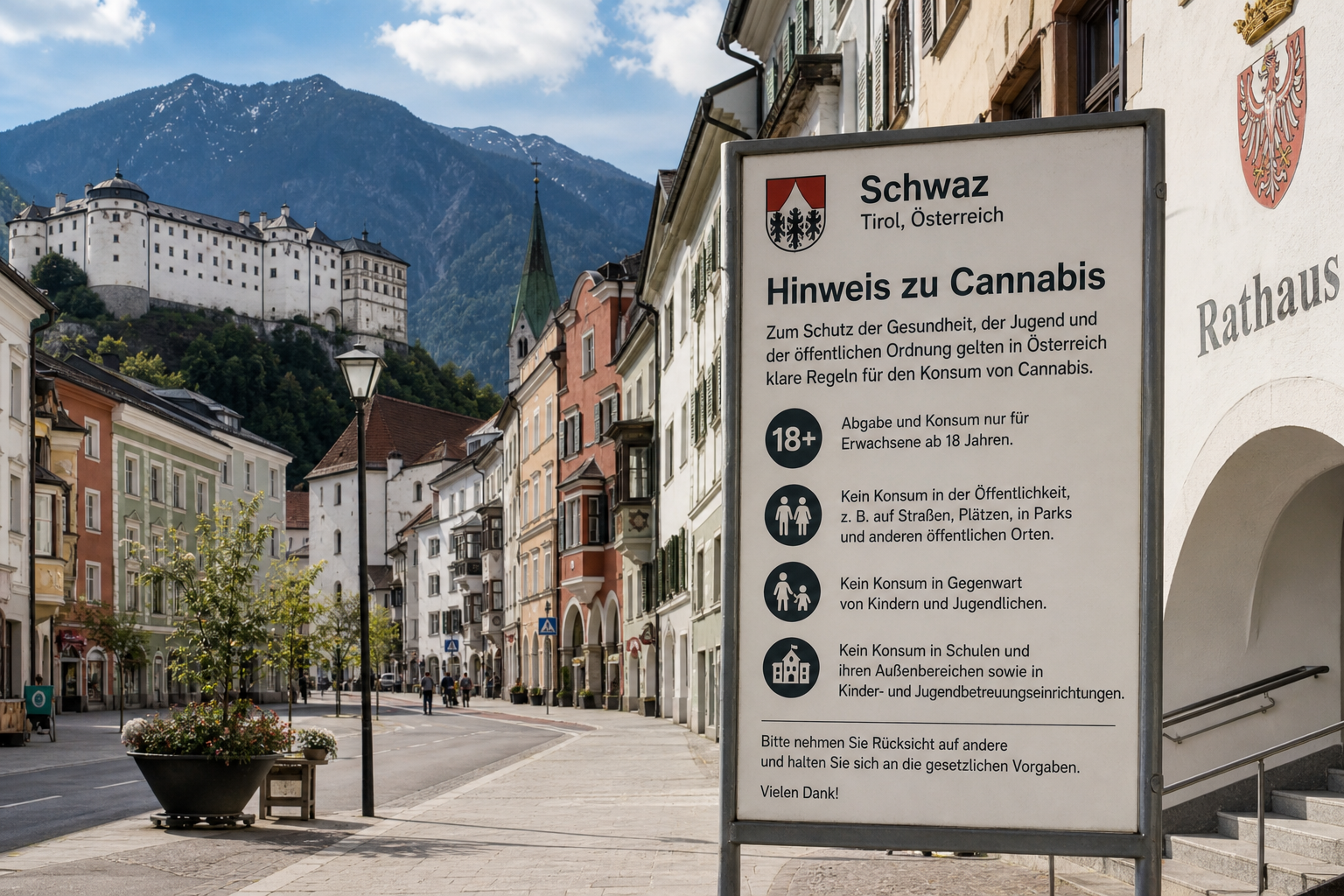
Understanding Cannabis restrictions in Schwaz requires looking first at Austrian national law. Schwaz is a town in Tyrol, but cannabis possession, supply, cultivation and use are mainly governed by federal rules rather than a separate municipal cannabis code. Local authorities can still manage public spaces, respond to nuisance, enforce traffic rules and apply venue-specific regulations.
This guide explains what residents and visitors should know about weed in Schwaz, including possession, public consumption, CBD products, medical access, driving and practical harm-reduction considerations. It is general information, not legal advice. Rules and enforcement can change, so anyone facing an investigation should consult a qualified Austrian lawyer.
How cannabis law applies in Schwaz
Austria generally treats cannabis containing relevant levels of tetrahydrocannabinol (THC) as a controlled narcotic under the Suchtmittelgesetz, commonly abbreviated as SMG. The key point is that personal possession is not made legal simply because a person has a small amount or intends to use it privately.
Depending on the circumstances, authorities may consider the substance, quantity, intended use, prior history and whether there is evidence of supply to others. Austrian law provides mechanisms that can result in a more treatment-oriented or deferred response in some personal-use cases, but these mechanisms should not be confused with legalization or guaranteed leniency.
For the current wording of Austrian statutes and regulations, consult the Austrian Legal Information System. The official text is more reliable than informal summaries, particularly when a case involves cultivation, sharing, importation or a suspected offence near a school or other protected setting.
Possession and sharing
Buying, possessing, transporting or sharing THC cannabis can create legal risk. Sharing without payment is not automatically harmless: transferring a controlled substance to another person may be treated differently from simple possession and can lead to more serious consequences.
Visitors should also avoid assuming that a product obtained legally in another country may be carried into Austria. Border crossings, airports and postal shipments create separate risks. A product’s packaging or a foreign prescription does not necessarily establish that importation is lawful under Austrian rules.
Cannabis laws in Schwaz and public places
There is no general reason to assume that cannabis is permitted in a Schwaz park, on a street, at a railway area, outside a bar or at a public event. Even where a person is not immediately stopped, public use can attract police attention, create complaints and expose the person to additional issues involving public order, smoking restrictions or possession.
Public consumption may also affect other people through smoke, smell and second-hand exposure. A considerate approach is not to use cannabis in shared or crowded spaces, near children, around entrances or in accommodation where smoking is prohibited. Hotels, landlords, employers, transport operators and event organisers can impose their own valid restrictions.
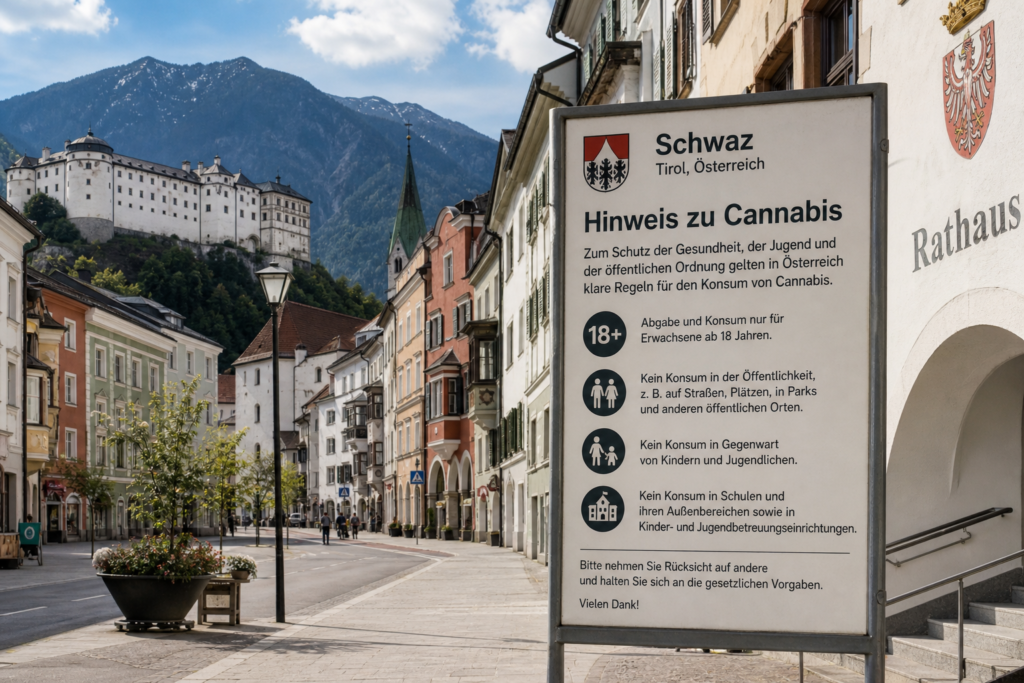
Schwaz’s local setting also matters practically. Visitors may move between the town, neighbouring communities and transport connections in the Inn Valley. Conduct that begins in one place can continue into another jurisdiction or involve railway, road or venue rules. Local boundaries do not replace Austria’s national drug law.
What visitors searching for weed in Schwaz should know
People searching for cannabis in Schwaz may encounter online advertisements, informal offers or products labelled as CBD. These sources are not proof that a product is legal, safe or accurately labelled. Purchasing from an unregulated seller can involve unknown THC strength, contamination, misleading packaging and legal exposure for both buyer and seller.
There is no general recreational cannabis dispensary system in Austria comparable to regulated adult-use markets in some other countries. A shop selling hemp or CBD merchandise should not automatically be treated as a licensed source of recreational THC cannabis.
For broader context on nearby regional terminology and regulation, readers can compare this guide with the article on hemp industry and regulation in Hall in Tirol. Hemp materials, CBD products and THC cannabis are related but legally distinct categories.
CBD and low-THC products
CBD is not the same as THC and usually does not produce the same intoxicating effect. However, a CBD label does not settle every legal question. The product’s THC content, plant material, intended use, ingredients, form and marketing can all matter.
Food, oils, flowers, cosmetics, vaping products and supplements may be subject to different rules. Some products can also contain enough THC to create an issue during roadside testing or laboratory analysis. Consumers should check Austrian requirements and use reputable, transparent suppliers rather than relying only on informal claims such as “legal” or “natural.”
Medical cannabis in Schwaz
Medical cannabis in Schwaz is not the same as recreational access. Austria has medical products and prescription pathways for particular treatments, but this does not mean that a patient can freely possess cannabis flower, grow plants at home or purchase any THC product by presenting a general medical explanation.
Patients should speak with an Austrian doctor and pharmacist about an appropriate, authorised medicine. They should also ask how a prescription works if travelling, whether the medicine may be carried across a border and what documentation is needed. A prescription from another country may not automatically authorise possession or importation in Austria.
Medical treatment should be based on a clinical assessment of benefits, risks, interactions and alternatives. Cannabis can affect alertness, coordination, mood and heart rate, and it may interact with other medicines. The Austrian public health portal provides general information about health topics and services through its official health information portal.
Driving, work and accommodation
Driving after using cannabis is a major practical risk. Intoxication can impair reaction time, attention, judgement and coordination. In Austria, roadside and legal consequences do not depend solely on whether a driver feels capable. A person may face problems when impairment is suspected or testing indicates recent consumption, and penalties can include measures affecting the driving licence.
The safest choice is not to drive after cannabis use and not to rely on coffee, sleep or a subjective feeling of sobriety as a guarantee. This applies to cars, motorcycles, bicycles and other situations where impairment could endanger the user or someone else. Plan transport in advance and use a sober driver or public transport where appropriate.
Workplaces can also restrict possession, impairment and use, especially in safety-sensitive roles. Employers may have internal policies that apply even when conduct occurs away from the workplace. Rental accommodation, hotels and holiday apartments may prohibit smoking or vaping, and breaking those rules can lead to cleaning charges, eviction or loss of a deposit.
What can happen after a cannabis-related stop?
A police encounter can lead to questions, seizure of suspected substances, identification checks and further investigation. The outcome depends on facts such as the amount, packaging, statements, location, prior history and whether another offence is suspected. Do not assume that a warning, a small quantity or personal-use claim guarantees that the matter will end immediately.
- Remain calm and avoid arguing about legal conclusions at the roadside.
- Do not give false information or sign documents you do not understand.
- Ask for an interpreter if language is a problem.
- Seek legal advice promptly if you are questioned as a suspect or receive official paperwork.
- Keep any prescription, product documentation or laboratory information available, while recognising that documents do not automatically make a product lawful.
Anyone concerned about dependency, anxiety, impaired control or repeated use can also contact a doctor or addiction-support service. Seeking health advice is separate from admitting a legal offence and can help identify safer options.
Practical ways to reduce legal and health risks
The most reliable way to avoid the legal consequences of THC cannabis in Schwaz is not to possess or use prohibited products. If someone nevertheless encounters cannabis, several choices can reduce immediate risk without changing its legal status:
- Do not buy from unknown sellers or accept cannabis for transport.
- Never share cannabis with another person, particularly a minor.
- Do not use cannabis in public, crowded areas, accommodation where it is prohibited or near children.
- Do not combine cannabis with alcohol, sedatives or other intoxicating substances.
- Do not drive, cycle in traffic or operate machinery while impaired.
- Keep all medicines in their original packaging and confirm travel requirements before crossing a border.
- Use official Austrian legal and health information when rules are unclear.
Readers interested in a nearby educational perspective can also review cannabis education and safer choices in Kufstein. The same basic principle applies across Tyrol: local geography may change, but federal drug rules remain central.
How Schwaz differs from a separate local cannabis regime
It is useful to distinguish a local restriction from a national prohibition. Schwaz can regulate municipal property, event conditions, local nuisance and the use of particular public facilities. It cannot create a general recreational cannabis market outside Austria’s federal framework. Conversely, the absence of a prominent local notice does not mean THC cannabis is lawful.
This distinction helps explain why searches for cannabis laws in Schwaz may produce confusing results. A town may have rules about smoking, events or public behaviour, while the most important possession and supply rules come from Austrian legislation. When in doubt, check the federal statute and obtain professional advice for a specific situation.
Conclusion
Cannabis restrictions in Schwaz are primarily shaped by Austrian national law. THC cannabis is not generally legal for recreational possession, purchase, sharing or cultivation, and public use can create additional practical problems. CBD and hemp products require careful checking because labels, product forms and THC content matter. Medical access exists only through appropriate medical and pharmaceutical channels, not through an unrestricted recreational system.
For residents and visitors, the safest approach is to avoid unregulated cannabis, never drive while impaired, respect venue and accommodation rules, and verify current requirements through official sources. If police, employment, travel or medical issues are involved, timely advice from an Austrian professional is more dependable than online assumptions.