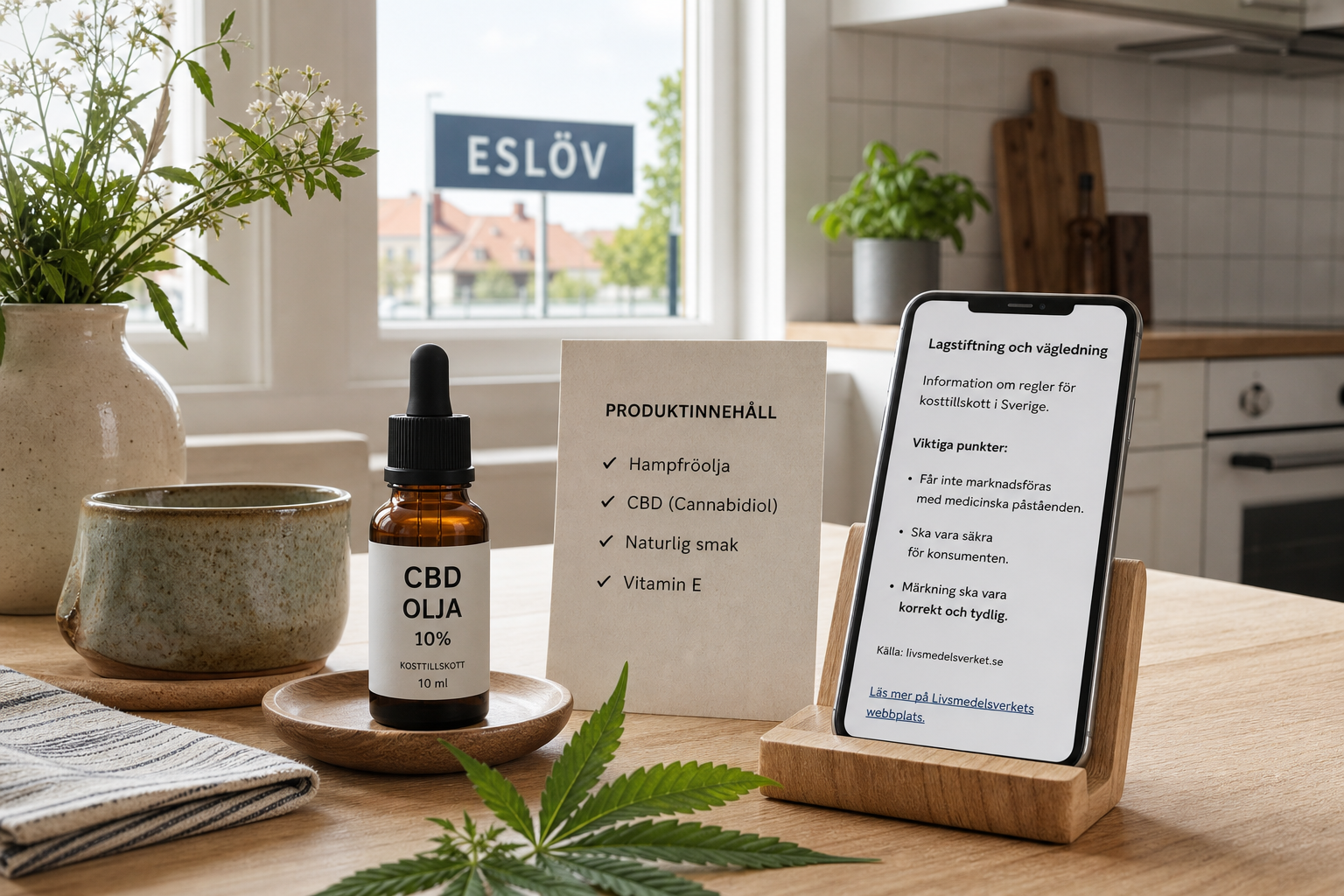
This CBD guide 2026 Eslöv, Sweden is for residents, visitors and anyone comparing cannabidiol products in Skåne. CBD is widely discussed as a non-intoxicating cannabis compound, but a product’s legal position depends on its ingredients, intended use, claims, manufacturing and route of sale. A bottle labelled “CBD” is not automatically legal, safe or medically effective.
The most useful approach is to separate three questions: what Swedish law permits, what a product actually contains, and whether there is a legitimate reason to use it. Rules and product classifications can change, so treat this article as practical background rather than a substitute for advice from a Swedish authority, pharmacist or clinician.
CBD in Eslöv: what the term really means
CBD, or cannabidiol, is one of the compounds found in the cannabis plant. Unlike THC, CBD is not generally associated with the same intoxicating effect. That difference does not make every cannabis-derived product lawful. Trace THC, extracts from different parts of the plant, pharmaceutical claims and the way a product is marketed can all matter.
Products sold as CBD may include oils, capsules, cosmetics, e-liquids, flowers, drinks and food supplements. These categories are not interchangeable. A topical cosmetic, an ingestible oil and a prescription medicine may face different requirements. The packaging and marketing language can also affect how a product is regulated.
CBD is not the same as medical cannabis
Medical cannabis refers to regulated medicinal products used under healthcare supervision. A wellness product bought online or in a shop is not automatically equivalent to a prescribed medicine, even if it mentions pain, sleep, anxiety or inflammation. Evidence, quality control, dosing and clinical oversight can be very different.
CBD laws in Eslöv and the wider Swedish framework
Eslöv follows Swedish national law rather than having a separate local CBD market with its own cannabis rules. Municipal authorities may be involved in consumer protection, food control or business supervision, but the central legal questions are determined mainly by national legislation and regulatory agencies.
One important issue is THC. Swedish authorities have treated THC-containing cannabis products seriously, and even a small amount may create legal risk depending on the product and circumstances. Do not assume that “hemp,” “full spectrum” or “less than 0.2% THC” on a label guarantees that a product is lawful in Sweden. Foreign rules and marketing descriptions may not match Swedish enforcement or product requirements.
For current information about medicines, medicinal claims and the status of cannabis-related products, consult the Swedish Medical Products Agency. If you are bringing a product across a border, check the Swedish Customs guidance before travelling rather than relying on a seller’s statement.
Food, supplements and novel products
Ingestible CBD products can raise food-law questions in addition to controlled-substance concerns. CBD extracts and products containing them may be considered novel foods or otherwise subject to authorization and safety requirements. A product being available on a foreign website does not prove that it can lawfully be sold or imported into Sweden.
Be especially cautious with oils, gummies, beverages and capsules that make health claims. Claims that a product treats a disease, replaces prescribed treatment or guarantees a medical outcome may indicate that it is being marketed as a medicine. Such claims should not be accepted without reliable regulatory and clinical support.
Buying CBD in Eslöv: practical checks before paying
Whether you are comparing CBD in Eslöv or ordering from a Swedish website, start with the product information rather than the advertising headline. A responsible seller should make it possible to identify the business, contact customer support and understand exactly what is being sold.
- Read the ingredient list: Look for CBD content, carrier oils, additives and any mention of THC or other cannabinoids.
- Check the product category: Food, cosmetics, vaping products and medicinal products are governed differently.
- Look for batch-specific testing: A credible certificate of analysis should identify the tested batch and show cannabinoid results, not merely display a generic laboratory logo.
- Assess the label: Missing dosage information, unclear origin, exaggerated promises or spelling-heavy packaging are warning signs.
- Verify the seller: Look for a real business identity, terms of sale, refund information and a clear customer-service route.
- Consider import risk: Products shipped from outside Sweden may be stopped, assessed or treated differently at the border.
No laboratory report can answer every legal question. Testing may also fail to detect contamination, pesticides, solvents or inaccurate labelling if the test is limited. Treat independent testing as one useful check, not as a complete guarantee.
Hemp-derived CBD in Eslöv: why source and format matter
Hemp-derived CBD usually describes CBD obtained from industrial hemp, but the phrase is not a universal legal exemption. The plant source, extraction method, finished formulation and THC content can all be relevant. CBD flower and other cannabis-like products may attract particular scrutiny because they can resemble controlled cannabis or contain measurable THC.
In practical terms, avoid products whose labels are vague about whether they contain THC. Do not rely solely on a percentage printed on a product page, especially when the seller does not provide a recent, batch-matched analysis. If you cannot establish what is in the product, the safer choice is not to use or import it.
For wider regional context, our guide to the hemp industry in Landskrona explains why hemp applications and consumer cannabis products should not be treated as the same thing.
Health considerations and responsible use
CBD can cause side effects and may interact with medicines. Possible concerns include drowsiness, gastrointestinal symptoms, changes in appetite and effects on how the liver processes some medicines. Risk may be greater when CBD is combined with alcohol, sedatives or other substances that affect alertness.
Speak with a doctor or pharmacist before using CBD if you take prescription medicines, have liver disease, are pregnant or breastfeeding, are under 18, or are considering CBD for a child. Do not stop prescribed treatment to try a commercial CBD product. A healthcare professional can help distinguish a regulated medical option from an unverified supplement or cosmetic.
Driving and workplace safety
Do not drive, cycle in traffic or operate machinery if a product makes you sleepy, impaired or uncertain. Products labelled as CBD may contain THC or may be inaccurately labelled. In Sweden, cannabis-related driving and possession issues can have serious consequences, so uncertainty about a product’s contents is a reason to avoid it.
Medical cannabis in Sweden: where CBD fits
Medical cannabis access in Sweden is not the same as buying over-the-counter CBD. A clinician must assess the patient, the condition and suitable treatment options. Some cannabis-based medicines may be prescribed in specific circumstances, but that does not mean that ordinary CBD oils, flowers or imported products are approved substitutes.
If you are seeking CBD for persistent pain, epilepsy, sleep problems, anxiety or another health concern, begin with healthcare advice. Ask what evidence exists for the intended use, whether a regulated medicine is appropriate and how possible interactions would be monitored. The answer may be that CBD is not suitable or that another treatment has stronger support.
Visitors and travel around Eslöv
Travellers should avoid carrying CBD across borders unless they have checked the exact product and applicable Swedish requirements. A product purchased legally in another country can still create problems when imported into Sweden. This is especially important for oils, flowers, vapes, edibles and products with detectable THC.
Keep prescribed medicines in original packaging and carry relevant documentation when travelling. Do not place an unidentified CBD product in checked luggage or assume that a retailer’s “travel certificate” overrides Swedish border rules. For related travel planning, see our practical overview of cannabis tourism rules in nearby Ystad.
A sensible decision checklist for 2026
- Define the purpose: cosmetic use, general wellness or a medical concern.
- Identify the exact product category and ingredients.
- Check for THC information and a recent, batch-specific laboratory report.
- Review the seller’s business details and return policy.
- Confirm whether the product may lawfully be sold, used or imported in Sweden.
- Ask a pharmacist or doctor about medicines, health conditions and dosing questions.
- Do not drive or mix the product with alcohol or sedating substances if you feel affected.
Conclusion
CBD in Eslöv should be approached as a regulated consumer and health topic, not as a risk-free cannabis alternative. Swedish rules can depend on THC, product composition, marketing claims, intended use and import circumstances. A clear label, trustworthy testing, cautious health decisions and current official guidance are more valuable than bold promises from a seller.
This CBD guide 2026 Eslöv, Sweden provides a starting point for informed choices. Before buying or travelling with CBD, verify the current position with the relevant Swedish authority and seek professional advice when the product is intended for a medical purpose.