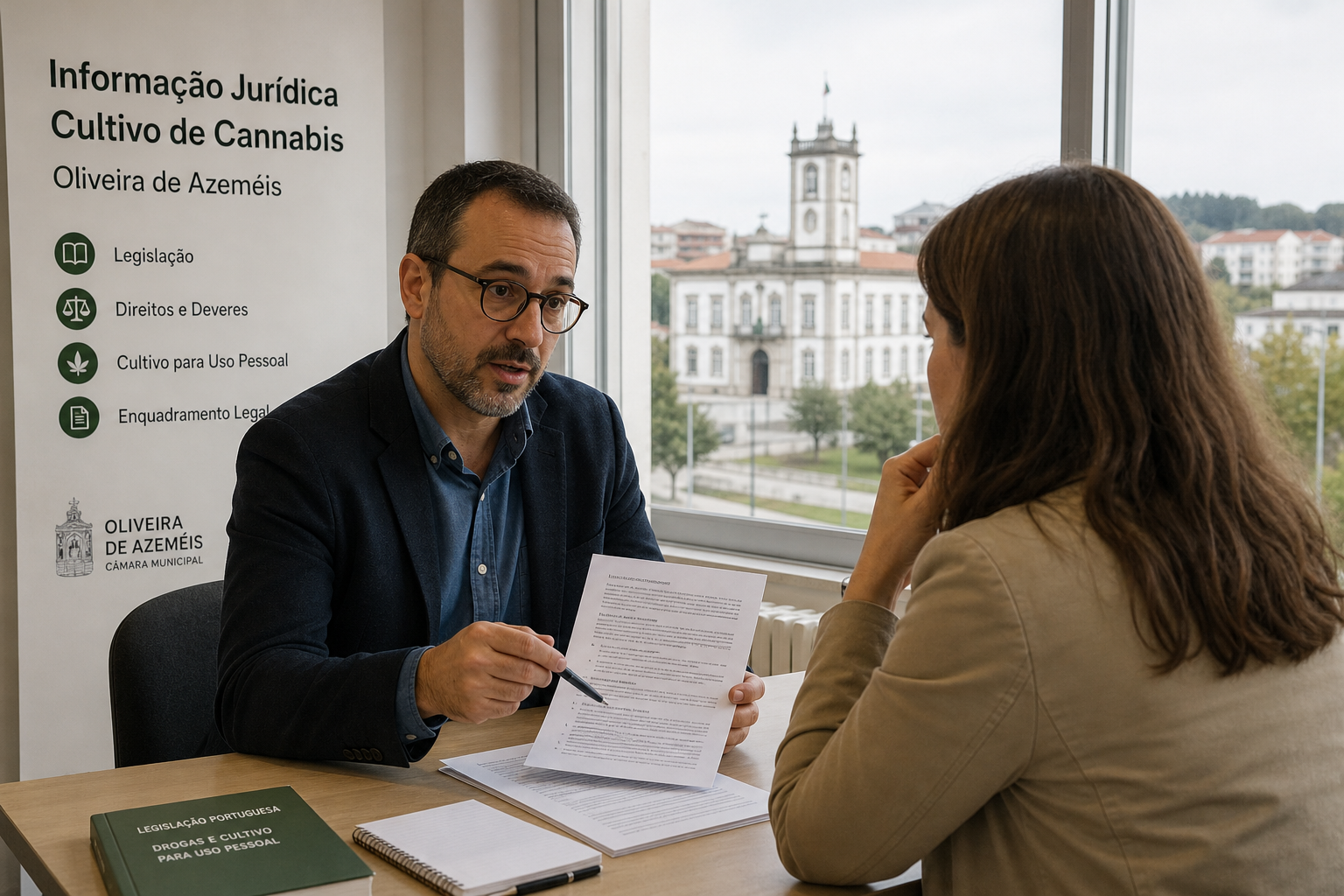
Understanding the Cannabis cultivation laws in Oliveira de Azeméis requires looking beyond local practice. Oliveira de Azeméis is a municipality in Portugal, but the rules governing cannabis cultivation are primarily established by national law. A private garden, balcony or indoor room is not automatically exempt from those rules, and growing a plant for personal use can still create criminal-law risks.
This guide explains the position as clearly as possible for residents, visitors and property owners. It distinguishes personal cultivation from licensed medical production, industrial hemp and possession, while also explaining why the fact that cannabis use has been decriminalised in some circumstances does not mean that cultivation is legal.
How cannabis cultivation is regulated in Oliveira de Azeméis
There is no general municipal licence in Oliveira de Azeméis that allows residents to grow cannabis for personal consumption. The municipality cannot create a local exception to Portugal’s national controlled-substances framework. Whether the activity takes place in the city centre, a rural parish or a private property, the same national restrictions apply.
Portugal’s decriminalisation model is often misunderstood. Decriminalisation of the personal use and possession of limited quantities changed how certain conduct is handled; it did not create a recreational cannabis market or a general right to cultivate plants at home. Cultivation remains legally distinct from possession and can be treated more seriously.
For current legislation and official legal publications, consult the Diário da República official legislation portal. Laws and administrative interpretations can change, so online summaries should not replace advice from a Portuguese lawyer when a specific case is involved.
Is growing cannabis at home legal in Portugal?
In general, no. Growing cannabis at home for personal use is not a broadly permitted activity under Portuguese law. This applies whether the plants are grown indoors, outdoors, in a greenhouse or in a discreet private garden. The number of plants, their size and whether they are mature may affect the facts of a case, but none of those details should be treated as a guaranteed safe harbour.
Personal cultivation is different from personal possession
A person may assume that growing a small amount is acceptable because Portuguese law takes a health-oriented approach to some personal possession cases. That assumption is unsafe. Possession, use, cultivation, supply and commercial trafficking are separate legal questions. A decision not to prosecute a minor possession matter would not automatically protect someone who produced the cannabis themselves.
Home cultivation can also create additional evidence or enforcement concerns. Plants, dried material, seeds, growing equipment, messages, financial records and electrical installations may all be relevant to how authorities assess the activity. Selling or sharing cannabis introduces further risks and can move a case away from personal use entirely.
Cannabis in Oliveira de Azeméis: what is permitted?
The lawful cultivation of cannabis is generally associated with regulated purposes rather than ordinary recreational growing. Licensed operators may be authorised to cultivate cannabis for medical, scientific or industrial purposes, subject to the applicable approvals, security controls, recordkeeping and inspections. A private individual cannot normally rely on those professional rules to justify a personal crop.
Licensed medical cannabis production
Portugal has a regulated medical-cannabis framework. Companies seeking to cultivate, manufacture or distribute cannabis-based products must meet requirements administered by the competent authorities. These requirements can include premises approval, security arrangements, quality systems, traceability and specific authorisations for the activity.
This is not the same as a medical patient being allowed to grow their own supply. A prescription or medical need does not ordinarily create a home-cultivation right. Patients should use authorised medical channels and discuss treatment with a qualified healthcare professional rather than attempting to produce medicine privately.
The Portuguese medicines regulator, INFARMED’s official website, provides information about medicines, regulatory responsibilities and the medical-cannabis framework. Availability, prescribing and product rules should be checked directly because they can differ from assumptions based on recreational cannabis laws in other countries.
Industrial hemp
Industrial hemp is not a blanket exception for private cannabis cultivation. Certain hemp varieties and products may be subject to separate agricultural, seed, food, cosmetic or industrial rules, including limits on THC and requirements for approved varieties. Farmers and businesses may need prior authorisation, registration or compliance with technical conditions.
Planting cannabis seeds described as hemp does not by itself prove that the crop is lawful. Anyone considering commercial hemp production near Oliveira de Azeméis should confirm the current requirements with the relevant Portuguese authorities before buying seed or preparing land. Importing seed, cultivating a crop and selling hemp-derived products can each involve different obligations.
What can happen if someone grows cannabis?
The consequences depend on the scale and circumstances. Authorities may consider the number and maturity of plants, the intended use, cultivation equipment, evidence of distribution, the role of other people and any previous conduct. A small personal crop is not necessarily treated in the same way as an organised production operation, but it is still not risk-free.
- Investigation: Police may investigate suspected cultivation and seize plants, dried cannabis, equipment or related materials.
- Criminal exposure: Unauthorised cultivation may lead to criminal proceedings, with the seriousness depending on the facts and applicable law.
- More serious allegations: Sale, supply, transport or organised production can create substantially greater legal risks than an allegation involving personal use.
- Property consequences: Tenants may breach rental terms, and landlords may face damage, nuisance or safety issues connected with unauthorised growing.
- Travel and immigration concerns: A police investigation or conviction can create practical problems for visitors, residents or people applying for visas and other permissions.
Only a qualified Portuguese legal professional can assess an individual situation. Do not assume that destroying plants, moving them or giving them to another person resolves the underlying legal issue.
Growing cannabis in Oliveira de Azeméis: practical local considerations
Local geography does not change the legal rule, but it can affect how a situation develops. Oliveira de Azeméis includes urban areas, residential neighbourhoods and more rural properties. Outdoor cultivation may create visibility, odour or boundary disputes, while indoor cultivation can raise concerns about electricity use, humidity, mould, fire risk and damage to a rented property.
These practical issues matter even where there is no allegation of supply. Neighbours, landlords or utility providers may report unusual odours, noise, electrical alterations or unsafe conditions. A discreet location is not the same as a lawful one, and privacy from neighbours does not prevent enforcement under national law.
People researching weed in Oliveira de Azeméis should also avoid relying on informal local advice. Rules described as tolerated in one household, parish or social group may not reflect current Portuguese law. Similar national principles apply in nearby municipalities, as discussed in this guide to cannabis access laws in São João da Madeira and this overview of marijuana laws in Ovar.
Seeds, plants and cannabis products
Buying or possessing seeds is not the same legal question as cultivating a plant. Seeds may be marketed for collection or other purposes, but germinating them can create a cultivation issue. Product labels, online advertisements and informal seller claims are not reliable evidence that planting is authorised in Portugal.
Likewise, CBD products and low-THC hemp products should not be confused with permission to grow high-THC cannabis. Food, cosmetics, supplements, flowers, oils and medicines may be regulated under different frameworks. A product that is lawfully sold for one purpose does not necessarily authorise cultivation or personal extraction.
Medical and safer legal alternatives
If cannabis is being considered for pain, sleep, anxiety or another health concern, speaking with a doctor is safer than self-producing an untested crop. A clinician can assess the underlying condition, review interactions with existing medicines and explain whether an authorised treatment is appropriate.
People who already have cannabis plants or products should avoid supplying them to others and should seek confidential legal advice before making decisions that could affect an investigation. Visitors should not transport cannabis across borders, even if it was purchased legally elsewhere. Portuguese decriminalisation does not make international transport lawful.
For broader health and travel context, readers may also find this practical guide to cannabis travel safety in Espinho useful. It is important to keep travel advice separate from cultivation advice: neither tourism status nor private accommodation creates a right to grow cannabis.
Questions to ask before taking action
- Is the activity personal, medical, scientific, agricultural or commercial?
- Does the person or organisation have the specific authorisation required for that activity?
- Does the seed or plant meet the rules for the intended use, including any THC or variety requirements?
- Are there rental, planning, fire-safety, electrical or nuisance issues at the property?
- Could possession, supply, importation or transport create a separate legal problem?
- Has current advice been obtained from an official authority or Portuguese lawyer?
Conclusion
The central point about cannabis laws in Oliveira de Azeméis is that local residence does not create a personal home-growing exemption. Recreational cannabis cultivation remains legally risky, while licensed medical, scientific and industrial activities operate under specific national controls. Decriminalisation of some personal possession or use should not be interpreted as legalisation of cultivation.
Anyone considering growing cannabis, producing hemp or accessing medical cannabis should verify the current rules with Portuguese authorities and obtain case-specific legal or medical advice. For most individuals, the safest approach is to avoid unauthorised cultivation, do not distribute cannabis and use regulated healthcare or commercial channels where legally available.