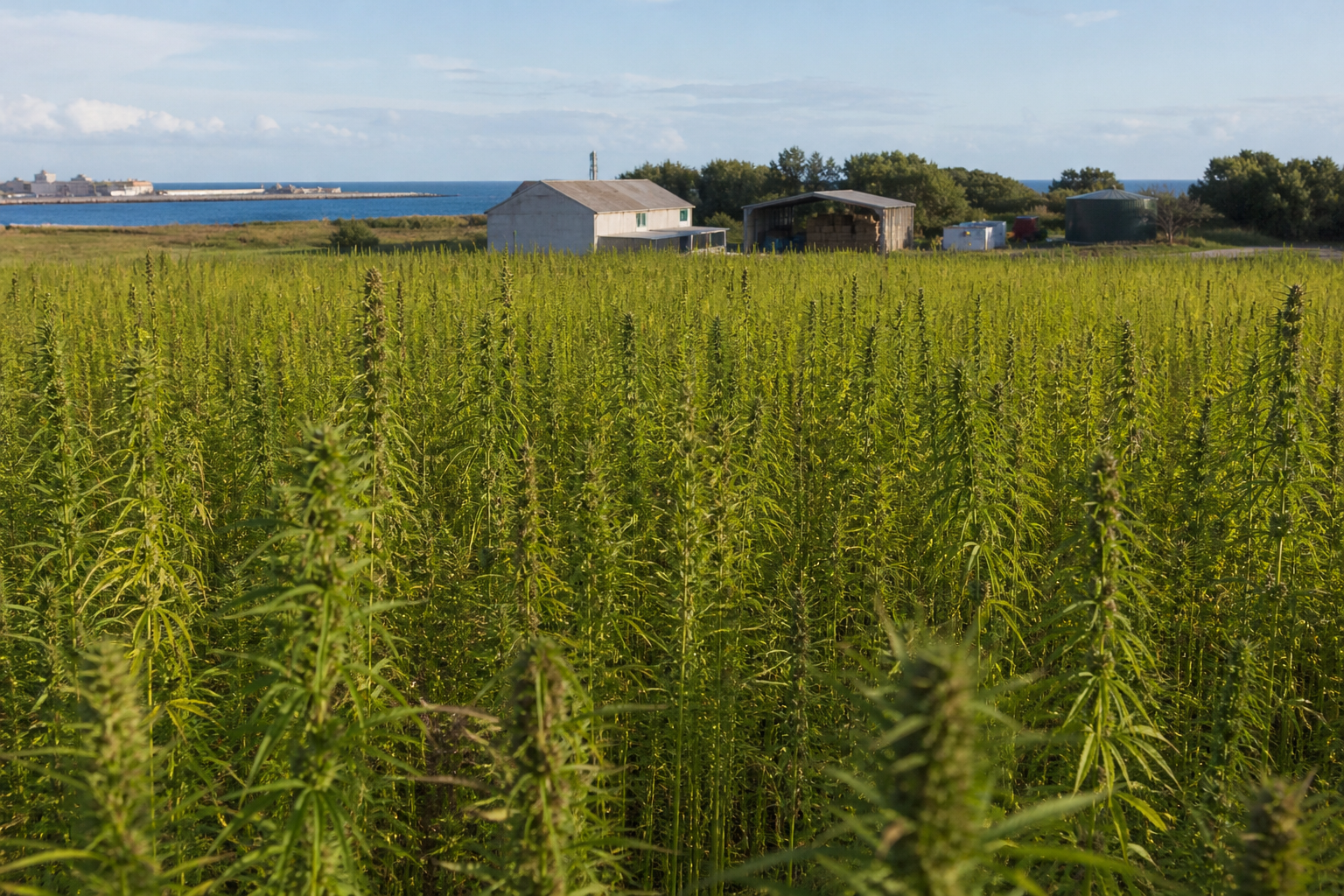
The hemp industry in Vila do Conde sits at the intersection of agriculture, sustainable materials, food innovation, wellness products and Portugal’s tightly regulated cannabis framework. Vila do Conde’s location in the Porto metropolitan area, access to transport infrastructure and connection to coastal and rural economies make it a useful place to examine how hemp-related businesses could develop.
However, local interest should not be confused with evidence of a large established hemp sector. Publicly available information does not necessarily show a major concentration of hemp farms, processing plants or specialist retailers in the municipality. A realistic assessment therefore needs to distinguish between current activity, potential opportunities and activities that require formal approval.
This guide explains what industrial hemp is, how Portuguese rules affect cultivation and commercialisation, and what businesses, residents and visitors should consider when discussing hemp production in Vila do Conde.
What the hemp industry means in Vila do Conde
Hemp is generally used to describe low-THC varieties of Cannabis sativa cultivated for fibre, seed, grain, hurd, food ingredients or other industrial purposes. It is not interchangeable with illicit cannabis, and a hemp crop is not automatically lawful simply because it is labelled “industrial.” The variety, plant part, THC content, intended use and applicable authorisations all matter.
In Vila do Conde, the phrase “hemp industry” can refer to several different parts of a value chain:
- Cultivation: growing approved varieties under the relevant agricultural and regulatory requirements.
- Primary processing: separating and preparing fibre, hurd, seed or other plant materials.
- Manufacturing: turning hemp inputs into textiles, insulation, packaging, composite materials, foods or cosmetics.
- Retail and distribution: selling compliant hemp-derived goods through physical shops or online channels.
- Research and services: providing agronomic, laboratory, logistics, design or legal expertise.
This broad definition is important because a municipality may participate in the sector without hosting extensive cultivation. A local company could process imported raw material, distribute products across northern Portugal or develop hemp-based construction materials while farms operate elsewhere.
Hemp production in Vila do Conde: local potential and practical limits
Hemp production in Vila do Conde would depend on more than available land. Farmers and project developers would need to assess soil conditions, drainage, irrigation, wind exposure, crop rotation, machinery access and proximity to a compliant processor. Coastal weather and the municipality’s mix of urban, agricultural and industrial areas could create both opportunities and constraints.
Hemp can be attractive in sustainability discussions because different varieties can provide fibre or seed while fitting into a wider rotation strategy. That does not mean every hemp crop is automatically low-impact or profitable. Yields vary by variety, climate, agronomy and end market. Transport, drying, storage and processing can also determine whether a project is commercially viable.
Questions for a potential grower
- Which variety is approved for the intended purpose and market?
- What notifications, registrations, permits or inspections apply before planting?
- How will the crop be tested and documented?
- Where will harvested material be dried, stored and processed?
- Is there a confirmed buyer rather than only speculative demand?
- Could pollen, odour, crop failure or accidental non-compliance create conflicts with neighbours?
These questions are especially relevant near populated areas. A cultivation proposal should be communicated clearly and managed professionally, even when the crop is lawful. Clear signage, traceability and contact with local authorities can help distinguish an authorised agricultural project from unauthorised cannabis cultivation.
Industrial hemp in Vila do Conde and the northern supply chain
Industrial hemp in Vila do Conde may have stronger prospects in processing, distribution and product development than in large-scale cultivation alone. Vila do Conde benefits from its position in northern Portugal, where businesses can connect with Porto, nearby municipalities and national transport routes. This could support small manufacturers, wholesalers and design-led businesses that use hemp as one input among several.
Potential applications include fibreboard, insulation, textiles, rope, paper, biocomposites, animal bedding and certain food products. Each application has different technical and regulatory requirements. A construction-material company, for example, must demonstrate performance and safety appropriate to the product, while a food business must comply with food law, labelling requirements and restrictions on health claims.
Local firms should also consider the difference between making a product from hemp fibre or seed and using cannabinoids. These are not the same regulatory category. A material made from processed stalk fibre may raise different questions from a food supplement or cosmetic containing a hemp extract.
Possible business opportunities
- Specialist distribution: supplying compliant hemp materials to manufacturers in northern Portugal.
- Sustainable product design: developing packaging, home goods or textiles with verifiable hemp content.
- Construction materials: exploring hemp-based insulation or composite products subject to technical certification.
- Food and seed products: selling permitted hemp seeds, oil or flour with accurate labelling.
- Consultancy and testing: supporting traceability, quality control and regulatory documentation.
- Education and tourism: explaining the history and industrial uses of hemp without promoting unlawful drug use.
Businesses considering hemp products in Vila do Conde should avoid vague sustainability claims. “Natural,” “eco-friendly” and “carbon neutral” can imply measurable environmental benefits that need evidence. Responsible marketing should identify the actual hemp component, country of origin where relevant, manufacturing process and disposal or recycling characteristics.
Portuguese regulation: hemp is legal only within defined conditions
Portugal’s approach combines drug-control rules, agricultural requirements, product-specific regulation and European Union standards. The legal status of a product cannot be determined from the word “hemp” on its packaging. THC levels, cannabinoids, plant parts, intended use and presentation all influence how authorities may treat it.
Anyone planning cultivation, processing or sales should consult the appropriate Portuguese authorities before committing money to a project. The official INFARMED website is a useful starting point for information connected with medicines, health products and regulated cannabinoid-related matters. Agricultural projects may also need guidance from the relevant agricultural and municipal bodies.
At European level, the European Commission’s information on hemp and agricultural policy provides context on hemp within the Common Agricultural Policy. It should be read alongside current Portuguese rules and any sector-specific requirements rather than treated as a complete permit guide.
Why product category matters
A hemp seed food, a fibre insulation panel, a cosmetic, a CBD-labelled product and a medicine may all be marketed using hemp-related language, but they do not share identical rules. Companies must verify permitted ingredients, testing requirements, claims, packaging, traceability and sales channels for each category.
Novel food rules can be relevant to cannabinoid-containing foods, while medicines and health products follow a separate regulatory pathway. Cosmetics must comply with cosmetic product requirements and cannot make unsupported therapeutic claims. A retailer that sells a product as capable of treating anxiety, pain or another condition may create legal and consumer-protection problems.
For consumers researching cannabis in Vila do Conde, the practical message is simple: a hemp label does not prove that a product is safe, effective or authorised. Look for a clearly identified manufacturer, batch information, ingredient details and a credible route for customer support. Be particularly cautious with products making dramatic medical promises.
Hemp retail and consumer awareness in Vila do Conde
A local shop may sell hemp-related goods without being a cannabis dispensary. Possible products include clothing, food ingredients, cosmetics, accessories and non-intoxicating wellness items. Product availability can change quickly, and online listings do not always reflect current compliance or stock.
Consumers should ask what part of the plant is used and whether the product contains cannabinoids. They should also check whether the packaging provides a full ingredient list, responsible-use information and batch or manufacturer details. Products intended for ingestion deserve additional caution because contamination, inaccurate cannabinoid labelling and interactions with medicines are possible concerns.
People taking prescription medicines, pregnant individuals and anyone managing a health condition should seek advice from a qualified healthcare professional before using cannabinoid products. No retail product should replace diagnosis or treatment from a licensed clinician.
For broader regional context, readers can compare this topic with local discussions of the cannabis industry in Ermesinde and CBD shops in Maia. These nearby examples are useful for understanding how terminology, regulation and consumer expectations can differ across northern municipalities.
Environmental and community considerations
Hemp is often presented as a sustainable crop, but responsible analysis must examine the entire supply chain. Environmental performance depends on inputs, irrigation, harvesting, transport, processing energy, product lifespan and what happens after use. A hemp product may be preferable in one application and unsuitable in another.
Community considerations are equally important. Residents may want clear information about the crop, expected planting and harvesting dates, traffic from agricultural vehicles and how complaints will be handled. Businesses operating in mixed urban-rural areas should maintain good records and avoid language that creates confusion with recreational cannabis.
Local authorities and project developers can support informed discussion by separating three subjects: lawful industrial hemp, regulated medical or pharmaceutical activity, and non-medical cannabis use. Combining them under one label can produce unnecessary fear and can also lead consumers to misunderstand their legal rights and responsibilities.
How to assess a hemp business opportunity
Before investing in a hemp business in Vila do Conde, use a staged approach rather than relying on trend-based claims.
- Define the product: identify the exact plant material, formulation, customer and intended use.
- Map the rules: confirm which authorities regulate cultivation, manufacturing, food, cosmetics, medicines, waste and transport.
- Test the economics: model land, labour, equipment, testing, insurance, storage, energy and distribution costs.
- Secure the supply chain: obtain written terms from growers, processors, buyers and logistics providers.
- Build quality controls: document testing, batch traceability, recalls, complaints and product claims.
- Plan communication: explain what the business does and does not sell, especially if it operates near homes or schools.
This process can reveal that the best opportunity is not cultivation. A company may be better positioned as a designer, processor, testing provider or distributor. The strongest proposals are likely to be those that solve a specific supply-chain problem and can demonstrate compliance from the beginning.
What the future may hold
The future of the hemp sector in Vila do Conde will depend on regulation, processing capacity, consumer demand and access to reliable markets. Growth is possible in materials, food, design and specialist services, but it should be measured through verifiable businesses and products rather than general online enthusiasm.
Research partnerships, local enterprise support and collaboration with agricultural or manufacturing organisations could help determine which applications suit the municipality. Pilot projects should include transparent environmental and economic evaluation. That evidence would be more useful than assuming that hemp is automatically profitable or sustainable.
For now, the most responsible view is one of cautious opportunity. Vila do Conde has geographic and economic connections that could support hemp-related activity, but any project must meet Portuguese requirements and demonstrate a credible route from approved input to lawful final product.
Conclusion
The hemp industry in Vila do Conde should be understood as an emerging possibility across agriculture, manufacturing, retail and research rather than as proof of a large established local market. Industrial hemp can contribute to useful products, but its value depends on suitable varieties, professional cultivation, compliant processing, accurate labelling and genuine demand.
Whether you are a farmer, entrepreneur, retailer or consumer, begin with the exact product and its legal category. Verify information with official authorities, keep claims evidence-based and treat cannabinoid products with particular care. A transparent, regulated and locally informed approach gives Vila do Conde the best chance of benefiting from hemp without creating avoidable legal, environmental or public-health risks.