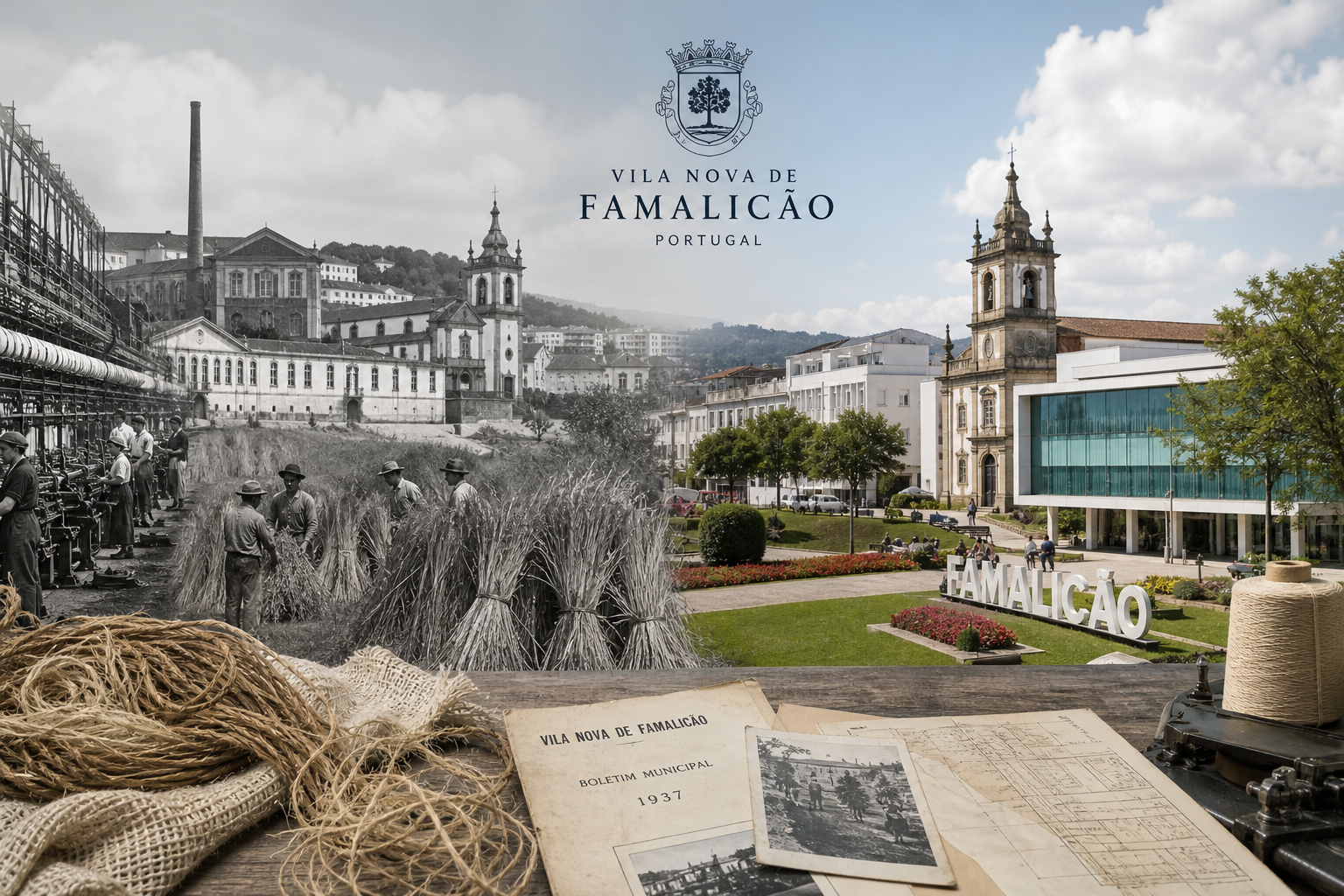
Cannabis history in Vila Nova de Famalicão is best understood through two connected stories: the older history of hemp and plant-based materials in Portugal, and the modern development of national drug policy. The municipality does not have a widely documented, separate cannabis timeline comparable to a major port or university city. Instead, local attitudes and practices have been shaped by the laws, health institutions and economic changes affecting northern Portugal as a whole.
This distinction matters. References to cannabis in Vila Nova de Famalicão may describe public policy, medical access, personal use, hemp products or cultural discussion, but they do not automatically prove a local tradition of cultivation or commerce. A careful history therefore separates verified national milestones from reasonable regional context and avoids turning limited evidence into local legend.
Cannabis history in Vila Nova de Famalicão: what can be established
Vila Nova de Famalicão is a municipality in Braga District, in the industrial and urbanised north of Portugal. Its historic identity has been closely associated with agriculture, manufacturing, commerce and textile-related activity. Those features provide useful context for understanding how hemp might appear in the broader material history of the region, but they should not be confused with evidence of a specialised cannabis industry in Famalicão.
Hemp and psychoactive cannabis are related but not interchangeable subjects. Hemp varieties have traditionally been valued for fibre, cordage, seed and other practical uses, while cannabis cultivated for intoxicating resin or flower belongs to a different legal and cultural discussion. Historical references to fibre plants, rural production or imported materials therefore cannot be used on their own to claim a local history of recreational cannabis.
Available public information does not establish a well-documented sequence of cannabis farms, famous local dealers, dedicated historic venues or a distinctive Famalicão cannabis movement. The more defensible conclusion is that the municipality has participated in Portugal’s changing national context while developing its own contemporary conversations about health, law and responsible behaviour.
Hemp, agriculture and northern Portuguese context
Before modern drug legislation, cannabis was not discussed using today’s sharp division between industrial hemp, medical cannabis and recreational marijuana. Across Europe, hemp was primarily considered a useful agricultural material. Its fibres could be used in ropes, cloth and other goods, while seeds and plant residues had additional practical applications.
In northern Portugal, rural economies were historically connected to small-scale agriculture, craft production and textile work. That wider setting helps explain why hemp may appear in discussions of traditional materials. However, the existence of textile or agricultural activity in the Minho region does not demonstrate that Vila Nova de Famalicão was a major hemp-growing centre. Reliable local history should identify a source before attributing a specific crop or trade to the municipality.
Industrial change also altered the role of traditional fibres. Mechanisation, imported raw materials and changing manufacturing systems reduced the importance of many older agricultural materials. In Famalicão, the growth of modern industry and urban connections is more securely documented than any cannabis-specific economic transformation. Hemp today is more likely to be discussed in relation to sustainable materials, food products, cosmetics or regulated low-THC goods than as a continuation of an uninterrupted local tradition.
Portugal’s twentieth-century cannabis context
The modern history of cannabis in Famalicão cannot be separated from Portugal’s national experience. During the twentieth century, cannabis was increasingly treated through international drug-control frameworks and domestic criminal law. Public discussion commonly focused on prohibition, policing and social risk rather than on distinctions between cannabis varieties or therapeutic applications.
As in other Portuguese municipalities, the local experience would have been shaped by national rules rather than by a separate Famalicão ordinance. Police practice, court decisions, health services and social attitudes all reflected the wider Portuguese framework. This is why claims about weed in Vila Nova de Famalicão should be treated as a question of local experience within national law, not as evidence that the city had its own independent cannabis regime.
Late twentieth-century debates also began to challenge the idea that every drug-related case should be handled primarily through criminal punishment. Health professionals, researchers and civil-society organisations increasingly supported approaches that distinguished personal consumption from trafficking and that treated problematic use as a public-health concern.
Decriminalisation and its local meaning
Portugal’s major policy change arrived with Law 30/2000, which came into force in 2001. Personal use and possession within defined limits were moved from the criminal sphere into an administrative framework, while trafficking and other serious supply offences remained criminal matters. The reform did not legalise cannabis, create a retail market or make public consumption risk-free.
Instead, people found with drugs for personal use could be referred to a dissuasion commission. These bodies were designed to assess the situation, provide information and encourage appropriate support where necessary. The reform changed the emphasis from automatic criminal prosecution toward prevention, health intervention and proportionality.
For residents and visitors researching cannabis laws in Vila Nova de Famalicão, the practical lesson is that decriminalisation is not the same as permission. Possession, use, cultivation, supply and transport remain legally distinct. Quantity thresholds, administrative procedures and enforcement decisions also require careful interpretation. The safest source for the legal text is the official publication of Portugal’s Law 30/2000.
The reform also influenced the tone of local public-health work. Municipalities do not set the core national drug framework, but local health professionals, schools, families and community organisations help communicate it. In a municipality such as Famalicão, that can mean prevention education, referral to treatment and practical advice rather than a distinct local cannabis policy.
Medical cannabis and contemporary regulation
Portugal later created a regulated pathway for medical cannabis. Law 33/2018 established a framework for medicines, preparations and substances based on cannabis for medicinal purposes. The system is not an open dispensary model: medical products are subject to regulation, professional assessment, prescribing requirements and authorised supply channels.
That distinction is important when discussing medical cannabis in Vila Nova de Famalicão. A patient’s access depends on the national health and medicines framework, the clinical assessment of an authorised professional and the availability of an approved product. A shop selling hemp-derived goods is not automatically a medical provider, and a product labelled as CBD should not be assumed to have the same status as a prescribed cannabis-based medicine.
The European Union Drugs Agency provides broader comparative background through its official information on drugs, health and drug policy in Europe. For Portugal, the key point is that medical use, personal possession, cultivation and commercial supply are separate legal questions. They should be checked independently rather than reduced to the vague idea that cannabis is simply “legal” or “illegal.”
How medical access affects local understanding
Medical regulation has made cannabis more visible in public discussion. Patients may ask about treatments, pharmacists may explain lawful products and families may encounter conflicting claims online. That increased visibility does not mean that every cannabis product has proven therapeutic value or that self-medication is safe.
People considering treatment should discuss symptoms, existing medicines, mental-health history and possible side effects with a qualified clinician. They should also be cautious about unverified oils, flowers and extracts marketed with medical language. The local availability of a product cannot replace professional advice or regulatory verification.
Cannabis culture and public discussion in Famalicão
Contemporary cannabis culture in Vila Nova de Famalicão is likely to be less about a single historic scene and more about overlapping conversations. These include youth prevention, personal autonomy, medical research, CBD products, policing, road safety and the environmental claims made by the hemp sector.
Online discussion can blur these categories. The terms cannabis, marijuana, hemp and CBD are often used interchangeably, even though they can refer to different plants, preparations and legal controls. A responsible local account should therefore ask several questions: Is the subject industrial hemp, a medical preparation or an intoxicating product? Is the discussion about possession, use, cultivation or sale? Is the information current under Portuguese law?
Local comparison can also be useful. For a nearby perspective on public education, readers can consult this guide to cannabis culture and responsible awareness in Braga. A separate regional comparison is available in the overview of cannabis industry and local context in Ermesinde. These comparisons should not be treated as proof of identical conditions in Famalicão; they simply show how national rules are interpreted in different northern municipalities.
What the local history does not show
A useful history must also identify its limits. There is no sound basis for claiming that Vila Nova de Famalicão has a famous cannabis-growing tradition, a legal recreational market or a unique decriminalisation policy. Nor should general references to northern Portugal be presented as municipality-specific evidence.
- National law applies in Famalicão, subject to the facts of each case.
- Decriminalised personal possession is not the same as legal retail sale.
- Industrial hemp is not interchangeable with high-THC cannabis.
- Medical cannabis requires regulated access and professional oversight.
- Historical claims should be supported by local archives, agricultural records, newspapers or academic research before being treated as established fact.
This cautious approach is not a weakness. It produces a more accurate account of how cannabis entered local awareness: through Portugal’s changing laws, international drug policy, health debates and wider regional economic life, rather than through an invented city-specific narrative.
Conclusion
The history of cannabis in Vila Nova de Famalicão is primarily a history of national change experienced at municipal level. Older hemp-related traditions belong to the broader story of European agriculture and materials, while the modern cannabis debate has been shaped by prohibition, Portugal’s 2001 decriminalisation model and the later regulation of medical use.
For anyone researching cannabis in Vila Nova de Famalicão, the most reliable approach is to distinguish hemp from psychoactive cannabis, medical products from informal goods, and administrative decriminalisation from full legalisation. Famalicão’s story is therefore not one of a documented cannabis boom, but of a northern Portuguese municipality navigating wider changes in law, health, industry and public understanding.