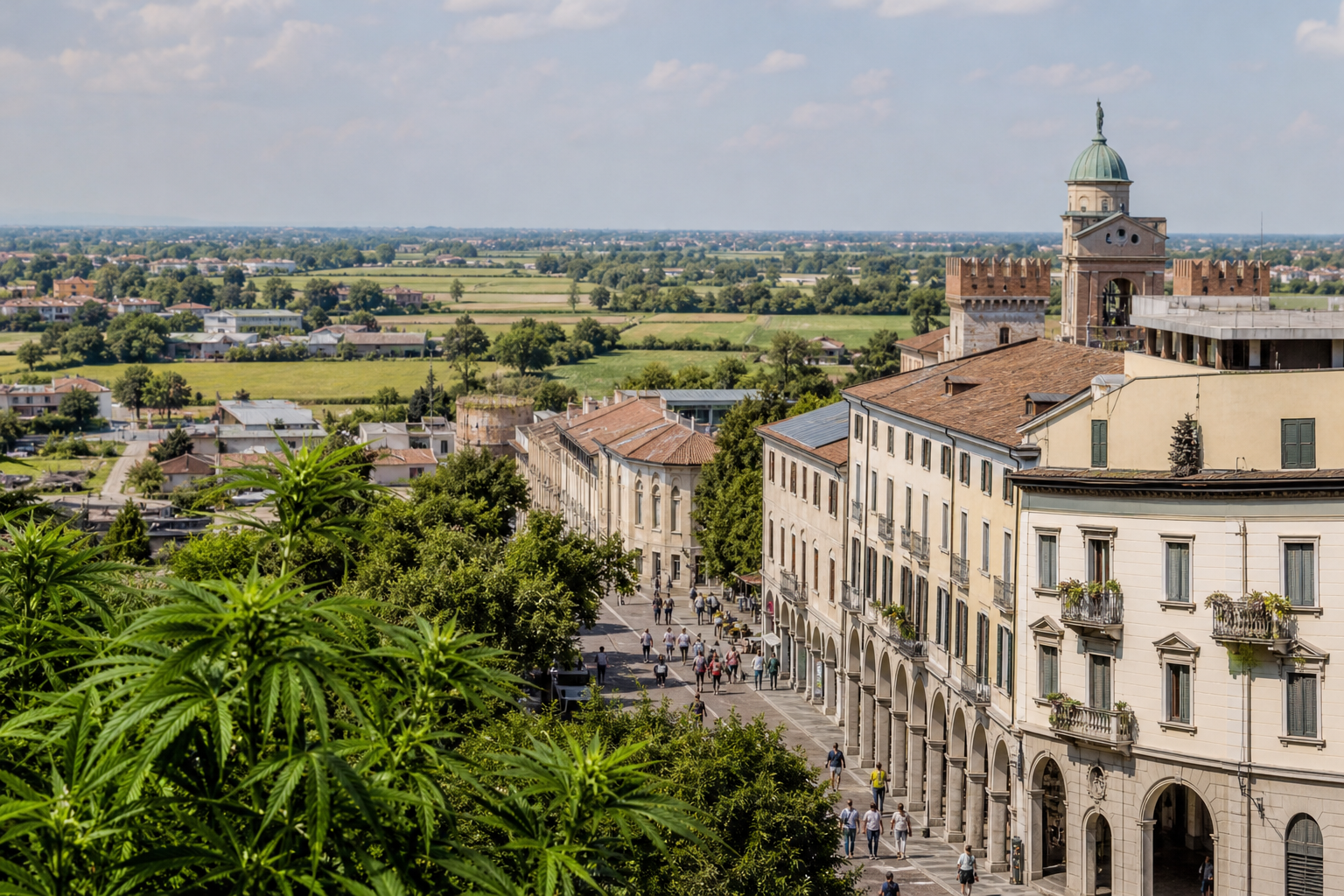
The Cannabis industry in Treviglio is best understood as a developing group of legal activities rather than a conventional recreational retail market. Treviglio, in the province of Bergamo, sits in a busy commercial area between Milan, Bergamo and Cremona. That location supports interest in hemp-derived goods, wellness products, agricultural research, professional services and regulated medical access. It does not, however, make recreational cannabis sales legal.
For residents, visitors and entrepreneurs, the important distinction is between industrial hemp, CBD products, prescribed medical cannabis and cannabis containing higher levels of THC. These categories are governed by different rules, and national legislation can change. This guide explains the local context without treating Treviglio as a free-market cannabis destination.
What the cannabis industry means in Treviglio
There is no reliable basis for describing Treviglio as a major centre of cannabis cultivation or recreational distribution. A more accurate view is that the local cannabis economy may include several connected areas:
- Licensed agricultural activity involving hemp varieties permitted under Italian and European rules.
- Retailers selling lawful hemp-derived products, subject to the product category and applicable restrictions.
- Pharmacies and healthcare professionals involved in access to prescribed cannabis-based treatments.
- Packaging, logistics, laboratory testing, compliance and professional advisory services.
- Consumer education about responsible use, product labelling and legal boundaries.
This wider definition is useful because the word “industry” can otherwise suggest that Treviglio has licensed dispensaries selling adult-use cannabis. Italy does not generally operate such a recreational dispensary system. A shop that advertises cannabis-related products is not automatically authorised to sell intoxicating cannabis.
Cannabis laws in Treviglio: the national rules that apply locally
Cannabis laws in Treviglio are primarily Italian national laws, not special municipal rules. The municipality can regulate business premises, planning, public order and local compliance, but it cannot create a legal recreational cannabis market outside the national framework.
In practical terms, the unauthorised sale, supply and production of cannabis containing prohibited levels of THC can lead to serious criminal consequences. Personal possession may also have administrative consequences, while circumstances such as quantity, intent, repetition or distribution can affect how authorities treat a case. Driving after using cannabis can create separate legal and safety risks, including problems where impairment or detectable substances are relevant under applicable enforcement rules.
Rules affecting hemp flowers, extracts, foods, cosmetics and other derivatives are especially sensitive to regulatory updates. Product labels, laboratory results and a seller’s assurances should not be treated as a substitute for legal verification. For the current legal text, consult the official Italian legislation database, Normattiva, and check guidance from relevant public authorities before buying, selling or importing a product.
Why “legal cannabis” can be misleading
In everyday conversation, “legal cannabis” may refer to industrial hemp, CBD, medical cannabis or products marketed as cannabis light. These are not interchangeable. A hemp product intended for fibre or seed has a different regulatory profile from a flower or extract. A prescribed medicine is different from a wellness product. The label must be considered together with the ingredients, intended use, THC content, manufacturing status and current law.
Medical cannabis in Treviglio
Medical cannabis in Treviglio is part of Italy’s regulated healthcare system. Patients do not normally obtain medical cannabis through an adult-use dispensary. Access involves a qualified doctor, an appropriate clinical assessment and a prescription prepared according to the applicable medical rules. Dispensing is handled through authorised pharmacies, which may need to prepare or order the medicine.
A patient should begin with a doctor who understands the relevant condition, previous treatments and possible interactions. Cannabis-based treatment can affect alertness, coordination, blood pressure and mental health, and it may interact with other medicines. It is not suitable for everyone, and a prescription does not remove the need for follow-up.
Availability can vary between pharmacies. A patient may need to ask whether a pharmacy dispenses the prescribed preparation, whether it must be ordered, what documentation is required and how the medicine should be stored. The Italian Ministry of Health provides the appropriate starting point for official health information through its Ministry of Health portal.
Medical cannabis should not be confused with CBD oils, supplements or products sold for general wellbeing. Those products cannot automatically replace a prescribed therapy, and a CBD product purchased online may not meet Italian requirements for composition, labelling or sale.
Hemp, CBD and retail opportunities around Treviglio
Businesses interested in hemp and CBD in Treviglio need to identify the precise product category before opening, importing or advertising. A business selling hemp seed foods, fibre products, cosmetics or other permitted goods may face different obligations from one selling extracts or inhalable products. Requirements can involve ingredients, testing, traceability, packaging, tax treatment, advertising and consumer protection.
Retailers should also distinguish between a product being available for sale and a product being safe, compliant or suitable for a particular claim. Health claims require particular care. Marketing a CBD product as a treatment for anxiety, pain, epilepsy or another disease can create regulatory problems if the claim is not authorised. Staff should avoid making medical promises and should direct customers with health concerns to a healthcare professional.
A compliance checklist for local businesses
- Confirm the product’s legal classification before placing it on the market.
- Obtain documentation showing the composition and origin of each batch.
- Use independent laboratory testing where appropriate and retain records.
- Review Italian packaging, language, ingredient and warning requirements.
- Do not advertise recreational intoxication or make unsupported health claims.
- Check supplier licences, invoices, traceability documents and recall procedures.
- Seek advice from a lawyer, accountant or qualified regulatory consultant before launch.
Businesses can also learn from the wider regional discussion. For example, this guide to cannabis shops in Crema illustrates why local product availability should be considered alongside Italian legal and safety requirements rather than assumed to represent a recreational market.
Consumers: how to assess cannabis-related products
People searching for weed in Treviglio should first clarify what they are actually looking for. If the goal is a prescribed treatment, the correct route is a medical consultation and an authorised pharmacy. If the goal is a non-intoxicating hemp product, the buyer should examine the label and seller carefully. Trying to obtain high-THC cannabis from an unlicensed source carries legal, health and personal-safety risks.
Before buying a lawful-looking product, check:
- The full product name, ingredients and intended use.
- Batch or lot information and a credible manufacturer or importer.
- Testing information that identifies cannabinoids and potential contaminants.
- Clear warnings about driving, pregnancy, age restrictions and medicine interactions where relevant.
- Whether the product is sold through a transparent business with a verifiable address and receipt.
Do not assume that an attractive package, a QR code or the word “natural” proves quality. Avoid products with unclear cannabinoid levels, exaggerated promises or instructions that encourage unsafe consumption. Edible products can be particularly difficult to dose and may produce delayed effects. Combining cannabis or cannabinoids with alcohol, sedatives or other psychoactive substances can increase risk.
Local economic potential and realistic limitations
Treviglio’s position in Lombardy may make it relevant to distribution, retail, logistics and professional services, especially because the town is connected to larger urban and industrial markets. The most realistic opportunities are likely to involve compliant supply chains, agricultural inputs, testing, packaging, education and regulated healthcare support rather than open recreational sales.
Any new venture should begin with market research and a regulatory assessment. Entrepreneurs need to confirm zoning, business registration, health and safety obligations, tax requirements, employment rules and the legality of every product line. A business plan based on social-media demand alone is not sufficient, particularly in a sector where national rules and enforcement priorities can change.
Local economic development should also be separated from claims about cannabis tourism. Treviglio should not be promoted as a destination where visitors can legally buy or consume recreational cannabis. Visitors remain subject to Italian law, and taking cannabis across national borders can create additional customs and criminal risks even where a product was purchased lawfully elsewhere.
Where to find reliable information
Because online cannabis information is often incomplete or promotional, readers should prioritise official sources, qualified healthcare professionals and transparent businesses. Check the date of any article, identify whether it discusses THC, CBD, hemp or medicine, and look for the jurisdiction covered. A rule applying in another Italian region or another European country may not answer a question about Treviglio.
For medical questions, speak with a doctor or pharmacist. For business questions, obtain advice from a professional familiar with regulated products. For legal questions, consult an Italian lawyer and verify the current text of the law. These steps are more reliable than relying on informal claims that a product is “legal everywhere” or that a shop is an authorised dispensary.
Conclusion
The cannabis industry in Treviglio is better described as a regulated and emerging ecosystem than as a recreational retail sector. Hemp agriculture, CBD-related commerce, compliance services and medical access may all form part of the local picture, but each area has different requirements. Recreational cannabis sales remain outside the ordinary legal market, and product rules can be complex or subject to change.
Consumers should use authorised healthcare channels for medical cannabis and assess hemp or CBD products through labels, testing and seller transparency. Entrepreneurs should verify national and local requirements before investing. With a careful distinction between medicine, industrial hemp, CBD and high-THC cannabis, residents and businesses can approach cannabis in Treviglio with more accurate expectations and fewer avoidable legal or health risks.