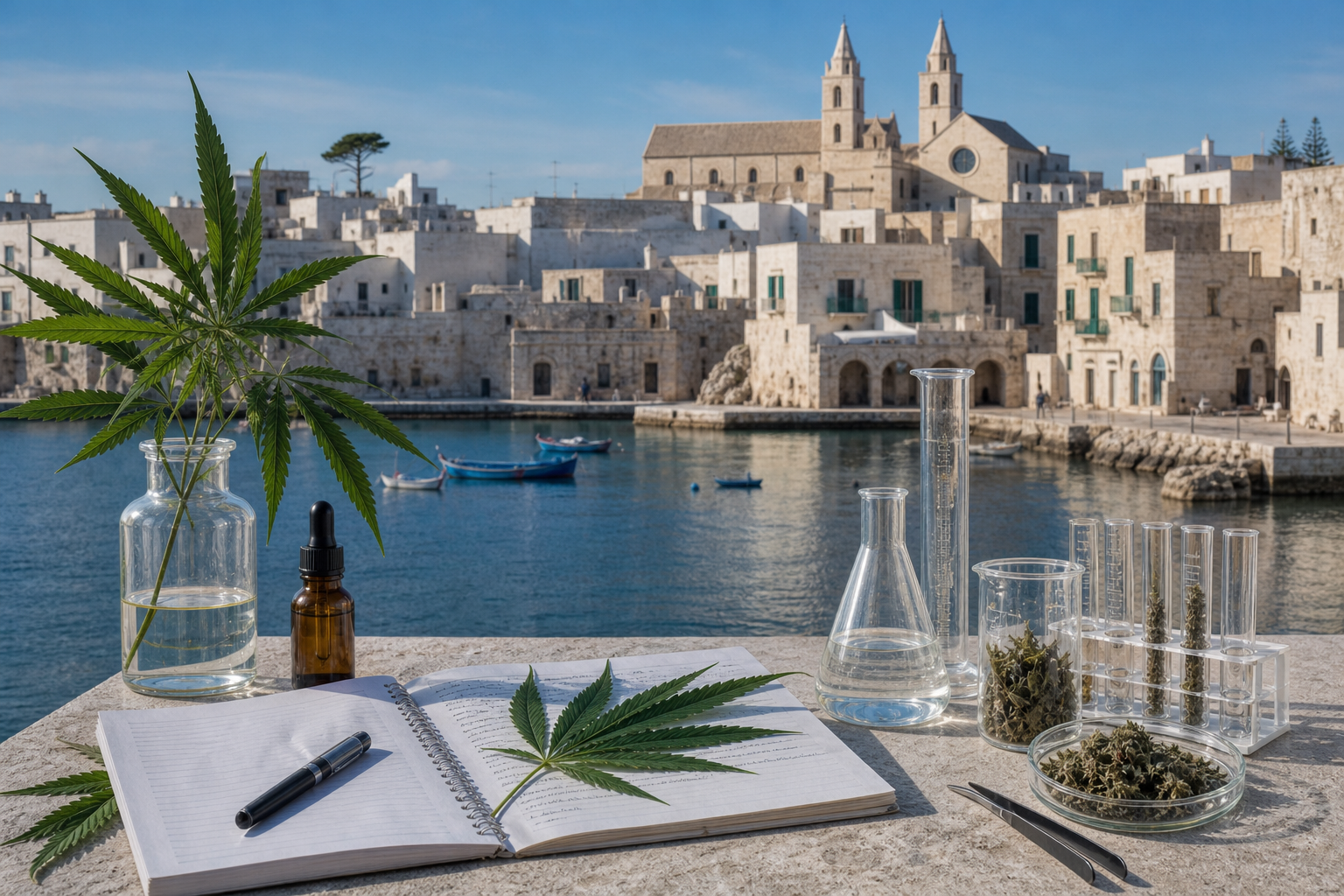
Cannabis research in Bisceglie should be understood through two connected perspectives: the evidence produced by Italian and international researchers, and the way national rules affect residents, patients and health professionals in the city. Bisceglie is in Puglia, where questions about medical treatment, prevention, hemp-derived products and drug policy are shaped primarily by Italian law rather than by a separate municipal cannabis system.
There is an important distinction between research about Bisceglie and research available to people in Bisceglie. Unless a study publicly identifies the city as a research site, it is not accurate to describe a national clinical trial or a regional health report as a Bisceglie-specific finding. A careful local guide therefore focuses on what can be verified: how cannabis science is evaluated, where Italian policy comes from, what medical access involves and which questions deserve further study in the community.
What cannabis research can tell us about Bisceglie
Research does not provide a single answer to whether cannabis is “safe” or “unsafe.” Outcomes vary according to the cannabinoid involved, dose, route of administration, frequency of use, age, medical history and whether a product has been tested and prescribed. Studies may examine therapeutic effects, adverse reactions, dependence, impaired driving, adolescent exposure, product quality or the social effects of regulation.
For Bisceglie, these findings are useful when interpreted alongside local realities. The city’s residents may receive care through services in the wider province of Barletta-Andria-Trani or elsewhere in Puglia, while national rules govern prescriptions and possession. That means cannabis in Bisceglie is not only a question of personal behavior; it also involves primary care, specialist medicine, pharmacies, prevention services, schools and public information.
Local evidence and national evidence are different
A local search may uncover news reports, health initiatives or academic work from nearby institutions, but those materials should not automatically be treated as proof of a citywide trend. A reliable study normally explains its sample, methods, dates and limitations. For example, a survey of patients in one clinic cannot establish how all residents of Bisceglie use cannabis, and a national prevalence estimate cannot show what happens in every neighborhood.
Anyone reviewing cannabis studies in Puglia should ask five basic questions:
- Who conducted the research and who funded it?
- Was the work peer reviewed or issued by a recognized public-health institution?
- Was the sample large and representative enough for the claim being made?
- Does the study distinguish medical use, non-medical use, CBD products and industrial hemp?
- Are the results current enough to reflect changes in products, prescribing practice or law?
Medical cannabis research in Bisceglie
Medical cannabis research in Bisceglie is best considered as part of the Italian evidence base. Research questions commonly include whether cannabinoid-based medicines can help with symptoms such as chronic pain, spasticity, nausea or appetite loss in particular clinical circumstances. Evidence quality differs by condition, and a promising mechanism or small study is not the same as strong proof of effectiveness.
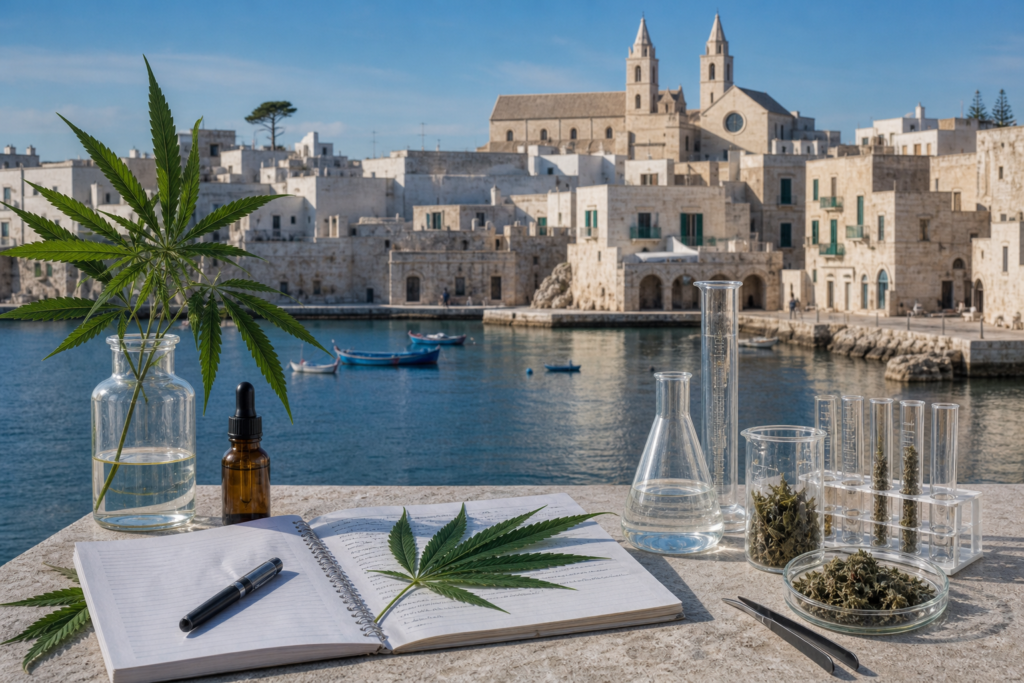
In practice, treatment decisions belong to qualified clinicians. A doctor must consider the diagnosis, previous therapies, other medicines, mental-health history, cardiovascular risks, pregnancy status and the possibility of impairment. Cannabis-based treatment can also produce side effects, including dizziness, sedation, changes in attention and cognitive effects. These concerns matter especially for people who drive, operate machinery or combine cannabis with alcohol or other sedating substances.
Patients looking for medical cannabis in Italy should use the formal healthcare pathway rather than relying on social media claims or unverified sellers. A clinician can explain whether a treatment is appropriate, what preparation is being considered and how it can be obtained through a pharmacy under the applicable rules. A prescription is not a guarantee that a treatment will work, and it should be followed by monitoring and review.
For broader background, readers can compare this subject with our guide to medical cannabis access in Afragola. The legal framework is national, but practical experiences can differ according to clinical services, pharmacy supply and regional healthcare organization.
How Italian cannabis policy shapes research and public health
Cannabis laws in Bisceglie are primarily determined at the Italian national level. Local authorities may support prevention, health education or public-order measures, but they do not create an independent legal market for recreational cannabis. Rules may also distinguish between medical preparations, industrial hemp, low-THC products and illicit possession or supply, so broad statements about “legal cannabis” can be misleading.
Official information should take priority over advertisements and informal advice. Italy’s Ministry of Health provides national health information, while the Istituto Superiore di Sanità is a central public-health and research institution. The Italian Ministry of Health website is also a useful starting point for checking current guidance and healthcare information. Because regulations and administrative procedures can change, readers should confirm details before travelling with cannabis, purchasing a cannabinoid product or discussing treatment with a healthcare professional.
Why legal categories matter
Industrial hemp, CBD products and cannabis medicines are often discussed together even though they may be subject to different rules and quality controls. A product’s label does not by itself prove that it is medicinally effective, legally compliant or free from contamination. Research also cannot be transferred directly from one product to another: a purified pharmaceutical preparation is not equivalent to an unregulated edible, flower product or vape cartridge.
People should be especially cautious about products making strong claims to treat cancer, anxiety, pain or other conditions without reliable clinical evidence. Such claims may encourage delayed diagnosis or unsafe self-treatment. Researchers and health professionals generally need precise information about composition, dose and route of use before they can assess likely benefits or risks.
Priority research questions for Bisceglie and Puglia
Even when a study is not conducted inside Bisceglie, it can suggest practical questions for local health planning. Research priorities should be framed in ways that protect privacy and avoid stigmatizing people who use cannabis.
- Patient access: How easily can eligible patients find informed clinicians and pharmacies able to support regulated treatment?
- Public understanding: Do residents know the difference between medical cannabis, CBD, industrial hemp and illicit products?
- Prevention: Which messages help young people understand impairment, dependence and the risks of combining substances?
- Road safety: How can public-health campaigns explain that feeling normal does not necessarily mean that driving ability is unaffected?
- Product quality: What risks arise from mislabeled, contaminated or unexpectedly potent products?
- Health equity: Are information and appropriate clinical referrals equally available to older adults, rural residents and people with limited resources?
These questions could be explored through anonymized healthcare data, carefully designed surveys, interviews with clinicians and community-based public-health research. Any local project should use transparent methods, informed consent and appropriate ethical oversight. Anecdotes from online groups may identify topics worth studying, but they cannot replace representative evidence.
Reading cannabis evidence critically
Search results about weed in Bisceglie may mix scientific papers with product marketing, personal stories and legal commentary. Readers can reduce confusion by checking whether a source states the exact substance studied and whether the findings apply to humans. Laboratory or animal research may help explain biological mechanisms, but it does not establish that a product is effective or safe for everyday use.
It is also useful to distinguish relative risk from individual risk. A study may report an association between frequent cannabis use and a health outcome without proving that cannabis alone caused it. Other factors, including tobacco, alcohol, underlying illness, sleep, socioeconomic conditions and access to care, may influence the result. Strong articles acknowledge uncertainty instead of presenting a single study as a final verdict.
Residents interested in community education can also consult our related overview of cannabis education in Molfetta and the discussion of cannabis culture and public context in Trani. Nearby examples can provide useful comparison, but they should not be mistaken for direct evidence about Bisceglie.
Practical guidance for residents and visitors
Anyone concerned about their own cannabis use should speak with a doctor, pharmacist or qualified addiction-service professional. Urgent symptoms such as severe confusion, chest pain, difficulty breathing, loss of consciousness or extreme agitation require immediate medical attention. Children and pets should never have access to cannabis products, particularly edibles, because accidental ingestion can be serious.
People considering a medical treatment should prepare a list of current medicines, relevant diagnoses and previous therapies before an appointment. They should ask about expected benefits, possible side effects, follow-up, driving restrictions and what to do if the product is unavailable. Visitors should not assume that a product purchased legally elsewhere can be carried across borders or used under the same rules in Italy.
Conclusion
Cannabis research in Bisceglie is most responsibly approached through the wider Italian and Puglian evidence base, combined with careful attention to local healthcare needs. Current research can inform discussions about medical treatment, product quality, prevention, dependence and road safety, but it cannot justify unsupported claims about the city or its residents.
The most reliable approach is to separate scientific evidence from advertising, distinguish national law from local context and seek medical advice for treatment decisions. As research and regulation develop, Bisceglie can benefit from clear public information, ethical local studies and health services that treat cannabis questions as part of evidence-based care rather than as a source of speculation.