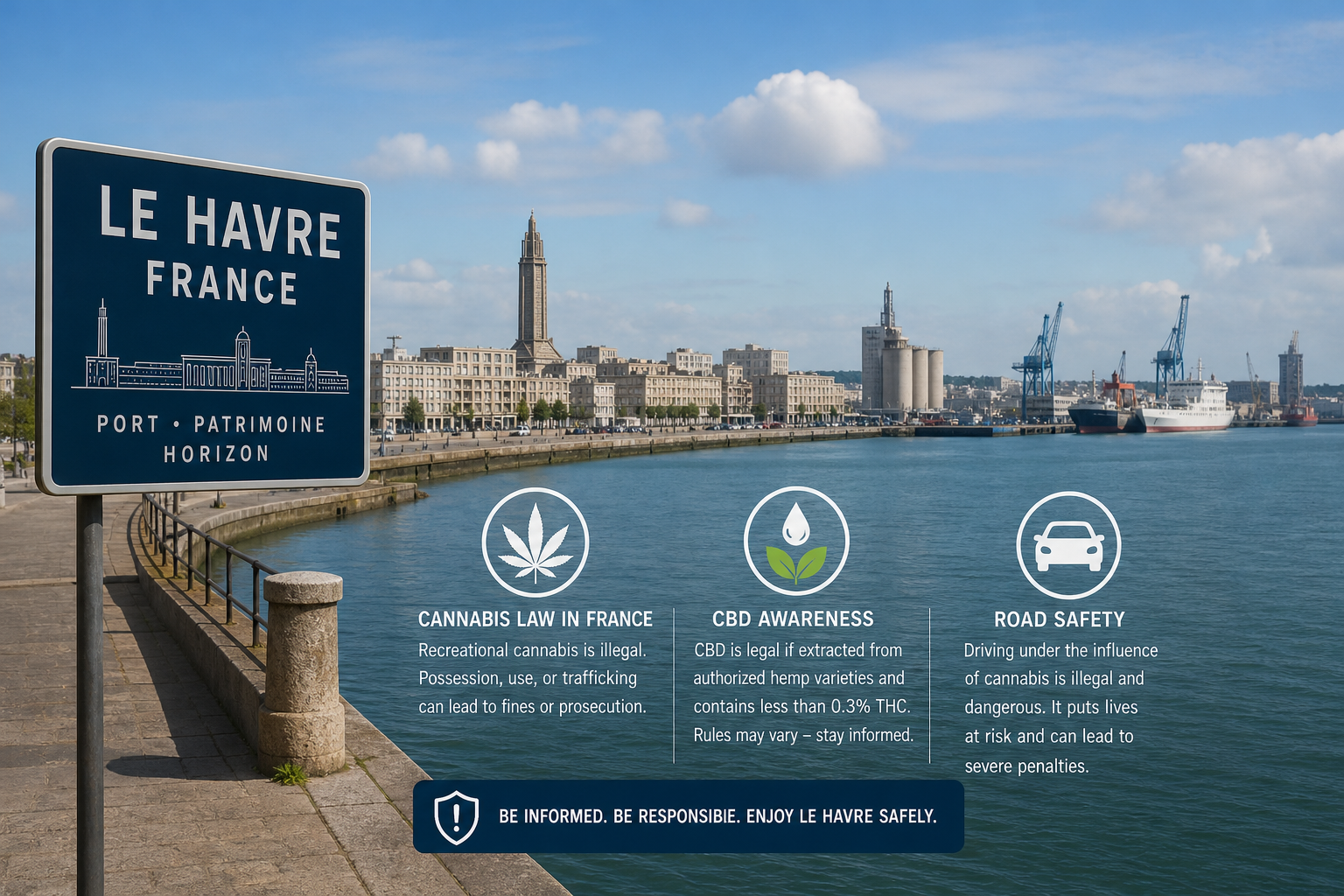
Finding reliable cannabis information in Le Havre means starting with French national law rather than assuming that rules resemble those in another country. Le Havre is a French port city in Normandy, and the same legal framework applies there as elsewhere in metropolitan France. Recreational cannabis remains prohibited, while CBD products are subject to different rules. Possession, use, transport and driving can all create legal or safety problems.
This guide explains the main rules for residents and visitors, how CBD differs from illegal cannabis, what medical access currently means, and where to seek confidential support. It does not provide purchasing advice or help anyone bypass French law. For comparisons with other destinations, see our practical guides to cannabis rules in Lille and cannabis in Paris.
Cannabis laws in Le Havre
The key point for anyone researching cannabis laws in Le Havre is that recreational cannabis is illegal in France. Using or possessing cannabis can lead to criminal consequences. Depending on the circumstances, police and prosecutors may use different procedures, including an on-the-spot fixed penalty for certain cases involving personal use. A fixed penalty is not the same as legalisation: the conduct remains unlawful and additional consequences may apply.
French authorities can also take action against cultivation, supply, sale, importation and distribution. Penalties depend on the facts, the quantity, the person’s role, prior history and whether aggravating circumstances are present. Visitors should not assume that a small amount is automatically ignored, and residents should not interpret informal local practices as permission.
For an up-to-date explanation of offences, procedures and penalties, consult the official French public-service information on narcotics and penalties. Rules and enforcement procedures can change, so official information is more dependable than social media posts or advice from strangers.
Possession, use and public places
Possessing cannabis for personal use is unlawful, whether it is carried in a pocket, stored in accommodation or kept in a vehicle. Consumption in streets, parks, beaches, stations, hotel rooms with restrictions, rented accommodation or other public-facing places can expose a person to police intervention and complaints. Public use may also create additional issues involving disturbance, smoke exposure or access by children.
There is no special cannabis zone in Le Havre where French law stops applying. A port, festival area, nightlife district or private gathering does not create an exemption. Landlords, hotels and venues may impose stricter no-smoking policies, and violating those rules can result in removal, loss of a deposit or other civil consequences.
Weed in Le Havre: what visitors should know
Searches for weed in Le Havre often come from travellers arriving by train, road, ferry or cruise connection. Bringing cannabis into France or carrying it across an international border is particularly risky. A product obtained legally in another country does not automatically become legal after arrival in France. This applies to flower, resin, oils, edibles, concentrates and products labelled with a different national standard.
Do not carry cannabis through a port, airport, railway station or customs checkpoint. Do not place it in checked luggage, a car, a coach or a cabin bag. Border controls can involve serious consequences beyond those associated with simple possession, and a traveller may also face missed transport, questioning or immigration complications.
- Do not transport cannabis between France and the United Kingdom, Belgium or any other country.
- Do not rely on packaging, a foreign prescription or a shop receipt as proof that a product is lawful in France.
- Do not accept a package or luggage from another person when you do not know its contents.
- Keep identification and travel documents separate from anything prohibited, and seek legal advice if stopped or arrested.
Cannabis in Le Havre and French CBD rules
Cannabis in Le Havre can refer to both prohibited marijuana products and lawful hemp-derived CBD products, but these categories should not be confused. CBD is not the same as intoxicating THC cannabis. Even so, a CBD product must comply with applicable French and European requirements, and product quality can vary considerably.
Consumers should be cautious with flowers, vapes, oils, food products and online purchases. Labels may be incomplete, laboratory testing may be unclear, and some products can contain more THC than expected. A product marketed as CBD is not automatically safe to drive with, suitable for medication, or guaranteed to pass a roadside drug test.
Do not consume a product before driving, operating machinery or performing safety-sensitive work. If a product causes drowsiness, anxiety, dizziness or impaired concentration, stop using it and seek medical advice. People who take prescription medicines should discuss CBD with a pharmacist or doctor because interactions are possible.
How to assess a CBD product
- Look for a clear ingredient list, batch information and a credible certificate of analysis.
- Be sceptical of claims that a product cures disease, guarantees a drug-test result or contains no regulated substances without evidence.
- Check whether the seller provides a transparent business identity and customer-safety information.
- Avoid products with damaged packaging, unexplained health claims or unclear instructions.
Medical cannabis in Le Havre
People searching for medical cannabis in Le Havre should distinguish regulated medical treatment from self-medication. France has developed a limited framework for medicinal cannabis under medical supervision, but this does not mean that recreational cannabis can be purchased from an ordinary pharmacy or prescribed for any condition on request. Eligibility, products, indications and prescribing arrangements depend on the current national framework.
A patient should begin with a doctor, specialist or pharmacist rather than a commercial seller or an unverified online source. Bring a complete list of medicines and explain any history of anxiety, psychosis, heart problems, pregnancy, substance-use difficulties or adverse reactions. Cannabis-based medicines can cause drowsiness, impaired attention, dizziness and other effects that matter for driving and daily activities.
Do not import cannabis medicine without checking the rules that apply to the medicine, its quantity, the country of departure and any required documentation. A prescription from another country may not be enough for travel into France. Patients should contact the relevant French authorities or a healthcare professional before travelling.
Driving, cycling and transport safety
French road rules treat driving after using narcotics as a serious offence. The issue is not simply whether a person feels intoxicated. A positive test can create legal consequences, and impairment may make a collision more dangerous. This applies to cars, motorcycles and other motor vehicles; caution is also essential when cycling, using scooters or walking near traffic.
Never drive after using cannabis or a THC-containing product. Do not assume that sleeping, drinking coffee, eating food or taking a shower eliminates the risk of detection or impairment. If you have consumed something and need to travel, use a sober driver or an appropriate public-transport option, and avoid putting another person at risk.
Visitors should plan transport before consuming any substance. Le Havre’s trains, buses, taxis and walking routes may offer alternatives, but availability varies by time and location. A taxi or ride service is safer than driving while impaired, although carrying prohibited cannabis remains unlawful regardless of how you travel.
Health risks and getting help
The effects of cannabis vary according to THC strength, dose, frequency, age, health, other substances and personal sensitivity. Possible short-term effects include impaired attention, slower reaction time, anxiety, panic, confusion, nausea and increased heart rate. Edibles can be especially difficult to judge because effects may take longer to appear and can last longer than expected.
Mixing cannabis with alcohol, sedatives or other drugs can increase impairment and make an adverse reaction harder to manage. Frequent use may affect motivation, memory or daily functioning for some people, and some users develop dependence or find it difficult to cut down. Adolescents and people with a personal or family history of psychosis may face particular concerns.
If someone has chest pain, severe confusion, trouble breathing, a seizure, loss of consciousness or extreme agitation, call emergency services in France on 112 or 15. Stay with the person, provide responders with honest information about what was taken, and do not try to make an unconscious person vomit.
For confidential information about substance use, risks and support options, the French public health service Drogues info service is a useful starting point. A doctor, pharmacist or local addiction-support professional can also help with questions about dependence, withdrawal, mental health or treatment.
Practical guidance for residents and travellers
- Check current French rules. Use official sources rather than relying on advice from a vendor, forum or travel acquaintance.
- Do not buy, carry or share recreational cannabis. Sharing can create legal risks even when no money changes hands.
- Keep cannabis away from borders and transport hubs. Never carry it across an international boundary or accept unknown luggage.
- Separate CBD from THC cannabis. Read labels carefully and remember that legal retail availability does not remove driving or health concerns.
- Protect children and vulnerable people. Store any lawful product securely and never leave edibles or oils where they can be mistaken for food or medicine.
- Seek professional help early. A healthcare professional can discuss symptoms, medication interactions and safer alternatives without relying on informal diagnosis.
Local context without local exceptions
Le Havre’s coastal setting and international connections may make cannabis questions more visible, but they do not create different possession or import rules. The same national law applies in residential neighbourhoods, near the waterfront, around transport facilities and in private accommodation. Local police activity and venue policies can vary, yet neither variation should be interpreted as a legal exemption.
For broader comparisons, our guides to cannabis policy in Saint-Étienne and cannabis laws in Montpellier explain why city-specific articles should still be read alongside national French rules.
Conclusion
The safest interpretation of cannabis information in Le Havre is straightforward: recreational cannabis remains illegal, cross-border transport is risky, CBD requires careful product checking, and driving after consumption should be avoided. Medical access is limited and supervised rather than an open retail system. Residents and visitors can reduce legal and health risks by using official information, refusing unknown products, planning sober transport and seeking professional help when needed.